Add Subtitles to Video Free: 5 Methods That Actually Work
Add subtitles to video free with YouTube, TikTok and free editors. Step-by-step captions, SRT export, timing rules and fixes for auto-caption errors.
5 min read
October 26, 2026

YouTube Shorts vs TikTok compared on specs, reach, algorithms and monetization, with a clear platform pick for creators and brands in 2026.
Written by:


YouTube reported that Shorts averaged more than 200 billion daily views in 2025, a figure YouTube CEO Neal Mohan announced in June 2025. That scale doesn't settle the YouTube Shorts vs TikTok choice. A view on Shorts can feed a channel, a search result, and a long video. A view on TikTok is more likely to test whether strangers comment, share, and follow. You're not choosing the bigger feed. You're choosing whether reach or relationship quality pays your bills, and the averages flip once account size enters the picture.
The averages only look decisive until you split them by account size, niche, and the job a view has to do. A searchable tutorial library points toward Shorts. A product that lives on fast reactions and comment threads points toward TikTok.
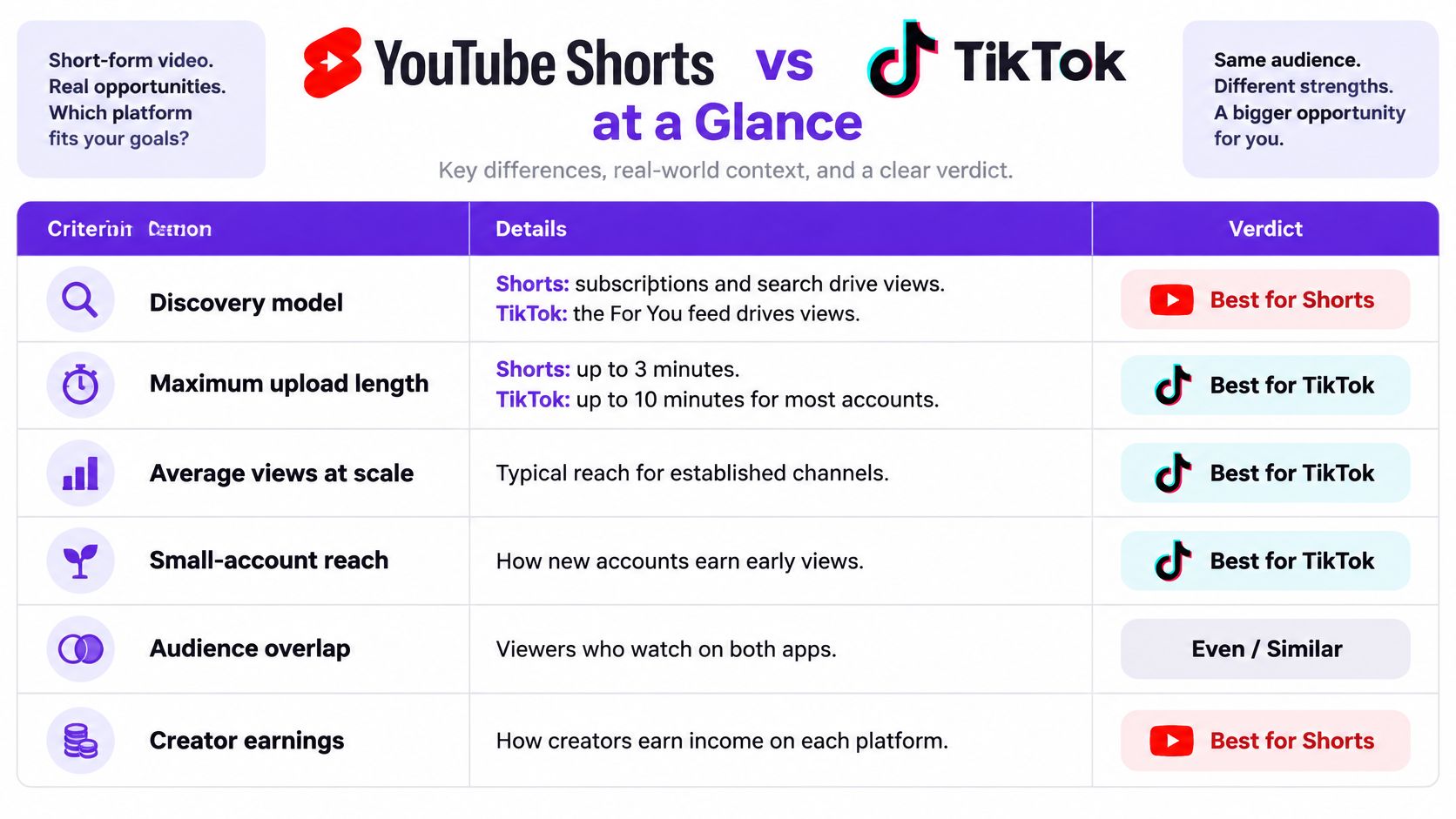
| Criterion | YouTube Shorts | TikTok | Better fit |
|---|---|---|---|
| Discovery model | Search, browse and subscriber feeds | For You feed driven by interests and sounds | Shorts for search-led niches, TikTok for trend-led content |
| Maximum upload length | 3 minutes | Up to 10 minutes for most accounts | TikTok for longer story clips |
| Average views at scale | Lower average per video at platform scale | Higher average per video at platform scale | TikTok for raw exposure |
| Small-account reach | Higher average views for accounts under 5,000 followers | Lower average reach, stronger comments and engagement | Shorts for views, TikTok for comments |
| Long-form funnel | Direct link to the channel and its library | Link-out only, with limited carry-over | Shorts |
| Revenue path | Ad revenue share through the Partner Program | Creator Rewards, TikTok Shop and brand deals | Shorts for ad share, TikTok for product sales |
Shorts launched as YouTube's answer to TikTok and reached global availability in July 2021; Lilach Bullock's history of Shorts by the numbers reports more than 2 billion monthly signed-in viewers in 2023 and recounts CEO Neal Mohan's June 2025 statement that Shorts averaged more than 200 billion daily views, about 186% above the earlier 70 billion mark.
Read that rise as a measurement change as much as momentum. In 2025 YouTube changed its counting rule, so a view now counts whenever a Short starts or replays, without the earlier minimum watch-time requirement. The total still shows huge exposure, but it cannot tell you how many viewers arrived through search, how many came from the feed, or how many will comment, book, or buy.
The change that matters most for repurposing is length. Since October 15, 2024, Shorts accepts square or vertical uploads up to 3 minutes, and Google's Shorts advertising guidance confirms that classification while recommending 9:16 vertical framing. A podcast answer or tutorial step no longer has to be amputated at 60 seconds to qualify.
TikTok gives you more room still. It allows considerably longer uploads than Shorts' 3-minute cap, so a single story can keep its setup, payoff, and context in one post. That extra room is useful for demos and multi-step tutorials, but it also raises the editing burden: a slow minute costs more on TikTok because the feed punishes drift faster than a channel page does.
| Specification | YouTube Shorts | TikTok |
|---|---|---|
| Recommended aspect ratio | 9:16 vertical, 1080×1920 master | 9:16 vertical, 1080×1920 master |
| Maximum upload length | 3 minutes, square or vertical | Considerably longer than Shorts' 3-minute cap |
| Ad length in feed | Up to 3 minutes | Set by the ad format you buy |
| Safe zone to protect | Bottom title and channel bar | Right-side action buttons and bottom caption area |
| Hook window to test | First 2 to 3 seconds | First 2 to 3 seconds |
| Best cut for repurposing | Full 3-minute story or 60-second highlight | Under 60 seconds for fast trends, several minutes for tutorials |
A Shorts ad can run up to three minutes, but the feed still rewards an early offer more than a late reveal. Put your offer, proof, and brand name near the front. If your key claim lands after the first exchange of attention, feed viewers may never hear it.
Practical rule: Export one clean 1080×1920 master, then cut platform variants from it. Never download one app's file and re-upload it to the other.
Frame your subject center-safe, burn in readable captions inside mobile-safe margins, and keep text clear of the bottom title bar on Shorts and the right-side buttons on TikTok. Once that master exists, you can upload YouTube Shorts from your phone without rebuilding the file, then trim a shorter TikTok variant when the story doesn't need the full runtime.
Check the Shorts format requirements in detail before you batch exports. A caption that sits under the title bar on every clip is a workflow error, not a creative choice.
TikTok documents its logic. Shorts doesn't, at least not to the same depth. That asymmetry should shape how confidently you optimize for each.
According to TikTok's explanation of how it recommends content, its For You ranking combines user interactions, content information, and user information. Interactions include likes, shares, comments, follows, full watches, and skips. Content signals include sounds, hashtags, views, and publication country.
TikTok identifies completion of a longer video as a stronger interest signal than weaker contextual signals such as matching viewer and creator country, and it describes watch time as a signal of enjoyment. Retention isn't a vanity metric there. It's the editing target.
Shorts distribution is shaped by viewing behavior in the feed, but also by surfaces TikTok doesn't have. Subscriptions, search, channel pages, and links to long-form videos all influence what spreads and what keeps earning views. A Short that sends satisfied viewers into your library does work a TikTok post can't replicate, even if its raw feed numbers look smaller.
Cutting a slow introduction moves TikTok results more than resizing the same clip ever will.
Compare these numbers separately by platform. Use topic and sound-relevant metadata on TikTok, and searchable titles with channel continuity on YouTube. Averaging the two feeds into one dashboard hides the very difference you're trying to exploit.
Platform reach averages flip depending on which accounts get counted. Metricool's State of Short-Form Social Media analysis of more than 6 million videos from over 375,000 accounts found TikTok averaged roughly 32,000 views per video, about six times the YouTube Shorts average of roughly 5,300.
For accounts with fewer than 5,000 followers, some analyses reverse that order, with Shorts posts drawing more views than comparable TikTok posts while TikTok still leads on engagement and comments. Both results can be true at once. Each counts a different mix of creators.

| Metric | YouTube Shorts | TikTok | What it signals |
|---|---|---|---|
| Average views per video, all accounts (2026) | About 5,300 | About 32,000 | TikTok gives more raw exposure at scale |
| Average views per post, accounts under 5,000 followers | Ahead in some analyses | Ahead in others | Account mix decides which platform wins |
| Engagement change, 2025 vs 2024 | Down 36% | Up 35.61% | TikTok engagement is growing faster |
| U.S. Shorts users not on TikTok | 45% | The other 55% use TikTok too | Cross-posting still reaches new viewers |
Account mix explains much of it. A dataset weighted toward established TikTok creators will crown TikTok. A dataset that isolates small accounts can crown Shorts. Statista's Q1 2024 comparison by account size reported that TikTok creator accounts generated more average views than YouTube Shorts accounts across every analyzed account-size category, so even the small-account advantage isn't stable across years or methods.
The engagement trend tilts clearer. Marketing Tech News' summary of Metricool's 2025 report found TikTok engagement increased by 35.61% year over year, while YouTube Shorts engagement declined by 36% compared with 2024. Views measure exposure. Comments, profile visits, and replies measure whether a relationship is forming, and an account that chooses on views alone can pick the platform that earns it less.
Google-cited research reported that 45% of U.S. YouTube Shorts users were not on TikTok, which means cross-posting can add genuinely new viewers instead of recycling the same audience. That figure covers U.S. users only. It says nothing about whether those viewers match your buyer.
The demographics that matter sit inside your own account. Pull the age, gender, and location breakdown from YouTube Studio and TikTok Analytics, then compare it with your buyer profile before naming a lead platform. A realtor working from borrowed averages can end up optimizing for viewers who will never book a viewing.
Direct per-view pay is the weakest reason to post Shorts. Shorts earns through a share of the Shorts ad pool under the YouTube Partner Program, pooled across creators rather than paid per ad on your specific clip. The money improves when a Short sends viewers to long-form videos, where ads run inside the content and each view is worth more. Treat Shorts as acquisition for your library, not as the product itself.
Guides to building affiliate funnels with YouTube Shorts make the same structural point. The clip creates demand, and a linked video, product, or offer captures it.
A sponsor doesn't buy your view count. They buy evidence that your audience listens. A niche TikTok account with heavy, specific comments can outprice a larger Shorts audience that watches without a word and swipes on, because the comment thread proves influence the view total only implies.
Price your sponsorships on engagement rate and audience fit, not on the biggest number on your profile.
Before you forecast revenue, confirm current thresholds and country eligibility in the YouTube Partner Program application guidance and inside TikTok's creator tools. Both programs revise criteria, and a plan built on last year's rules misprices your effort.
Say your source is a 20-minute tutorial or interview. The footage is shared. The packaging shouldn't be.
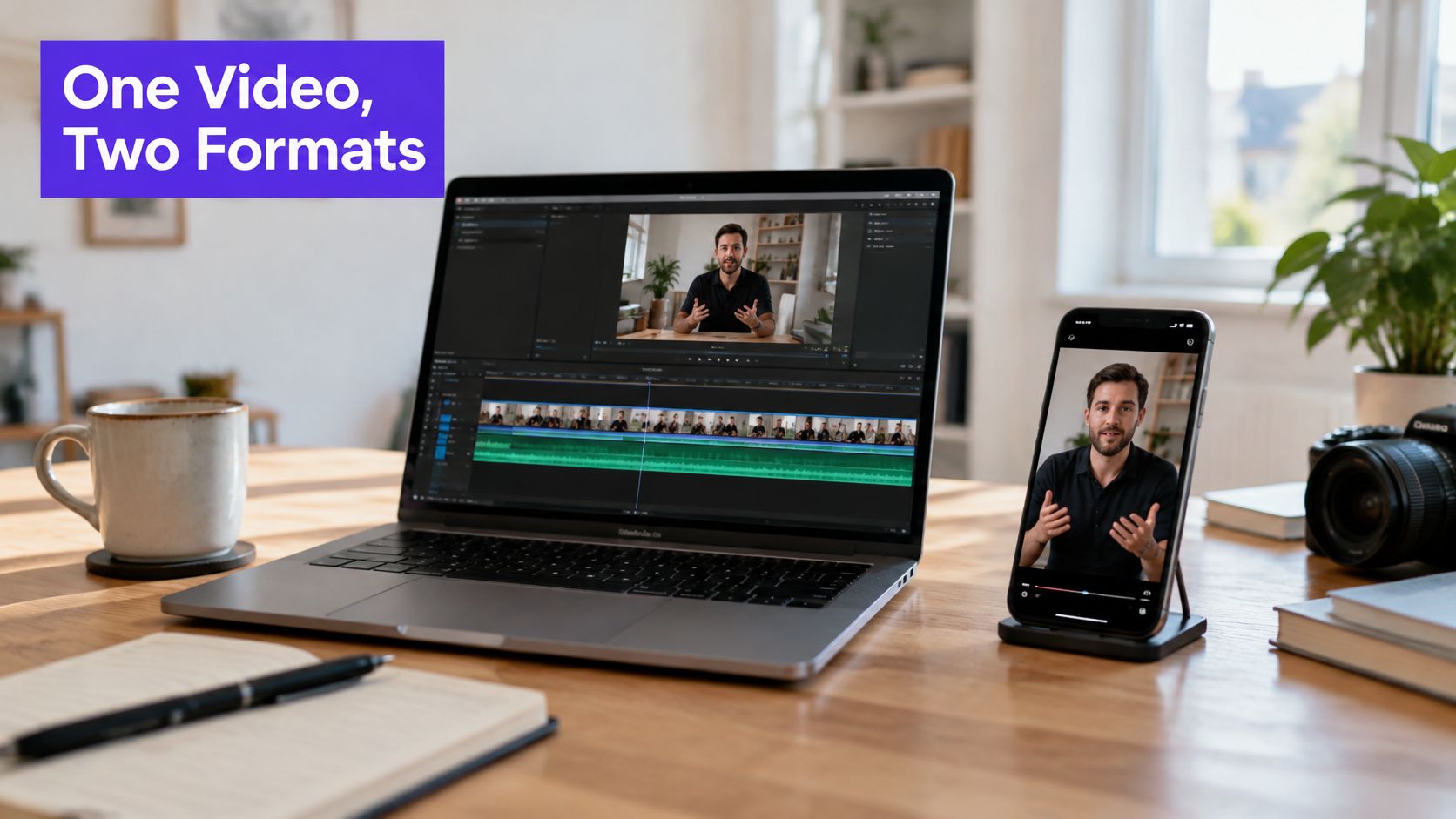
From that one tutorial, you'd publish a 3-minute Shorts explainer that resolves one sub-problem and points to the full lesson, plus a 45-second TikTok built around the single most surprising claim. Same expertise, different jobs.
The workflow below shows how that split looks in practice, from one recording to two native cuts.
Watch the sound choice. Trending audio available to personal accounts may not be licensed for business use, so brands should check commercial music options before a campaign depends on a track they can't legally run.
Tools can shorten the mechanical work. Taja AI, for example, turns a long video into captioned short clips formatted for different platforms, which you then repackage per feed following a structured content repurposing workflow. Automation handles the crop. You still own the hook, title, and call to action, because reusing a clip isn't the same as reusing its packaging.
Your situation, not the platform averages, should pick your lead channel.
| Situation | Lead platform | Second platform | Measure first |
|---|---|---|---|
| Local service provider or realtor seeking inquiries | YouTube Shorts | TikTok for local trend clips | Inquiries, form fills and profile visits |
| Educator or podcaster with a long-form library | YouTube Shorts | TikTok with a separate hook | Long-form watch time from Shorts viewers |
| Brand chasing awareness at scale | TikTok | YouTube Shorts for evergreen, search-led clips | Unique viewers and follows |
| Niche account under 5,000 followers | YouTube Shorts | TikTok for comment-driven discovery | Views per post and comments |
| Trend-driven entertainment creator | TikTok | YouTube Shorts with repurposed best clips | Completion rate and shares |
Cross-posting isn't duplication by default. Revid's roundup of Shorts statistics cites Google research reporting that 45% of U.S. YouTube Shorts users were not on TikTok and 65% were not on Instagram Reels. Shorts can deliver incremental reach. What that figure doesn't establish is whether those users convert better or want different content, which is exactly what your own test has to answer.
If Shorts sends fewer viewers but those viewers watch your long videos and book calls, Shorts wins for your business regardless of TikTok's view advantage. If TikTok comments surface objections, product ideas, and buyers, that conversation is worth more than silent reach. Decide which signal you'll privilege before you publish, or you'll cherry-pick the metric that flatters whichever platform happened to spike.
One source video can create two different business opportunities, but only if you measure the platforms against different outcomes.
Start this month. Match your account to one row in the table, publish the first batch of eight ideas on both platforms, and put the comparison date on your calendar now.
Taja AI turns one long-form video into captioned, platform-formatted shorts for YouTube Shorts and TikTok, so you can run that 30-day test without editing every cut by hand. Upload a tutorial, podcast, or listing walkthrough, generate your variants, and schedule them from one dashboard. Start your first batch free at Taja AI and let your own numbers pick the winner.


We are blessed to work with leading brands & Companies


We try to make easy and simple for every professionals. Get 30 days free trial - No credit card required.


© 2025 Taja AI. All rights reserved.