.jpeg)
YouTube Shorts Format: A Complete 2026 Creator Guide
Master the YouTube Shorts format in 2026 with exact specs on duration, aspect ratio, resolution, and file types plus upload and discovery best practices.
5 min read
October 4, 2026

Navigate the YouTube Partner Program application for 2026. Learn eligibility, steps, and how to fix common rejection reasons to get approved.
Written by:


You're probably in one of two places right now. You opened the Earn tab in YouTube Studio, saw that monetization is finally within reach, and assumed the next step was simple. Or you hit one milestone, applied fast, and then realized YouTube's version of “monetized” isn't always the version creators expect.
That confusion is common because the YouTube Partner Program application isn't just one finish line anymore. There are two. One gets you into fan funding features. The other enables ad revenue. If you mix those up, you can hit the button at the wrong time, set the wrong expectations, and spend days waiting for an outcome that feels disappointing even when it's technically correct.
I've seen creators obsess over subscribers while ignoring channel health, or chase Shorts views without understanding what opportunities they yield. The cleaner approach is to treat YPP like an approval process, not a vanity milestone. Numbers matter. But so do policy signals, account setup, and whether your content looks original and coherent when a reviewer lands on your channel.
The hardest part of the YPP process isn't usually creating the application. It's understanding what YouTube is evaluating when you apply. Most creators focus on the visible numbers because they're easy to track. Subscribers, watch hours, Shorts views. Those are the obvious gates. But YouTube also checks whether your account setup is complete, whether your channel is in good standing, and whether your content fits monetization policies.
That's why rushing the application rarely helps. Hitting a threshold only means you've earned the right to apply. It doesn't mean approval is automatic, and it definitely doesn't mean every monetization feature turns on at once.
Practical rule: Don't treat the moment you become eligible as the moment you should submit. Treat it as the moment to audit the channel first.
If you've been grinding on titles, thumbnails, retention, and discoverability, that work still matters here. A channel that's built for consistent viewer satisfaction usually looks healthier during review than one built around shortcuts. If you need help sharpening the videos that get you to eligibility in the first place, this breakdown of YouTube ranking factors is useful because it ties growth decisions back to what moves videos.
A lot of bad advice starts with oversimplifying YPP into one milestone. That's outdated. The modern process has separate paths, separate features, and a review step that people underestimate. Some channels qualify for a lower entry point and assume ads are next. They aren't.
The right way to approach monetization is simple:
That's what keeps the process boring. Boring is good here. A boring YouTube Partner Program application is usually the one that gets through with the least drama.
The biggest mistake I see is creators saying they're “eligible for YPP” without specifying which version. As of 2026, YouTube runs a two-tier structure. The lower tier gives access to fan funding features, while the higher tier enables full monetization including ad revenue, according to YouTube's Partner Program eligibility page.
If you only remember one thing from this article, remember this: 500 subscribers does not mean ad revenue is on. That's where most confusion starts.
| Requirement / Feature | Fan Funding Tier | Full Monetization Tier |
|---|---|---|
| Subscribers | 500 | 1,000 |
| Recent upload requirement | 3 public videos within the past 90 days | Not listed as part of the full ad revenue threshold on the cited requirement summary |
| Long-form path | 3,000 valid public watch hours over the past 12 months | 4,000 valid public watch hours over the past 12 months |
| Shorts path | 3 million valid public Shorts views in the last 90 days | 10 million valid public Shorts views in the last 90 days |
| Ad revenue sharing | No | Yes |
| Fan funding features like memberships and Supers | Yes | Yes |
That split matters more than most guides admit. The lower tier exists to let smaller creators access things like fan funding and merchandise features sooner. It does not mean your regular long-form videos or Shorts will start generating ad revenue.
A lot of frustration comes from valid approvals at the lower tier that feel like failures because the creator expected ads to activate.
That misunderstanding is one reason many creators feel blindsided. A useful write-up on YouTube Studio planning and analytics is this YouTube Studio deep dive, especially if you're deciding whether your channel is naturally better suited to long-form watch hours or the Shorts view path.
The watch-hours route usually fits channels built around tutorials, commentary, education, interviews, podcasts, reviews, and any format where viewers stay for longer sessions. The Shorts route fits channels that already know how to package fast, repeatable ideas that can scale through short-form discovery.
Neither path is easier by default. They reward different strengths.
Here's the practical trade-off:
If your long-form catalog already drives steady viewing, forcing a Shorts-only push just to chase a threshold can distract from what's working. On the other hand, if your channel naturally thrives on vertical clips, trying to manufacture hours with weak long-form uploads usually produces clutter, not progress.
At this point, creators need precision.
At the lower threshold, you're applying for access to fan funding-related features. At the higher threshold, you're applying for full monetization including ad revenue. That's the clean distinction. If your goal is ads, hold yourself to the higher target, even if the lower one becomes available first.
The unwritten rule is simple. Don't apply with a fantasy version of the tier in your head. Apply for what that tier provides.
You can meet the visible eligibility numbers and still make your YouTube Partner Program application harder than it needs to be. Before applying, check the channel like a reviewer would. You're looking for avoidable problems, not just missing milestones.
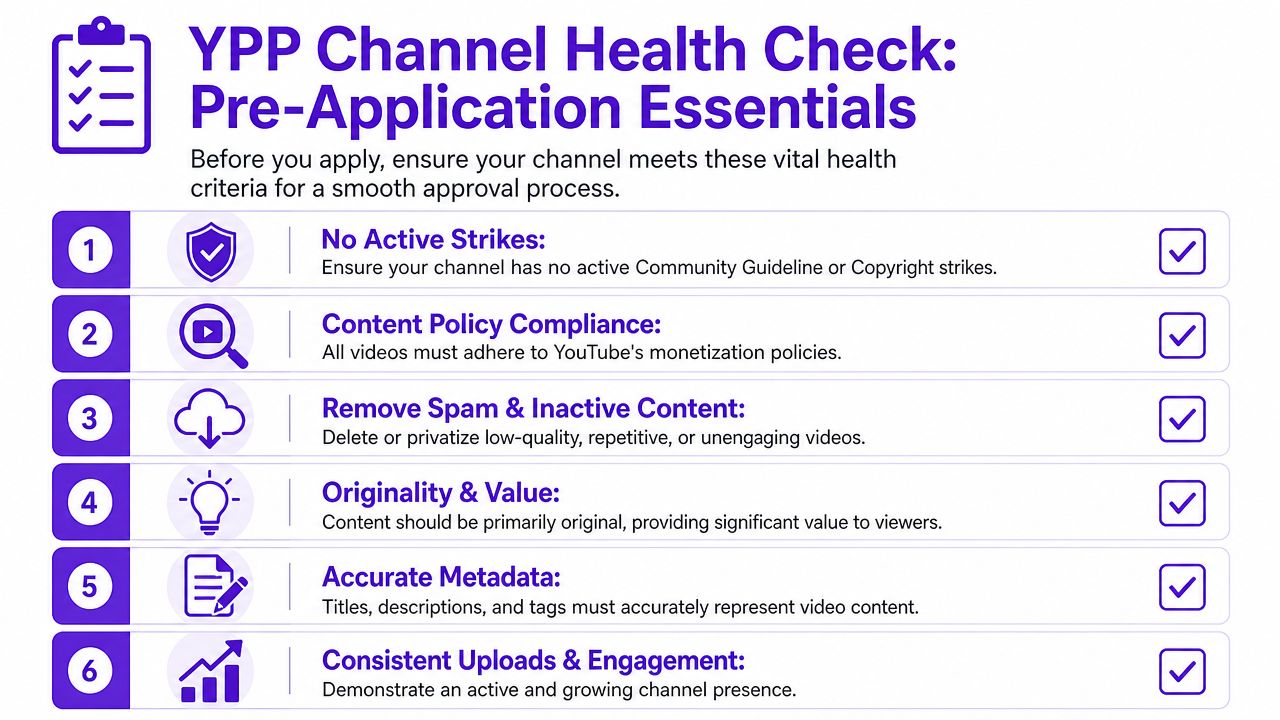
For full monetization, creators need to meet one of YouTube's technical thresholds and also complete platform requirements like two-step verification and resolving any Community Guidelines strikes, which last 90 days, as summarized in this Backstage guide to YPP requirements.
That gives you a short pre-application checklist:
Most creators audit metrics. Fewer audit presentation. That's a mistake.
Open your channel homepage, then look at your uploads tab, your most-viewed videos, your thumbnails, and your descriptions. Ask basic questions. Does the channel have a clear theme? Do your titles accurately reflect what the viewer gets? Are there low-value uploads that make the catalog look messy, duplicated, or auto-generated?
Channel review habit: Your top-performing videos set the tone for your application. Reviewers don't experience your channel as a spreadsheet. They experience it as a body of work.
This is especially important for creators working with music, visuals, compilations, or heavy editing workflows. If your content depends on packaging, metadata, and differentiation, this guide on AI music video SEO is worth reading because it focuses on making each upload clearer and more distinct to both viewers and the platform.
Not every weak video needs to disappear. But if your catalog includes uploads that look spammy, repetitive, misleading, or thin on original value, clean that up first.
A practical pre-flight pass usually includes:
If you're trying to strengthen the underlying signals before review, this resource on increasing YouTube watch time is useful because it focuses on viewer retention decisions that also make a channel look healthier overall.
The goal here isn't perfection. It's coherence. A clean channel with a clear point of view is easier to trust than one that looks assembled from disconnected experiments.
You hit apply expecting ads to switch on soon, then YouTube shows steps for terms, AdSense, and review. For a lot of creators, that is the moment the tier confusion becomes real. Applying at the 500-subscriber level can get you fan funding features if you meet the lower YPP entry requirements, but it does not mean full ad revenue is around the corner. Ads stay tied to the higher threshold.
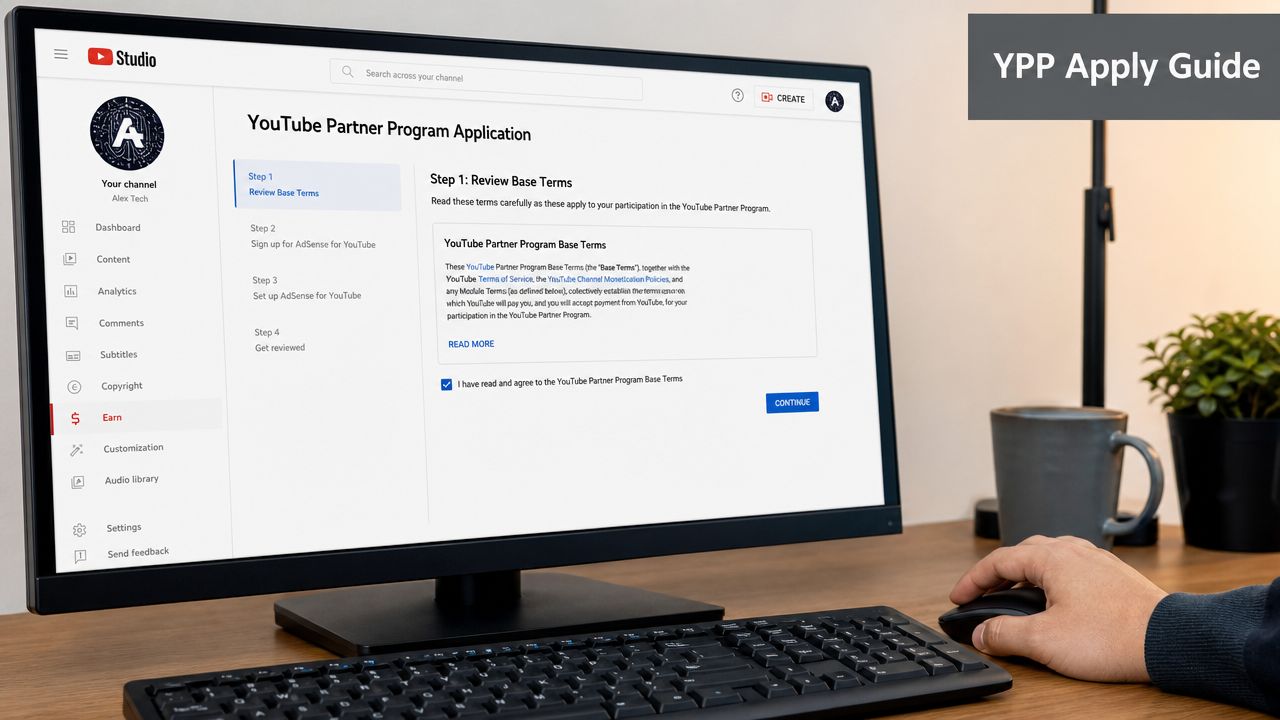
Inside YouTube Studio, the path is simple: Earn > Apply. The practical part is less about clicking buttons and more about knowing what you are applying for. If your channel qualifies for the lower tier, YouTube may let you apply for fan funding features such as memberships, Supers, or shopping tools. If you qualify for the higher tier, the same area is where you apply for full monetization, including ad revenue.
That distinction matters because creators often treat YPP as one finish line. It is two. The application flow looks similar, but the outcome is different.
The process usually has three steps.
First, accept the YPP terms on the correct channel. This sounds obvious until you manage multiple channels under one Google login. I have seen creators approve terms on the wrong brand account, then waste days figuring out why nothing looks right in Earn.
Second, create or connect your AdSense for YouTube account. Many applications stall at this stage. Old AdSense accounts, duplicate account attempts, mismatched payee details, and incomplete identity or tax information can all slow things down. If your payment setup has been sitting untouched for years, check it carefully before you submit.
Third, send the channel for review. After that, there is nothing productive about refreshing the page every hour.
The form takes minutes. Verification takes longer.
Common sticking points include:
Use the waiting period well. Keep publishing at your normal standard, and avoid sudden format changes that make the channel look inconsistent right after submission.
A helpful explainer sits below if you want a visual overview of the process before opening Studio:
Reviewers are not judging one good video. They are judging whether the channel, as a whole, looks monetizable and stable.
That usually means three things. The content shows original value. The catalog makes sense as one channel, not a pile of unrelated tests. The account setup does not raise payment or policy problems.
Channels at the 500-subscriber tier should be especially careful here. Approval at that level can give access to fan funding features, but it does not confirm that the channel has crossed into full ad monetization. Channels at the 1,000-subscriber tier face the same policy review, just with a different payoff if approved.
Go into the application with the right expectation, and the process feels a lot less mysterious.
Creators often assume rejection means copyright trouble. Sometimes it does. But many denials come from a broader issue: the channel doesn't show enough original value, or the catalog looks repetitive, stitched together, or too dependent on third-party material.
Another common problem is expectation mismatch. As noted in this Uppbeat article on the YouTube Partner Program, creators often hit the 500-subscriber threshold, apply, and then feel blindsided when ads don't activate because ad revenue remains locked until 1,000 subscribers.
That's not a technical glitch. It's a misunderstanding of the tier.
A lot of people hear “reused content” and think YouTube only means stolen clips. In practice, the issue is often more subtle. You can assemble content legally and still make it look too thin, too templated, or too dependent on material that doesn't feel meaningfully transformed.
That usually shows up in channels built around:
You need to make your value obvious. Not assumed. Obvious.
That can mean stronger commentary, visible expertise, clearer on-camera framing, better scripting, original examples, or a narrative structure that makes the piece feel authored rather than assembled.
If a reviewer can remove your narration, captions, or perspective and the video still mostly works the same way, your contribution may be too thin.
Here's a practical fix pattern:
Audit your top traffic videos first
If your most-viewed uploads are also the weakest in originality, they shape how the channel is judged.
Rewrite repetitive packaging
Similar thumbnails and near-identical titles can make different videos look interchangeable.
Add clear transformation
Commentary, explanation, critique, comparison, teaching, and storytelling all help when they are substantial.
Cut the filler uploads
If a video exists only because you wanted volume, it may weaken the catalog.
Repurposing isn't the problem by itself. Lazy repurposing is.
If you turn one long video into many Shorts, each short should have its own reason to exist. Different hook, different angle, different learning, different emotional beat. If they all feel like fragments dumped onto the channel, reviewers can read that as low-effort repetition.
A strong repurposed short usually does one specific job. It answers one question, isolates one insight, or delivers one clean moment. It doesn't rely on the full original video to make sense.
That distinction matters outside of YPP too. Channels that repurpose well usually serve viewers better because each asset feels intentional instead of recycled.
Don't immediately blame YouTube and reapply with nothing changed. Read the rejection notice closely. Then compare it against the actual state of your channel.
The creators who recover fastest usually do three things well:
That takes patience, but it's better than repeatedly submitting the same problem in a slightly different wrapper.
You hit submit, then the second-guessing starts. Creators check Studio three times a day, wonder whether one odd upload will hurt their chances, and mix up approval with instant earnings. That confusion gets worse if you applied at the 500-subscriber level expecting full ad revenue. Those are different outcomes, and YouTube treats them differently.
While your application is under review, keep the channel steady. Publish the same kind of videos that got you here. A sudden switch into unrelated Shorts, recycled clips, or trend-chasing uploads can make the channel look less consistent than it did the day you applied.
Read the approval email carefully, because your next steps depend on which YPP tier you entered.
If you qualified through the 500-subscriber route, you may get access to fan funding features like memberships, Supers, and shopping features available in your region. That does not mean your long-form videos are now earning standard ad revenue. Full ad revenue still sits behind the higher 1,000-subscriber tier and the watch time or Shorts performance requirements tied to it. This is the point many guides blur, and it leads creators to apply with the wrong expectations.
If you qualified for full YPP, set monetization preferences video by video and review your ad settings inside Studio. Don't assume every upload should run every ad format. Mid-rolls can raise revenue on some videos and hurt retention on others. That trade-off is real, especially on channels built around tutorials, commentary, or tightly paced storytelling.
Payment is separate from approval. You still need to finish the payment setup and meet YouTube's payout requirements before money is sent. Approval gives you access to monetization features. It does not put cash in your account that same week.
Treat the rejection as a review of the whole library, not just your latest upload.
An appeal only makes sense if YouTube clearly got it wrong and you can point to that error. If the channel really does have reused content, repetitive formats, unclear ownership, or thin value across a chunk of the catalog, fix the catalog first. I've seen creators waste a month arguing with the decision when the better move was to remove weak uploads, tighten the format, and make the channel easier to trust on a second review.
Patience helps here. A rushed reapplication with the same underlying problems usually gets the same result.
The strongest channels don't wait for AdSense to solve everything. They use YPP as one revenue layer and build other income sources that fit the audience, such as products, services, affiliates, sponsorships, or leads for an existing business.
That mindset also takes pressure off the 500-versus-1,000 subscriber gap. If you enter at the lower tier, fan funding can start proving audience intent before ad revenue arrives. If you enter at the full tier, ads become one part of a healthier mix instead of the only plan.
The goal is a channel that keeps earning without depending on one switch inside YouTube.
If you want to turn long-form videos into publishable clips, posts, and channel-ready assets without adding more editing hours to your week, Taja AI is worth a look. It helps creators repurpose content faster, stay consistent, and keep their publishing pipeline moving while they focus on making better videos.


We are blessed to work with leading brands & Companies


We try to make easy and simple for every professionals. Get 30 days free trial - No credit card required.


© 2025 Taja AI. All rights reserved.