.jpeg)
How to Add Captions to Video for Maximum Reach
Learn how to add captions to video across YouTube, TikTok, and Instagram. Master SRT files, styling, and automation to boost reach and accessibility.
5 min read
September 15, 2026

Unlock YouTube's algorithm. Discover key YouTube ranking factors: CTR, watch time, & more. Get actionable tips to boost video performance in 2026.
Written by:


The most repeated advice about YouTube is also the least useful: “just hack the algorithm.”
That framing is wrong. You're not trying to outsmart a machine. You're trying to help YouTube make a good recommendation to the right viewer at the right time. If your video gets the click and then keeps attention, distribution expands. If it gets the click and disappoints, distribution contracts. Most ranking advice breaks because it treats metadata as the whole game when metadata is only the opening move.
That's why understanding YouTube ranking factors matters more now. The platform moved a long time ago from simple keyword matching toward a system shaped by viewer behavior. Briggsby's analysis of 3.8 million data points across 100,000 videos and 75,000 channels found that the strongest positive correlates for search performance were watch time, channel authority, positive sentiment and engagement, and broad keyword targeting in titles, descriptions, and tags, as detailed in Briggsby's YouTube search analysis. That tells you something important: ranking isn't won by tags alone, and it isn't won by content quality alone either. It's a feedback loop.
Creators who grow consistently usually manage both halves of that loop. They package the video well enough to earn the click, then they structure the video well enough to deserve continued distribution. That's the difference between short-lived spikes and durable traffic from search, suggested, and browse.
A lot of creators still approach YouTube like it's early Google. Find a keyword, put it in the title, repeat it in the description, add tags, publish, wait. That can still help YouTube understand the topic, but it's no longer enough to carry a weak video.
YouTube has been described as weighing relevancy, engagement, and quality, with search and watch history helping personalize recommendations. In practical terms, YouTube uses signals such as titles, tags, descriptions, and video content to judge relevancy, while watch time helps determine whether a video is useful for similar queries, as summarized in Serpstat's breakdown of YouTube ranking logic. That shift changed the job of SEO on YouTube. SEO no longer means “stuff the right words in the right boxes.” It means “make the right promise, then fulfill it.”
The old checklist mindset causes a lot of confusion because creators mix up two different categories:
Input factors influence whether the video gets sampled. Performance factors influence whether the video keeps getting pushed.
Practical rule: YouTube doesn't reward optimization by itself. It rewards optimization that leads to satisfied viewing.
That's why superficial fixes often fail. A stronger thumbnail can raise clicks, but if the opening minute drags, those extra impressions won't turn into sustained reach. A detailed description can improve topic clarity, but it won't rescue a video that loses viewers immediately.
For creators in 2026, the key opportunity isn't finding secret settings. It's building a repeatable process for matching viewer intent, packaging clearly, and improving satisfaction after the click. That approach works in search, but it also helps in browse and recommendations because the same core logic applies: YouTube wants to keep viewers watching.
If you understand that feedback loop, every metric in YouTube Studio starts to make more sense.
The simplest way to understand YouTube is this: it's a satisfaction engine. Its job isn't to “reward creators.” Its job is to recommend videos that people are likely to choose and continue watching.
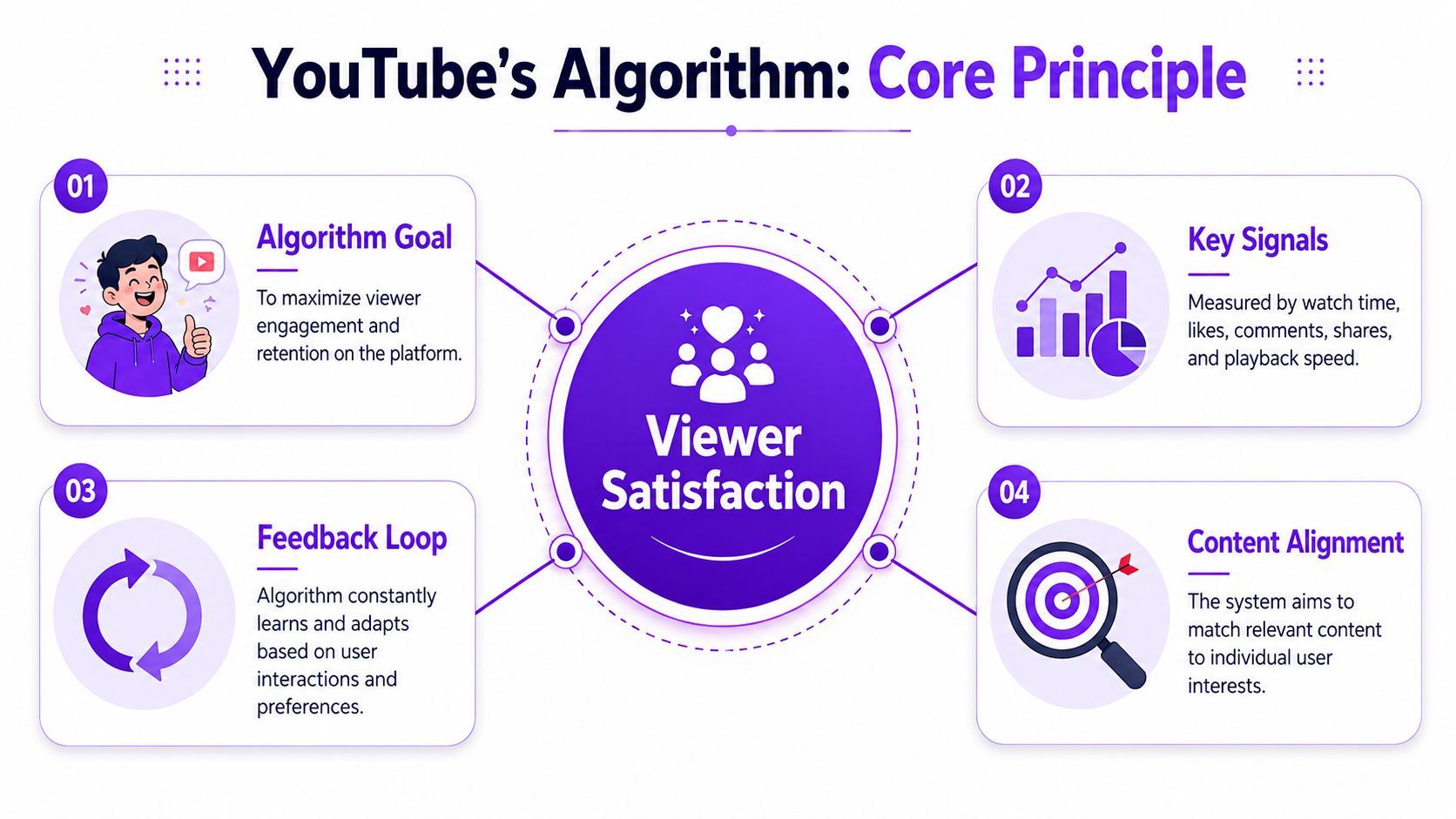
Those three words sound abstract until you map them to what creators control.
| Signal bucket | What YouTube is trying to learn | What creators can influence |
|---|---|---|
| Relevancy | Is this video about what the viewer seems to want? | Title, thumbnail framing, description, tags, spoken content |
| Engagement | Did viewers interact positively with it? | Topic choice, clarity, pacing, prompts that fit the moment |
| Quality | Did the video satisfy the need behind the click? | Retention, watch time, structure, production decisions |
Relevancy gets your video considered. Satisfaction keeps it in circulation.
That's why packaging and content can't be separated. If your thumbnail promises “fastest way to fix X,” but the first minute contains a long intro and backstory, the viewer feels friction immediately. YouTube reads that friction through behavior.
A useful analogy is to think of YouTube as a chief programming director. It's constantly testing what to put in front of each viewer. It doesn't know your intent. It only sees signals.
That has practical consequences:
If you use background music, this is one place creators often miss alignment. The wrong audio can make a tutorial feel slow or a commentary video feel overproduced. Resources like AI music for YouTube can help creators match mood and pacing more deliberately, which matters because viewer satisfaction is often shaped by small production choices, not just topic selection.
The algorithm doesn't “like” your video. Viewers do, or they don't. YouTube just measures the outcome.
Another overlooked part of satisfaction is navigability. Chapters help viewers jump to what matters, and they help the platform parse structure. If you haven't been using them consistently, this guide to YouTube chapters as an underused SEO weapon is worth reviewing because it improves both discoverability and the post-click experience.
Ranking often stalls before performance data has a chance to help. The usual cause is weak packaging. YouTube can test a video only if the title, thumbnail, and metadata give it a clear audience and a clear promise.
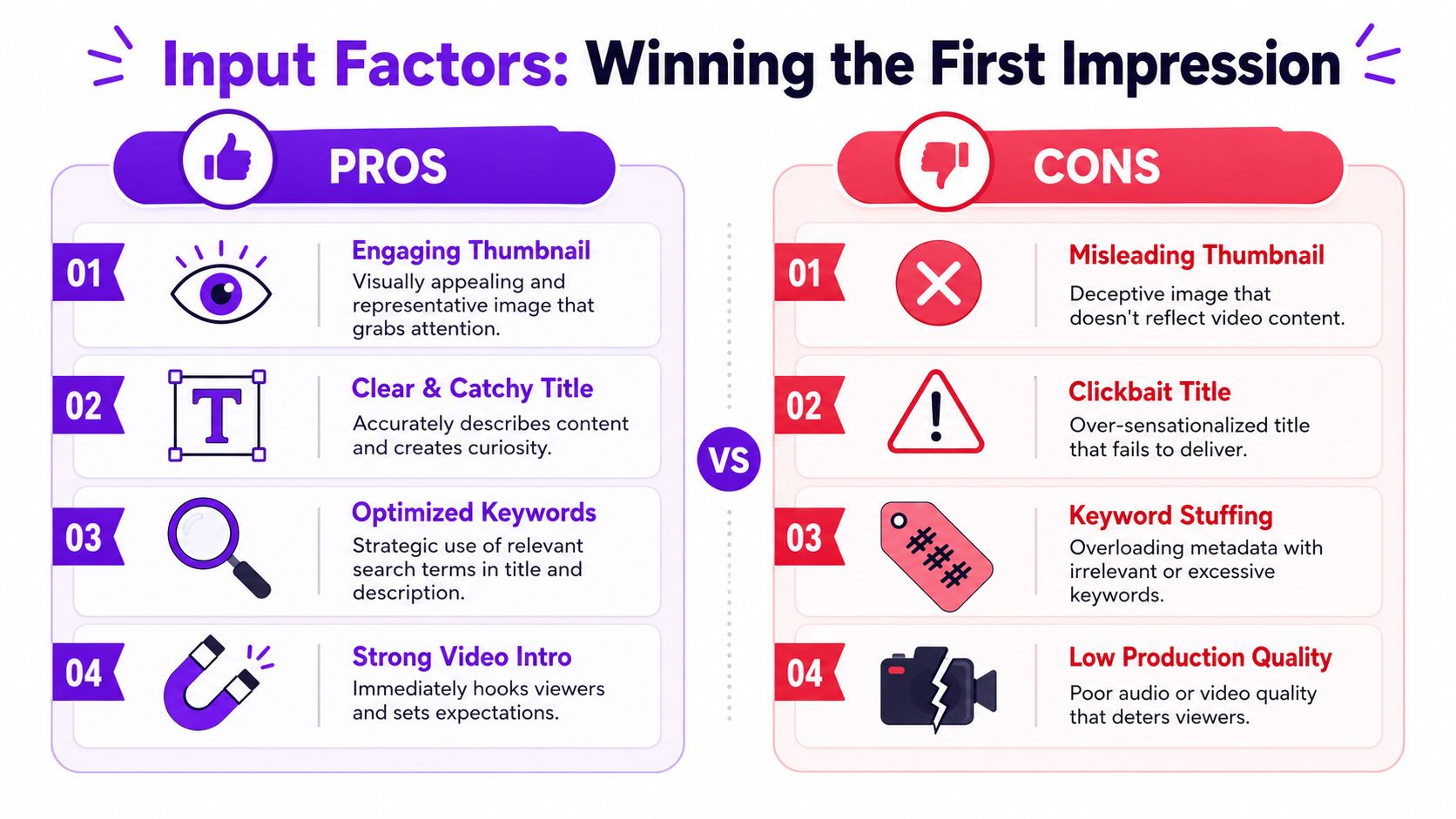
Viewers make the click decision fast, but the decision is rarely random. The title explains the value. The thumbnail frames the angle and urgency. If those two elements point in different directions, YouTube gets a messy test. CTR drops, or the wrong viewers click and leave early.
A better way to build packaging is to work backward from the viewer you want. Ask three questions:
That last part is where creators often hurt themselves. Curiosity helps. Confusion does not. If the title promises a step-by-step tutorial and the thumbnail looks like drama or news, you attract mixed intent. Mixed intent usually leads to mixed retention.
A useful rule from practice: strong thumbnails qualify the click. They help the right viewer recognize themselves in the topic.
For creators testing multiple visual directions, roundups of AI tools for content creation can help compare design and workflow options. For a YouTube-specific process, AI thumbnail workflows for YouTube click intent are useful because they focus on matching packaging to viewer intent, not just generating louder graphics. Taja is helpful here for rapid iteration. I use tools like that to produce several title and thumbnail angles, then narrow them based on the audience segment the video is meant to win.
Metadata works like labeling on a shelf. It helps YouTube understand what the video is about, who it fits, and which searches or recommendation paths make sense. That job is less glamorous than thumbnails, but it affects the quality of the initial test.
Descriptions should explain the topic in plain language. Good descriptions mention the problem, the method, and the takeaway. Tags still have a role, mainly for reinforcement and edge cases like name variations, common misspellings, or closely related phrases. Keyword dumping adds noise.
Analysts at Search Engine Journal reported that transcripts, higher resolution, and videos in a common mid-length range appeared frequently among top-ranking results in Search Engine Journal's YouTube SEO study. The practical takeaway is straightforward. Clear semantic signals help YouTube place the video more accurately, and accurate placement gives the video a better shot with the right viewers.
A practical upload stack looks like this:
This embedded example is useful for thinking about how packaging and structure support discoverability:
Creators often treat upload choices and post-publish metrics as separate jobs. In practice, they form a loop. Packaging chooses the audience for the first test. That audience creates the retention, watch time, and engagement pattern YouTube uses to decide what happens next.
That is why broad packaging can backfire, especially on smaller channels. A wide-net title may raise curiosity, but if the video serves a narrower problem, the audience signal gets diluted. Strong input factors reduce friction, set the right expectation, and give your video cleaner data from the first wave of impressions.
Better inputs lead to better tests. Better tests lead to better distribution.
Publishing starts the true test. Your title and thumbnail get the click. Viewer behavior decides whether YouTube keeps sending traffic.
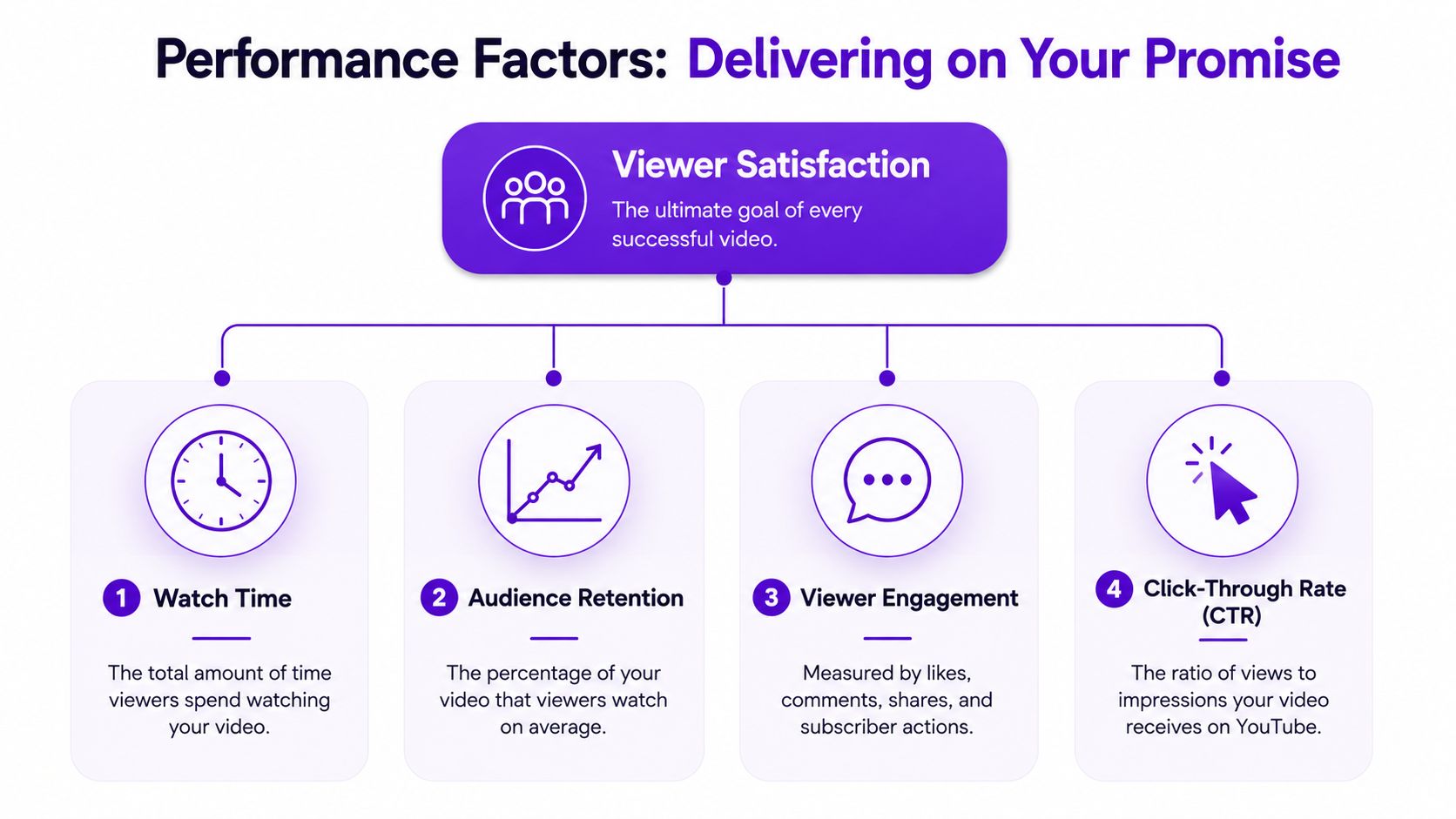
Performance factors are not isolated metrics. They work as a feedback loop.
CTR shows whether your packaging earns a trial click.
Audience retention shows whether the video fulfills the expectation created before the click.
Watch time shows how much viewing depth the video generates across the audience YouTube tested it on.
Engagement adds supporting evidence that viewers found the experience worth responding to.
The practical point is simple. Good packaging can get a video into the first round. Only audience response gets it into the second, third, and fourth round. I have seen plenty of videos open with a strong CTR, then stall because the first 30 seconds wandered or the title promised a broader payoff than the content delivered.
Earlier research cited in this article also supports what creators see every week in analytics. Videos that hold attention and generate positive response tend to earn more distribution over time.
Single metrics mislead. The pattern between them is what helps you make the right fix.
| Pattern | What it usually means | What to fix |
|---|---|---|
| High CTR, weak retention | Packaging sold a stronger outcome than the video delivered | Rewrite the intro, cut slow setup, and bring the promised result earlier |
| Low CTR, strong retention | The content works once people enter, but the first impression is weak | Test a new title angle or thumbnail concept |
| Strong early retention, later collapse | The opening earned attention, but the structure lost momentum | Reorder sections, remove repetition, and tighten transitions |
| Good views, low comments or shares | The video is useful, but it does not create much reaction or identity | Add a clearer point of view, stronger stakes, or a direct prompt |
A creator who only watches likes and comments will miss the bigger signal. Retention and watch time usually carry more weight because they show whether people stayed. A video can rank with average engagement if viewers keep watching. It rarely keeps growing if viewers click, sample, and leave.
Diagnostic shortcut: If viewers click and leave early, your input factors are attracting the wrong audience or setting the wrong expectation.
You do not need a huge reporting stack. You need a clean review habit after publishing.
Start with impressions and CTR together. That tells you whether the topic and packaging are earning trials from the audience YouTube is testing.
Then check the retention graph. This is often the fastest way to find the underlying problem. A sharp drop in the opening usually points to slow setup, unnecessary branding, or a mismatch between the promise and the first minute. A gradual decline usually points to pacing, structure, or weak payoff density.
Next, compare average view duration with total watch time. One shows depth per viewer. The other shows scale multiplied by depth. A short video can still perform well if the hold rate is high and the audience match is clean.
Finally, review traffic sources. Search viewers usually want a faster answer and tighter relevance. Browse viewers often respond better to stronger curiosity and storytelling. If you package a search video like a browse video, the mismatch shows up fast.
This is one of the better uses for AI tools such as Taja. Not to magically fix rankings, but to speed up pattern spotting across titles, thumbnails, and retention outcomes. The useful question is not "What should AI make for me?" It is "What recurring mismatch is AI helping me catch faster?"
For practical ways to improve hold rate and increase session depth, this guide to increasing YouTube watch time is a useful companion because it stays focused on viewer behavior, not surface-level tricks.
A strong title and thumbnail can earn the test. Context often decides how much trust YouTube gives that test in the first place.
The platform evaluates a video inside a larger system: your channel's topic history, the kinds of viewers who usually respond to your uploads, how often people return, and whether one video leads naturally into another. Ranking is not just a score on a single upload. It is a running estimate of how predictable your channel is for a specific audience.
Channel authority is really pattern recognition at scale. If a creator publishes clear, useful videos around one problem set, YouTube gets more confident about who to show those videos to. If the same channel jumps between unrelated topics, that confidence grows more slowly because the audience match is less stable.
Small channels still break through all the time. They usually do it by staying narrow, matching intent closely, and giving the viewer exactly what the packaging promised. Larger channels have more margin for error because they already have history. Newer channels need cleaner signal.
Three patterns usually strengthen channel-level trust:
A random hit can spike traffic for a week. A focused library keeps feeding the system useful evidence.
YouTube also cares about what your video causes next. If viewers finish a tutorial on your channel and immediately watch the follow-up, that is a stronger outcome than one good video with no next step. It shows the platform that your content creates momentum, not just isolated clicks.
Creators often miss this because they optimize each upload like a standalone pitch. A better model is a playlist-shaped content strategy. One video answers the current question. The next video answers the question that naturally follows.
That is how channels become easier to rank over time.
A good upload can win attention. A connected library can keep earning distribution months later because the system has more evidence that your content satisfies a viewer beyond the first watch.
Publishing rhythm plays a role here too. Active channels generate fresher feedback about audience fit, which helps YouTube keep calibrating who responds to your content. The goal is a schedule you can sustain while keeping the promise-to-payoff ratio high.
Loyal viewers matter for the same reason. Returning viewers are one of the clearest signs that the channel is building a relationship, not just collecting one-off clicks. That relationship improves future testing because YouTube already knows a subset of people is likely to respond.
External traffic works the same way. An email list, newsletter mention, podcast plug, or social clip can give a video an early push, but only if that audience is a real match. Good outside traffic gives YouTube clean training data. Bad outside traffic muddies the signal with weak watch behavior.
This is one of the more practical ways to use AI tools such as Taja. Not to generate random packaging at scale, but to spot patterns across your channel: which topic clusters keep producing return viewers, which title styles attract the wrong audience, and which videos start strong but fail to lead anywhere else in the library.
The larger point is simple. Inputs start the process, performance confirms the promise, and context determines how much confidence the system carries into the next upload. Creators who manage that full loop usually grow faster than creators who optimize one video at a time.
The old debate between metadata and viewer satisfaction misses the essential task. You need both. Upload-time choices shape discovery, and the first 24–72 hours can set the trajectory because that's when CTR and early retention start establishing whether recommendation growth is likely, based on RankX Digital's discussion of YouTube ranking factors.
Use a repeatable checklist. Don't rely on instinct when the same failure points show up video after video.
Define the search or viewer intent
Decide what exact problem, question, or outcome the video addresses. If the intent is muddy, every other optimization choice gets weaker.
Write the title and thumbnail together
Test them as a pair. If the thumbnail creates drama but the title creates ambiguity, you'll attract the wrong click.
Audit the opening minute
Cut anything that delays payoff. Confirm the promise quickly and show the viewer they're in the right place.
Add semantic structure
Upload a clean description, relevant tags, captions or transcript, and chapters where appropriate.
Check the viewing path
Give the viewer a next step with end screens, pinned comments, or a verbal bridge to a related video.
The first review window should be tight and specific.
Tools can reduce manual work. Taja AI is one example. It generates YouTube-focused titles, descriptions, tags, and chapters from a video upload, and it also repurposes long-form content into short clips and social assets. In practice, that helps with both sides of the ranking system: clearer upload-time inputs and more external entry points back to the core video.
The important part isn't automation for its own sake. It's consistency. Most channels don't underperform because the creator lacks ideas. They underperform because the optimization work happens irregularly.
| Stage | Priority question | Action |
|---|---|---|
| Before recording | What exact outcome am I promising? | Lock the angle before scripting |
| Before upload | Is the packaging specific and believable? | Finalize title, thumbnail, description |
| At upload | Can YouTube and viewers parse this easily? | Add tags, transcript, chapters |
| Early review | Are clicks turning into watch time? | Compare CTR with retention |
| After diagnosis | Is the issue promise or delivery? | Repackage or re-edit future intros |
You don't need a massive team for this. You need a system you'll use.
Usually, the click is outpacing the experience. Your title and thumbnail got attention, but the opening or structure didn't hold it. That tells YouTube the packaging is stronger than the video. Fix the promise mismatch first.
Look for delay. Long branded intros, throat-clearing, and backstory usually hurt early retention. Open with the problem, the payoff, or the proof that you'll solve it.
Sometimes, yes. Update the packaging, improve chapters, add stronger descriptions, and recirculate them through related content. If you have a backlog, workflows built around old-library optimization can help you identify videos with decent topic relevance but weak presentation.
Because metadata only gets you considered. Distribution expands when viewers confirm that your video was a good recommendation. Strong YouTube ranking factors work together. Input earns the click. Performance earns the reach.
If you want a simpler way to handle the packaging and repurposing side of this process, Taja AI is built for exactly that workflow. It helps turn long-form videos into optimized titles, descriptions, chapters, thumbnails, and repurposed clips so you can spend less time on repetitive upload tasks and more time improving the videos themselves.


We are blessed to work with leading brands & Companies


We try to make easy and simple for every professionals. Get 30 days free trial - No credit card required.


© 2025 Taja AI. All rights reserved.