Content Calendar Free: 10 Tools & Templates (2026)
Compare 10 content calendar free tools and templates—Sheets, Trello, Notion, schedulers—with pros, cons, use cases, and Taja AI workflow tips.
5 min read
October 24, 2026

Build a TikTok content strategy in seven steps: set goals, pick pillars, batch production, repurpose videos, post consistently and measure what works.
Written by:


You've posted for three weeks, copied a few trends, and your views jump from decent to dead with no clear pattern. Nothing's booked, nobody's calling, and you can't tell whether the next video should be shorter, funnier, or more useful. That isn't a talent problem. It's a system problem.
A workable TikTok content strategy treats each post as a testable experiment inside a longer path. One video gives a quick answer, the next provides proof, and a third points to action. You verify every claim before you scale it, and you judge results by whether people finish, save, and visit your profile, not by raw views alone.
Start with three decisions, in this order.
This setup prevents the common drift where every video tries to entertain, teach, sell, and build a brand at once. A single goal tells you which metric matters. A single problem tells you which examples to film. Together they fit naturally into a broader organic growth strategy built on repeatable content instead of one-off posts.
| Account type | Primary goal | Lead metric | Starting angle |
|---|---|---|---|
| Solo creator | Followers and watch time | Average watch time and follows per 1,000 views | One skill taught per video |
| Local business (contractor, clinic, agent) | Calls, bookings and DMs | Profile visits per view and link taps | Before-and-after work and common customer questions |
| Podcaster or educator | Listens and episode clicks | Completion rate and profile visits | Hook that names one episode claim, with a clip per key insight |
| Small team (2-5 people) | Qualified leads and brand recall | Shares per view and saves | Named owner for each pillar and one shared calendar |
Local businesses shouldn't optimize mainly for followers because bookings happen off the app, often after a profile visit. Podcasters should judge a clip by whether it sends people to the episode, not whether strangers liked the excerpt. Small teams need ownership more than ideas, so assign each pillar a named person.
Then choose your market. TikTok's advertising tools indicated potential reach of 1.59 billion users worldwide in January 2025, equivalent to about 27.5% of the global population aged 18 and older, according to DataReportal's summary of TikTok advertising reach. The United States accounted for 136 million and Indonesia for 108 million in that same reporting. Localize hooks, language, and examples to your largest market, and treat the figure as a planning benchmark, not an exact user count.
Write your goal, audience problem, and payoff on one line at the top of your content document. Every idea that doesn't serve that line waits.
Viewers aren't only scrolling for entertainment. A Pew Research Center survey published in November 2024 found that 62% of U.S. adult TikTok users use the platform to look at product reviews or recommendations, rising to 74% among users ages 18 to 29, according to Pew Research Center's survey of U.S. TikTok users. Your mix therefore needs evidence, not just personality.
Content pillars are recurring themes that keep a feed coherent. Formats are the shapes those themes take. Choose three to five pillars, then give each one two or three formats you can repeat without inventing a new show every week.
The hierarchy below shows how pillars break into repeatable formats.
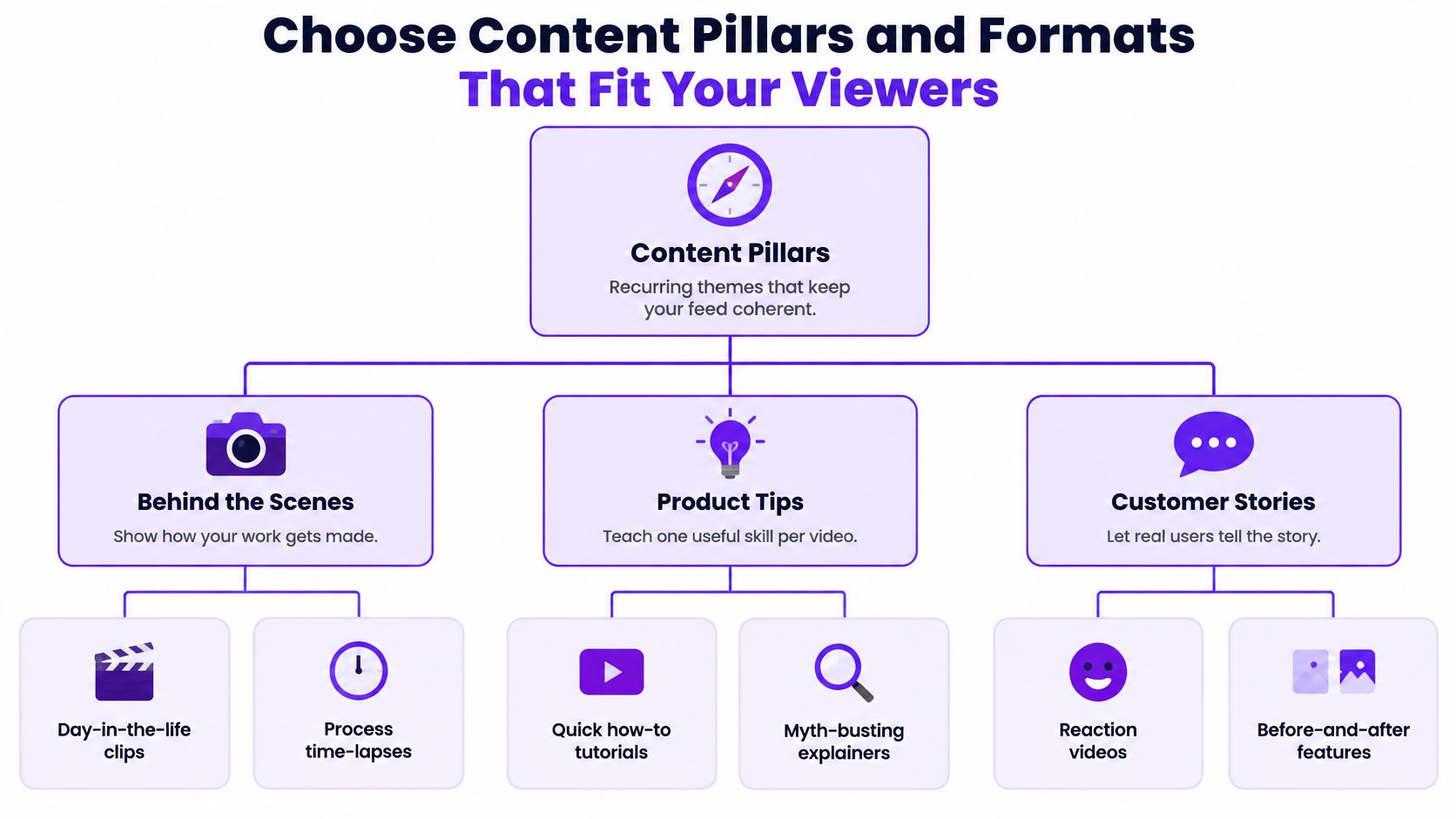
Write each pillar as a viewer question, not a topic label. "Pricing" is vague. "Why do two roof quotes for the same house differ?" gives you a hook, a demonstration, and a comment prompt in one line.
| Format | Typical length | Job it does | Local-business example |
|---|---|---|---|
| Answer clip | 21-34 seconds | Resolves one question people type into search | How to tell if a roof quote is fair |
| Demonstration | 15-30 seconds | Shows the outcome quickly | Drywall patch from first cut to final paint |
| Customer proof | 20-40 seconds | Reduces doubt through a real voice | Homeowner explaining the pickup and cleanup |
| Behind-the-scenes | 30-60 seconds | Builds familiarity and trust | Crew arriving at 7 a.m. and prepping the site |
| Comparison or review | 31-60 seconds | Supports the consideration stage | Two materials, their costs and honest limits |
A workable weekly split for a small account is two answer clips, one demonstration, one customer proof post, and one behind-the-scenes post. That balance gives searchers something useful, skeptics something verifiable, and returning viewers a reason to recognize you. Drop any format that doesn't serve the goal you set first, even if it's trending.
A local shop can film a quick answer about a common customer question, then see viewers leave before the useful part. Treat each post as an experiment: make one clear promise, deliver it quickly, and use viewer behavior to shape the next edit.
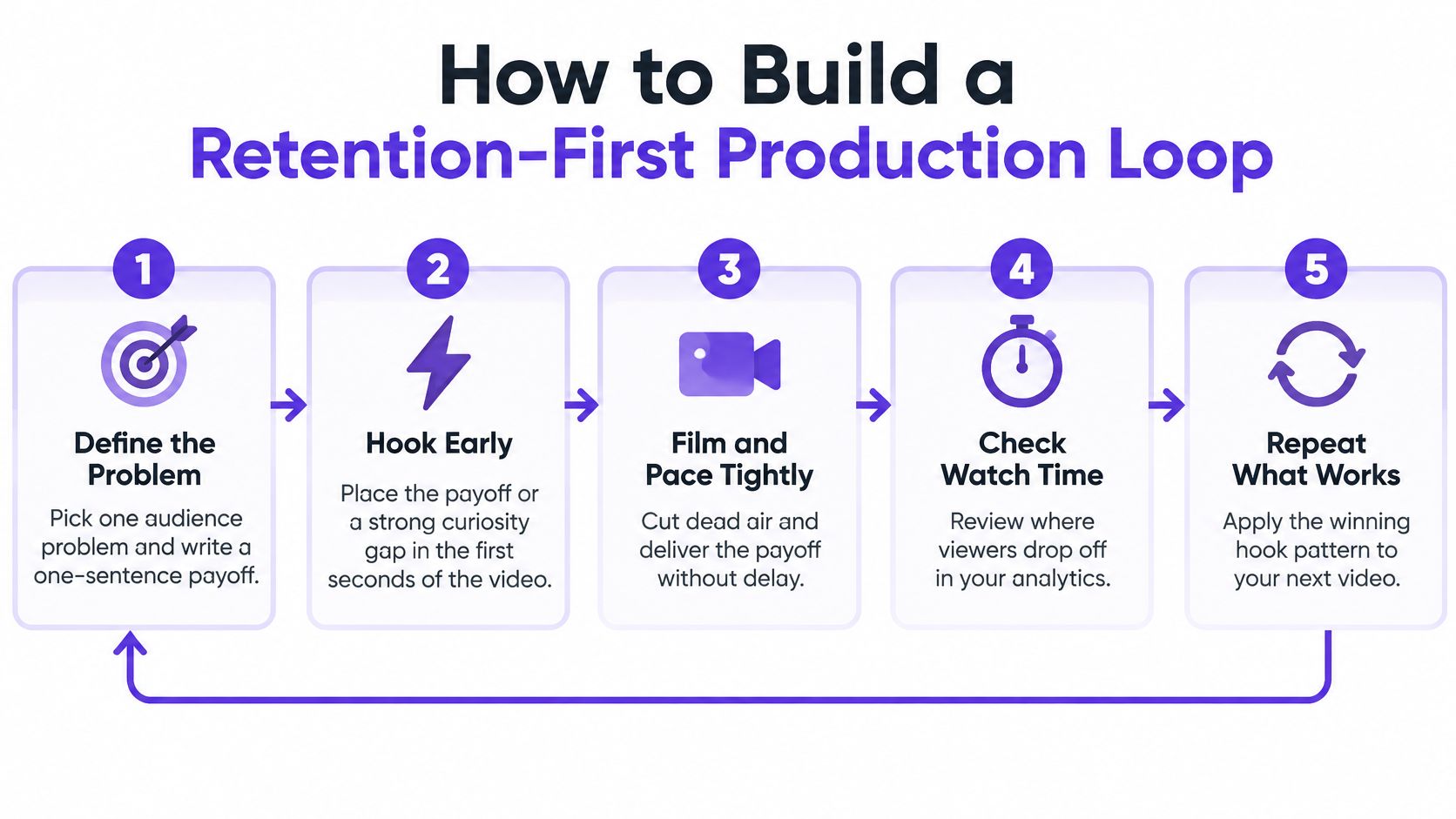
Use the same five checks for each video:
This is the working discipline behind short-form video creation that earns completion. A clear structure often serves a small team better than spending limited time on expensive production.
Start with a short edit in the 21-34 second range. Once you have its completion rate, test a longer 31-60 second version with the extra context included. Compare the longer edit's completion rate with the short edit's result, and keep the added length only if it improves the viewer experience enough to justify the production time.
Opus summarizes retention benchmarks in its analysis of TikTok length and retention data. Use roughly 40-60% of a video watched as a planning heuristic from that benchmark, not as a confirmed TikTok ranking rule. Your own results should guide the edit; a benchmark cannot tell you whether a particular audience will stay for more detail.
The example below shows how pacing and opening structure can affect whether viewers stay.
Keep a tight, single-claim edit as the default. Add context only when comparing versions shows that viewers continue watching, rather than because the topic feels important to cover in full.
A high-impression video with early abandonment offers weaker evidence of audience fit than a smaller video people finish, rewatch, or share.
For repurposed recordings, cut separate single-idea clips, each with its own hook, payoff, captions, and end frame. Assess every clip as its own experiment. An excerpt that keeps the original's slow setup may lose viewers before it reaches the point.
Discovery on TikTok often feels like browsing, even when it's functioning as search. Recent U.S. research found that 86% of Gen Z internet users search on TikTok weekly, close to 90% for traditional search engines, while 38% of TikTok searchers begin on a traditional search platform then move to TikTok and 34% do the reverse, according to research on Gen Z search behavior across platforms. One topic therefore needs a path, not a single optimized video.
That's the gap in most advice about keywords and hashtags. Ranking one clip doesn't explain what satisfies the viewer before, during, and after they find you. Recommendations, comments, and related videos guide people invisibly, so your job is to design the handoffs.
The viewer below represents that in-between moment, searching on a phone without thinking of it as formal research.

| Stage | Viewer question | Asset to publish | Success signal |
|---|---|---|---|
| Discovery | What is the problem and the basic answer? | 21-34 second answer clip | Completion rate and shares |
| Proof | Does this work for someone like me? | Follow-up with a demo, customer or reply to top comments | Saves and profile visits |
| Action | What should I do next? | Long-form video, booking page, newsletter or comparison | Bookings, email signups or link clicks |
Take a real estate agent answering "What do first-time buyers pay at closing?" The discovery clip names the main cost categories in plain language. The proof post walks through a real closing statement with personal details blurred and answers the top objection from the comments. The action asset is a written guide or booking page, linked from the profile and referenced in a pinned comment.
Give each asset one job so no single video has to discover, convince, and convert at once. Track profile visits and link clicks between assets to see where the path breaks. If discovery performs but proof gets no profile visits, your follow-up isn't answering the core objection.
Confident delivery and a busy comment section don't prove you're credible. A 2025 study of 494 users found that people evaluating TikTok information focus heavily on comments and video elements rather than checking official external sources, with perceived credibility also influenced by algorithmic recommendations, live streams, and social presence, according to a 2025 study of credibility assessment on TikTok. That puts the burden on you to build verification into the post itself.
Run this six-part check before publishing.
Separate experience content ("what worked for me") from general advice ("what you should do"). Viewers can then judge how much weight to give each. In health, finance, legal topics, home services, or education, direct people to an authoritative source when the consequences of a mistake are serious.
Contrarian check: comment volume isn't success if the thread is full of unresolved objections or repeated misunderstandings.
Track corrected misunderstandings and saves alongside shares. Rising confusion is a signal to revise or follow up, not to celebrate engagement. A high-retention video that viewers can't verify can damage trust faster than a quiet, accurate one builds it.
Aim for three to five high-quality posts per week and increase frequency only after one format shows repeat results. Posting more often doesn't repair weak hooks or low retention. It just produces more evidence of the same problem, faster.
Cadence decides whether your system survives a busy month. A sustainable schedule you can hold for several weeks gives you comparable experiments. A burst followed by silence gives you noise.
This is the point where a structured content repurposing workflow for turning recordings into clips saves the most time, because the logging and tagging happen once. A forty-minute podcast episode can supply a full week of distinct angles if each clip is treated as its own asset.
Publish on TikTok first if TikTok is your test platform, then cross-post to Instagram Reels and YouTube Shorts with captions rewritten for each feed. Don't paste the same caption everywhere and call it distribution. Titles, opening text, and calls to action behave differently per platform.
For small teams, tools matter mainly for queueing and consistency. Taja AI can generate clips from long-form video, add captions and TikTok-specific formatting, and schedule posts across TikTok, YouTube, Instagram, Facebook, X, and LinkedIn from one dashboard. Whether you use a scheduler or post manually, the rule stays the same. Every clip needs a pillar, a hypothesis, and a measurable target action before it enters the calendar.
A clip can earn a large view count and still fail to move viewers toward an action. Compare normalized metrics such as completion rate, shares per view, and profile visits per view to see how posts perform relative to reach. For engagement by views, add the likes, comments, shares, and saves on a post, then divide by its views and multiply by 100. TikTok's analytics may present the components separately, so use the same interaction set each time you compare.
The benchmark summaries of TikTok engagement rates from Shno report an average engagement-by-views figure near 3.85% and about 4.40% for accounts with 1,000-5,000 followers in its 2025 comparison. Treat these figures as context, not targets. Your own recent posts, audience, and goal are more useful decision points.
| Metric | What it tells you | How to use it |
|---|---|---|
| Average watch time | How long viewers stay | Compare posts in the same length band |
| Completion rate | Whether viewers reach the payoff | Compare with your recent posts |
| Shares per view | Whether viewers pass the post along | Watch the trend, not a single result |
| Comments per view | Questions and objections viewers raise | Read comments for substance |
| Profile visits per view | Whether the post builds interest in you | Check after proof-focused posts |
| Engagement by views | Likes, comments, shares, and saves relative to views | Calculate consistently; use benchmarks only as context |
Review results weekly for patterns, then use monthly reviews to decide what to keep or change. Test one major variable at a time, such as the opening line, clip length, visual pattern, caption, or call to action. Changing several at once makes it hard to identify what affected the result.
Use these decision rules:
A contractor's roof-quote clip with strong completion and steady profile visits is a better scaling candidate than a viral clip viewers abandon early, especially if it generates no calls. Choose one pillar, one length band, and one lead metric for the coming month. Keep the test focused, verify the response, and scale only what repeatedly moves viewers from discovery toward action.
Use this fill-in plan to run your TikTok content strategy for four weeks without redesigning it midstream. In week one, pick one pillar, one length band, and one lead metric. Write the goal, audience problem, and payoff line at the top of your document and don't change them until week four ends.
Fill in your specifics before filming. Pillar: ______. Length band: ______. Lead metric: ______. Target action per post: ______.
Week two: change one creative variable per post, such as the opening line, clip length, or visual pattern. Record the pillar, hook type, audience intent, and target action for each post so comparisons stay clean.
Week three: compare completion rate, shares per view, and profile visits per view against your last ten posts. Read comments for repeated objections and turn the strongest one into a proof follow-up.
Week four: keep any format whose completion held, retire formats that dipped after a fair test, and scale only a pillar with repeat results. Then choose the single variable you'll test next month.
Don't judge the plan by your best post. Judge it by whether a format repeats, viewers move from discovery to proof, and your lead metric moves in the direction your goal requires.
Turn your next long recording into a week of TikTok-ready clips with hooks, captions, and scheduling handled in one place, so you can run this four-week test without becoming a full-time editor. Start building your repeatable system today with Taja AI and publish your first test batch this week.


We are blessed to work with leading brands & Companies


We try to make easy and simple for every professionals. Get 30 days free trial - No credit card required.


© 2025 Taja AI. All rights reserved.