.jpeg)
10 Hashtags for Music to Boost Discovery
Find the best hashtags for music by genre, platform, mood, and trend, plus practical ways to mix broad and niche tags for stronger discovery.
5 min read
October 5, 2026

Master short form video creation with actionable steps for scripting, shooting, editing, and distributing high-performing clips. Build your system in 2026.
Written by:


You've just published a strong long-form video. The conversation is useful, the guest is engaging, and the recording contains several moments your audience would value. Then the initial traffic fades, and the video starts sitting in your archive while you wonder what to publish next.
That's where short form video creation becomes practical. You don't need to invent a new idea for every TikTok, Reel, or Short. You need a reliable way to identify the strongest moments in work you've already done, reshape them for vertical viewing, and distribute each cut with enough editorial care that it feels intentional rather than mass-produced.
Creators often approach short-form content as a separate production line. They open a blank document, search for a fresh idea, write a new script, arrange a recording session, and repeat the process until the schedule becomes exhausting. That approach makes every clip feel like a new project, even when the business already has hours of interviews, lessons, podcasts, webinars, and presentations available.
A repurposing workflow changes the starting point. The long-form recording becomes a source library, not a finished asset with only one possible use. A thoughtful answer from an interview can become an educational clip. A disagreement can become a discussion prompt. A clear explanation can become a discovery asset that introduces a new viewer to the full recording.
YouTube's reported scale illustrates why this matters. The platform said Shorts had passed 2 billion logged-in users globally each month in 2023, after reporting approximately 1.5 billion monthly logged-in Shorts users in 2022, an increase of at least 500 million users in roughly one year (YouTube's Shorts advertising overview). Those figures measure monthly users, not total views, so they shouldn't be confused with consumption volume. The broader lesson is that a long-form video can feed a distribution format with enormous audience access.
Begin each session by reviewing the recording for complete thoughts, not isolated sentences. A usable short normally has a clear premise, enough context to make that premise understandable, a satisfying payoff, and an ending that doesn't feel abruptly cut off.
Create a simple selection sheet with columns for:
This prevents the common mistake of selecting clips because they sound interesting in isolation. A clever sentence may perform poorly if the viewer can't understand who is speaking or what problem the sentence solves.
Practical rule: One short should make one promise and keep that promise. If a segment contains several valuable ideas, separate them into several edits.
The workflow becomes easier to maintain when the stages are distinct. First select. Then shape the script. Then edit for the destination platform. Then review captions, framing, audio, and meaning. Finally, publish and record the result. Separating those decisions reduces the temptation to polish weak source material for hours.
Automation can help with repetitive discovery, transcription, and formatting, but it shouldn't replace judgment about context or editorial tone. A useful overview of the broader approach is this guide to automating content creation, especially for teams that need consistency without turning every recording into a manual editing project.
A strong long-form interview can produce several short clips, but the same export will not perform identically on every platform. YouTube Shorts, Instagram Reels, and TikTok place viewers in different discovery environments. Adapt the opening, captions, framing, description, and next action instead of treating distribution as a file-upload task.
| Platform | Useful role | Creative emphasis | Distribution consideration |
|---|---|---|---|
| YouTube Shorts | Discovery connected to a deeper video library | Clear answers, strong excerpts, searchable context | Make the clip useful on its own, then give interested viewers a reason to explore the longer recording |
| Instagram Reels | Visual discovery and relationship building | Deliberate framing, recognizable brand style, shareable moments | Keep the edit native while matching the account's wider visual identity |
| TikTok | Fast testing of ideas, opinions, demonstrations, and explanations | Direct openings, conversational delivery, immediate tension | Show the premise quickly and let the clip feel natural in the feed |
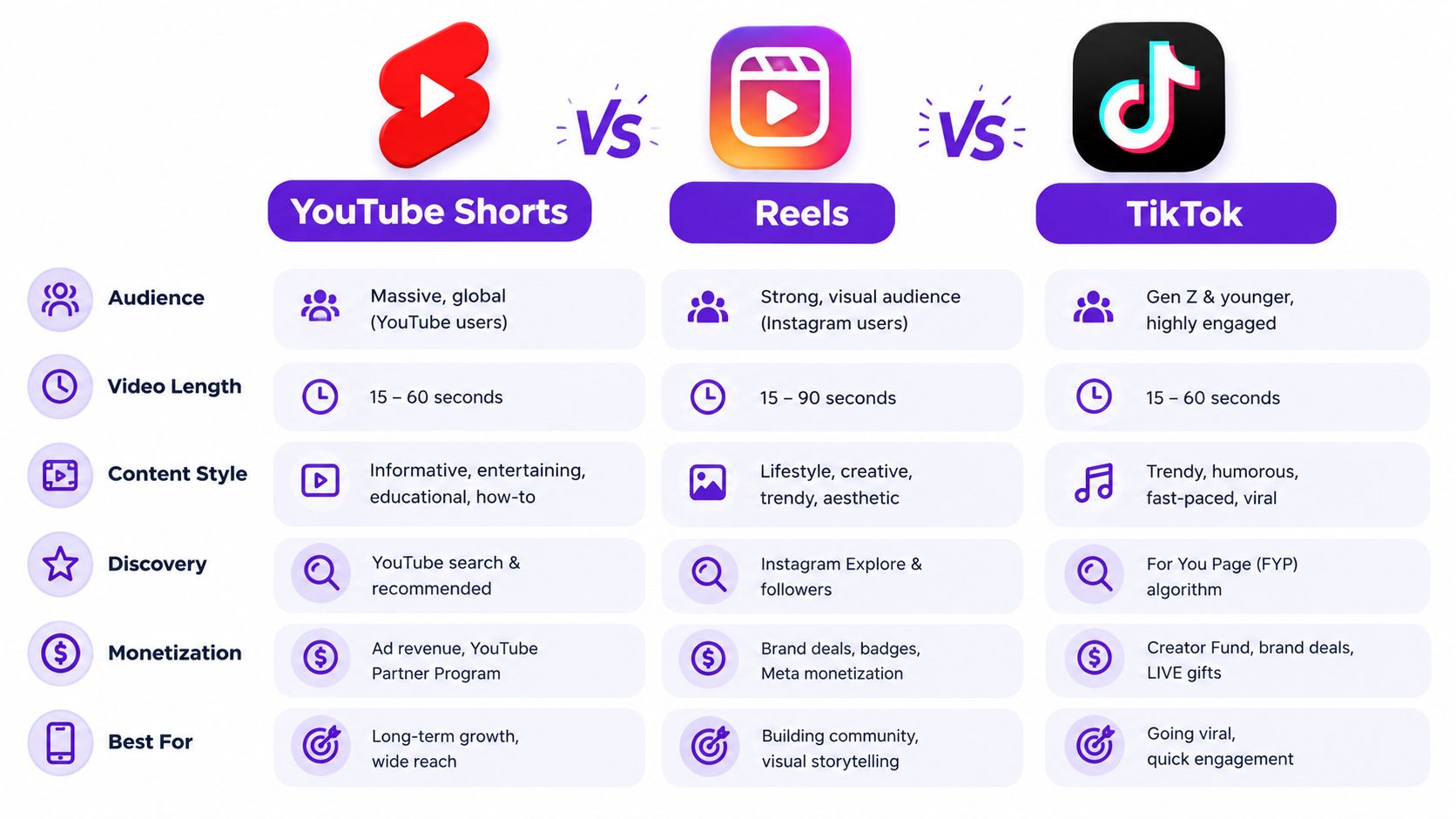
YouTube Shorts works well as an entry point to a longer interview, tutorial, or presentation. Select a segment that delivers a complete insight rather than a vague teaser. “Watch the full video” gives viewers little reason to continue if the Short has not answered anything. Deliver the useful point first, then position the full recording as the place for context, examples, or further explanation.
Instagram rewards consistency in presentation. Expensive production is not required. The subject, typography, caption placement, and opening frame should look intentional, whether a local service provider shows a visible transformation or an educator explains one idea directly to camera. A repurposed clip can keep its original substance while adopting the account's established visual treatment.
TikTok allows a more immediate, conversational delivery. Questions, objections, surprising observations, and direct responses often create a faster entry than formal introductions. Clarity still controls retention, but excessive polish can make footage taken from a podcast or webinar feel disconnected from the feed. Keep the speaker's natural energy where it supports the point, and cut pauses that delay it.
The scale of YouTube Shorts makes careful adaptation worthwhile. YouTube reported more than 70 billion daily views since launching in 2021, along with 2 billion monthly logged-in users, according to YouTube's Shorts advertising overview. Those figures measure different forms of activity, but they show why one long-form asset deserves platform-specific packaging rather than one universal export.
Retention should guide the edit. If viewers leave before the premise becomes clear, change the opening before adding effects. If they stay through the payoff but do not continue, improve the connection between the short insight and the longer asset.
For paid campaigns, teams testing performance-driven short form video ads should treat the first visual, spoken premise, caption readability, and landing-page connection as one experience. Automation can prepare crops, captions, and multiple exports, while an editor should still approve context, tone, and the moment selected from the source.
Use the YouTube Shorts format guide to check destination requirements before building a publishing queue. That small review reduces rework when one long-form recording becomes a repeatable stream of clips across TikTok, YouTube, Instagram, and LinkedIn.
A long-form answer rarely works as a short because it contains a good sentence. The editor has to preserve the logic of the answer while removing the conversational material that helped the original speaker arrive there.
Start by writing the clip's central beat in one sentence. For example, a property professional might focus on one inspection mistake, an educator might isolate one misconception, and a podcaster might extract one counterintuitive explanation. If the proposed clip needs several unrelated examples to make sense, it probably contains more than one short.
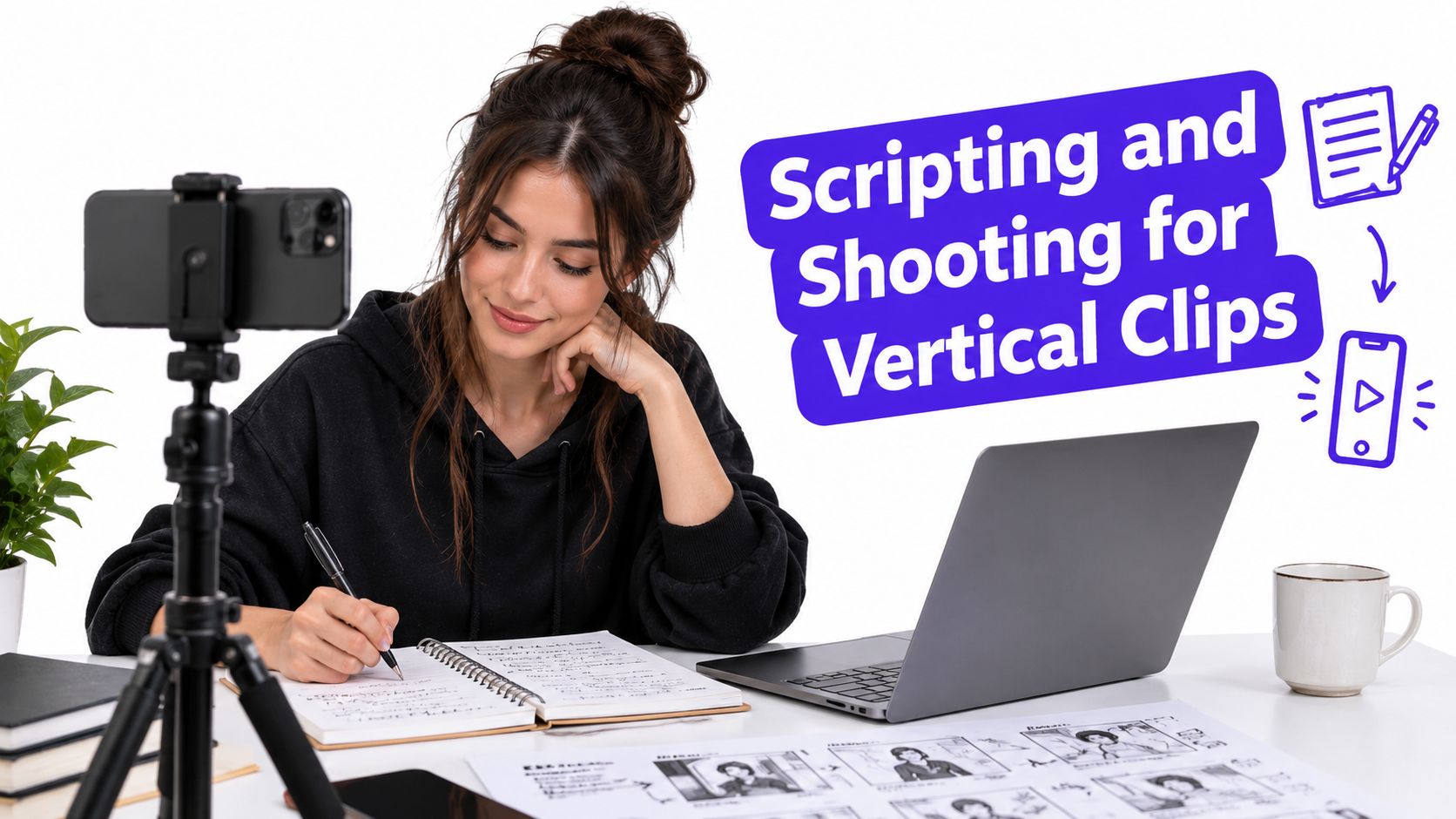
Build the edit inside a 9:16 canvas and review the actual crop, not just the original horizontal footage. Keep the primary face, product, demonstration, or object in a stable visual position. Automatic center-cropping often places the wrong subject in the frame, cuts off relevant gestures, or leaves the viewer searching for the thing that matters.
Industry research found that central framing reduced visual-search behavior and cognitive load, supporting deliberate subject placement instead of automatic center-cropping (research on framing and visual attention). The practical implication is simple. Reframe with intention, especially when the source includes two speakers, slides, physical products, or movement across a room.
Before exporting, check these details:
Rapid editing doesn't mean frantic editing. Viewers should understand who is speaking, what changed, and why the next shot belongs there. A cut that saves time but forces the audience to decode the scene can damage comprehension more than a quiet pause.
The opening deserves its own review. Create alternative first moments from the same underlying clip, such as a direct claim, a question, or a visual payoff. Keep the body comparable so you're testing the opening rather than changing the entire creative concept.
A direct claim might suit a technical explanation. A question can work when the source addresses a common objection. A visual payoff may be stronger for a demonstration, transformation, or physical process. Don't choose based only on which version sounds clever in the editing room. Compare how viewers respond to the opening and whether the rest of the clip earns the promise.
Burned-in captions are useful for sound-off viewing, but they need editorial review. Use readable line breaks, enough contrast, and timing that follows the speaker rather than racing ahead. Captions should support the visual story, not cover it.
For additional mobile-specific considerations around layout, framing, and ad-safe design, consult this guide to vertical video ads. The same principles apply to organic clips because viewers experience both formats through small screens and fast-moving feeds.
Repurposing scales when the team treats each clip as an editorial unit, not as a byproduct of an automated export. The unit needs a distinct premise, a coherent sequence, accurate captions, and a destination that matches its intended audience.
A practical pipeline starts with the long-form transcript. Mark moments where the speaker answers a question, changes direction, explains a process, challenges an assumption, or tells a compact story. Then group the candidates by audience need rather than by the order in which they appear in the recording.
A useful batch might contain several types of clips:
The categories keep a batch from becoming a collection of near-identical highlights. They also make later analysis more useful because you can compare clips with similar purposes instead of treating every view as evidence of the same outcome.
Automation is valuable for transcription, candidate selection, rough cuts, caption generation, and repeated formatting. It's less reliable at deciding whether a shortened statement still means what the speaker intended. A system can identify a sentence with high lexical relevance while removing the qualification that made the sentence accurate.
Caption accuracy is an accessibility and editorial issue, not merely a finishing touch. A review of a decade of social-video caption research found that Deaf and hard-of-hearing viewers, neurodivergent audiences, and multilingual viewers depend on captions, while creators still face inadequate tool support (review of social-video caption research).
Review every generated transcript for:
Don't judge the batch only by how quickly it was produced. A wrong name in one clip can damage trust across the entire series, especially for medical, financial, educational, religious, or property-related content.
Teams building a broader SEO-driven content workflow should connect the video's topic, transcript, title, description, and landing page. The short shouldn't be optimized in isolation if it's part of a larger search and distribution system.
A detailed content repurposing workflow can help organize these stages into a repeatable operating process. Keep a human approval step before publishing, even when the system handles the repetitive work. The goal isn't to eliminate editorial control. It's to spend that control where it has the greatest effect.
Likes are easy to see and easy to overvalue. They can help indicate resonance, but they don't tell you whether viewers understood the opening, stayed for the payoff, or took the next action. Retention should be treated as a funnel of related measurements, not a single score.
Start with the definitions. Completion rate is completed plays divided by video starts. View-through rate is average watch time divided by total duration. Those formulas use different denominators, so the percentages answer different questions. Platform dashboards may also label similar concepts differently, which is why a percentage should never be compared across platforms until you've confirmed how it was calculated.
Export analytics weekly from TikTok, Instagram Reels, and YouTube Shorts. For each video, retain:
Per-video engagement can be calculated as (likes + comments + shares) / views × 100. That figure measures interaction relative to views. It is not a completion rate, and it shouldn't be used as a substitute for retention.
Measurement warning: A high interaction rate can coexist with weak completion. A controversial opening may attract comments while losing viewers before the explanation arrives.
Available benchmark guidance places typical completion rates around 40 to 55 percent for YouTube Shorts, 40 to 50 percent for TikTok, and 45 to 65 percent for Instagram Reels. For videos shorter than 20 seconds, completion above 70 percent is considered strong (short-form video measurement guidance). These ranges are directional, not universal targets, because audience, topic, duration, editing style, and denominator definitions vary.
A retention curve can show where the clip loses people. A steep drop at the opening points to a weak premise, unclear framing, or a mismatch between the first moment and the promised value. A stable opening followed by a later decline may indicate that the body repeats itself, delays the payoff, or introduces unnecessary context.
Compare tightly scoped cuts against one another, but change one meaningful creative variable at a time. If the hook, duration, topic, caption style, and call to action all change together, you won't know what caused the difference. Likes can help you choose which conversations deserve a response. Retention curves are more useful for improving the construction of the next edit.
A short can reach a large audience and still produce no useful business result. That problem is especially serious for local providers, real-estate professionals, educators, podcasters, faith organizations, and small teams whose success depends on relevant inquiries rather than anonymous attention.
Industry reporting indicates that 73% of consumers prefer short video when learning about a product or service, but preference doesn't prove conversion without measurable follow-up (creator economy report). Use that preference as a reason to explain your offer clearly, not as evidence that every view has commercial value.
Assign each clip a funnel role:
A local contractor might publish a discovery clip about a recurring homeowner mistake, followed by a qualification clip explaining which projects the company handles. An educator can use one video to clarify a concept and another to invite viewers to a lesson or course. A congregation can separate broadly encouraging content from clips that explain meeting times or community programs.
Track the next step with a unique landing page, UTM-tagged link, platform-native lead form, booking question, or an offer that asks viewers to mention the video. If the audience falls outside your service area or lacks purchase intent, reach alone can become a distraction.
Taja AI turns long-form videos into ready-to-publish Shorts, clips, captions, thumbnails, and platform-specific posts, with tools for vertical formatting, editing, scheduling, and content planning. Upload a recording to Taja AI and use the resulting clips as a starting point for a measured repurposing workflow, then apply your own editorial review before publishing.


We are blessed to work with leading brands & Companies


We try to make easy and simple for every professionals. Get 30 days free trial - No credit card required.


© 2025 Taja AI. All rights reserved.