.jpeg)
How Long Should IG Reels Be: A 2026 Creator Guide
How long should IG Reels be in 2026? Get data-backed length recommendations for awareness, engagement, and conversions, plus platform limits and quick tips.
5 min read
September 20, 2026

Build an organic growth strategy that compounds. Learn goals, content repurposing, SEO, distribution and a 90-day roadmap for small teams.
Written by:


You publish something solid. A long video, a thoughtful podcast, a useful guide. It gets a small burst of attention, then disappears. Three days later, you're back at a blank content calendar, trying to come up with the next thing from scratch.
That's the trap most small teams call content strategy. It's really just repeated production without a system.
A workable organic growth strategy looks different. It treats every strong idea like an asset you can package, distribute, measure, and improve across multiple channels. That matters more now because small teams rarely lose on quality first. They lose on inconsistency, weak distribution, and chasing formats that don't compound.
The biggest advantage small teams have isn't speed alone. It's the ability to build a tight system around a narrow audience without layers of approval, channel silos, or bloated campaigns.
A lot of founders and solo creators hear "organic growth" and think SEO blog posts. That's too narrow. McKinsey framed organic growth as a broader operating discipline, not a single tactic, and reported that 93% of surveyed companies had pursued at least one strategy to generate organic growth in the prior three years, while nearly two-thirds said it was at the top of executive agendas in that period (McKinsey on mastering strategies of organic growth). For a small business, that same logic applies at a smaller scale. Growth from within usually comes from some mix of better positioning, better offers, and better distribution.
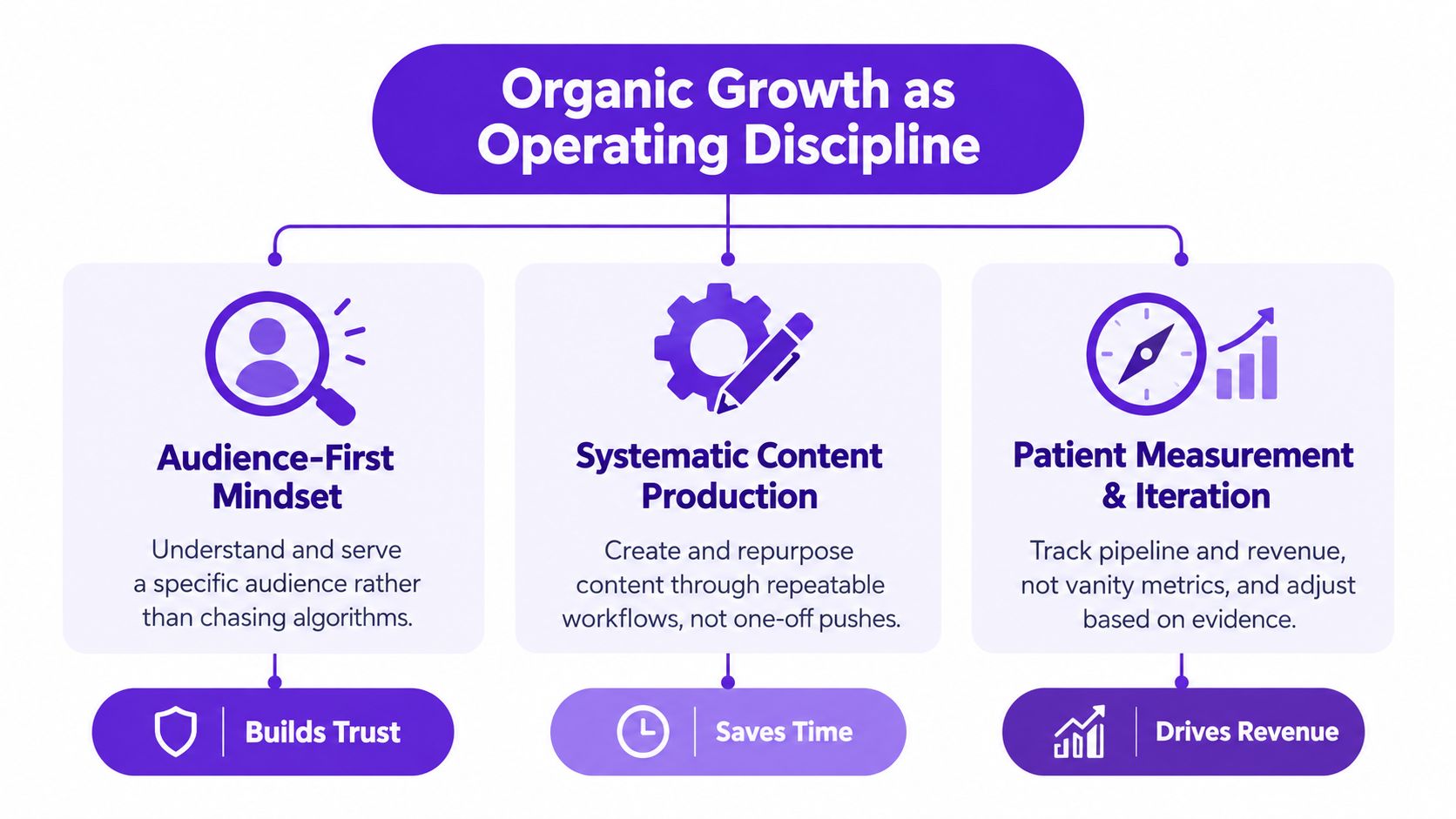
One post going viral can help. It usually doesn't build a business.
What compounds is a repeatable loop:
The practical shift is simple. Stop asking, "What should I post today?" Start asking, "What asset can I publish this week that can feed every channel for the next month?"
Practical rule: If a piece can't be reused, excerpted, or reframed, it's probably too disposable to anchor your growth system.
Paid reach is useful when you already know what converts. It's a rough teacher when you're still figuring out your audience. Organic content gives you more than traffic. It gives you language, objections, proof points, and repeat questions straight from the market.
That matters for more than SaaS or creator brands. Community-led organizations use the same principle. If you're looking at how mission-driven groups apply consistent outreach instead of one-off promotion, this guide on how to expand your church outreach is a good example of system thinking in a different setting.
For lean teams, organic growth works when three things happen together:
That last part is where people get sloppy. A channel can look active while the business stays flat. Organic growth wins when your content library becomes an acquisition asset, not a treadmill.
Most organic programs drift because the team starts publishing before deciding what "good" looks like.
If you don't set a benchmark, every result feels ambiguous. A small bump in sessions can look promising. A temporary dip can feel like failure. Both reactions waste time.
Before you touch a content brief, define three things in plain language:
That final step matters more than is usually admitted. A local service business may want booked calls. A consultant may want qualified inquiries. A creator with a productized offer may want email subscribers first and sales second. Those goals shape what traffic is worth chasing.
A more practical way to benchmark organic growth is to compare your current session base against your revenue stage and vertical, then decide where the gap is. One benchmark set for B2B SaaS at the growth stage, roughly Rs 10–50 Cr ARR, puts median monthly organic sessions at about 45,000, with the 25th percentile near 18,000 and the 75th percentile near 90,000. That same benchmark notes that top-performing programs at this stage often target 8–15% monthly organic-session growth, while pre-revenue teams may need 30–50% monthly growth until they reach product-market fit (UpGrowth organic growth benchmarks by ARR stage).
Use that carefully. Those numbers are useful because they show the shape of goal setting, not because every business should copy them.
| Stage | Median Sessions | Growth Target |
|---|---|---|
| Pre-revenue | Qualitative benchmark only | 30–50% monthly growth |
| Growth stage | 45,000 | 8–15% monthly organic-session growth |
Open GA4 and pull your monthly organic sessions over the last few months. Then ask:
Benchmark against stage and business model first. Raw traffic comparisons alone push teams into bad decisions, especially when one company publishes for awareness and another publishes for demand capture.
Once you know the gap, your next move gets clearer:
A good benchmark should calm you down, not hype you up. It tells you whether to create more, optimize what exists, or stop chasing traffic that doesn't support the business.
Most burnout doesn't come from publishing. It comes from rebuilding the machine every week.
Small teams get stuck because they treat every channel as a separate job. One script for LinkedIn. Another idea for Instagram. A fresh angle for email. A custom edit for Shorts. That approach can work for a while if you're fueled by adrenaline. It usually collapses when client work, sales, or operations get busy.
The fix is to build around a single source asset.
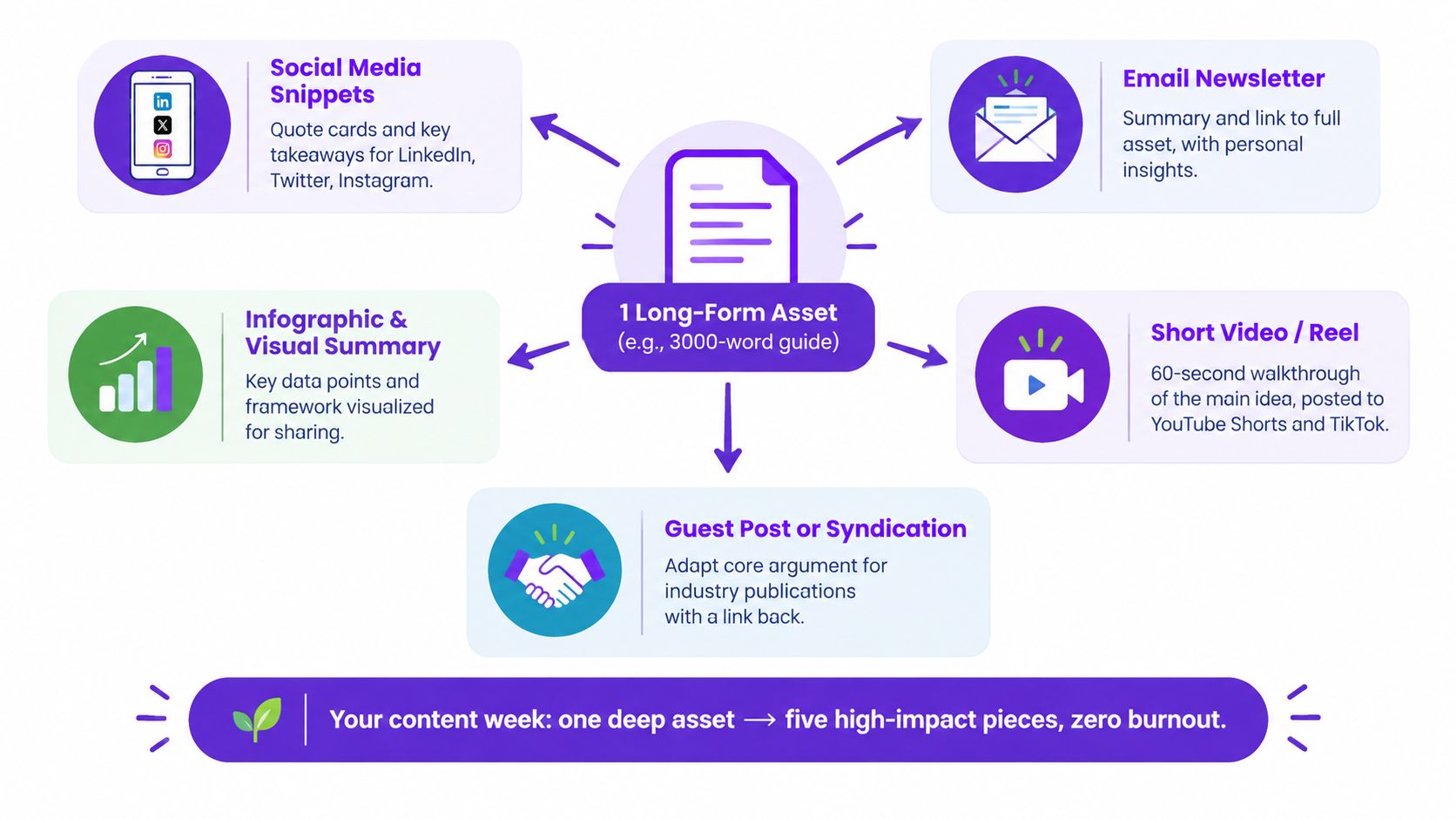
The best weekly source asset is usually one of these:
What doesn't work as well is starting with a weak asset and hoping repurposing will save it. It won't. If the core piece lacks a clear point, every derivative asset feels generic.
A practical workflow looks like this:
Extract the main argument
Write the one sentence the whole asset proves. If you can't summarize it cleanly, the piece is too loose.
Pull the strongest moments
Look for tension, contrarian lines, examples, mistakes, and tactical instructions. These become clips, quotes, carousels, or posts.
Match outputs to channel behavior
A LinkedIn post can carry nuance. A Short needs a sharp hook. An email needs a reason to click. A blog summary should answer the question directly.
Package with templates
Brand templates save more time than editing tricks do. Use repeatable caption styles, thumbnail structures, lower-thirds, and post frameworks.
Default to vertical when possible
Vertical clips travel farther across platforms and reduce editing overhead when you're distributing to multiple social surfaces.
A tool can help if the bottleneck is formatting and scheduling rather than strategy. For example, Taja AI's content repurposing workflow shows how one long-form video can be turned into shorts, captions, thumbnails, blogs, and channel-specific posts from a single source file.
A good explainer on this from another angle is Bruce and Eddy's guide to maximize engagement via repurposing, especially if you're trying to get more mileage from content you already recorded.
Use a weekly system simple enough to survive a busy month.
Don't aim for perfect omnipresence. Aim for consistent reuse.
Here's a walkthrough that illustrates the general repurposing mindset in action:
A lot of content work feels productive while producing very little.
Stop spending your best hours making tiny design choices for posts that haven't earned distribution proof yet.
Common time sinks include:
If one long-form asset can't generate many useful pieces, that isn't a repurposing problem first. It's a source-asset problem. Fix the raw material.
Publishing isn't distribution. And distribution isn't the same as posting the same caption everywhere.
A modern organic growth strategy has to assume fragmented attention. Someone may discover you from a search result, see a clip a week later, read an email after that, and only then convert. That's why distribution now deserves the same operating discipline as production.
Recent market data projects the global content distribution market at USD 113.25 billion in 2025 and USD 169.41 billion by 2031, which shows that distribution is turning into a real budget category, not an afterthought. The same source also notes that a 2025 B2B benchmark summary says 89% of B2B marketers use organic social media platforms to distribute content (Mordor Intelligence on the content distribution market).
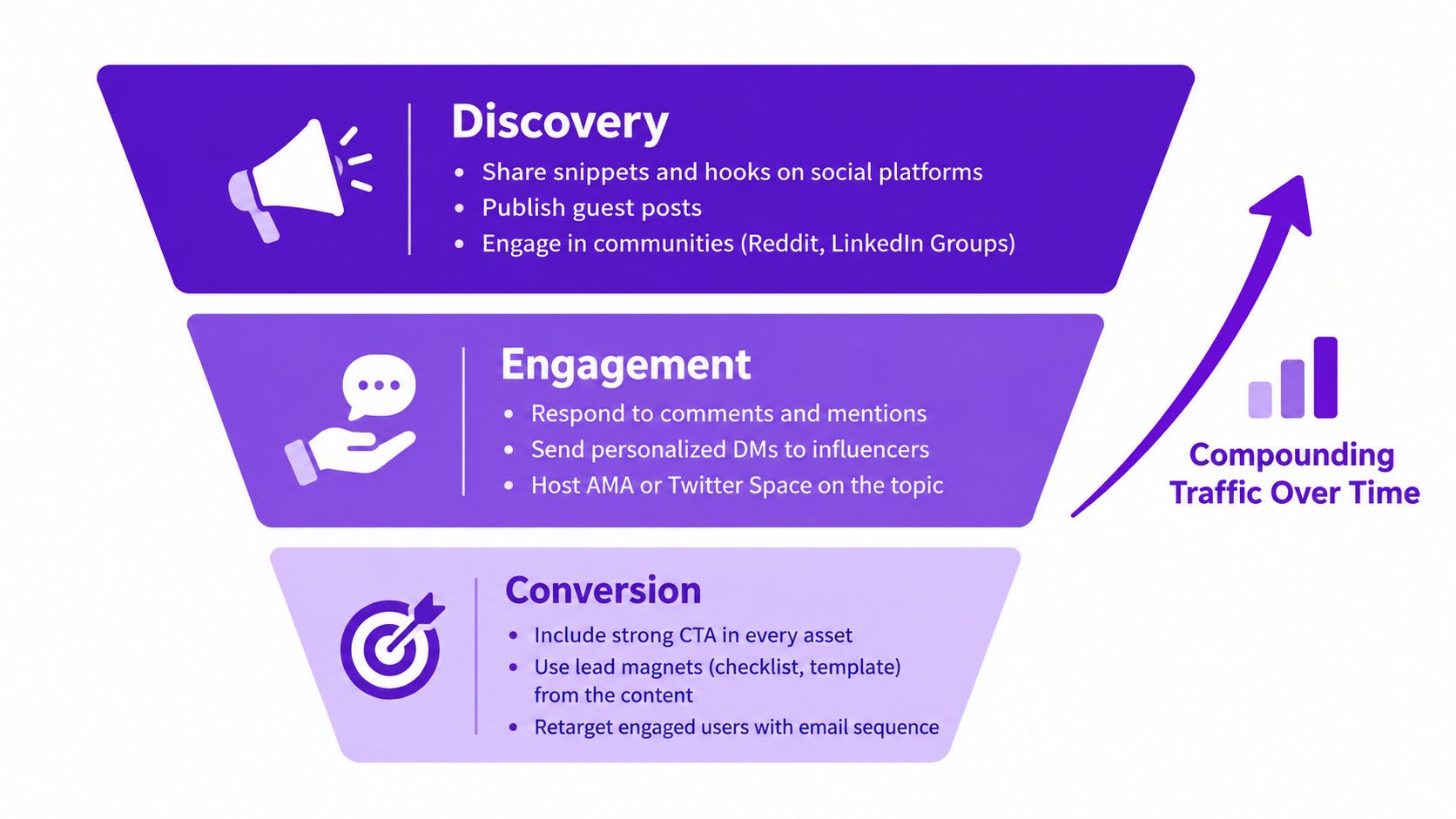
A simple sequence works better than trying to "be everywhere."
Short excerpts, hooks, and searchable assets do their job.
Use:
Now the prospect needs a reason to stay.
That often means:
Many "organic" programs get fuzzy. If every asset ends in vague awareness, the audience consumes but doesn't move.
Use direct next steps. Book a call. Download a checklist. Watch the longer breakdown. Join the email list. Read the comparison page.
New SEO programs often grow slower than people expect. One benchmark set reports 0–15% growth in months 1–3, 10–50% in months 4–6, and 20–80% in months 7–12 for newly launched programs. It also notes that meaningful gains for new high-quality content commonly take 9–12 months, and volatility after core updates can swing results from -30% to +40% (Cactus Marketing organic traffic growth benchmarks).
That timing changes how you should work.
A lot of teams reverse this. They obsess over tiny on-page tweaks before they have enough meaningful content to matter.
One useful way to think about distribution is that every asset should serve one of three jobs:
If you're trying to systematize that process across channels, this guide on content distribution strategy is a useful reference point for structuring the workflow.
SEO and distribution support each other best when the content is designed for both humans and retrieval. Clear titles, direct answers, smart internal links, and repeat exposure across channels make the library easier to discover and easier to trust. Posting more without that structure usually just creates more scattered assets to maintain.
A lot of organic programs look healthy right before someone asks the uncomfortable question: did any of this produce business?
That's where vanity metrics collapse. Impressions, rank screenshots, and follower growth can tell you whether content is getting seen. They don't tell you whether the work is helping the business acquire customers.
Recent coverage on measurement shows a clear shift. Revenue, conversion rate, and pipeline are now the priority, while impressions, keyword rankings, and bounce rate have fallen lower on marketers' priority lists. It also points to a persistent gap. Teams still struggle to connect organic content to pipeline when discovery happens across multiple sessions and surfaces (Be Omniscient on measuring organic growth in 2025).
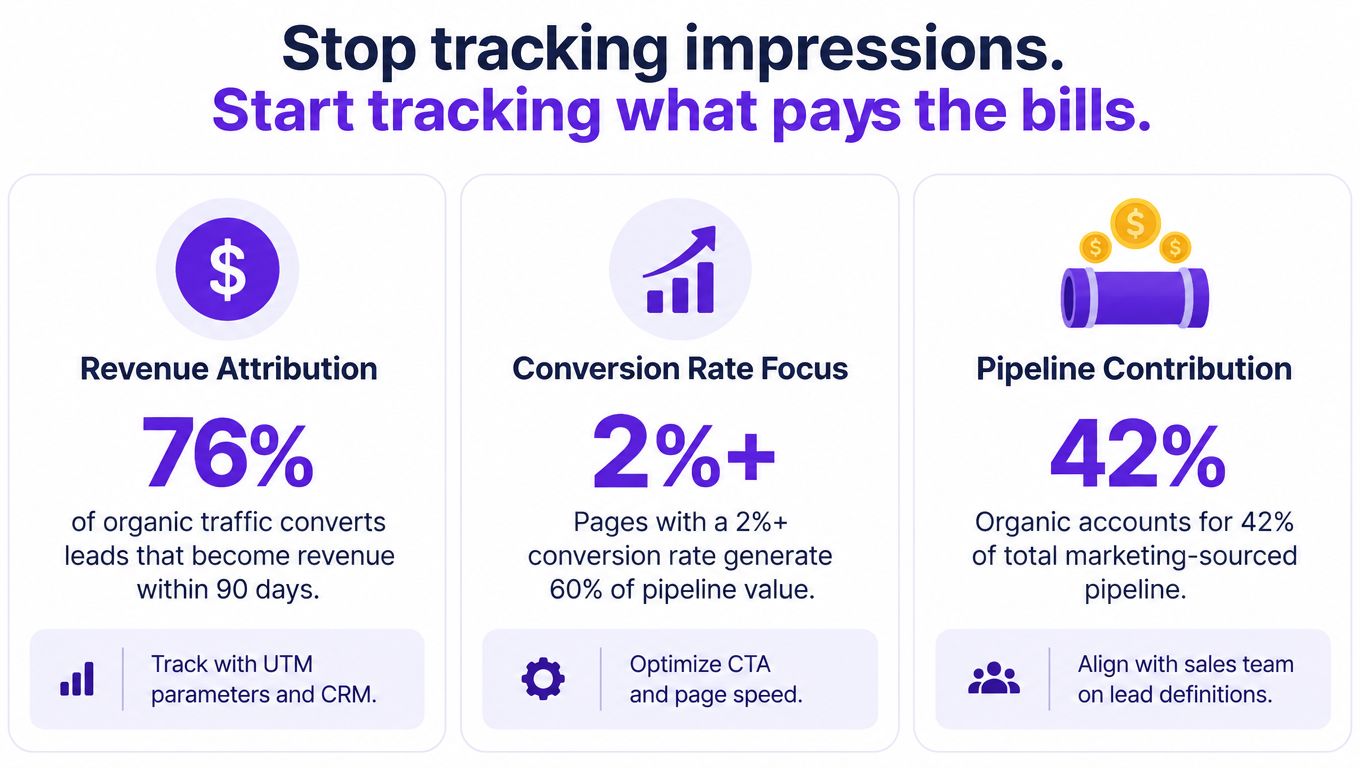
For a lean team, a useful measurement stack has two layers.
These tell you whether content is attracting the right kind of attention.
Track things like:
These tell you whether organic discovery contributes to actual growth.
Track:
If you're looking for a grounded walkthrough of the mechanics, this guide on how to track organic search revenue is a practical companion.
This is less about perfect attribution and more about building a believable operating picture.
Use a simple setup:
Organic discovery often works as a chain, not an event. Someone may first meet your brand through search, return from social, and convert from email. If you only credit the last touch, you'll underinvest in the content that started the journey.
The teams that win with organic don't insist on perfect attribution first. They build enough attribution to make better decisions every month.
Too many teams optimize too early and too broadly. Wait until a page or topic shows some traction, then improve the parts that matter:
That last point matters because overconcentration creates fragility. If one cluster stalls, the whole program can flatten. A mixed library across awareness, consideration, and decision intent is usually more stable.
Video can also play a direct role in that pipeline path, especially for trust-heavy offers. This breakdown of lead generation with video is useful if your content engine includes demos, explainers, interviews, or talking-head education.
A strong organic growth strategy doesn't need a huge team. It needs a clear cadence you can keep.
The first ninety days are about building signal, not proving mastery. If you expect instant compounding, you'll abandon the process too early. If you treat the quarter like a system setup phase, you'll make better choices.
Focus on the foundation.
Pick one audience segment. One core offer. One repeatable content theme. Then set up the basics:
Don't try to cover every platform in the first month. Pick the channels where your audience already pays attention.
This phase is for consistency and distribution discipline.
Create and publish on a weekly rhythm. One core asset should generate multiple native outputs. Organize them into a simple sequence instead of random posting.
A useful weekly sprint can look like this:
| Week focus | Primary action | Checkpoint |
|---|---|---|
| Publish | Release one core asset | Was it clear and useful enough to repurpose? |
| Repurpose | Cut clips, summaries, quotes, emails | Did each piece match the platform? |
| Distribute | Schedule and manually seed key pieces | Which channels drove replies, clicks, or return visits? |
| Review | Check leading indicators and assisted conversions | Which topics deserve another pass? |
Optimization starts to matter more than volume.
Look for patterns, not isolated wins.
By day ninety, you should have a much clearer answer to three questions: what your audience responds to, which distribution paths get attention, and which assets help move people toward revenue.
A practical organic system should feel boring in the right ways. The same inputs, the same cadence, the same review loop. That's usually what compounding looks like before it looks impressive.
The best part is that this approach stays workable even when you're busy. You don't need a fresh campaign every week. You need a source asset, a repurposing workflow, a distribution sequence, and a habit of checking what influenced pipeline.
Taja AI helps turn that process into a repeatable workflow by converting long-form video into shorts, captions, thumbnails, blogs, and platform-specific posts, then scheduling distribution from one dashboard. If you're trying to grow organically without becoming a full-time editor, visit Taja AI and see how it fits into the system outlined here.


We are blessed to work with leading brands & Companies


We try to make easy and simple for every professionals. Get 30 days free trial - No credit card required.


© 2025 Taja AI. All rights reserved.