.jpeg)
10 Repurpose Examples to Multiply Content Reach
Explore 10 repurpose examples for turning long-form content into clips, posts, blogs, emails, and lead magnets across creator and business niches.
5 min read
September 17, 2026

Build a content distribution strategy that actually works. Learn how to map audiences, pick channels, repurpose assets, and measure ROI across every platform.
Written by:


Most content distribution advice is backwards. It tells you to publish first, then “promote” later, which is how good assets end up buried under the next deadline. If you want reach, don't treat distribution like a final checkbox. Treat it like the operating system that decides how every asset gets routed, reformatted, and shipped the same week it goes live.
The old model was simple, and weak. A team wrote a blog post, posted it once, maybe shared it on LinkedIn, then waited for search traffic. The modern model is built around social-first discovery, email retention, and paid amplification, because that's how content gets seen. In the 2024 B2B Content Marketing Benchmarks study, 90% of B2B marketers said they use social media platforms for organic distribution, ahead of blogs at 79%, email newsletters at 73%, and email at 66%. The same study found that 86% of organizations also use paid content distribution channels, with 78% using social media advertising or promoted posts, 64% using search engine marketing or PPC, and 59% using digital display advertising. That benchmark makes the point plain, distribution is no longer a single post and a prayer.
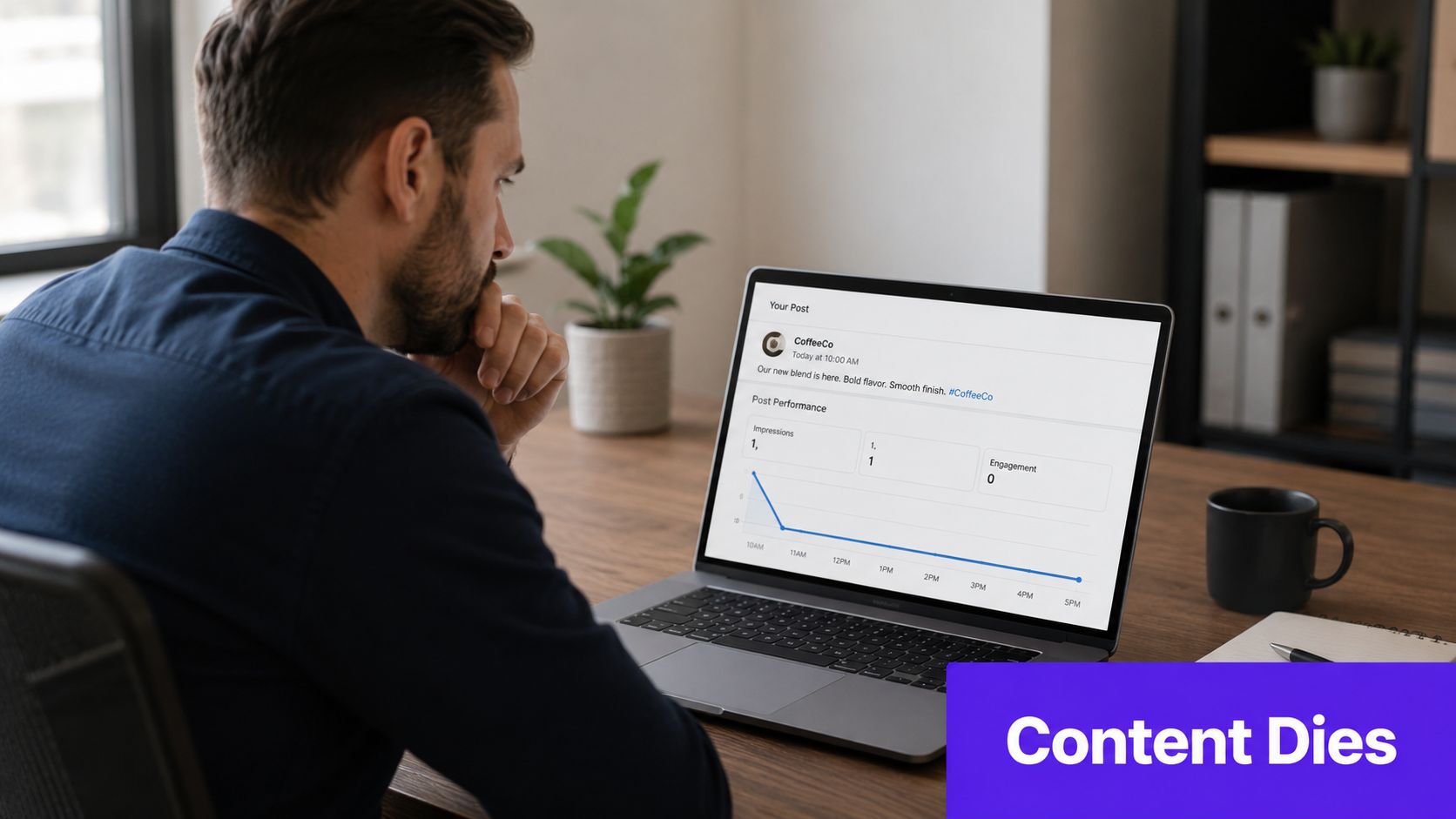
First, teams over-invest in creation and under-invest in shipping. They spend days polishing one asset, then give distribution ten minutes of attention. Second, they pick channels by habit, not by audience behavior. Third, they lack a documented process, so every launch depends on whoever remembers to post it.
Practical rule: if distribution is not written down, it won't happen consistently.
A real content distribution strategy replaces that chaos with a repeatable system. It defines where content starts, which channels carry it, what format each channel needs, and who owns each handoff. That's the difference between random posting and a machine that compounds effort. The goal isn't more activity. It's more mileage from every asset you already make.
Most content doesn't fail because it's bad. It fails because nobody routes it properly after publish. The asset may be strong, the angle may be sharp, and the hook may be useful, but if the team sends it into one channel and stops, reach collapses fast. That's the default failure mode for most brands, and it's the reason so many teams mistake creation volume for distribution maturity.
The problem usually starts with the launch mindset. A writer or producer finishes the asset, hits publish, then hands the work over to “promotion,” which often means one social post and one newsletter mention. That's not a strategy. It's a tiny afterthought attached to a lot of upstream effort.
A working content distribution strategy does something different. It treats the anchor asset as the source material for multiple outputs, each with a specific role. One version exists to attract discovery, another exists to deepen retention, and another exists to move someone closer to action. When teams don't separate those roles, every channel gets the same generic post, and none of them works especially well.
The latest benchmark data shows why this matters. In the 2025 benchmark summary, 84% of marketers said they distribute content through at least three channels simultaneously, 92% use social media regularly, and 61% rely on email newsletters as a primary distribution method. That benchmark lines up with the world, where the winning move is no longer “publish and wait.” It's coordinated repurposing.
A strong system removes three leaks. It stops the one-channel habit, it gives every channel a job, and it creates ownership before launch day. That's why the best teams don't ask, “Where should we post this?” They ask, “What role does this asset play, and which channels should carry which version?”
For local businesses, creators, and podcasters, this matters even more. A single interview, listing walkthrough, or how-to video can feed social posts, short clips, newsletter sections, and search-friendly assets. But only if distribution was designed as part of the process, not appended at the end.
The point is simple. If content dies after publish, the problem usually isn't content quality. It's the operating model.
Don't start with channels. Start with the people you're trying to move and the action you want from them. That sounds basic, but many teams skip it and then wonder why the content gets reactions instead of results. A channel only matters if your audience already uses it and if the channel can support the outcome you want.
Use three questions for every segment:
Write the answer in plain language. Not “small business owners.” Say “homeowners in one service area who need proof before they call.” Not “podcast listeners.” Say “existing listeners who need a reminder to come back, plus new people discovering the show through clips.” The tighter the segment, the easier the channel decision becomes.
A YouTube creator might map subscribers to retention content and searchers to discovery content. A local realtor might map homeowners to neighborhood updates and sellers to listing walkthrough clips. A podcaster might map loyal listeners to newsletter recaps and new listeners to short-form clips. Same strategy, different audience.
A channel without a funnel role is just noise. Discovery channels pull in new attention. Retention channels keep people engaged after the first touch. Conversion channels move people into a lead form, a booking page, a subscribe action, or a direct response.
If you can't say what a channel is supposed to do, it's probably stealing time from one that can.
This is also where tools matter. If your workflow is messy, a platform like Taja AI fits the “route it everywhere” part of the job better than a one-off posting habit, because the whole point is to manage distribution across multiple surfaces without rebuilding the process every time.
A simple audience-and-goal map can fit on one page. That page should tell you who you're talking to, what they care about, where they already spend time, and which move you want them to make next. Everything else flows from that.
Channel selection gets easier when you stop ranking platforms by hype and start ranking them by job. Owned, earned, and paid each play a different role. Owned gives you control. Earned gives you credibility. Paid gives you reach once you already know what works.
The mistake is treating every channel like it should do everything. It should not. One channel should drive discovery, another should deepen trust, and another should turn attention into action. Small teams do not need twenty channels. They need a stack with clear jobs.
The strongest setup usually looks like this:
That framing keeps you honest when the team wants to add every shiny platform. If a channel does not serve one of those roles, it is a distraction.
Here's a practical scoring template you can use before committing time:
| Channel | Customer Usage (1-5) | Lead Discovery (1-5) | Organic Reach (1-5) | Tier |
|---|---|---|---|---|
| Email Newsletter | ||||
| YouTube | ||||
| Instagram Reels | ||||
| Paid Social |
Score each channel by where your audience already spends time, how easily it surfaces new leads, and how much organic reach it still delivers. Then pick the highest-scoring channels and stop pretending the others matter equally.
Paid needs a clear rule too. In the 2024 benchmark, 86% of organizations used paid content distribution channels, but the better move is to layer paid on top of a strong organic base, not try to brute-force reach with ads alone. Use paid to extend good organic content, not to rescue weak positioning.
If you need a practical starting point for audio-first teams, choose and license podcast music before you lock your channel plan. Audio assets get reused constantly, and brand consistency breaks fast when teams improvise.
For teams that are managing distribution across multiple surfaces, a platform like Taja AI fits the routing side of the job better than a one-off posting habit. The point is to manage distribution across channels without rebuilding the process every time.
The right stack usually is not glamorous. It is one channel for discovery, one for depth, one for conversion, and one place to test. That is enough to build momentum without spreading the team thin.
The core mistake in content operations is building one asset in one format and expecting it to work everywhere unchanged. That's lazy, and it burns time later. A better approach is to build one strong anchor asset, then break it into modular pieces that match each platform's habits and constraints.
Pick one source asset, a long video, podcast episode, webinar, or pillar article. That asset becomes the raw material for everything else. The repurposing job starts by asking what each derivative needs to accomplish, not by copying the same message into new boxes.
A clean workflow looks like this:
That is where format templates earn their keep. A LinkedIn carousel needs a different opening than an Instagram Reel. An email snippet needs a different rhythm than a YouTube Short. If you don't write those constraints down, your team will waste time reformatting the same idea three different ways.
A modular workflow works best when the team knows who owns what.
Operational rule: if one person is doing capture, editing, copy, and approval, the workflow is not modular. It's overloaded.
A 20-minute interview can become a YouTube Short, a LinkedIn carousel, an Instagram Reel, three quote graphics, and a newsletter section if you plan the conversion before you start editing. That isn't extra work if the system is built properly. It's the whole point of the system.
For teams that want automation without losing control, automate content creation is useful as a reference point because the win comes from reducing manual repetition, not from skipping judgment. Manual production gives you control, semi-automation saves time on repetitive assembly, and full automation only works when the source material and templates are already tight. Use automation where the process is repetitive. Keep humans on positioning, selection, and final approval.
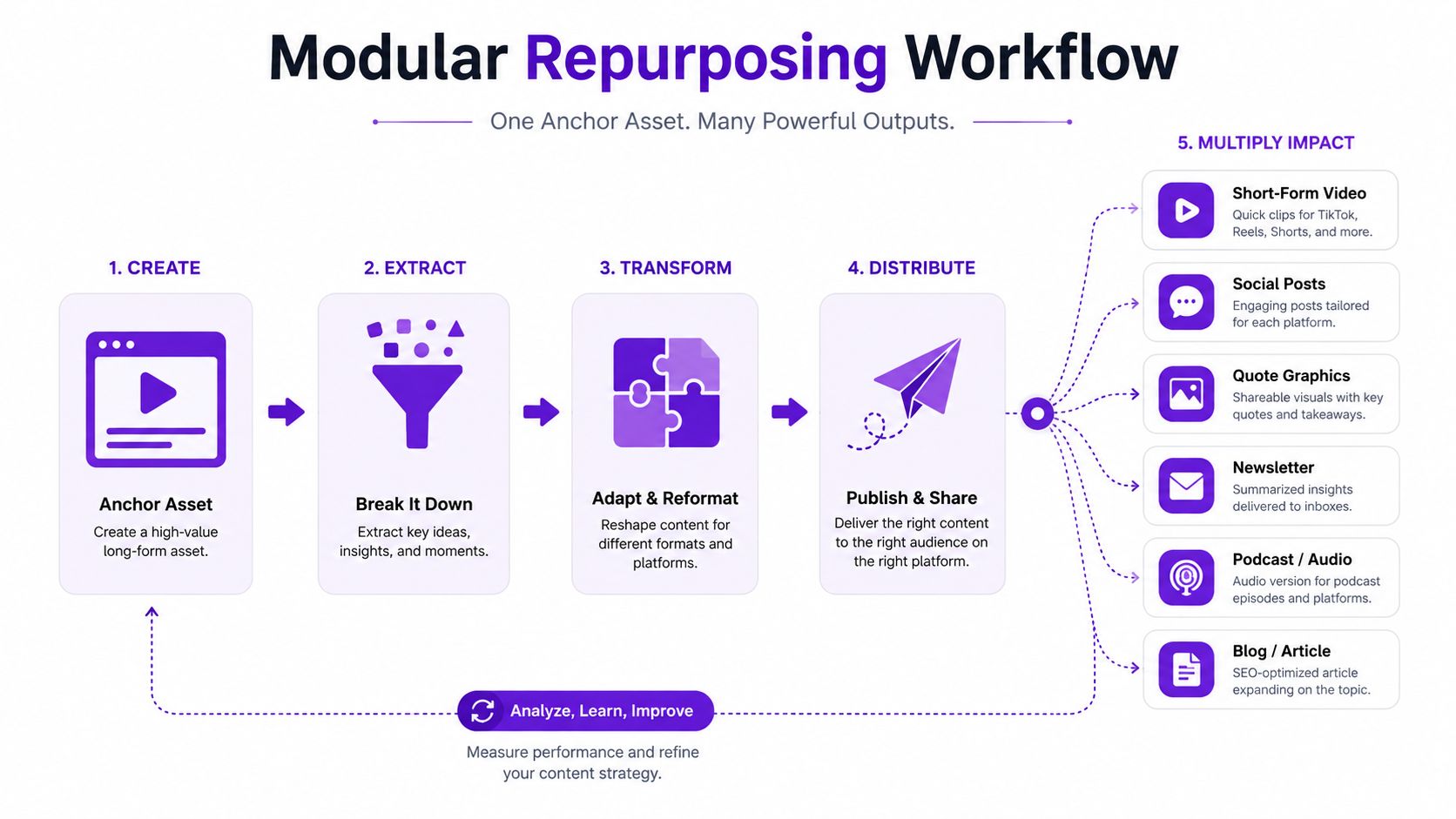
A workflow like this turns one recording session into a week of platform-ready output. That's the key advantage many teams overlook.
A calendar without ownership is just a planning document. A distribution SLA changes that by assigning who ships each asset, how fast, and on which channels. That's how a small team keeps pace without resorting to last-minute scrambling.
Use a rolling four-week calendar, not a static monthly spreadsheet. Each week should show the anchor asset, the derivative pieces, the publish dates, and the channel owner. That way, every new piece of content has a distribution path before production is finished.
A simple weekly rhythm works well:
A backlog boost matters. Not every good asset needs to be new. Some of your best distribution work will come from reviving an older piece with a sharper hook, a different format, or a new channel fit.
A useful SLA should answer four things:
That last part matters more than people admit. If a post misses its launch window, the content doesn't just lose timeliness. It often loses momentum across every connected channel.
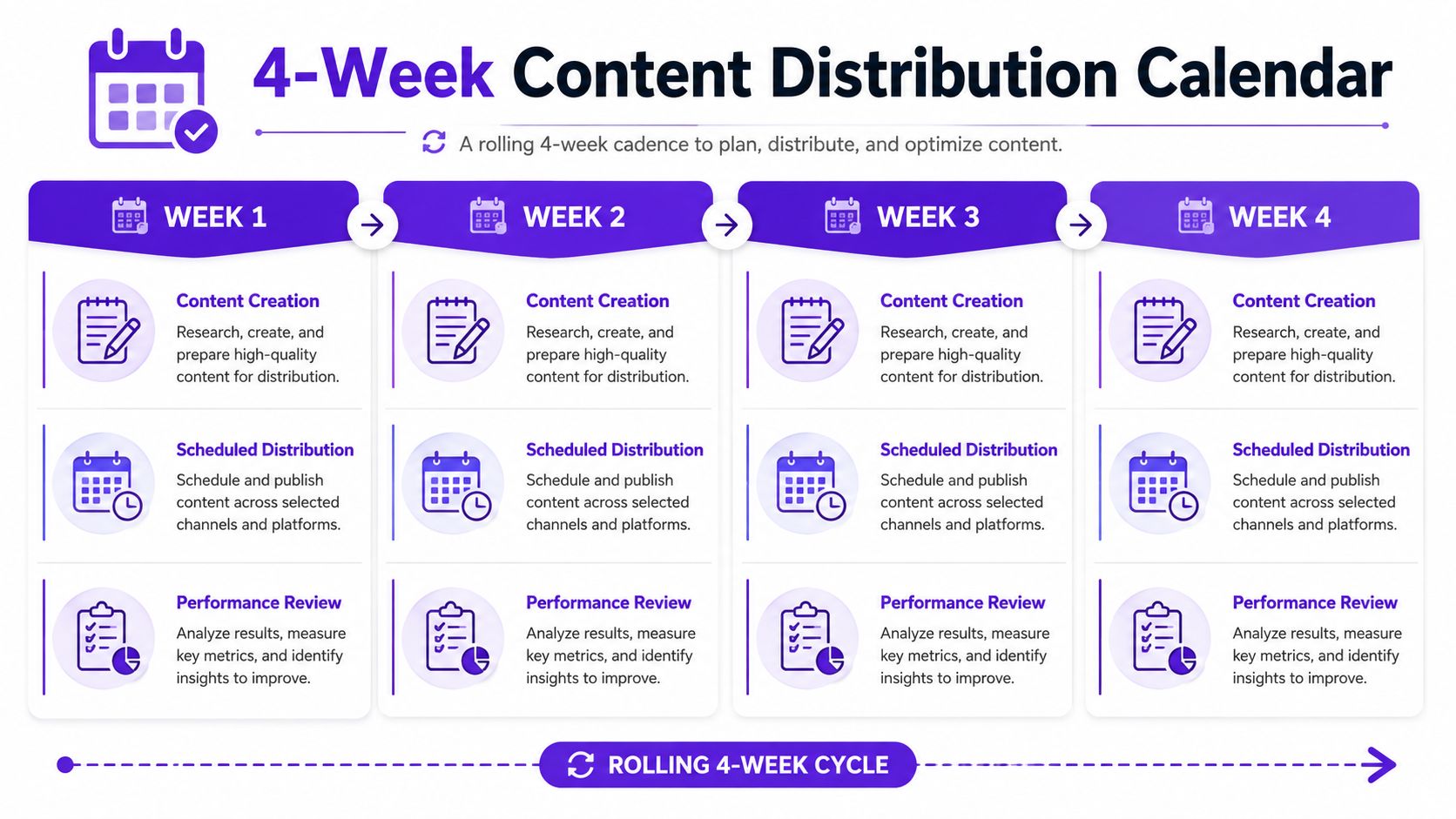
Practical distribution guidance recommends documenting a distribution SLA that defines who ships each asset, how fast, and on which channels, alongside a format template library that specifies exact structure, character limits, image dimensions, and hook patterns for each channel. That operating guidance is right because distribution becomes reliable only when it's operationalized.
If you want a calendar structure to model, how to create a content calendar is a useful reference for turning publishing into a repeatable cadence. The point isn't perfection. It's making sure content doesn't leave production without a routing plan.
A distribution calendar plus SLA gives you a system that can survive busy weeks, lean teams, and missed deadlines without collapsing into chaos.
The same operating system works for different businesses, but the routing changes. A creator, a local business, and a podcaster don't need the same distribution mix. They need the same logic applied to different constraints.
A solo creator should treat the long video as the anchor and the clips as discovery assets. The main channel can carry the full version, while Shorts, community posts, and a newsletter section handle repeats and reminders. The creator's job is to extract the strongest moments once, then distribute them in smaller forms across the week.
If time is tight, skip the vanity extras. Keep the high-signal clip, the thumbnail, the title, and one post that drives people back to the full video. That's enough to keep the system alive without turning editing into a second job.
A local agent should think in zip codes, neighborhoods, and seller intent. One walkthrough video can become a listing post, a neighborhood update, a short-form clip for social, and a follow-up email to warm leads. The goal isn't broad reach. It's local trust.
What to skip when overloaded? Fancy motion graphics. A clear property hook, a good caption, and a direct next step matter more. Buyers and sellers care about relevance and response speed, not production flourish.
A podcaster gets the most value from cutting long interviews into short discovery pieces. One episode can supply a trailer clip, a quote graphic, a guest pull-quote for email, and a recap for returning listeners. The best podcasters don't treat each episode as a standalone upload. They treat it as a content source.
If the week is stacked, don't try to squeeze every idea out of every episode. Keep the strongest hook, the strongest quote, and one recurring distribution channel that your audience already uses. That keeps the show visible without wrecking the production schedule.
The common thread is simple. Each audience needs a different channel mix, but the operating pattern stays the same. Anchor, repurpose, route, repeat.
If you don't measure distribution, you're just making noise in public. The right dashboard is small, specific, and tied to the role of each channel. Reach tells you if the asset is being seen. Engagement tells you if it landed. Retention tells you if people stayed. Conversion tells you if it moved them.
Use the minimum KPI set and ignore the rest unless it ties back to a real decision.
These metrics map cleanly to funnel role. Discovery channels should be judged heavily on reach and engagement. Retention channels should be judged on time-based behavior and repeat contact. Conversion channels should be judged on clicks, sign-ups, bookings, or whatever action matters to the business.
Run a weekly review, not a quarterly postmortem. Every week, ask three questions. What got attention? What got ignored? What should we repeat, revise, or kill?
Expert methodology on distribution emphasizes defining audience and goals first, mapping channel fit to where the segment already consumes content, publishing through owned, earned, and paid channels, and optimizing with channel-specific KPIs, analytics, and periodic recalibration. That framework is the right final filter because distribution should behave like an operating system tied to pipeline outcomes, not ad hoc posting.
A simple 30-60-90 day cycle keeps the work honest. In the first month, test hooks and formats. In the second, double down on what earns repeat results. In the third, cut channels that waste time and move that effort into the stack that's working.
Don't optimize for applause. Optimize for repeatable distribution behavior.
The first three experiments I'd run are these. Test a new hook style on your best discovery channel. Repackage one anchor asset into two different formats. Move one high-performing derivative into email and measure whether it extends the asset's life.
Distribution gets better when the team stops guessing and starts reviewing. That's how a content system compounds instead of resetting every week.
If you want a cleaner way to turn long-form content into shorts, captions, thumbnails, blogs, and platform-specific posts from one upload, start using Taja AI. It's built for the exact problem this playbook solves, repurposing and scheduling content across channels without making your team live inside an editor. Visit it if you want your content distribution strategy to run like a system instead of a scramble.


We are blessed to work with leading brands & Companies


We try to make easy and simple for every professionals. Get 30 days free trial - No credit card required.


© 2025 Taja AI. All rights reserved.