.jpeg)
10 Best Instagram Reels Maker Tools for Creators in 2026
Compare 10 Instagram Reels Maker tools for editing, vertical templates, captions, and publishing, with honest limits and use cases for 2026.
5 min read
October 15, 2026

Learn effective multi channel management to grow your audience without burnout. This guide provides a complete strategy, workflows, and tools for 2026.
Written by:


You're probably already doing the hard part.
You record the video. Write the post. Clip the reel. Resize the graphic. Rewrite the caption for LinkedIn. Shorten it for X. Add hashtags for Instagram. Upload to YouTube. Then you realize the product link changed, one platform has old pricing, another still shows an out-of-stock item, and the analytics are scattered across six tabs you won't have time to review.
That's the trap. Most creators and small teams don't struggle because they lack effort. They struggle because effort doesn't scale when every channel runs on manual coordination.
Multi channel management solves that problem when it's treated as a system, not a posting checklist. The actual win isn't “being everywhere.” It's building a repeatable machine that lets you show up on the channels that matter, keep the experience consistent, and avoid turning your marketing into a second full-time job.
A familiar pattern shows up when a creator starts gaining traction.
First, one platform works. Then a second feels necessary. Soon there are five active channels, all demanding native formatting, channel-specific copy, comments, scheduling, and reporting. What looked like expansion turns into duplication. The same message gets rebuilt over and over with slightly different packaging.
The biggest mistake isn't under-posting. It's confusing activity with impact.
A creator can spend an entire afternoon moving one idea across Instagram, TikTok, YouTube Shorts, LinkedIn, and Facebook, then still feel behind. The content may be solid. The workflow isn't. That gap is where burnout starts.
Two things usually happen next:
That's why stronger social media marketing strategies focus less on posting volume and more on automation, adaptation, and process design.
A real multi channel management setup starts with one question: what should happen after the core asset is created?
If your answer is “someone copies it everywhere,” you don't have a channel strategy. You have a labor problem.
A better model is simple. One piece of core content enters a workflow. That workflow turns it into channel-ready versions, schedules distribution, and routes performance data back into planning. When that's working, each new channel adds opportunity without multiplying chaos at the same pace.
Practical rule: If adding one more platform immediately creates more manual tasks than measurable upside, the system is broken before the channel is.
For creators and lean teams, this often starts with reducing handwork around repurposing and publishing. Tools and workflows that automate content creation can remove the repetitive production layer that drains time without adding much strategic value.
The point isn't to do less marketing. It's to stop spending skilled time on low-value repetition.
Many assume multi channel management means posting on several platforms. That's too shallow to be useful.
The better analogy is a central command center. Strategy, content, distribution, and measurement all run through one operating system, even if the audience sees different formats on different channels.
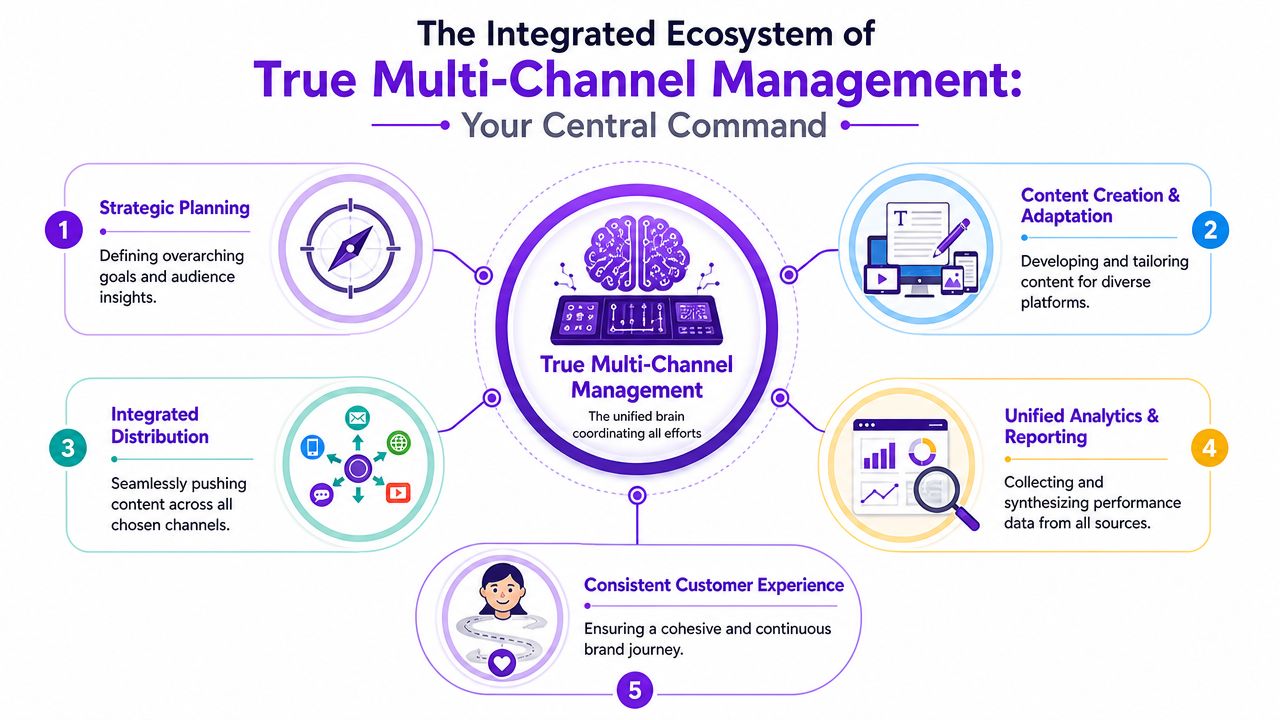
A practical setup usually includes these connected pieces:
If one of those pieces breaks, the whole system gets noisy. You may still publish regularly, but the channels won't reinforce each other.
True multi channel management doesn't mean every platform gets the same asset.
It means every platform supports the same business objective while respecting channel behavior. A YouTube video might build depth. A Reel might create first-touch discovery. LinkedIn might convert the same topic into authority. Email might carry the strongest call to action.
That distinction matters for visual content too. Teams that sell physical products often underestimate how much creative consistency shapes cross-channel performance. If your imagery changes quality or style every time it moves platforms, the brand feels fragmented. Good resources on product photography for fashion brands are useful here because they show how a single visual standard can support multiple surfaces without looking repetitive.
Multi-channel works when customers experience one brand with many expressions, not many disconnected brands using the same logo.
When people miss this, they over-invest in output and under-invest in coordination. That's why some brands look active everywhere but still feel forgettable.
The upside is real. So is the drag.
An industry analysis reported that brands using 3+ channels achieve a 287% higher purchase rate than single-channel approaches, while brands using 5+ coordinated channels see a 412% higher purchase rate at the aggregate level. The same analysis also noted that marginal ROI can fall below 30% of the first channel by the fifth channel unless channels are added sequentially and data is unified, which is why attribution and cross-channel measurement matter so much in practice (multi-channel marketing strategy analysis).
When channels are coordinated, they don't just stack impressions. They help move people through different stages of decision-making.
One person discovers you through short-form video, checks your website later, joins your email list, and finally buys after seeing social proof on another platform. Another person watches long-form content first, then uses Instagram to keep up with your brand until they're ready to act.
That's why multi-channel can outperform a single-channel bet. Different channels do different jobs. Some create awareness. Some build trust. Some close. Some keep customers warm after the sale.
Small teams usually don't fail because they chose the wrong channel first. They fail because the operating load gets out of hand.
Shopify's guidance on multichannel management emphasizes synchronized product, inventory, and order data to avoid stockouts and inconsistency, and recommends starting with one channel and testing OMS, IMS, and analytics workflows before scaling (Shopify enterprise guidance on multi-channel management). That advice matters far beyond ecommerce catalogs. The same principle applies to creators, agencies, and service businesses.
Here's what operational drag looks like in practice:
A lot of “multi-channel advice” skips this part. It sells the growth story but ignores the labor story.
The break-even point for another channel isn't when you can technically publish there. It's when you can support that channel without weakening the rest of the system.
That's the difference between growth and sprawl.
Most channel problems start before the first post goes live. They start in planning.
A workable strategy doesn't begin with “Which platforms should I add?” It begins with audience behavior, business goals, and content format. Once those are clear, channel decisions get easier.
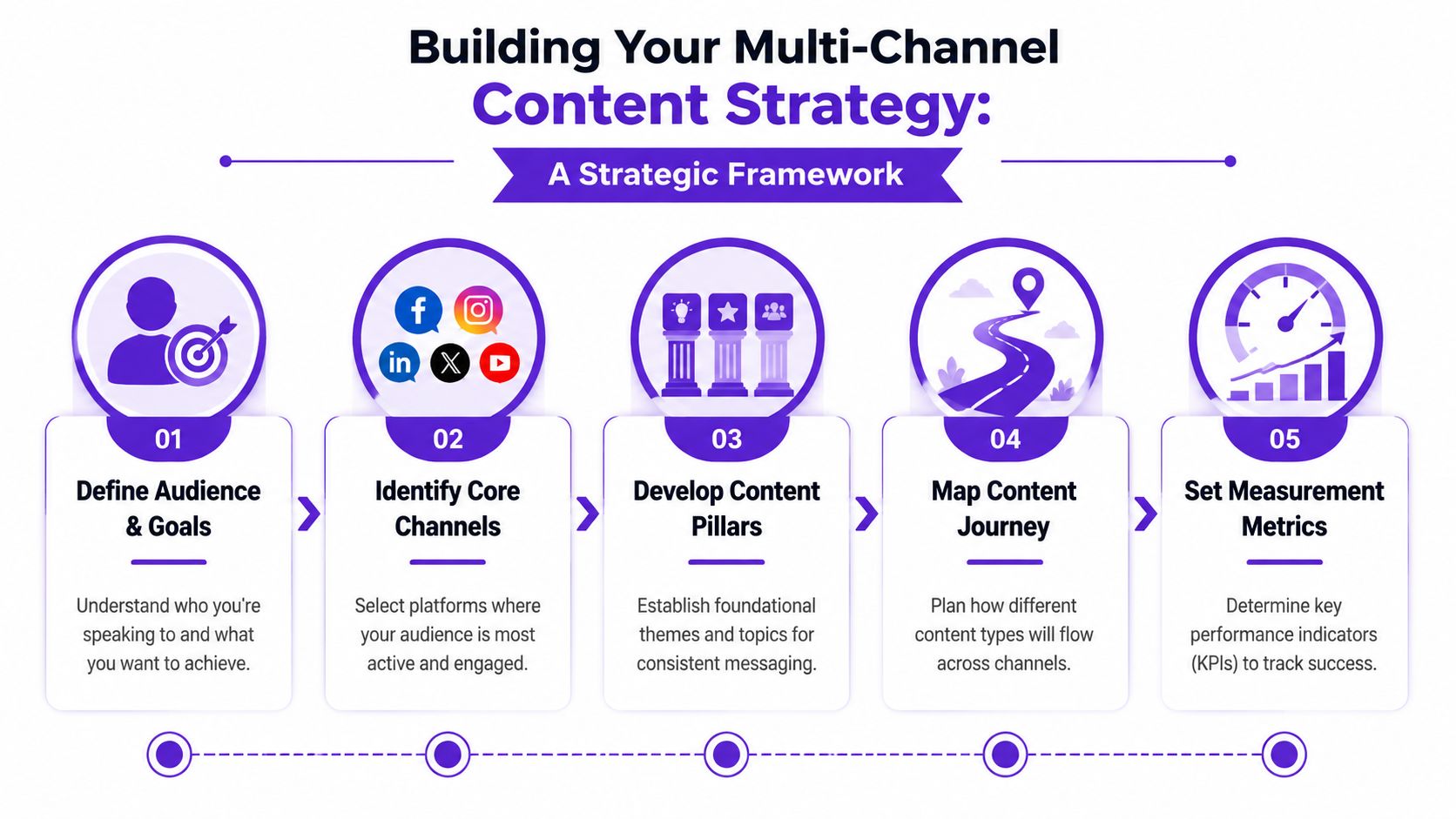
Don't start with every platform you could use. Start with the few you can support well.
A simple filter helps:
Audience fit
Where does your buyer already spend time? Not where marketers say attention is moving. Where does your specific audience reliably engage?
Format fit
If your strength is teaching with nuance, long-form video and email may outperform fast-turn short posts. If your offer is visually obvious, short-form and image-led channels may carry more weight.
Operational fit
Some channels ask for daily responsiveness. Others reward depth over frequency. Choose the mix your team can sustain.
If you need a reference point for turning one asset into multiple publishing paths, this guide on content distribution is useful because it frames channel selection around actual workflow capacity.
Content pillars keep your messaging stable while letting formats vary.
For most creators and small businesses, three to five pillars are enough. More than that usually creates overlap and confusion. Good pillars are broad enough to generate many posts, but specific enough that the audience starts recognizing your point of view.
Examples might include:
The key is repetition with variation. You want the market to remember what you stand for.
Strategy becomes efficient. Every channel needs a job.
A strong setup might look like this:
| Channel | Primary role | Best use |
|---|---|---|
| YouTube | Depth and trust | Long-form education, search intent, authority |
| Attention and brand familiarity | Reels, carousels, story-based reminders | |
| Credibility | Insight posts, case framing, professional positioning | |
| Conversion and retention | Offers, nurture, follow-up, direct response |
When teams skip this step, every platform tries to do everything. That usually means none of them do anything especially well.
A channel with no role becomes a maintenance burden. A channel with a role becomes an asset.
The old model was create separately for every channel. That model burns time fast.
The modern approach is create once, distribute many. One core asset becomes the source material for every downstream format. The workflow is where multi channel management becomes practical instead of exhausting.
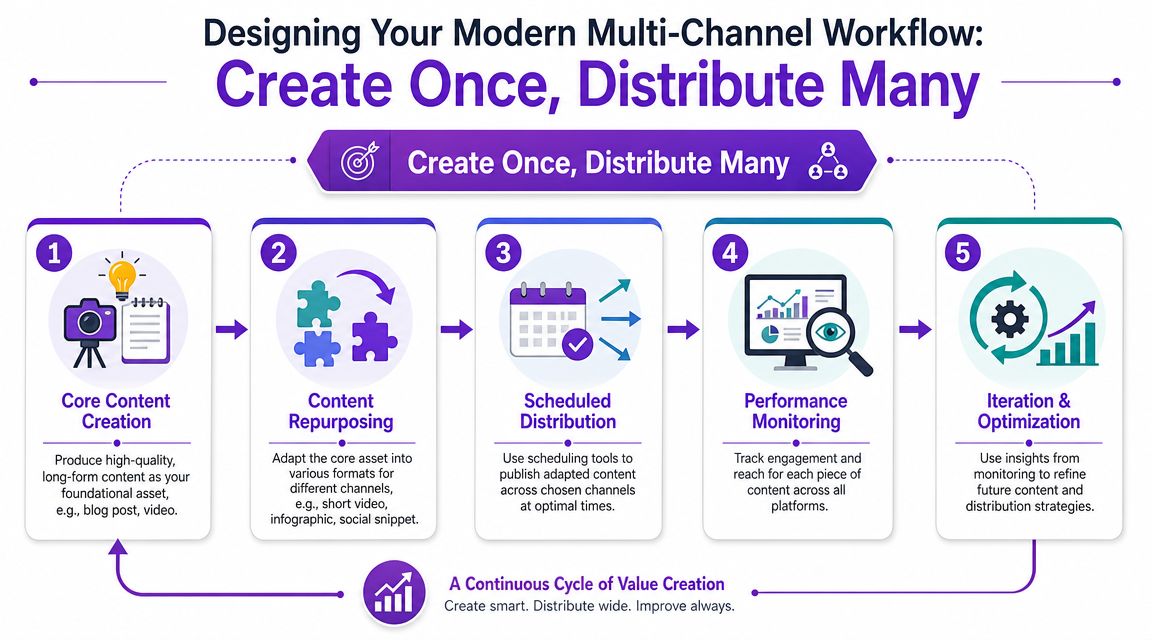
The core asset is usually the thing that carries the most substance. A podcast episode. A teaching video. A webinar. A product walkthrough. A detailed article.
From that asset, pull out:
This is also where live content can become more efficient. If streaming is part of your strategy, guides on how to restream live video feeds can help you think about one broadcast feeding several destinations without running separate productions.
Creators often publish when they finish something. Teams publish when the calendar says to.
That distinction matters because a channel strategy needs rhythm. Batch creation, scheduled release, and planned repurposing protect consistency when the week gets crowded.
A lean workflow usually looks like this:
Here's a useful mental shift. Scheduling isn't just a convenience feature. It's what lets your content operation survive interruptions.
The video below shows the kind of platform shift many teams are making toward systemized, multi-platform execution.
Many teams find themselves struggling. They want exact channel-by-channel credit in an environment that no longer supports perfect visibility.
In today's attribution-fragmented, privacy-constrained environment, strategy decisions often fail at the data layer and require automation plus performance data to optimize across the full customer journey, rather than relying on perfect channel-by-channel attribution (multi-channel engagement analysis).
That means your workflow should look for signals such as:
Stop asking which single post caused the sale. Start asking which channel mix consistently moves qualified people closer to action.
That one shift makes reporting usable again.
Most software demos look good until your team tries to run actual operations through them.
The right tool isn't the one with the longest feature list. It's the one that removes coordination overhead across content, publishing, and data flow. If it creates another silo, it's adding work, not reducing it.
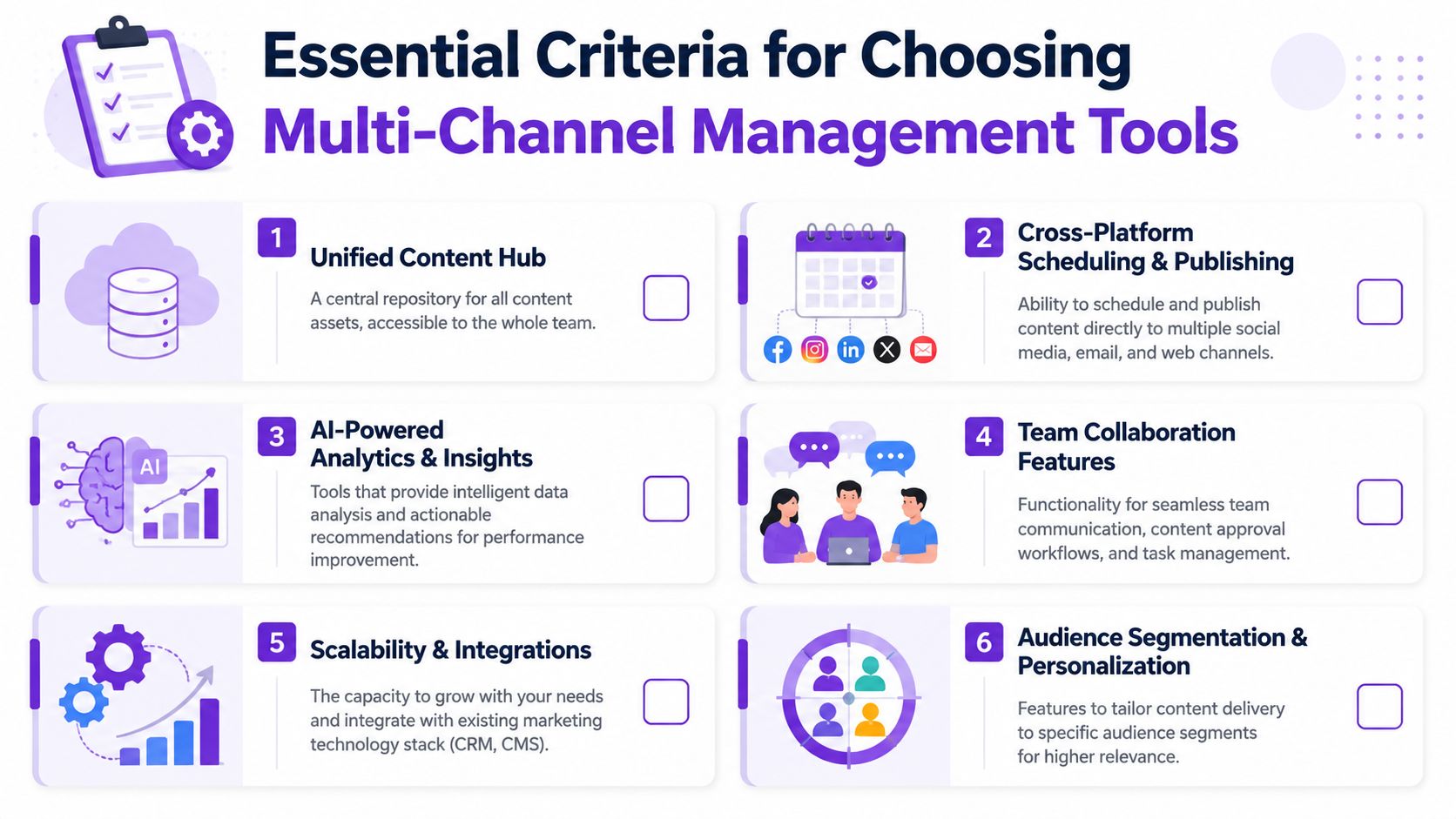
The core technical requirement for any multi-channel system is a unified data layer that synchronizes events across every channel in near real time. Effective systems need direct integrations and automated routing from a central source of truth (channel management software requirements).
That principle applies whether you're managing products, appointments, lead forms, or content assets. If updates don't flow from one source of truth, inconsistency shows up fast.
When evaluating tools, check for these capabilities:
A lot of teams shop by category. Social scheduler. Analytics platform. Content tool. DAM. Editor. That often creates a stack full of handoffs.
A smarter approach is to buy for your biggest current bottleneck. If your issue is repurposing speed, prioritize that. If approvals are slowing you down, collaboration matters more. If publishing is fragmented, central scheduling matters first.
For content-heavy teams, content automation software is worth evaluating because it can compress multiple manual steps into one workflow. One example in this category is Taja AI, which turns long-form video into shorter assets and platform-specific outputs, then supports scheduling from a single dashboard. That type of setup fits teams whose biggest drag comes from production and distribution, not from enterprise-grade reporting.
A tool usually won't say it's a poor fit. You have to spot the signs.
| Red flag | What it usually means |
|---|---|
| Great publishing, weak integrations | Data will fragment later |
| Strong analytics, clunky creation flow | Your team will still bottleneck upstream |
| Too many manual approval steps | Speed will collapse as output grows |
| Channel support without adaptation tools | You'll still be reworking every asset by hand |
The best tool choice is often the one that makes your weekly operation feel boring in a good way.
Strategy only matters if it survives a normal week.
A strong multi-channel strategy has been linked to 91% greater customer retention, and customers who engage across multiple channels have 30% higher lifetime value than single-channel customers (multi-channel customer retention data). That's why operational discipline matters. The value doesn't come from opening accounts everywhere. It comes from running a reliable system.
Use one weekly cadence and adapt it by business type. Don't reinvent your workflow every Monday.
| Task | Solo Creator Focus | Agency Focus | Local Business Focus |
|---|---|---|---|
| Core content production | Record one flagship video or podcast episode tied to one offer or theme | Produce client anchor assets in batches and confirm approvals early | Capture one useful customer-facing video, offer update, or FAQ |
| Repurposing | Cut clips, extract quotes, draft captions, prepare one email | Turn approved assets into channel-specific packages for each client | Convert one local update into short posts, story content, and one longer post |
| Scheduling | Queue all posts for the week in one sitting | Load client calendars, stagger timing, assign review checkpoints | Schedule posts around business hours, promotions, and service demand |
| Community response | Check comments and DMs once or twice daily in focused blocks | Route replies by client, escalation type, and urgency | Respond to inquiries, reviews, and booking questions promptly |
| Performance review | Review which topics, hooks, and formats got real engagement | Compare channel contribution across accounts and flag repeated winners | Track which posts create calls, visits, messages, or quote requests |
| Next-week planning | Double down on one strong angle and cut one weak one | Update content briefs based on account-level patterns | Repeat what drives customer action and pause what only fills the feed |
A good SOP doesn't make marketing feel exciting. It makes it repeatable when you're busy, distracted, or short-staffed.
For solo operators, the win is simplicity. For agencies, it's standardization. For local businesses, it's consistency without losing focus on the actual business.
Done right, multi channel management stops feeling like endless posting and starts functioning like infrastructure.
Taja AI fits this workflow if your main bottleneck is turning one long-form video into multiple ready-to-publish assets without rebuilding everything by hand. It repurposes video into shorts, captions, thumbnails, blogs, and channel-specific posts, then schedules distribution from one dashboard. If you want a system that reduces production drag before you add more channels, you can explore Taja AI.


We are blessed to work with leading brands & Companies


We try to make easy and simple for every professionals. Get 30 days free trial - No credit card required.


© 2025 Taja AI. All rights reserved.