.jpeg)
How to Do Auto Captions on Instagram for Reels That Pop
Learn how to do auto captions on Instagram for Reels, Stories and feed videos — enable, edit, fix errors and make captions readable every time.
5 min read
September 19, 2026

How long should IG Reels be in 2026? Get data-backed length recommendations for awareness, engagement, and conversions, plus platform limits and quick tips.
Written by:


Most creators still treat Reel length like a universal rule. They open Instagram, default to a familiar short template, and assume the platform still rewards the shortest possible cut.
The 2026 data says that habit is too blunt. A large analysis of roughly 140,000 Instagram Reels from business accounts found that 45 to 60 second Reels produced the highest engagement rate at 0.35% and the highest median views at about 10,374, while Reels under 30 seconds reached only about 4,700 median views and clips longer than three minutes dropped to about 4,428 median views, according to Moonb's 2026 Instagram Reel length analysis.
That single finding changes the question. The issue isn't just how long should IG Reels be. It's how long should this Reel be for the job you need it to do.
A creator records a useful product demo, trims it down to 15 seconds because that's what everyone says works, posts it, and gets a familiar result. Decent completion. Weak reach. Few profile visits. Almost no downstream action.
That pattern makes sense if you're optimizing for one metric and one metric only. It breaks once you look at how different Reel lengths serve different business outcomes.
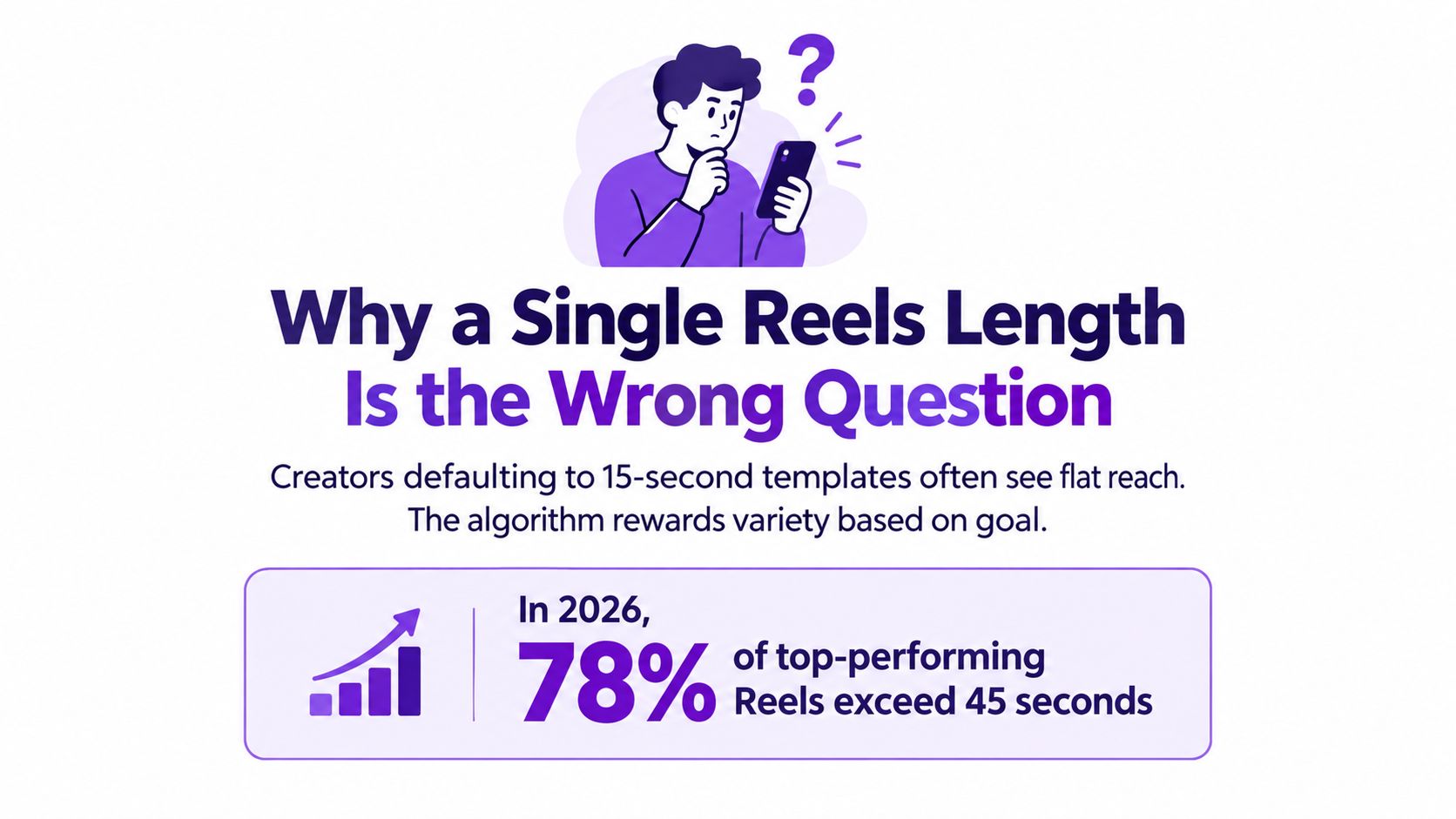
Length isn't good or bad. It only matters relative to the signal you're trying to improve.
If you want reach, Instagram needs enough watch time and enough content substance to justify showing the Reel to more non-followers. If you want completion, shorter clips have a structural advantage because they ask less from the viewer. If you want engagement, the answer can sit in the middle, where the video is long enough to say something but short enough to hold attention.
A useful 2026 framing comes from Socialinsider's review of recent Reel length benchmarks. Their core point is that recent analyses don't agree on one "best" duration because they're measuring different outcomes. One benchmark points to 45 to 60 seconds as the strongest overall engagement zone. Another favors 15 to 30 seconds for completion and reach efficiency.
Practical rule: If two credible benchmarks disagree, don't average them. Separate the goal each one is actually measuring.
The popular under-30-seconds advice survives because it contains part of the truth. Short Reels often finish better. But that doesn't mean they create the best business result.
For many business accounts, the bigger mistake isn't posting too long. It's posting too short to build enough narrative weight for saves, comments, profile visits, or buying intent. A quick trend clip and a concise tutorial don't play the same role.
The better question is simple. Which outcome matters most for this specific Reel: reach, completion, engagement, or conversion?
Creators often confuse performance advice with technical limits. They aren't the same thing. Instagram may let you publish a certain length, but that doesn't mean every length gets the same distribution treatment.
Recent 2026 coverage notes that Reels up to 3 minutes can be eligible for Explore-style distribution, and Instagram was also reported to be extending recording up to 90 seconds, which is why blanket advice like "always stay under 30 seconds" now misses a big part of the picture, according to Socialinsider's video benchmark coverage.
Here's the plain-language version.
| Limit Type | Duration | Distribution Note |
|---|---|---|
| In-app recording ceiling | 90 seconds | If you need more, pre-record externally and upload |
| Main Reels distribution window | Up to 3 minutes | Explore-style distribution is reported within this window |
| Legacy trim minimum in some workflows | 15 seconds | Older workflows may still behave differently |
| Over-3-minute uploads | Over 3 minutes | Better treated as long-form feed content than discovery-first Reels |
If your goal is discovery, keep your Reel at or under the current three-minute distribution window. If you're trying to publish a polished script at the edge of the in-app recorder cap, film outside Instagram so you aren't boxed in by the composer.
Creators doing product walkthroughs or educational content usually care less about raw recording inside the app and more about post-production. A workflow built around external editing gives you more control over pacing, on-screen text, and CTA timing. If that's your focus, guides on editing reels for conversions are more useful than generic posting tips because they deal with what happens after the shoot.
For file specs and formatting choices, this Instagram video format guide is a practical companion to the length question.
Instagram changes caps in stages. The only limit that matters on publishing day is the one visible in your own Reels composer.
A 140,000-Reel sample is useful for one reason. It is large enough to expose patterns that small creator case studies often miss.
The first pattern is about reliability, not a magic number. In the Moonb benchmark introduced earlier, business-account Reels clustered around a middle-duration advantage, but the more important takeaway is that duration behaved differently across posting contexts. That matters because broad averages can hide whether a length works because of the format itself or because certain creators, niches, and publishing habits tend to use it.
Small studies are good at spotting retention behavior. They are weak at judging distribution. A benchmark with roughly 140,000 Reels from business accounts is more useful for reach questions because it smooths out one-off trend spikes, single-audience anomalies, and creator-specific editing styles.
It also shifts the benchmark you should trust.
If a creator says, "My 12-second Reels always pop off," that may be true for meme cuts, reaction clips, or trend audio. It is a poor default for product explainers, educational content, and offer-driven Reels, where viewers need more context before they engage or click.
The value of a longer Reel is often structural. Business accounts that need reach rarely win with raw brevity alone. They win by fitting a complete narrative unit into one scroll-stopping asset: hook, proof, payoff, then CTA. That sequence is hard to execute in very short runtimes unless the audience already knows the creator or the format is simple.
That is why blanket advice like "keep it under 30 seconds" breaks down. Shorter clips can be efficient, but efficiency is not the same thing as distribution strength.
A large benchmark helps separate those two ideas.
Use big-sample reach data to choose your starting range. Use smaller completion studies to fine-tune creative style inside that range.
That distinction keeps you from overcorrecting toward ultra-short Reels just because they finish at higher rates. A Reel can retain well and still fail to spread if it does not create enough viewer response, watch time depth, or informational payoff to justify wider distribution.
| Benchmark Type | Better For | Main Weakness |
|---|---|---|
| Large business-account sample | Estimating likely reach by duration band | Averages can hide niche-specific winners |
| Small account-level study | Comparing completion and engagement per view | Too narrow for broad reach decisions |
| Personal creator anecdotes | Generating format ideas | Highly biased by audience, niche, and editing skill |
The practical judgment is straightforward. For reach, trust the large-sample benchmark more than creator folklore. For completion, trust targeted retention studies more than broad median-view tables. The right duration depends on the result you want, not on a single universal ideal.
Two pieces of 2026 evidence can both be true at once.
A large benchmark says 45 to 60 seconds is the strongest zone for overall reach and engagement. A separate benchmark says 15 to 30 seconds can be the strongest zone for engagement per view and completion behavior, especially for quick-hit formats.
In a 2026 dataset of 346 Reels from 108 Instagram accounts, the 15 to 30 second range produced the highest engagement per view at 9.1%, compared with 7.3% for 0 to 15 seconds, 5.3% for 30 to 60 seconds, and 8.1% for 60 seconds plus, according to Highviz's Reel length breakdown.
The same benchmark family also reported that 15 to 30 second videos can reach 70% to 80% completion rates, while 15 seconds or less reached around 72% completion versus 46% for longer video, which reinforces why shorter formats still dominate in retention-heavy content.
Reach and completion aren't interchangeable.
| Length Bucket | Median Views Index | Avg Completion Rate | Best For |
|---|---|---|---|
| 15 to 30 seconds | Lower than the top reach band | Highest in the benchmarked short ranges | Fast retention, punchy storytelling, simple offers |
| 45 to 60 seconds | Highest in the large reach benchmark | Lower than short-form completion leaders | Discovery, broad distribution, fuller explanations |
A Reel can win on completion and still lose on reach. That's not a contradiction. It's two different platform signals producing two different outcomes.
The practical mistake is treating one as a substitute for the other.
The only useful answer to how long should IG Reels be is a goal-based one. Start with the outcome. Then choose the duration.
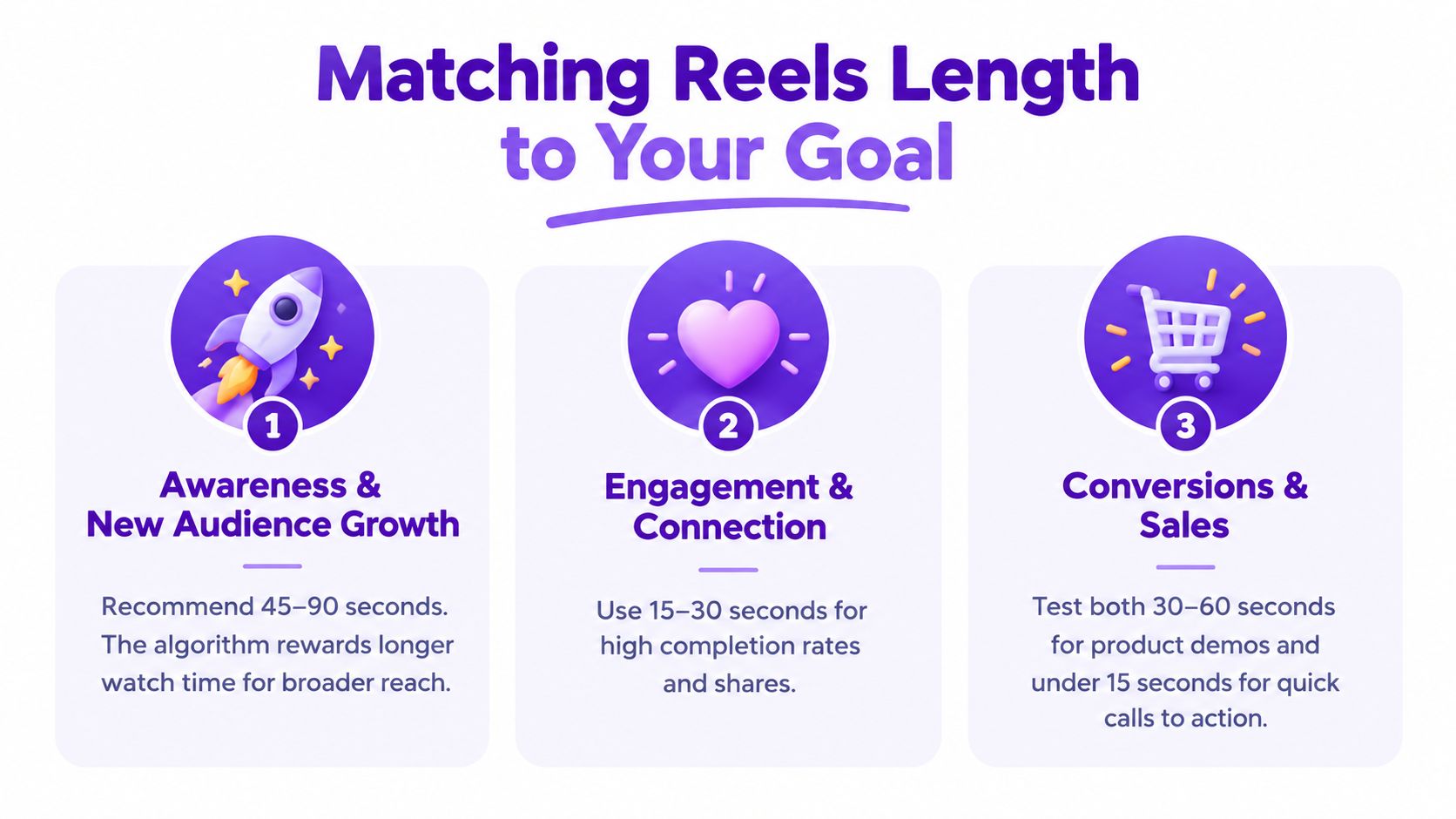
Use 45 to 90 seconds when you need a Reel to travel.
That range gives you enough room for a credible hook, context, and payoff. It also avoids the thinness problem that hurts many ultra-short business Reels. For coaches, local services, podcasters, and educators, this is often the strongest range for saying one useful thing clearly enough that non-followers keep watching.
Use 15 to 30 seconds when the content is naturally compact.
This works best for:
In those cases, shortness isn't just tolerated. It's the product.
A helpful growth companion here is this guide on how to grow Instagram followers, especially if you're pairing Reels with profile optimization and posting cadence.
The visual summary below is worth using as a production shortcut.
For conversions, the right length is usually 30 to 60 seconds.
That isn't because longer always converts better. It's because business Reels that drive action often need three ingredients: a problem statement, a quick mechanism or demonstration, and a clear CTA. Most creators can't fit all three cleanly into a very short format without sounding rushed.
Use the final third of the Reel for the CTA. Keep it verbal and visual. Tell the viewer exactly what to do next, whether that's a profile visit, a DM keyword, or a link tap.
Decision shortcut: If the Reel needs context to create trust, don't force it into a trend length.
The "always go under 30 seconds" rule was built for a simpler version of Reels strategy. It assumed loops and quick completions were the safest path to distribution.
That logic still helps for some content. It fails when creators apply it to every business objective.
In a 2026 report covering 346 Reels, clips under 15 seconds retained 66.0% of their own length on average, while Reels over 60 seconds retained only 16.4%, according to Highviz's Instagram Reels report.
That gap is significant. Longer videos do pay a retention cost. If your content depends on pure discovery, trend participation, or broad cold-audience exposure, shorter cuts still have an advantage.
The problem is that creators turned a tactical retention insight into a universal content law.
Shorter isn't automatically better if the Reel needs more than a slogan to work. Product education, local-service trust building, mini case explanations, and interview snippets often improve when the idea gets room to breathe. That's where the underused middle range matters most.
The overlooked opportunity in 2026 is the 40 to 75 second band. It feels too long for trend mimicry and too short for full teaching, so many creators skip it. That's exactly why it's useful. It often carries enough depth to earn saves and enough brevity to stay shareable.
For niche experts, this is usually the highest-compromise.
The smartest move in 2026 isn't choosing one duration and hoping it fits every platform goal. It's cutting one strong source video into multiple Reels, each designed for a different outcome.
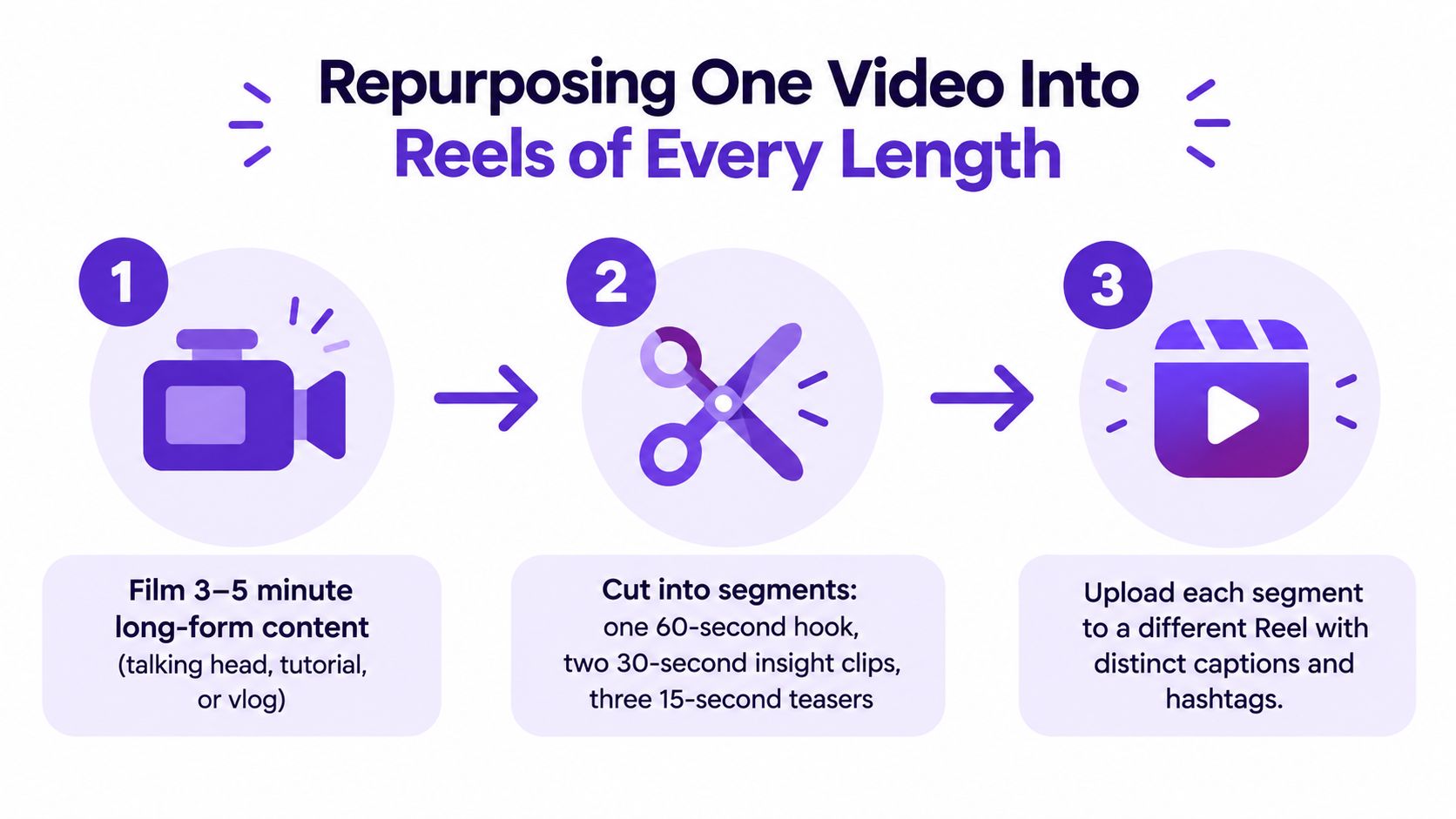
Record one master clip with enough substance to support several cuts. Interviews, tutorials, podcasts, listing walkthroughs, and founder updates work especially well.
Then pull out three assets from the same source:
This is more efficient than scripting three unrelated Reels because the heavy work happens once. The angle changes. The footage doesn't have to.
A useful workflow looks like this:
If you're creating visual-first assets, resources on Instagram Reels video generation can help with concepting and assembly before you trim for platform-specific goals.
For teams working from podcasts, webinars, or talking-head recordings, this guide to repurposing content lays out the broader system behind the clip-first workflow.
One option in this category is Taja AI, which turns long-form video into platform-ready shorts, captions, thumbnails, and scheduled posts from one upload. In a workflow like this, the value isn't just cutting clips. It's generating several Reel-ready versions from the same source material so you can test length against purpose without re-recording.
One recording session should create multiple duration bets. Instagram evaluates each Reel on its own, so one idea deserves more than one cut.
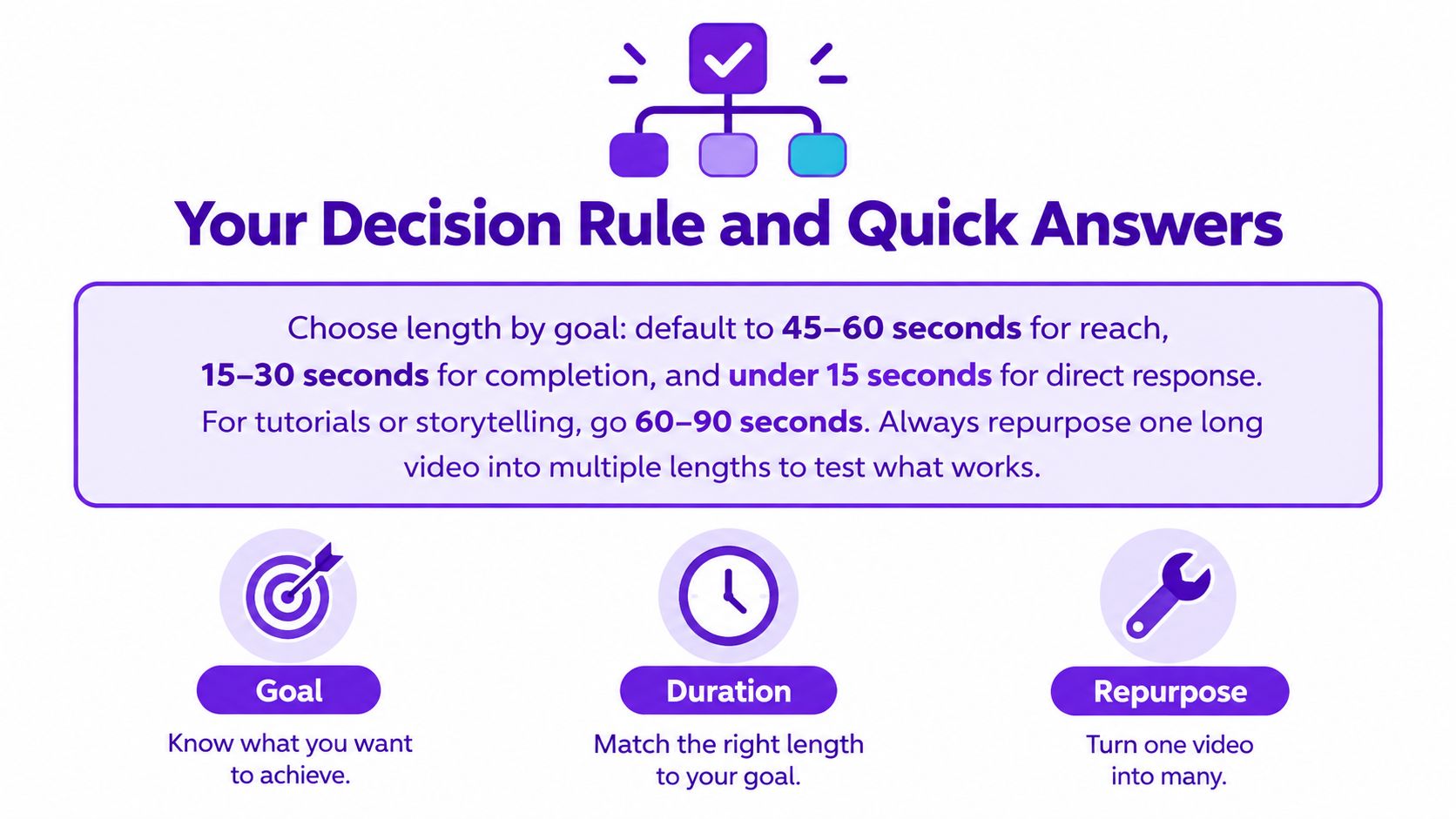
The cleanest decision rule is this. Choose length by objective, not by habit. Default to 45 to 60 seconds for reach, use 15 to 30 seconds for completion-heavy content, and use 30 to 60 seconds when the Reel needs enough context to drive action. If the content is instructional or story-based, stretch toward 60 to 90 seconds only when every segment earns its place.
Does the three-minute cap matter for small accounts?
Yes, if growth is the goal. Once a Reel starts functioning more like follower-only content than non-follower discovery content, small accounts lose their main distribution advantage.
Do loops still matter?
Yes, but mostly for content that naturally benefits from replay. A loop is helpful when it supports retention. It's not a substitute for clarity or payoff.
Should Stories-style Reels and Explore-style Reels use different durations?
Usually, yes. Content aimed at existing followers can tolerate more context. Discovery content needs a faster start and a cleaner single idea.
Keep this next to your filming notes:
Most Reel length advice fails because it treats all content as the same type of asset. It isn't. A trend clip, a service explainer, and a product demo shouldn't share one default duration.
The right answer to how long should IG Reels be in 2026 is narrower and more useful. Match the length to the job. Then test against your own baseline.
Taja AI helps you do exactly that by turning one long video into multiple short-form assets, including Reel-ready clips at different lengths, plus captions and publishing support. If you're tired of guessing whether a single cut should be 15, 45, or 90 seconds, it gives you a practical way to test all three from the same source material without rebuilding the workflow each time.


We are blessed to work with leading brands & Companies


We try to make easy and simple for every professionals. Get 30 days free trial - No credit card required.


© 2025 Taja AI. All rights reserved.