.jpeg)
10 Instagram Reel Captions That Drive Action
Explore 10 Instagram Reel captions with hooks, CTAs, niche formulas, hashtag examples, and Taja AI ideas for faster content creation.
5 min read
September 24, 2026

Discover what is a good CTR across search, display, YouTube, email, and social with benchmarks and proven tactics to boost clicks.
Written by:


Most advice about what is a good CTR starts with the wrong question. There isn't a single percentage that tells you whether a campaign is healthy, because click-through rate changes with channel, intent, audience stage, and even how much of the result page gets consumed before a click happens. A number that looks weak in search can be strong in display, and a number that looks great in search can still be meaningless if the post-click traffic doesn't convert.
That's why the smartest teams stop asking for a universal benchmark and start asking what context the benchmark comes from. CTR is a ratio, not a verdict, and the ratio only becomes useful when you compare like with like.
Industry roundups from 2025 to 2026 show exactly why a single good CTR number falls apart the moment you strip out context. Search ad CTR can sit around 6.64% in one benchmark set and 3.17% in another, while display benchmarks can land at 0.57% or 0.46%. Those are not competing truths. They are different campaign mixes, different intent levels, and different surfaces competing for the same click.
A person typing a query into search is already signaling intent. A person seeing a display placement while browsing something else is not. That gap changes everything, which is why a CTR that looks weak in one channel can be strong in another, and a CTR that looks strong can still be a poor business result if the traffic never converts.
Practical rule: if the user came looking for something, the benchmark should be higher. If the placement interrupted someone's browsing, the benchmark should be lower.
A useful answer to what is a good CTR starts with channel behavior, not a single averaged score. Search ads commonly sit in the 3% to 6% range, display ads are usually around 0.3% to 0.6%, and B2B email is commonly 2% to 5%, according to Statsig's CTR benchmark overview. The spread is the point. It reflects how much friction exists between attention and action.
Branded search and non-branded search deserve separate benchmarks too. The CXL CTR benchmark guide notes that branded search campaigns can exceed 20% CTR, while non-branded Google Search campaigns often target 5% or more. Those campaigns are doing different jobs. One is capturing demand that already exists, the other is competing for interest where certainty is lower.
A good benchmark is the one that reflects your actual traffic source, not the average of everything you've ever run.
The wrong move is comparing your Search Console CTR to a social ad benchmark, or your display CTR to a branded keyword campaign. That is the wrong frame. A stronger comparison is between placements with similar intent, similar attention conditions, and similar audience expectations. variant_6 helps teams keep that comparison grounded when they are sorting through paid media packages and trying to separate channel performance from bundle claims.
AI-driven feeds make this even messier. A YouTube placement that is filtered through recommendation systems has a different click pattern than a search result, and creators using tools like Taja AI's YouTube ranking factors guide are working in an environment where discovery is shaped by more than the thumbnail alone. CTR still matters, but it is only one signal inside a larger attention system.
The practical question is not whether your CTR is good in the abstract. It is whether it is good for that channel, that intent level, and that stage of the journey.
The most useful answer to what is a good CTR is a channel map, not a single scorecard. Different placements create different attention patterns, so the right comparison is always within the same surface and audience stage. Search is intent-heavy. Display is interruption-heavy. Email depends on list quality and topic fit.
The ranges below give teams a working starting point. They will not replace your own historical data, but they will stop you from judging a channel by the wrong standard.
| CTR Benchmarks by Channel in 2026 | Average CTR | Good CTR Range |
|---|---|---|
| Google Search ads | 6.64% or 3.17% across broad benchmark sets | 3% to 6%, with branded search often much higher |
| Google Display ads | 0.57% or 0.46% across broad benchmark sets | 0.3% to 0.6% |
| B2B email | Not provided in the verified data | 2% to 5% |
| Meta ads | Not provided in the verified data | 1% to 2% |
| LinkedIn ads | Not provided in the verified data | 0.5% to 1% |
| YouTube | Not provided in the verified data | 0.5% to 1%, depending on surface |
Search benchmarks are useful because they reflect active intent. Display benchmarks are lower because the ad is competing with whatever the user was already doing. The gap is structural, not a sign that one creative team is better than another.
YouTube needs even more context. A creator-focused benchmark guide breaks CTR down by search, browse, and suggested traffic, and a practical internal reference on YouTube ranking factors helps explain why packaging and discovery signals have to work together. Browse CTR and search CTR should be judged separately, since they answer different user needs.
If you manage ads and need outside help, a structured package like variant_6 can be useful as a reference point for how agencies think about campaign setup and optimization. The value is not the package name itself, it is the reminder that campaign architecture changes the CTR target before creative even enters the conversation.
The cleanest rule is simple. Compare within the same channel, same intent, and same funnel stage. If you compare across surfaces, the benchmark stops being a benchmark and becomes noise.
CTR in 2026 doesn't behave like it did when search results were simpler. AI-driven answers, richer result pages, and feed-based discovery have made the click harder to win, even when the creative is strong. A declining CTR doesn't automatically mean your message got worse. Sometimes the page just got more crowded.
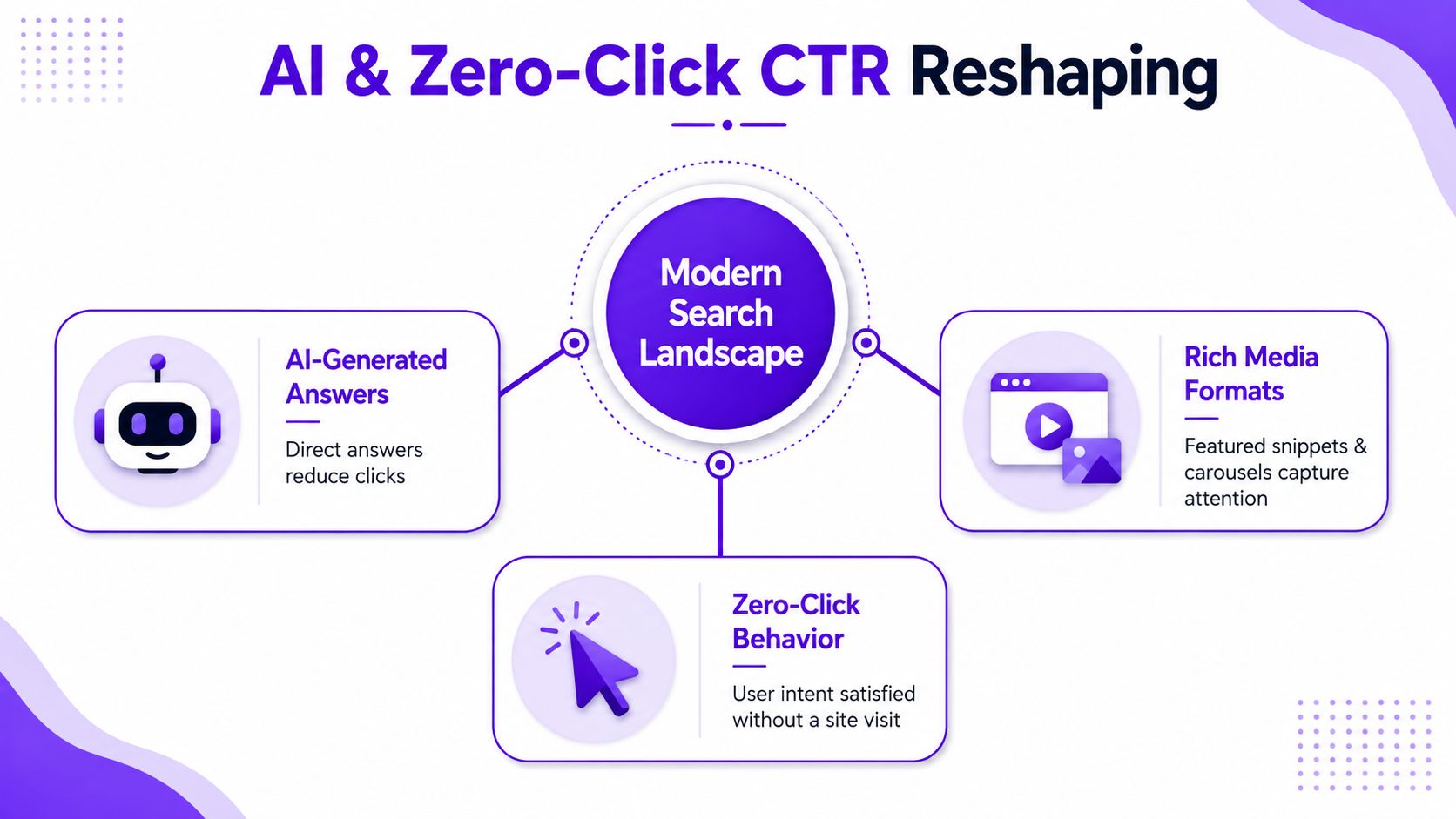
Google's own definition still frames CTR as clicks divided by impressions, which is accurate but incomplete when the results page itself can answer the question before a visitor leaves the page, as described in Google Ads help. That's why a strong-looking CTR can coexist with weak business outcomes. The number only tells you that someone clicked. It doesn't tell you why, or whether that click was worth having.
More searches are being resolved on the results page itself. Featured snippets, knowledge panels, people-also-ask blocks, local packs, and AI-generated answers absorb attention that used to flow to organic results and ads. The verified benchmark notes that CTR was already falling before AI, and that AI Overviews accelerated a trend that was already in motion.
That matters because a lower CTR isn't always a creative failure. It can be a SERP design problem. If the searcher gets the answer instantly, the click never had much of a chance.
Feed-based platforms create a similar issue. Social feeds increasingly reward watch time, saves, comments, and native engagement over outbound clicks. Creators who judge every post by CTR alone often miss the signal, which is whether the content keeps people inside the platform long enough to build distribution. The same principle shows up in Taja AI's social media guidance, where content performance is tied to platform-native behavior rather than a single outbound metric.
A falling CTR deserves investigation, not panic. Check whether impressions are holding steady while clicks decline. If they are, the surface itself may be intercepting traffic. If the traffic mix changed, the benchmark changed with it.
A weaker CTR can mean your audience got less likely to click, or it can mean the platform got better at answering them before they leave.
That distinction matters for SMBs and creators. In both cases, a good CTR now depends on whether the click is still the main goal. Sometimes it isn't. Sometimes the true win is visibility, recall, or being cited as the source the answer is built from.
CTR is useful only up to the point where clicks stop predicting value. Once that happens, optimizing for more clicks can make performance worse. Google's definition makes the limit obvious, because clicks divided by impressions says nothing about what happens after the click.
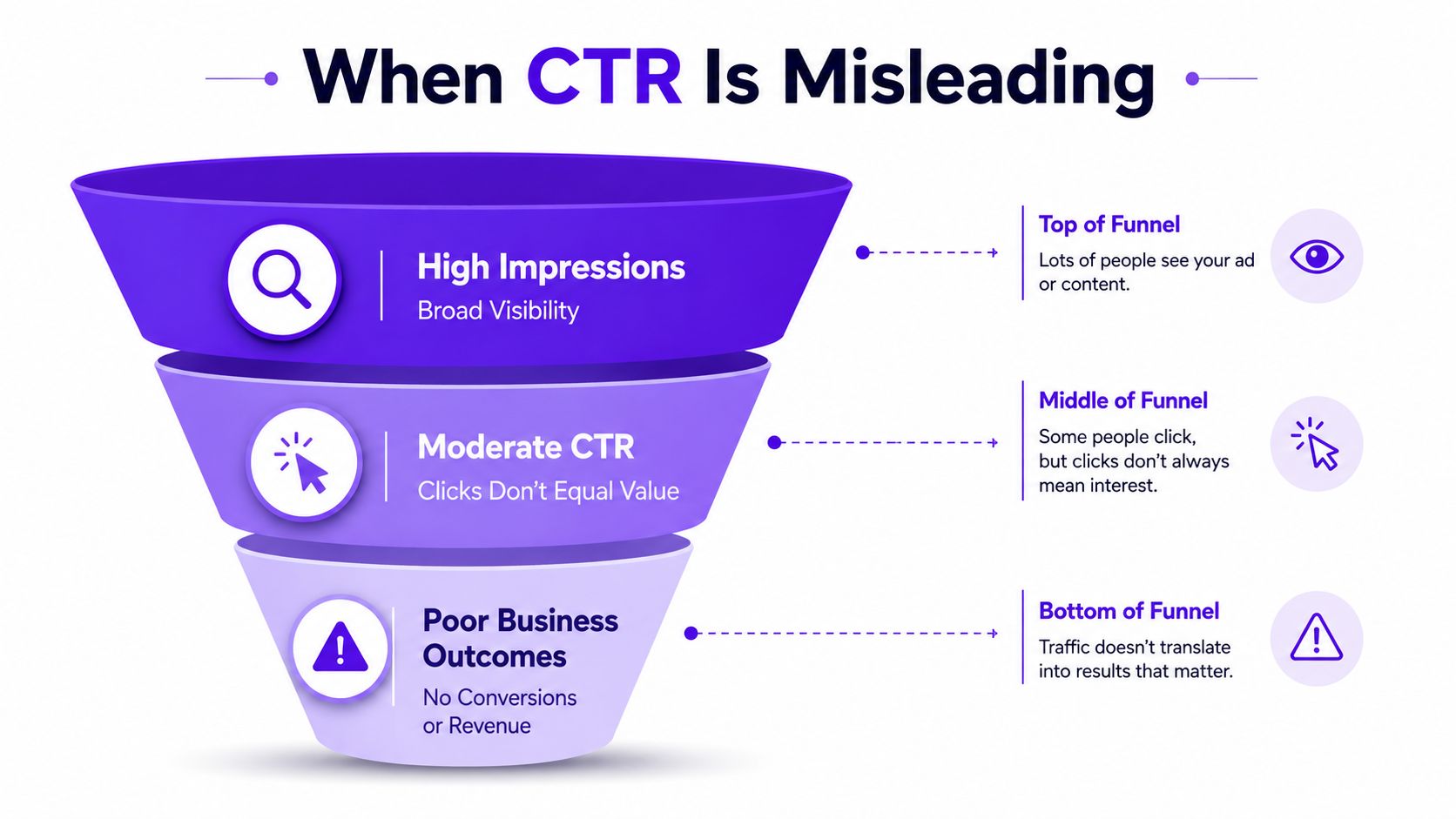
High CTR can hide bad traffic. A broad-match keyword can attract curious but irrelevant searchers. A clickbait headline can pull traffic that bounces fast. A social ad can generate a lot of clicks and still fail to produce a single qualified lead. In every case, the report looks active while the business result stays flat.
For most SMBs, CTR should sit beside downstream metrics that reveal whether the click was worth earning.
That pairing is especially important for local services and B2B. A campaign can look “good” on CTR and still waste budget on people who were never close to buying. A lower CTR with stronger conversion quality is often the better business outcome, even if the report looks less exciting.
High CTR can signal a problem when the wording is too broad, the promise is too vague, or the creative overstates what the offer delivers. It can also happen when ads attract research traffic instead of buyer traffic. In those cases, the metric is working as designed, but for the wrong audience.
That's why good operators don't chase CTR in isolation. They ask whether the click moved someone toward a sale, a booked call, a qualified lead, or a meaningful content action. If the answer is no, the CTR is probably flattering the campaign more than it should.
Improving CTR usually means making the first impression clearer, sharper, and more relevant. The mechanics differ by channel, but the logic stays the same. People click when the promise feels useful, specific, and easy to trust.
For search, the strongest lever is still the title. For YouTube, it's the thumbnail-title pair. For email, it's the subject line and preview text. For social ads, it's the first visual and the first line of copy.
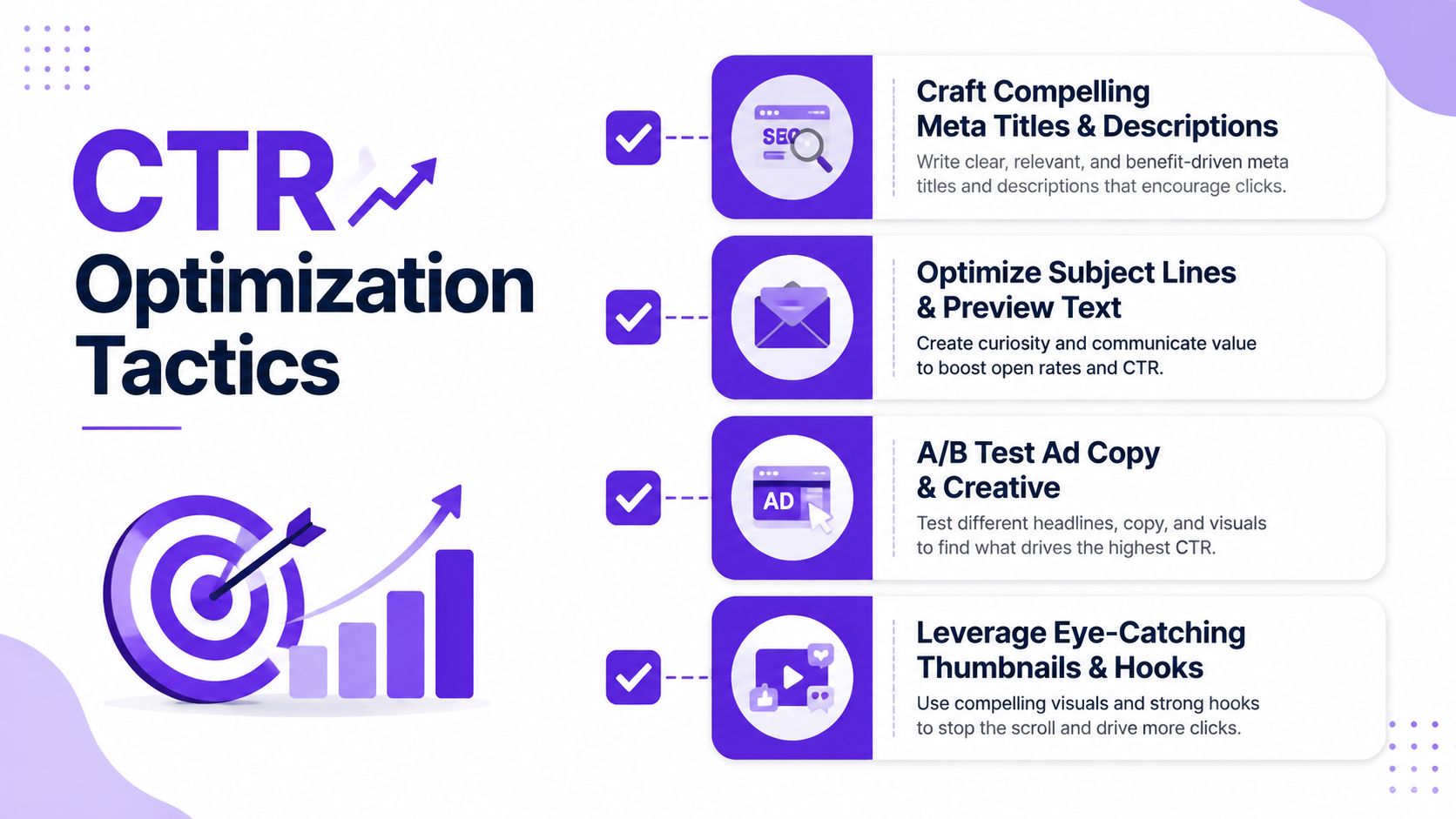
Search snippets win when they match intent quickly. A title like “Best Lawn Care Services in Austin” is clearer than “Local Outdoor Help for Your Property” because the searcher can identify relevance in a glance. Meta descriptions don't always control the snippet, but a well-written one still helps when Google uses it.
Add structured data where it fits, and make the promise specific enough to beat nearby results. If the page is about a comparison, say that. If it solves a narrow problem, say that instead of burying the point under generic language.
YouTube clicks rise when the thumbnail communicates the video's payoff before the title even finishes being read. Clean contrast, readable text, and a single obvious subject usually outperform cluttered designs. Facial expressions and visual tension can help, but only when they support the topic instead of looking forced.
The tactical pattern is simple. Show the outcome, not the process. The internal guide on how to improve click-through rate is useful for turning that into a repeatable workflow without drifting into clickbait.
Email clicks improve when the subject line creates curiosity without feeling cryptic. The preview text should extend the subject, not repeat it. Personalization helps only when it feels relevant, not pasted on.
If your list is broad, segment first. A clean segment often does more for CTR than another round of clever copy. For a practical view of engagement-oriented creative, these practical steps for higher engagement are a helpful reminder that the same principle applies across channels, even when the surface changes.
Social creative needs a pattern interrupt. That can be a visual contrast, an unusual opening line, or a direct problem statement that stops the scroll. The first second matters more than the polished explanation that comes later.
Useful habit: test one variable at a time. If you change the headline, image, and CTA in the same round, you won't know what actually moved the click.
A creator or SMB doesn't need a massive budget to improve CTR. They need tighter packaging, cleaner positioning, and a willingness to cut anything that makes the message harder to understand.
CTR gets better when testing becomes routine instead of occasional. A one-off redesign can help, but the genuine gains come from repeated experiments that show which wording, visuals, and offers keep winning over time. Without a workflow, teams end up guessing from one campaign to the next.

The simplest testing stack is also the most practical. Use an ad platform's built-in split testing for copy, use thumbnail testing tools or native upload variants for YouTube, and use email preview tools that show how subject lines render across inboxes. Then review the results in one dashboard so you can see trends instead of isolated wins.
That last step is where many groups fail. They get the result, then lose the reasoning. A simple log of what was tested and why it worked saves time later, because patterns start to emerge across campaigns.
For creators, AI-powered repurposing tools can make testing less labor-intensive by generating multiple titles, thumbnail concepts, and short-form derivatives from a single long-form video. Taja AI is one option in that category, because it can turn a long-form upload into multiple content assets that are easier to test across surfaces. That matters when you're trying to learn which packaging earns the click without rebuilding the content from scratch every time.
The goal isn't to automate judgment. The goal is to produce enough variants that your testing is based on evidence, not hunches. If you only ever publish one version, you're not optimizing CTR. You're hoping for it.
A durable CTR strategy starts with a simple shift in mindset. Stop treating CTR as a universal score and start treating it as a channel-specific signal. Then compare it to business outcomes, not just to past clicks. A campaign that draws less attention but better leads is usually the better campaign.
A useful quarterly review looks at three things. First, which channel or surface is underperforming relative to its own benchmark. Second, which assets are getting impressions but not earning clicks. Third, which tests should be repeated because they produced a clear pattern, not just a lucky lift.
For creators, the best system is the one that turns each piece of content into multiple testable assets. A long video can become several thumbnails, several title angles, and several short clips. That gives you more surface area to learn from, which matters more in a crowded feed than polishing one perfect version and hoping it lands.
The businesses that win this game won't be the ones chasing a mythical universal percentage. They'll be the ones who understand their channel, respect the intent behind the impression, and keep improving the packaging without losing sight of the outcome.
If you want a faster way to generate and test video titles, thumbnails, clips, and platform-specific posts from one upload, visit Taja AI. It's built for creators and SMBs that need more asset volume without adding more manual editing. Use it to support a CTR workflow that's grounded in testing, not guesswork.


We are blessed to work with leading brands & Companies


We try to make easy and simple for every professionals. Get 30 days free trial - No credit card required.


© 2025 Taja AI. All rights reserved.