.jpeg)
How to Post a YouTube Video on Facebook: 2026 Guide
Learn how to post a YouTube video on Facebook in a few simple steps. Follow these methods to share videos easily and boost your social media engagement in 2026.
5 min read
September 26, 2026

Build tone of voice guidelines that actually get used. Learn the discovery, documentation, and implementation steps top creators use.
Written by:


You've got the same problem every growing team hits eventually. The brand sounds polished in the homepage copy, casual in a YouTube caption, overly formal in support emails, and weirdly stiff in a LinkedIn post that was clearly written by a different person on a different deadline. That's usually not a writing talent issue, it's a tone of voice guidelines issue, and the gap shows up fast once content has to move across channels, risk levels, and audiences.
The teams that get this right stop treating tone as a single personality trait and start treating it like an operating system. They define what stays constant, what changes by context, and what writers should do when the message is sensitive, regulated, or just too important to sound “brand cute.”
A lot of tone documents fail for the same reason: they read like a brand manifesto, not a tool a writer can use at 4:45 p.m. on a deadline. The PDF says the brand is bold, authentic, and human, but the team still ships copy that sounds different on every surface because those words don't tell anyone what to write next.
That's where interpretation drift starts. One writer thinks “authentic” means conversational. Another thinks it means vulnerable. A third thinks it means playful, even in an error message. The result is a brand voice that changes shape depending on who had the last edit.
The other failure is easier to spot. Most guides don't include enough anti-examples, so writers only see what the brand wants, not what it rejects. If you never show the off-brand version, people fill in the blanks themselves, and they fill them in differently.
Practical rule: if a tone guide can't survive a new writer, a support agent, and an AI draft on the same day, it isn't operational yet.
Channel context is where the damage gets worse. A social post and a billing notice do not carry the same trust expectation, yet many brands force both into one “friendly, confident” mold. That creates awkward copy on the front end and risky copy on the back end, especially when the message needs to be clear, regulated, or emotionally careful. For teams dealing with content approvals, this is also where a tighter workflow helps, which is why a structured review process matters as much as the guide itself, as outlined in Taja's content approval workflow.
What separates a useful guide from a decorative one is specificity. The useful version names where tone shifts, where it stays fixed, and what writers should never do when the context changes. The decorative version just hopes the words “warm” and “professional” will do the rest.
Before you define tone, you need an honest look at the tone you already have. Many teams skip this and jump straight to adjectives, which is how they end up writing guidelines for an ideal brand that doesn't match the content they publish.
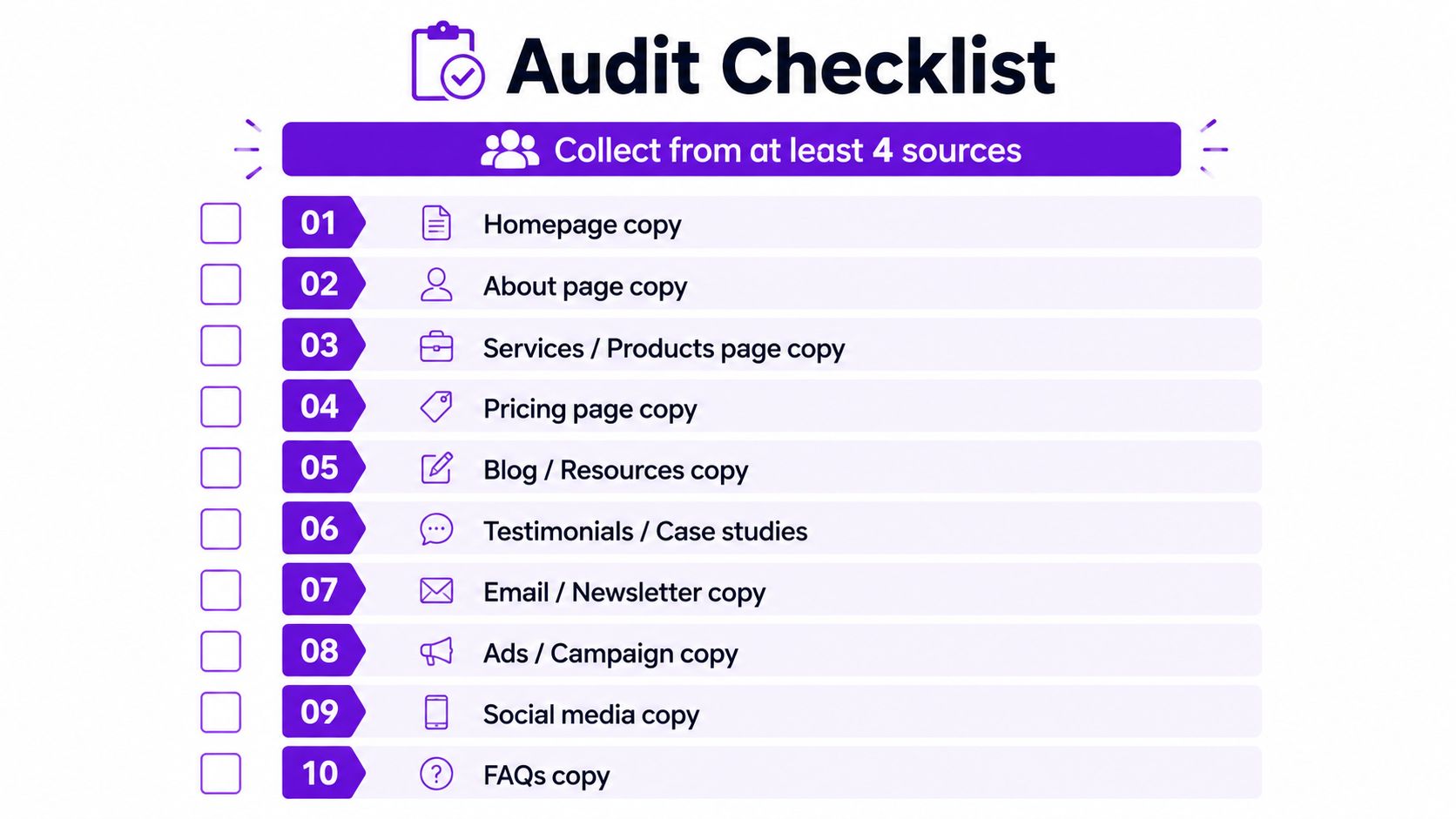
Start by collecting 10 to 15 real copy samples from at least four channels. Pull from places where the brand already speaks under pressure and in public, such as the homepage, an About page, customer emails, social captions, help articles, product updates, or ad copy. If your archive is huge, prioritize content that gets reused, edited by multiple people, or seen by high-intent readers.
Use a simple scoring grid with three columns, brand fit, clarity, and channel appropriateness, and score each sample on a 1 to 3 scale. The point isn't precision for its own sake, it's pattern recognition. A piece that scores high on clarity but low on channel fit tells you the message is sound but the delivery is wrong for that surface.
Here's the kind of template that works in practice:
Sample name: Homepage hero
Channel: Website
Brand fit: 3
Clarity: 2
Channel appropriateness: 3
Notes: Direct, but too abstract in the first line
Sample name: Support reply
Channel: Email
Brand fit: 2
Clarity: 3
Channel appropriateness: 1
Notes: Helpful, but too casual for a billing issue
That exercise gives you raw material for a workshop instead of a room full of opinions. It also helps you spot accidental patterns, like a writer who naturally uses shorter sentences, or a channel that has drifted into marketing-speak while others stayed plain.
If you need a handy reference for style variation in another industry, Saleswise listing description tools is a useful example of how description language can be shaped for different listing contexts without flattening every message into the same voice.
A simple rule keeps the audit honest. If a sample was written for a dead campaign, outdated offer, or deprecated product line, don't let it define the voice. The audit should reflect the content your team still wants the brand to sound like.
For teams that want the audit to turn into a publishable system, a QA pass helps translate findings into usable standards, which is why a documented review step belongs in the process as much as the writing itself, as discussed in Taja's quality assurance process.
The strongest voice guides stay small. NN/g recommends keeping the number of target words to a handful, and that advice matches what works on teams, because writers remember a few clear traits and ignore a long adjective pile. The goal isn't to describe your brand in every possible mood, it's to give people a usable decision filter.
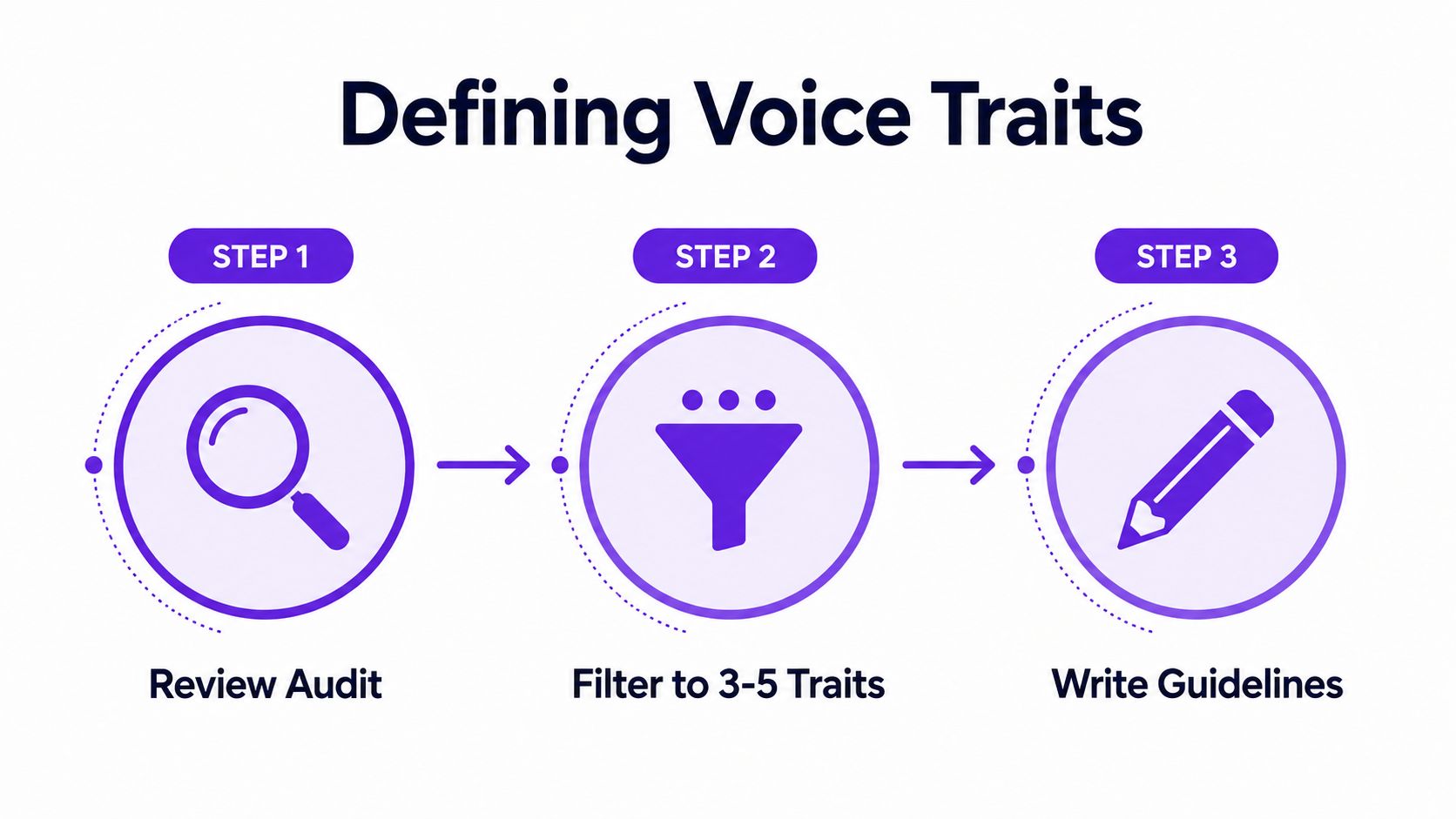
A good way to do this is to turn your audit into 3 to 5 core traits and then give each one a definition, a do example, a don't example, and a short prompt fragment. That format is easier to use than a glossy brand statement because it tells writers what the trait looks like in an actual sentence.
NN/g's framework is useful here because it breaks tone into four dimensions, humor, formality, respectfulness, and enthusiasm, and it recommends testing with 3-point or 5-point Likert scales so teams can check whether copy matches the intended profile. That's the difference between a voice guide that sounds good in a deck and one that changes output in the editor.
Write the trait so a new teammate can act on it without asking for a meeting.
The other piece that matters is the anti-tone word. If a trait is “clear,” the anti-tone might be “clever.” If a trait is “calm,” the anti-tone might be “hype.” That negative boundary matters because it stops the guide from drifting back toward the nearest cliché when deadlines get tight.
Stakeholder workshops go better when people argue about sentence behavior instead of brand feelings. “We sound confident” is a vague disagreement. “We lead with the answer and avoid rhetorical questions” is a rule you can test.
This is also where teams often overcompromise. They try to keep every stakeholder happy by adding more traits, more adjectives, and more exceptions. That usually weakens the guide. A sharper result comes from choosing the few behaviors that show up consistently in the audit and dropping the rest.
A practical reference point is the kind of trait-card approach used in brand systems for creator businesses, where a voice file becomes a working asset rather than a presentation. If you need a broader branding lens for content-led businesses, brand your business with Flexwork Podcast Studios is a useful example of how a brand system can support consistent output without turning every channel into the same script.
Once you've got the trait set, freeze it long enough to test. If writers can't apply it in live copy, it's not a trait yet, it's a preference list.
Abstract traits only become useful when they turn into sentences people can copy, adapt, or reject. That's why the best guides pair every core trait with dos, don'ts, and sample lines that show the difference in plain language. Writers don't need more praise for the brand, they need a model they can reach for under deadline pressure.
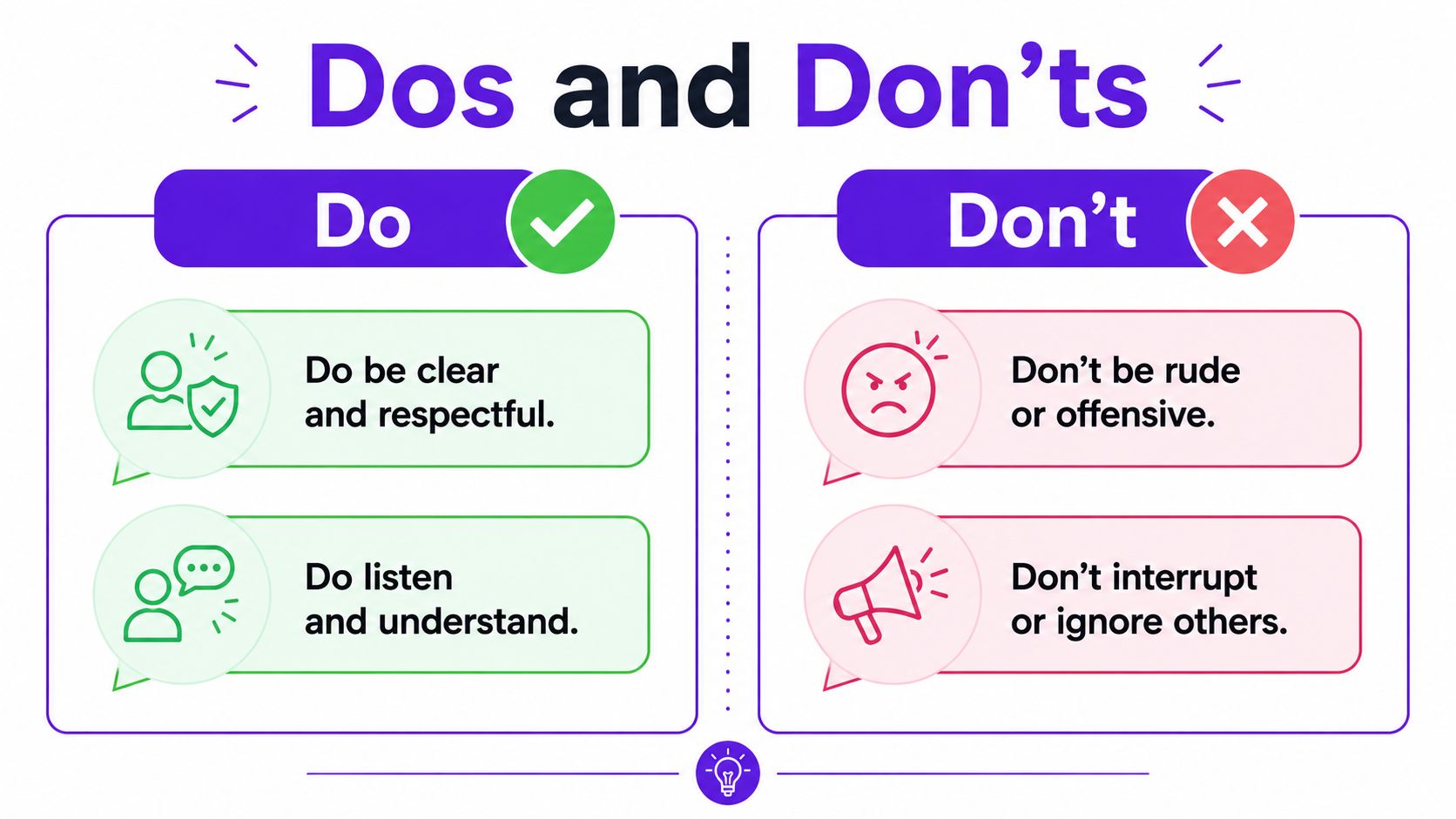
The fastest way to write these is to start with one trait and draft a sentence pair.
The first line is direct and useful. The second sounds polished, but it creates distance in a moment where the reader wants clarity more than ceremony.
You can do the same thing for content types that get reused often:
The rule here is simple, anti-examples teach faster than positive examples alone. When writers can see what the off-brand version sounds like, they make better calls without waiting for editorial rescue.
A new writer should be able to read the guide in under 20 minutes and still know how to draft a first pass. That means short sections, tight examples, and no long theory blocks. The guide should answer practical questions like what to open with, what words to avoid, how formal to sound in support, and when a CTA should be direct instead of playful.
A basic structure works well:
Assign an owner to keep the guide current, and tie review triggers to launches, new markets, or recurring feedback from editors. If nobody owns the guide, it becomes a static file that people reference only when something goes wrong.
One more detail matters here. Don't write examples so polished that nobody believes they can recreate them. Writers use examples best when the sentences feel realistic enough to adapt, not so perfect they become decorative.
The biggest mistake in tone work is assuming one personality fits every surface. That approach might look tidy in a slide deck, but it breaks the moment a social post, a billing email, and a policy notice all need different levels of warmth and authority.
Government and public-service guidance makes this obvious. GOV.UK tells writers to avoid marketing-speak and explain acronyms, which pushes content toward plain language and trust. The New South Wales Department of Education tone cards go further by recommending an average of 20 words per sentence, plus informative and inclusive language, while avoiding colloquialisms, jargon, and humour in official writing. Those are not brand flourishes, they're operational choices for communication under public scrutiny.
A casual channel is not automatically a casual message. Social media can handle lighter language, but customer support, healthcare, legal-sensitive updates, and public-sector notices need more restraint because readers are checking for competence, accuracy, and care.
Here's the useful comparison:
| Channel/Context | Tone Approach | Example Adjustment |
|---|---|---|
| Social caption | Light, direct, quick to scan | Short sentences, one clear idea, minimal jargon |
| Support email | Calm, helpful, specific | Use plain language, name the next step, avoid jokes |
| Healthcare or legal-sensitive note | Formal, precise, reassuring | Remove slang, define terms, lead with facts |
| LinkedIn post | Professional, readable, opinionated only when justified | Slightly more context, but still concise |
| Public-sector notice | Plain, inclusive, instruction-led | Explain acronyms, avoid marketing language |
The practical rule is to define channel norms and risk norms separately. A message can be low-risk but still need a formal tone because the platform expects it. A message can be high-trust and still need warmth because the reader is frustrated and needs reassurance.
Many guides get tangled here. They write “be friendly” in one place and “be formal” in another, then act surprised when writers choose the wrong one. The better approach is to define what changes and what doesn't. Vocabulary might stay stable, while sentence length, formality, and emotional intensity shift by channel.
For global SMBs and service businesses, this is especially important because the same core message often gets repurposed across YouTube, LinkedIn, Instagram, and email. If you force one voice across all of them, credibility drops in at least one place. Context rules solve that by telling writers when to lean conversational and when to lean evidence-led.
A tone system works when it tells writers what to do differently, not just what to do generally.
The cleanest guides separate “always true” rules from “context-specific” rules. That lets the brand stay recognizable without pretending every surface deserves the same delivery.
Tone guidelines fail when teams treat them like a launch file and never touch them again. The teams that keep them useful treat them like an operating system for publishing, with review, ownership, and feedback built in. Consistency becomes a habit in the workflow, not a slogan in a folder.
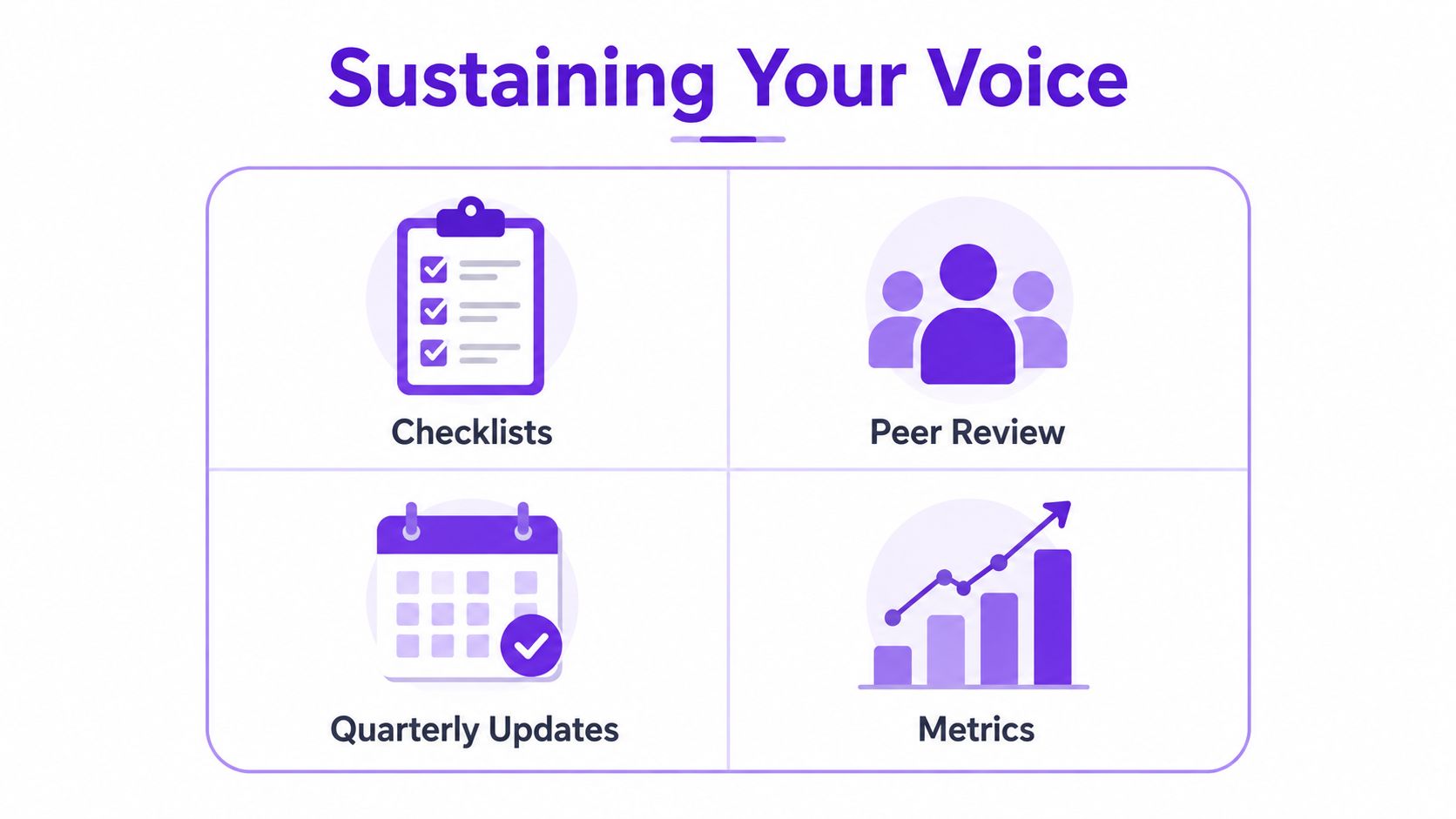
A measurement stack is not the starting point. A short editorial checklist catches most drift if it asks the right questions, such as whether the opening matches the intended tone, whether the vocabulary matches the guide, whether the message fits the channel, and whether the CTA sounds natural for the context.
Peer review helps too, especially when the feedback stays focused on voice instead of grammar alone. A second reader should be able to say whether a line feels too promotional, too stiff, too casual, or too vague. That kind of review is more useful than a broad “looks good” approval, because it gives writers something they can revise.
If your team uses AI-assisted drafting, the checklist matters even more. Taja AI, for example, publishes brand voice consistency guidance that looks at recurring patterns in sentence length, vocabulary level, humor, directness, and first-person usage, then turns those patterns into trait cards with do examples, don't examples, and prompt fragments. That keeps the guide close to the workflow, instead of leaving it in a doc nobody opens during production.
Review cadence matters because brands change, products change, and teams change. A quarterly update rhythm is enough for many small teams, but the trigger should be tied to launches, new markets, recurring feedback, or repeated rewrite patterns that show the guide is out of sync.
A sustainable system usually includes four things:
Ownership matters just as much as process. One person or one team needs to maintain the guide, approve edits, and decide when a new rule should replace an old one. Without that, the document becomes orphaned and nobody knows which version is current.
Training is the last piece. New hires should not learn the guide by osmosis. They should see the tone rules, the anti-examples, and the context shifts during onboarding, so the standard starts on day one instead of after a messy correction cycle.
If you want a cleaner way to keep tone consistent across repurposed content, Taja AI can help by turning long-form video into shorts, captions, blogs, and platform-specific posts while preserving brand context through templates and structured outputs. Visit it if you want to build a more repeatable content process around the tone rules you have already defined.


We are blessed to work with leading brands & Companies


We try to make easy and simple for every professionals. Get 30 days free trial - No credit card required.


© 2025 Taja AI. All rights reserved.