.jpeg)
Organic Growth Strategy That Scales Without Paid Ads
Build an organic growth strategy that compounds. Learn goals, content repurposing, SEO, distribution and a 90-day roadmap for small teams.
5 min read
September 21, 2026

Master brand voice consistency with this practical playbook covering documentation, AI workflows, and scalable measurement frameworks.
Written by:


You can feel it before you can name it. A long-form video had the right energy, the comments were strong, and the original script sounded unmistakably like you, then five AI-generated shorts, a LinkedIn post, and an email recap go live and suddenly the whole package feels flatter, cleaner, and less human. The problem usually isn't the idea, it's brand voice consistency, or more accurately, the absence of a production system that can preserve it while content gets repurposed at speed.
That gap gets expensive fast. Consistent brand presentation has been widely tied to up to 23% higher revenue, with later reporting putting the figure at up to 33%, and independent summaries saying 68% of companies saw 10% to 20% revenue growth from brand-consistency initiatives Envive's summary of brand voice consistency research. The point isn't that every short clip needs to sound poetic, it's that fragmented tone makes audiences work harder to recognize you, trust you, and keep moving toward a click or reply. If you've ever watched AI-assisted content come back sounding like a competent stranger, you've already seen the failure mode.
A lot of teams still treat voice as a slide in a brand deck. That works until one creator, one freelancer, or one model starts producing at volume. If you're repurposing long-form into shorts, captions, and multi-channel assets, the operational question is simple: how do you scale output without sanding off the personality that makes the content work in the first place? For a practical repurposing workflow, see Taja AI's content repurposing tool, because the core issue is not whether content can be multiplied, it's whether the multiplied versions still sound like they came from the same source.
Practical rule: if the audience can't tell which assets came from the same team without seeing your logo, your voice system is too loose.
The best branding agencies usually talk about this as consistency across every touchpoint, but the cleaner way to think about it is production control. Voice is something you can define, version, test, and gate before publication. Once you start thinking that way, the fix stops being “write better” and becomes “build the workflow that keeps tone drift from escaping.”
The first sign of drift usually shows up in a place you didn't expect. A creator watches a strong YouTube episode get chopped into shorts, then reads the captions and notices the rhythm is off, the openers are generic, and the punchline feels like it came from a content farm. Nothing is technically wrong, but the package doesn't carry the same personality, and that mismatch is what audiences feel first.
That's because AI-assisted repurposing changes the failure pattern. Human writers can drift too, but AI systems tend to flatten the signals that make a voice recognizable, especially when the source material is long, conversational, and full of timing that doesn't survive extraction. The result is content that keeps the facts but loses the cadence, confidence, or warmth that made the original effective.
When voice breaks during repurposing, the issue usually sits in the process, not in the prompt alone. One person edits hooks, another rewrites captions, and a third person approves by gut feel, so the content passes through several hands without anyone comparing it to a baseline. That's how a brand ends up sounding polished and forgettable at the same time.
If you work with agencies, the same dynamic shows up there too. The useful question isn't whether they can write well, it's whether they can operate a repeatable voice system across ads, social, email, and support. That's why a resource like Moonb's list of best branding agencies is useful, not because the logos are impressive, but because the stronger firms usually think in systems rather than slogans.
If the repurposed version feels “correct” but not recognizable, the production line is removing too much texture.
Voice drift also hurts internal efficiency. Review cycles get longer because stakeholders keep saying the same vague thing, “this doesn't sound like us.” Nobody can fix that comment until they know what “us” means in language, cadence, and structure. A brand voice system turns that frustration into something testable.
The operational stakes are straightforward. Trust weakens when the same brand sounds cheerful in one place, corporate in another, and robotic in a third. Conversion suffers because the message asks for belief while the voice signals uncertainty. Consistency doesn't guarantee performance, but inconsistency taxes it.
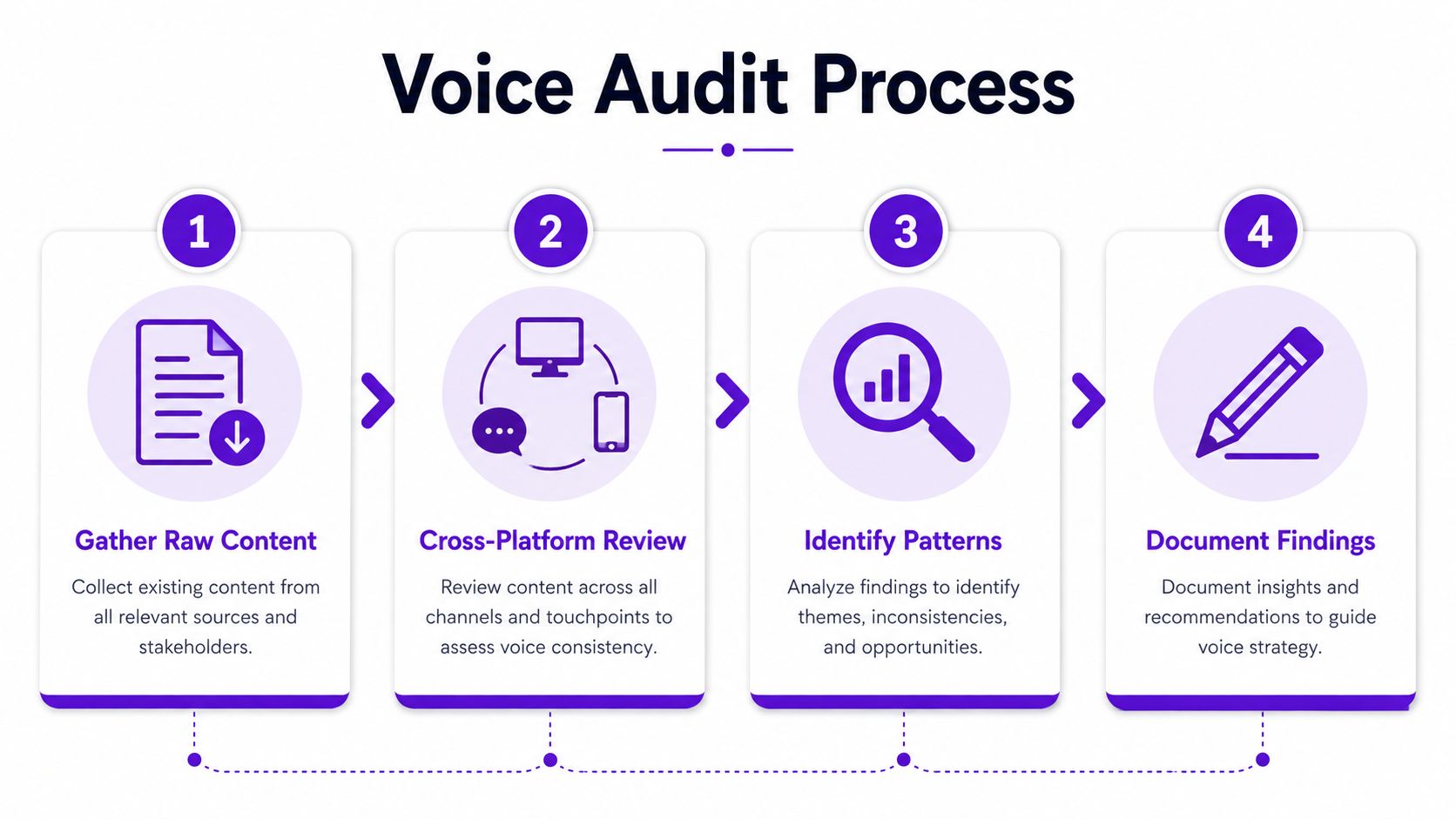
Before you write a style guide, pull the raw material from the last 90 days of content. Use the writing your audience has already seen and responded to, not the adjectives someone wrote in a brand workshop months ago. That means YouTube transcripts, LinkedIn posts, email campaigns, short-form captions, support replies, and any other public-facing writing people already connect with your brand.
The practical move is to collect a strong sample set of branded examples, then split it into a working set and a holdout set so you can check the voice later instead of guessing at it. The exact size matters less than the spread, because underrepresenting one content type, such as support replies or short captions, can make the system fail on the formats that matter most.
Start by reading for recurring language. Pull out the phrases people repeat, the sentence openings that feel unmistakably yours, the kinds of questions you ask, and the level of directness you use when you are confident. If your podcast transcript sounds conversational but your captions read like release notes, you have already found one of the fracture points.
From there, define three to five traits that are observable enough to test. “Warm” is too vague by itself, but “uses contractions, opens with a personal aside, and closes with one clear takeaway” can be checked by a human or an AI prompt. That shift matters because voice documentation should describe behavior, not aspiration.
A simple working session usually looks like this:
One useful comparison is brand archetype strategy for substack writers. Archetypes can help you name the feel of the voice, but they do not replace the audit. The audit shows what your content already does well, where it breaks, and which patterns can survive repurposing.
The core payoff is that documentation stops being guesswork. You are no longer asking, “What should our voice be?” You are asking, “What does our voice already do well, where does it fail, and which patterns can survive repurposing?”
Most voice guides fail because they turn into adjective soup. Teams write down 12 qualities, then nobody can tell how those words should change a headline, a caption, or an email reply. A usable voice system needs fewer traits, clearer definitions, and examples that leave almost no room for interpretation.
The best place to start is with the traits people can perform. If a trait can't be translated into sentence shape, wording, pacing, or level of formality, it isn't ready yet. That's why a strong trait card should feel like an instruction set, not a brand philosophy statement.
Take a trait like warm. On its own, it sounds nice, but it doesn't help a writer or a model make decisions. Turn it into rules like these, and it becomes usable:
That same structure works for other traits too. Confident might mean direct statements, decisive verbs, and no hedging. Curious might mean asking precise questions and avoiding certainty where evidence is thin. The goal is to make each trait visible in the draft, not just visible in a slide.
A good way to stress-test your voice set is to compare it to a broader archetype framework. If you need a faster mental model for that exercise, Narrareach's brand archetype strategy for Substack writers can help you see whether your voice leans more guide, challenger, specialist, or something else. The point isn't to copy archetypes, it's to avoid traits that are too abstract to govern actual writing.
Each trait card should include four pieces:
That structure does two things. First, it keeps the guide short enough to use. Second, it makes voice transferable across a freelancer, a new hire, or a language model without losing the center. If you need more than five traits to explain the voice, the system is probably overdescribed.
The most useful test is simple, hand a trait card to someone who has never written for the brand and ask them to draft a caption. If they can do it without a long explanation, the trait is working. If they can't, the rule is still too fuzzy.
Human style guides and AI prompts are not the same artifact. A style guide can say “sound confident and approachable,” but a prompt needs more specific instructions about sentence length, phrasing patterns, and what to avoid. If you treat the two as interchangeable, the model will produce something plausible and slightly off, which is exactly how voice erosion sneaks in.
The cleanest approach is to layer the system. Start with the trait cards, then turn each trait into explicit language rules, then turn those rules into prompt instructions and examples. That gives the model something it can follow, and it gives editors something concrete to check.
Core voice should stay stable across channels. Channel instructions handle the container, not the personality. A LinkedIn post can be more structured than a YouTube Short caption, and an email subject line can be tighter than both, but the underlying voice still has to feel like it came from the same brand.
That distinction matters when you use repurposing systems like the ones discussed in Taja AI's AI-powered content generation guide. If the prompt only says “rewrite this for LinkedIn,” the model optimizes for format and loses tone. If the prompt says “keep the tone direct, practical, and calm, then adapt the length and rhythm for LinkedIn,” the output has a much better chance of staying recognizable.
A workable prompt stack looks like this:
Examples matter because models follow patterns better than abstractions. If you show one on-brand hook and one off-brand hook, the difference becomes legible quickly. The same goes for thumbnail text, recap captions, and email subject lines. Give the model the shape you want, not just the adjective you want it to embody.
Human review still matters at the edges. Voice is a judgment call when humor, urgency, or restraint is involved, and no prompt catches every case. The right operating model is not “AI writes and humans rubber-stamp.” It's “AI drafts within a tight lane, then humans catch the places where tone becomes too flat, too eager, or too generic.”
A YouTube Short, a LinkedIn post, and an email subject line should not read as if they were written for the same screen size. They still need to sound like the same brand. That comes from keeping core voice stable while letting channel voice handle length, rhythm, and formatting.
The same rule applies when content moves across markets. The true test is not whether every locale uses identical phrasing, it is whether the brand still feels recognizable after native-language adaptation. Taja AI's multi-channel management overview is useful here because distribution choices and voice choices need different controls.
| Channel | Length | Rhythm | Voice Trait in Action |
|---|---|---|---|
| YouTube Short caption | Very short | Immediate, punchy | Opens with a direct payoff, then gets out of the way |
| LinkedIn post | Moderate | Structured, readable | Uses clear paragraphs and a practical takeaway |
| Email subject line | Very short | Tight, selective | Keeps the same confidence, but strips everything nonessential |
Controlled variation matters. A line may need a warmer opener in one market, a more formal register in another, or a different cultural reference altogether. That is not drift. It is adaptation within a defined system.
The production problem shows up when teams repurpose the same idea across channels and languages without a clear handoff between the source voice and the local rewrite. A content system that works on YouTube may need a different sentence shape on LinkedIn, and a subject line may need a sharper front load than either of them. The goal is not to preserve every word. The goal is to preserve the recognizable pattern of how the brand speaks.
A validator fits after draft generation and before publication. In a basic setup, it checks for banned phrases, tone drift, and structural mismatches before anything gets approved. It is especially useful once editors are handling AI-assisted repurposing at scale, because the same message can be reworked for different surfaces without losing the traits that make it sound on brand.
The value is speed with control. The validator does not replace judgment, and it does not need to. It catches the obvious mismatch early, so a human can fix the opening, the sentence shape, or the parts that pulled the copy off voice. Without that gate, review turns into a slow manual scan where every draft is judged by feel, and the standard shifts from editor to editor.
Use the same personality, change the delivery. If the audience can still tell the brand is speaking, even when the format and language change, the system is doing its job.
A lot of teams say they care about voice consistency, then never measure it. That creates a familiar failure mode. Everyone can hear drift, but nobody can say whether it is improving or getting worse. Once voice is treated as a production metric instead of a vague preference, it becomes something you can manage.
A validator is the cleanest starting point. Basic versions flag banned words, overused phrases, and obvious tone mismatches. More advanced versions compare a draft against a baseline corpus and score whether it stays close enough to the brand's approved language to publish.
Practical rule: if a draft fails the voice check, do not rewrite everything. Fix the sentence shapes, the openings, and the parts that broke the tone first.
For larger teams, a trained classifier can act as a gate before publication. It helps when AI is generating first drafts across multiple channels, because the model can score tone drift in a consistent way. Start with 200 to 500 high-performing examples, split them 80/20 for training and validation, train for 3 to 4 epochs, and iterate 2 to 3 times to get closer to production-ready accuracy. Those ranges matter because voice systems usually break when the training set is too thin or too narrow. NAV43 validator workflow
Smaller teams can use a lighter process. Once a week, pull ten random assets and score them against the trait cards by hand. Track the results in a simple sheet, then look for which trait keeps slipping. That gives you a directional signal without needing a full machine-learning pipeline.
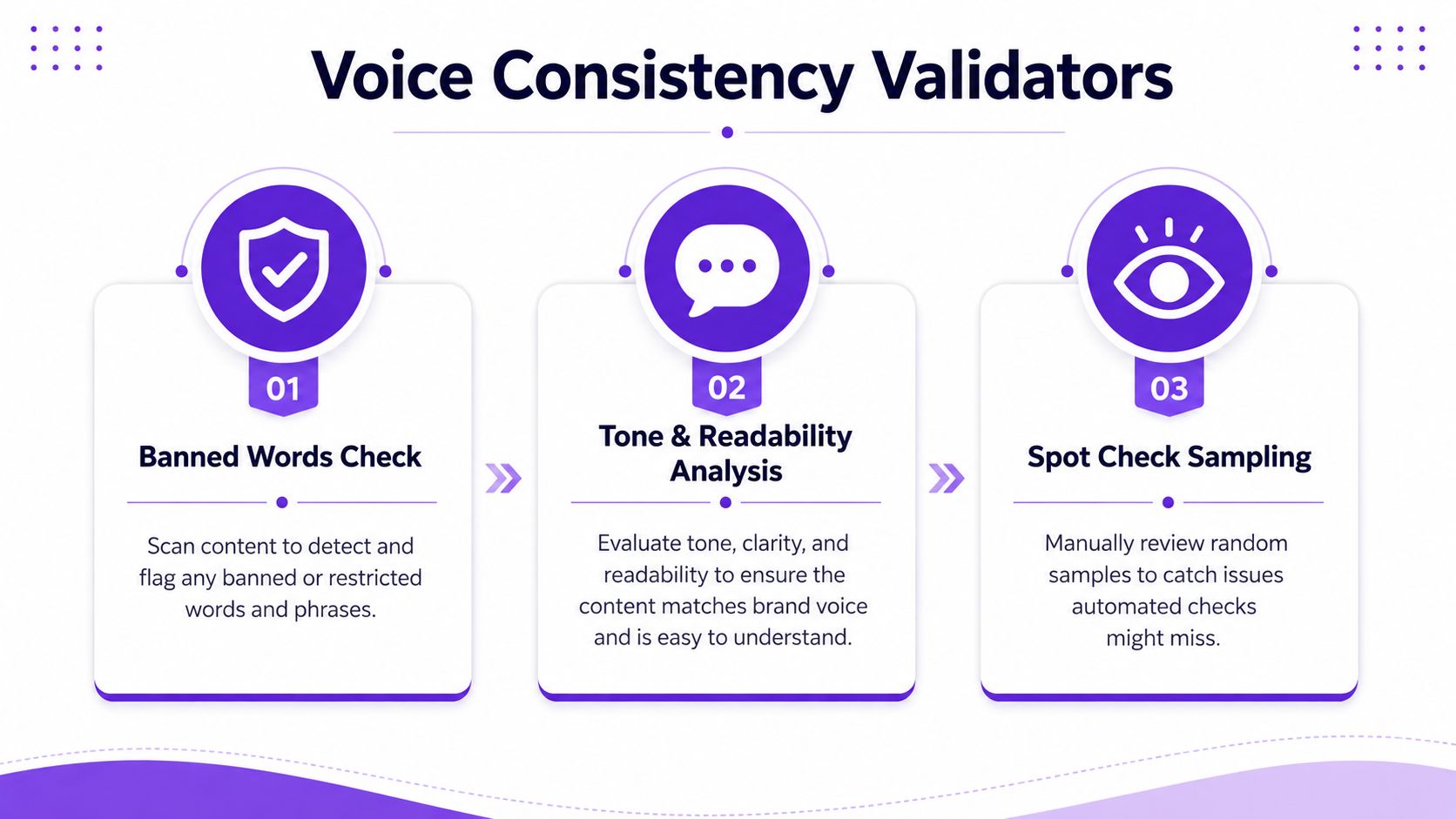
The important part is ownership of the feedback loop. If output starts sounding more generic, the validator or spot check should catch that shift before the audience does.
Brand voice decays when the process is left to memory. A Monday routine fixes that because it gives the team a repeatable way to look at the same traits, prompts, and assets every week instead of reacting only when someone notices a bad post. That rhythm is what keeps a brand sounding like itself after the initial documentation rush fades.
A simple rollout works in 30, 60, and 90 days. Week 1 is the audit, week 2 is trait definition, week 3 is prompt and validator setup, and by week 4 you should have the first full measurement cycle. The point isn't speed for its own sake, it's momentum with feedback built in.
By the end of the first month, you should have three things in place, trait cards, prompt rules, and a review path for AI-generated drafts. After that, the job shifts from creation to enforcement. If a team keeps adding new traits every time a post feels slightly off, the voice guide turns into clutter instead of guidance.
The usual mistakes are predictable:
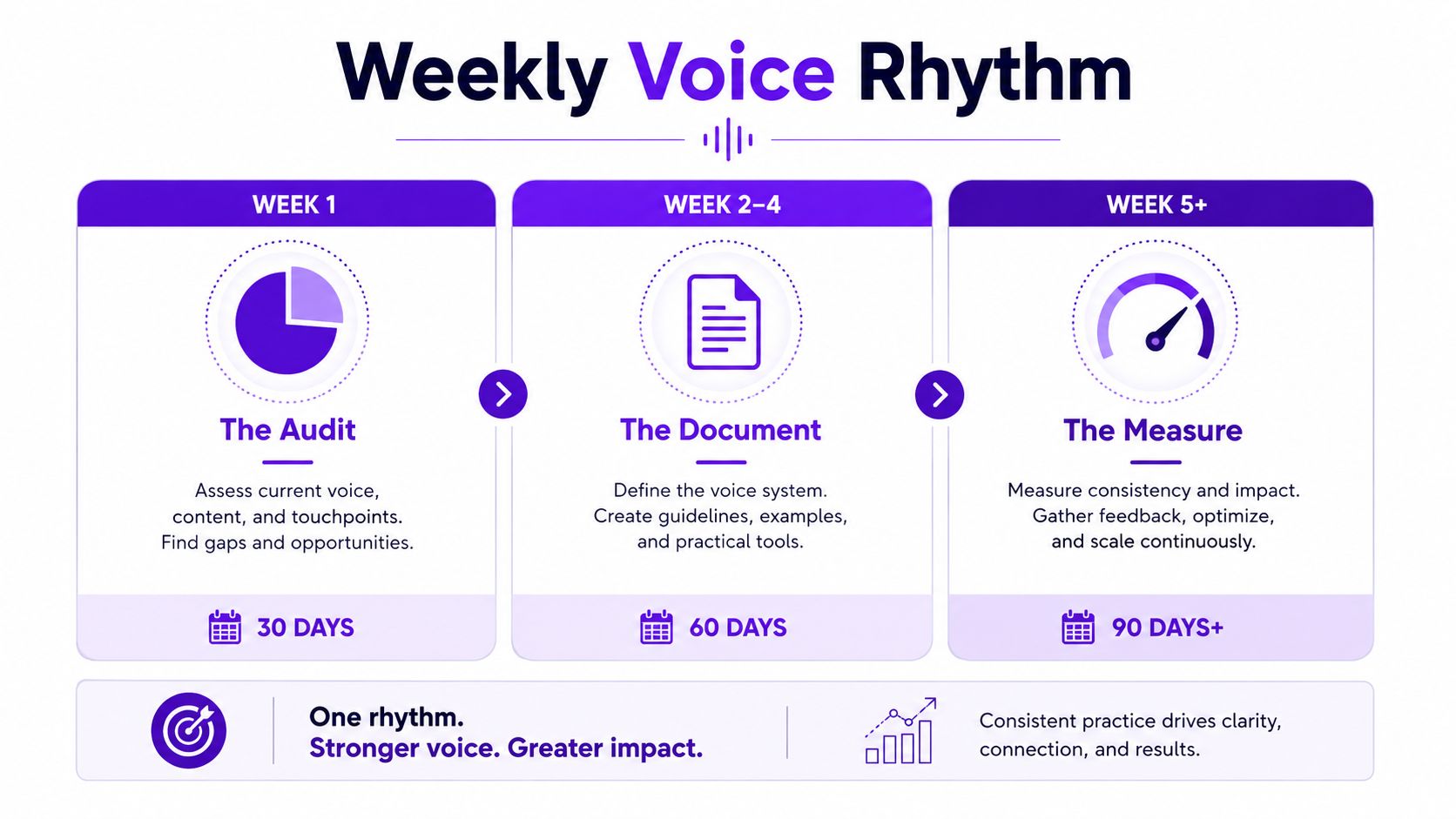
A healthy voice system is visible in the work. Humans use the trait cards without arguing over them. Prompts reflect the same rules. Validators catch drift before publication. The content still sounds like the creator, the brand, or the team that earned the audience in the first place.
If you want a repurposing workflow that helps keep that consistency in motion, Taja AI turns long-form video into shorts, captions, blogs, and platform-specific posts while using your brand voice as part of the generation process. It's worth looking at if you need one system to help generate, adapt, and distribute content without losing the voice that makes people recognize you.


We are blessed to work with leading brands & Companies


We try to make easy and simple for every professionals. Get 30 days free trial - No credit card required.


© 2025 Taja AI. All rights reserved.