.jpeg)
Repurposing Content on LinkedIn: A Practical 2026 Guide
Learn repurposing content on LinkedIn with a 2026 playbook that turns long-form videos and posts into carousels, captions, and scheduled assets that convert.
5 min read
September 16, 2026

Ai powered content generation - Master AI-powered content generation in 2026. Discover workflows, use cases & best practices to grow your brand efficiently
Written by:


Most businesses are using AI content the exact wrong way. They're chasing output while eroding trust.
That sounds dramatic, but the direction of the market makes the risk obvious. One roundup says 47% of marketers already use AI tools for content creation, nearly 94% plan to use them, and by 2026, as much as 90% of online content may be AI-generated according to Browsercat's AI content statistics roundup. When everybody can publish faster, speed stops being an advantage. Judgment becomes the advantage.
If you're a creator or small business owner, that changes the game. AI won't help you just because you turned it on. It helps when you use it to turn one strong idea into many useful, platform-specific assets without flattening your voice into generic sludge. If you skip that part, you'll publish more and matter less.
The biggest problem with AI powered content generation isn't that it writes poorly. It's that it writes plausibly.
That's more dangerous. Weak content is easy to spot and fix. Plausible content slips through. It sounds polished, uses the right phrases, and still says nothing new. A local business publishes ten AI-written posts about common customer questions. A creator pushes daily captions, summaries, and newsletters from a chatbot. Everything looks productive. Engagement weakens, replies slow down, and the brand starts sounding like everybody else in the feed.
Most AI content problems aren't technical. They're strategic.
When owners hand content production to a prompt and call it a system, they usually create three failures at once:
That third problem gets ignored. More output doesn't mean more reach. It often means more mediocre assets competing against your own stronger work.
Practical rule: If AI helps you publish more but makes your business sound less specific, it's hurting you.
This matters even more for service businesses and creators who rely on accurate business information. Search tools and AI assistants already get details wrong about companies, including hours, services, and other basics. If that risk is part of your reality, Wispra's guide to AI search engine recommendations is worth reading because it shows how bad machine-generated business information can become when nobody is checking it.
AI shouldn't be your replacement writer. It should be your repurposing engine.
Use it to extract clips from a strong long-form video. Use it to turn a webinar into a blog draft, email sequence, show notes, captions, and social posts. Use it to create first passes you can shape. Don't use it to mass-produce lifeless filler nobody asked for.
Here's the blunt version. AI can either multiply your best ideas or multiply your laziness. It does both very efficiently.
AI content tools get described like they're digital authors. That's the wrong mental model.
A better model is this. AI is a very fast creative co-pilot with a terrible instinct for truth. It can help you draft, summarize, reformat, and remix. It cannot reliably decide what matters, what's accurate, or what sounds unmistakably like you unless you guide it.
Generative AI systems are built on transformer-based large language models trained on massive datasets. That setup lets them generate text, images, or video from prompts by predicting statistically likely continuations, as explained in Hexaware's overview of generative AI for content operations.
That last phrase matters. Statistically likely continuations.
The model isn't thinking. It isn't verifying. It isn't choosing your strongest argument because it understands your business better than you do. It's predicting what usually comes next based on patterns it learned during training.
That's why these tools are often strong at:
They're often weak at:
A lot of AI advice treats prompting like magic. It isn't.
Prompt quality matters, but the key levers are broader. You need a clear source asset, strong inputs, real examples of your voice, and human editing at the end. If the source material is vague, the output will be vague. If the prompt is generic, the output will be generic. If nobody reviews the draft, mistakes will survive.
AI is fast because it predicts. It's useful because you correct it.
That's the shift in mindset most owners need. Stop asking, “Can AI create my content?” Ask, “Which parts of my content workflow are repetitive enough for AI, but important enough to still need my standards?”
Think of AI powered content generation as a compression and expansion tool.
It compresses research, transcripts, meetings, videos, and rough notes into usable raw material. Then it expands that material into multiple formats. That makes it ideal for repurposing. It does not make it an automatic substitute for point of view.
Here's the simplest way to judge a tool:
| Question | Good sign | Bad sign |
|---|---|---|
| Does it start from your real material? | It repurposes your videos, notes, or transcripts | It invents generic content from thin air |
| Does it preserve your voice? | It lets you guide style and constraints | It outputs the same tone every time |
| Does it support review? | You can edit, refine, and approve | It encourages one-click publishing |
| Does it improve workflow? | It removes manual rewriting and formatting | It just creates more drafts to clean up |
If you remember one thing, remember this. AI is a multiplier. It multiplies the quality of the system around it.
Many users approach AI as a single-step writing shortcut. That's amateur behavior. Significant gains emerge when you treat AI as part of a full production system.
One market estimate places the global AI-powered content creation market at USD 2.15 billion in 2024, rising to USD 2.56 billion in 2025 and USD 10.59 billion by 2033, implying a 19.4% CAGR according to Roots Analysis on the AI-powered content creation market. Another estimate in the same market category projects continued double-digit growth. The takeaway isn't just that adoption is growing. It's that teams are moving from one-off generation to repeatable workflows.
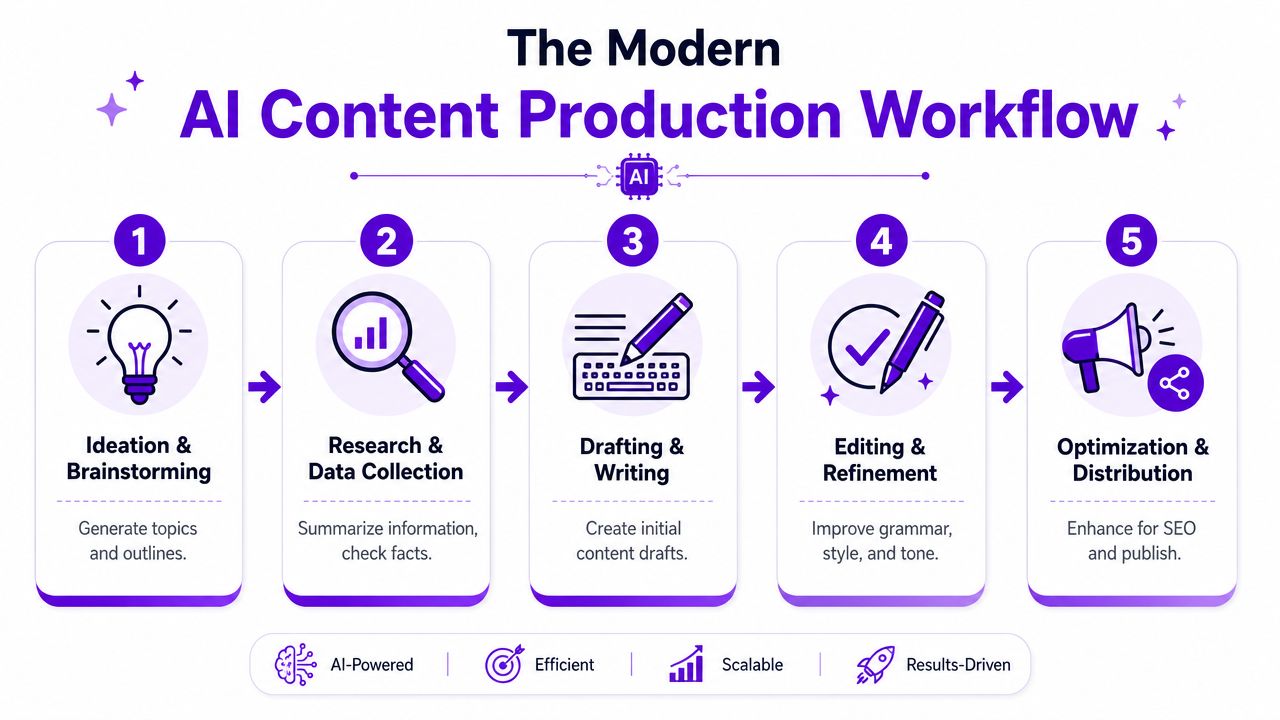
The strongest workflow begins with something real. A podcast episode. A sales call recording. A webinar. A YouTube video. A founder memo. A customer FAQ.
That source asset gives the AI something concrete to work from. It also lowers the risk of thin, copycat output because the material originates with you.
A practical workflow usually looks like this:
The best use of AI isn't replacing your strategist. It's removing the formatting, slicing, summarizing, and adaptation work that steals time from strategy.
Use it aggressively in these parts of the pipeline:
If you want a practical example of that shift from manual production to systemized repurposing, Taja's article on automating content creation shows the kind of workflow businesses are trying to build.
The bottleneck isn't usually idea generation. It's turning one good idea into enough quality assets to meet your audience where they are.
Here's the model I recommend for small teams:
| Stage | Human role | AI role |
|---|---|---|
| Strategy | Choose audience, offer, angle | Suggest themes and formats |
| Source creation | Record video, talk through ideas, teach | Transcribe and organize |
| Asset generation | Approve priorities | Draft variations by channel |
| Editorial review | Fix facts, sharpen voice, remove fluff | Flag alternatives and rewrites |
| Distribution | Decide cadence and channel mix | Format, schedule, and adapt |
That's the difference between content chaos and a scalable system. AI powered content generation works when the human owns direction and the machine handles transformation.
The best use cases for AI aren't glamorous. They're profitable. They save time, preserve momentum, and help you squeeze more value out of content you already made.

Experts cited by Grand View Research argue that AI is best used for brainstorming, drafting, and workflow automation, while human oversight remains essential for strategy and authenticity in its analysis of the AI-powered content creation market. That's the right standard. Don't ask AI to replace your judgment. Ask it to expand the useful life of your strongest material.
If you publish video, you're already sitting on underused assets.
A single long-form recording can become a week or month of content if you process it correctly. Say you record a twenty-minute YouTube video answering common client questions. That one file can produce:
That's not content spam if each asset serves a real job. The short clip creates discovery. The blog captures search intent. The email deepens trust. The caption carries context. Repurposing works when each format meets a different consumption habit.
One tool built around that workflow is Taja's AI for social media marketing guide, and platforms in that category focus on turning long-form recordings into shorts, posts, blogs, and supporting assets instead of forcing creators to rebuild everything by hand.
Not every workflow deserves automation. Here's where AI usually earns its place.
Creators should use AI to cut editing overhead, not outsource their perspective.
Good fits include:
Bad fits include fully AI-written opinion content with no original examples, no story, and no review.
SMBs often need consistency more than originality. That makes AI useful, but only when grounded in real expertise.
Strong applications:
Weak applications:
If search visibility is part of the workflow, pairing repurposing with specialized AI SEO software can help structure and optimize assets after you've established the core message.
Here's a useful benchmark. If the asset can be traced back to a real customer conversation, real video, real process, or real lesson, AI can usually help repurpose it well. If it starts as empty keyword bait, AI will usually make it worse.
After you've mapped the workflow, seeing the transformation in action helps:
Ask three blunt questions before you automate anything:
| Question | If yes | If no |
|---|---|---|
| Does this begin with real source material? | Repurpose it | Don't generate it yet |
| Does the format match a real audience need? | Publish it | Skip it |
| Can a human review it quickly? | Systematize it | Simplify the workflow first |
That filter alone will save you from most bad AI content decisions.
AI content tools are useful. They're also overrated by people who've never had to protect a brand.
The upside is obvious. AI speeds up the parts of content production that people repeat constantly: drafting, summarizing, reformatting, clipping, rewriting for different channels, and turning rough material into publishable first versions. Small teams benefit most because they usually don't have a dedicated editor, writer, strategist, SEO lead, and social manager. One person is doing all of it.
The downside matters more than the sales pages admit. Logical Position notes that a key challenge in AI-powered content generation is preventing generic, low-trust output, and that AI drafts still require human strategy and fact-checking because large language models can miss nuance, introduce errors, and create rework or brand-compliance problems in its guidance on AI content workflows.
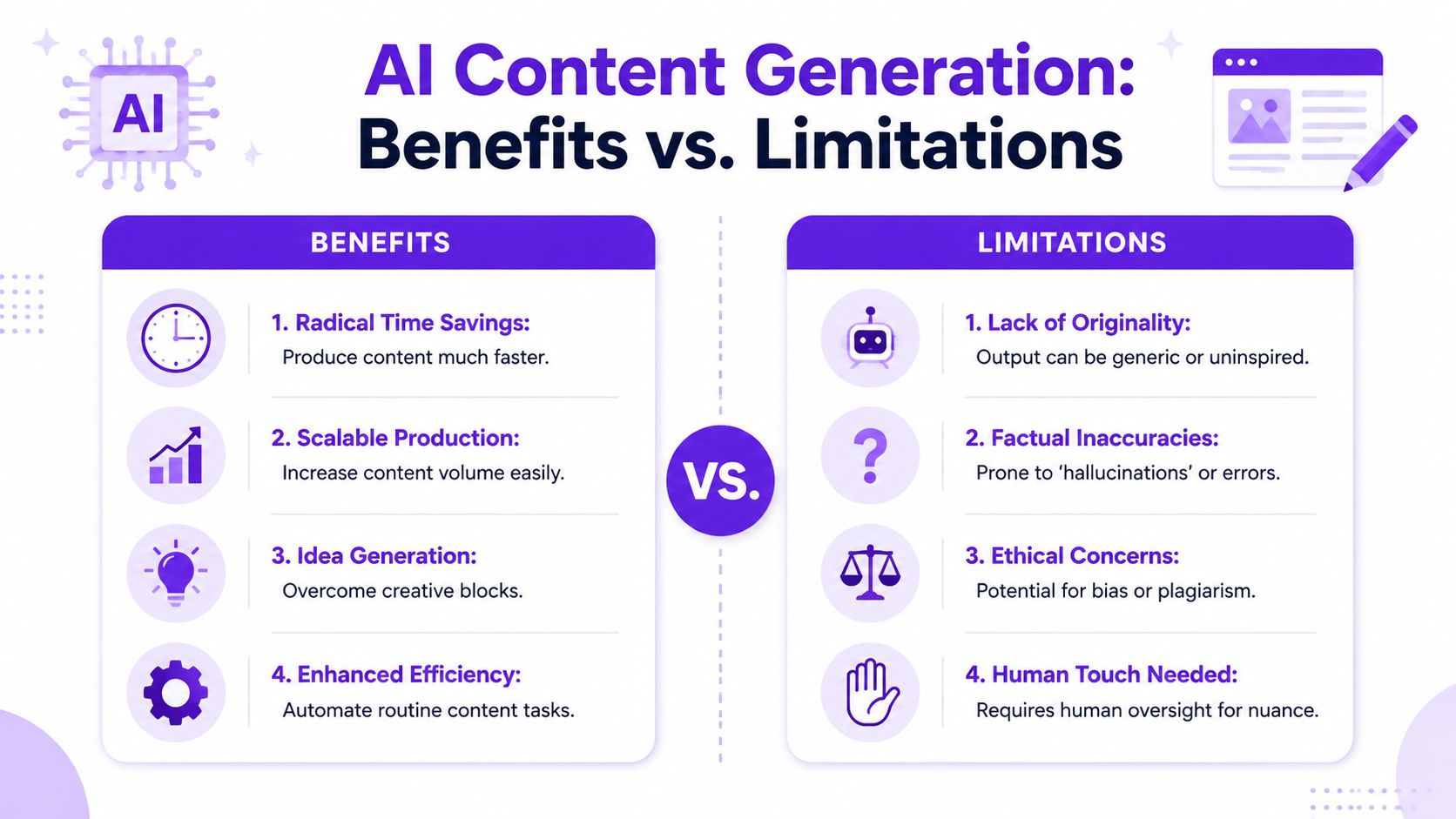
The benefits are real when you stay disciplined.
Use AI where repetition is high and originality is low. Keep humans where trust and nuance decide the outcome.
The limitations aren't small. They hit the parts of content that influence brand preference.
Most AI drafts are readable. That's not the same as memorable. If the model gives you a smooth paragraph that could belong to any competitor, the content has failed even if the grammar is clean.
The system predicts likely wording, not verified truth. That means service details, industry specifics, product claims, legal nuance, and customer context can all get distorted unless someone checks them.
A founder-led business, educator, coach, agency, or local expert usually wins because of distinct tone and perspective. Unedited AI output sands that down fast.
Cheap-looking automation often creates expensive cleanup. If your team has to rewrite every draft from scratch, the tool didn't save time. It just moved the workload.
| Benefit | Hidden cost if unmanaged |
|---|---|
| Faster first drafts | Weak original thinking |
| More output from one asset | More low-value content if you publish everything |
| Easier multichannel production | Voice inconsistency across platforms |
| Lower manual workload | More fact-checking and compliance review |
The unvarnished truth is simple. AI is not a content strategy. It's a production layer. If your strategy is weak, AI scales the weakness. If your strategy is sharp, AI lets you execute it without drowning in manual work.
The market is moving fast enough that ignoring AI isn't a serious strategy. Grand View Research estimates the generative AI in content creation market will grow from USD 14.8 billion in 2024 to USD 80.12 billion by 2030, reflecting a shift toward pipeline-style production, and it specifically points teams toward human-in-the-loop review, brand-voice constraints, and performance measurement in its report on the generative AI content creation market.
That recommendation is exactly right. If you want AI powered content generation to work, build constraints first and automation second.
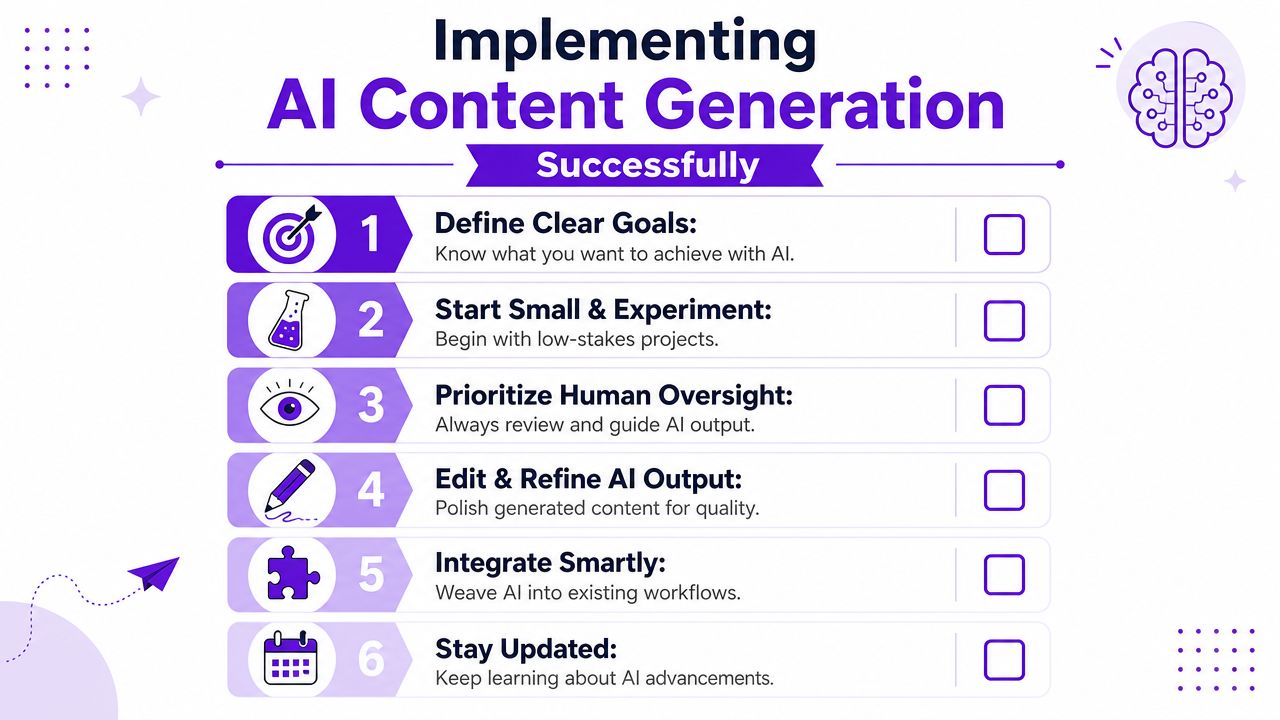
Start with this operating standard:
Pick one high-value workflow
Don't automate everything. Start with one repeatable process, such as turning long-form video into clips, captions, and a blog draft.
Create a brand voice kit
Give the tool examples of how you speak, what words you avoid, how formal you are, and what your offers are. If your inputs are sloppy, your outputs will be bland.
Require review before publishing
This is not optional. A human needs to check facts, tone, context, and calls to action.
Measure asset quality, not just quantity
More posts is not a business result. Track which formats drive replies, watch time, leads, consultations, or meaningful engagement.
Use AI to repurpose proven ideas
Start from topics that already worked in sales calls, client meetings, webinars, videos, or newsletters. Proven inputs beat speculative prompts.
Tighten the loop over time
Save high-performing prompts, document repeatable structures, and kill workflows that generate too much cleanup.
A lot of founders buy AI tools before they define the operating model. That's backwards.
Choose tools based on the job:
The winning setup isn't the one with the most automation. It's the one your team can trust enough to use every week.
If you remember nothing else, keep this rule. Automate transformation. Keep judgment human.
That means AI should handle adaptation, formatting, repackaging, and first drafts. You should still own claims, positioning, proof, and voice. Businesses that follow that split will move faster without becoming generic. Businesses that ignore it will flood their channels with polished filler and call it efficiency.
If you want a practical way to turn one long-form video into shorts, captions, blog assets, thumbnails, and platform-specific posts without rebuilding the workflow manually, Taja AI is built for that repurposing model. It fits best when you already have valuable source content and want a faster path from recording to distribution while keeping final editorial control.


We are blessed to work with leading brands & Companies


We try to make easy and simple for every professionals. Get 30 days free trial - No credit card required.


© 2025 Taja AI. All rights reserved.