.jpeg)
How to Make a Shorts Video That Actually Gets Views
Learn how to make a shorts video that drives real engagement. Master hooks, vertical formatting, and AI repurposing to scale your content without burnout.
5 min read
September 28, 2026

Learn how to craft compelling social impact storytelling that drives change. This practical guide helps creators share meaningful stories effectively.
Written by:


The most popular advice about social impact storytelling is also the least useful: tell one powerful story, make it emotional, and hope people share it. A moving testimonial can earn attention, but attention alone rarely changes behavior, policy, or community norms. Sustainable impact comes from an operating system that connects lived experience with evidence, ethical production, clear action paths, and disciplined distribution.
That system treats every interview as part of a managed story portfolio, not a disposable campaign asset. It gives the team a central narrative, a repeatable way to collect stories, a method for pairing emotion with results, and a repurposing workflow that protects the subject's voice while adapting the content for each channel.
A viral story can produce sympathy without producing sustained action. Viewers may watch, react, and move on because the story leaves key questions unanswered: what happens next, who is responsible, and how can someone participate? Emotion opens attention. A repeatable system turns that attention into action.
Durable social impact storytelling has always depended on repetition, portability, and shared narrative structure. Anti-slavery narratives converted lived experience into public pressure. Harriet Beecher Stowe's Uncle Tom's Cabin was published in 1852, and the 1958 comic Martin Luther King and the Montgomery Story helped communicate the civil rights struggle. The comic later crossed languages and borders, including use by Egyptian activists before the Arab Spring. The history of stories for change documents these examples within a tradition spanning at least 170 years.
The practical lesson is straightforward. A nonprofit does not need to produce a book or comic, but it does need a message that people can understand, repeat, and connect to a meaningful action. That message must survive interviews, edits, captions, donor updates, and advocacy posts without losing its core meaning.
An isolated testimonial often follows a familiar sequence: someone describes hardship, the organization presents its intervention, and the viewer sees a hopeful ending. The format can work, yet repeated polished transformations flatten complexity. Stronger stories preserve the participant's agency, acknowledge what remains unresolved, and show evidence that the work continues beyond the final frame.
Production also breaks down when each asset follows a separate campaign calendar. One team publishes a donor appeal, another posts a volunteer profile, and a third produces an advocacy video. Each piece may be competent, while the organization still sounds like three different institutions.
Practical rule: Keep a story in the portfolio when it reinforces the organization's central meaning, includes credible evidence, and leads a defined audience toward a defined action.
Teams should pair narrative and proof during planning, not add data during final editing. The nonprofit storytelling benchmark analysis reports that 82% of nonprofits use storytelling in fundraising, while 55% saw improved results after adding storytelling. It also reports that 70% of donors want stories showing the results of their gifts, and another summary states that 90% want data alongside stories. The workflow implication is practical: collect the human account, the measurable result, and the next action as one story package.
Authenticity then becomes an operating standard rather than a production style. The participant's account, the organization's actual work, the supporting evidence, and the requested action must agree. Useful articles on authentic marketing reinforce that consistency, but teams still have to apply it in interviews, approvals, edits, and platform adaptations. A reusable source file, evidence notes, consent record, and action language make that standard easier to maintain without exhausting the team.
Before you schedule an interview, define the story your organization is trying to make possible. A metanarrative is the larger explanation beneath individual stories. It answers four practical questions: what does the organization believe, what problem stands in the way, what change is possible, and how can people contribute?
A food access nonprofit might frame its metanarrative around dignity rather than scarcity. Its individual stories could feature a parent navigating food costs, a volunteer building neighborhood relationships, and a policy advocate pushing for better systems. The people and settings differ, but every story supports the same idea: communities deserve reliable access to nourishing food, and collective action can improve the conditions that shape access.
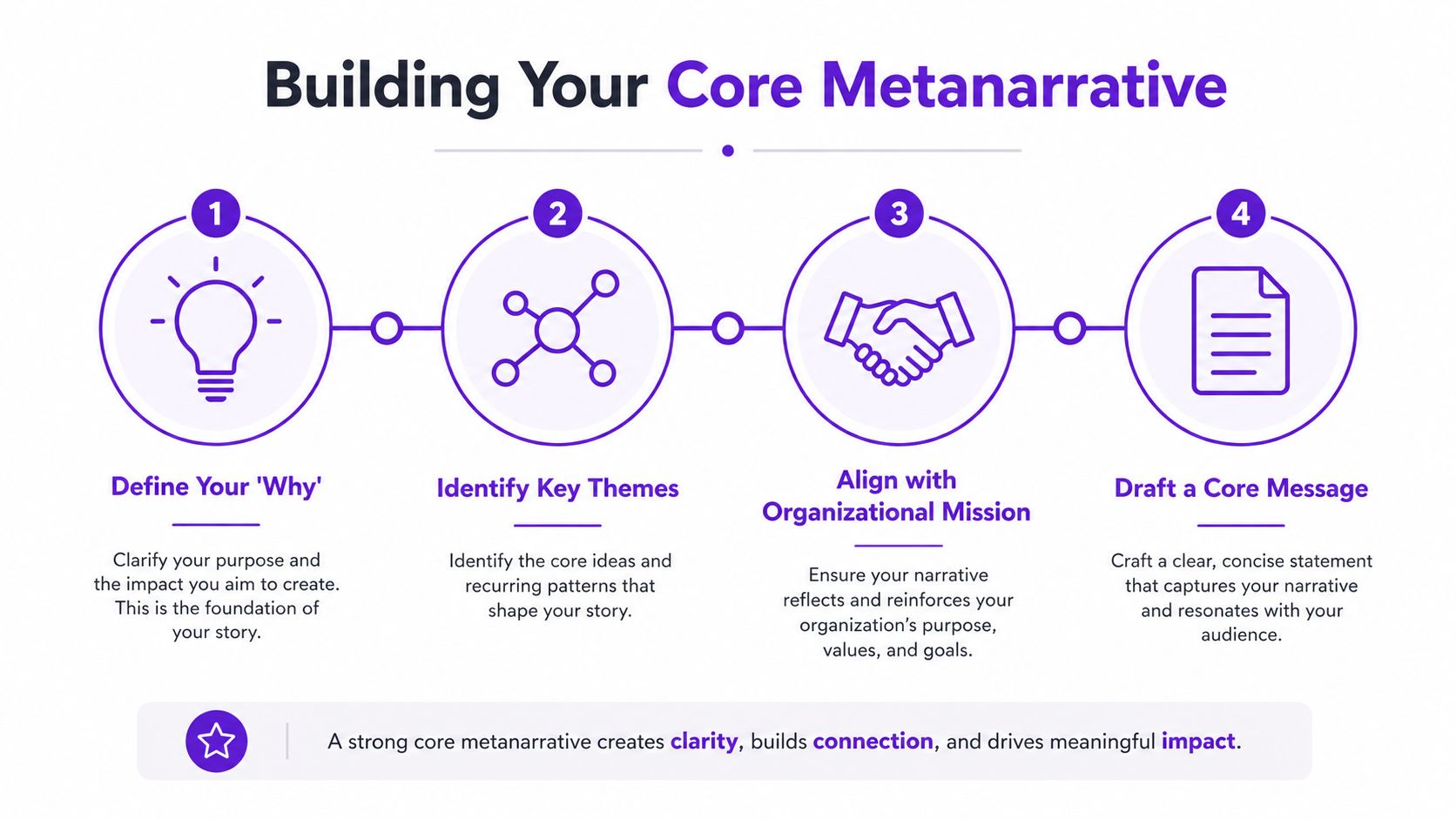
The Social Impact Organization framework provides a practical sequence:
Define the metanarrative. Write a short statement that connects the mission to a human value such as safety, belonging, dignity, opportunity, or justice. Avoid a slogan. Describe the tension and the desired shift.
Build a story portfolio. Collect multiple authentic stories that express the metanarrative from different viewpoints. A participant story can establish lived experience. A staff story can explain the response. A community or partner story can show how change travels. Layer stories by audience and action stage rather than publishing whichever interview was completed most recently.
Assign narrative ownership. Give one person responsibility for consistency across scripts, edits, captions, visual choices, and calls to action. The framework describes this role as a master storyteller, responsible for preserving narrative hooks, character development, and a coherent climactic arc across channels. Ownership doesn't mean one person approves every comma. It means someone protects the meaning of the whole system.
List the phrases your team repeats when describing the mission. Then mark which ones express:
If a new story can't connect to those four areas, it may be interesting without being strategically useful. If every story relies on the organization as the hero, revise the frame. Participants should have agency, communities should have knowledge, and the organization should clarify its role rather than claim ownership of the transformation.
The framework matters because stories become weaker when teams treat them as isolated assets. A portfolio gives the audience repeated entry points while allowing each platform to emphasize a different part of the same core message.
An interview can either return control to the person telling the story or take it away. The difference often appears before the first question, in who chooses the setting, who understands the intended use, and whether the participant can decline a topic without losing access to support.
Consider two approaches. In the extractive version, an interviewer arrives with a list of dramatic questions, asks for the hardest moment, and guides the participant toward a predetermined conclusion. The final edit may be emotionally powerful, but the subject has little control over the interpretation.
In a participatory version, the interviewer explains the audience, formats, risks, and distribution plan in plain language. The participant chooses what can be shared, identifies the details that matter, and reviews the finished story before publication. The interviewer still shapes the conversation, but the subject remains a collaborator rather than raw material.
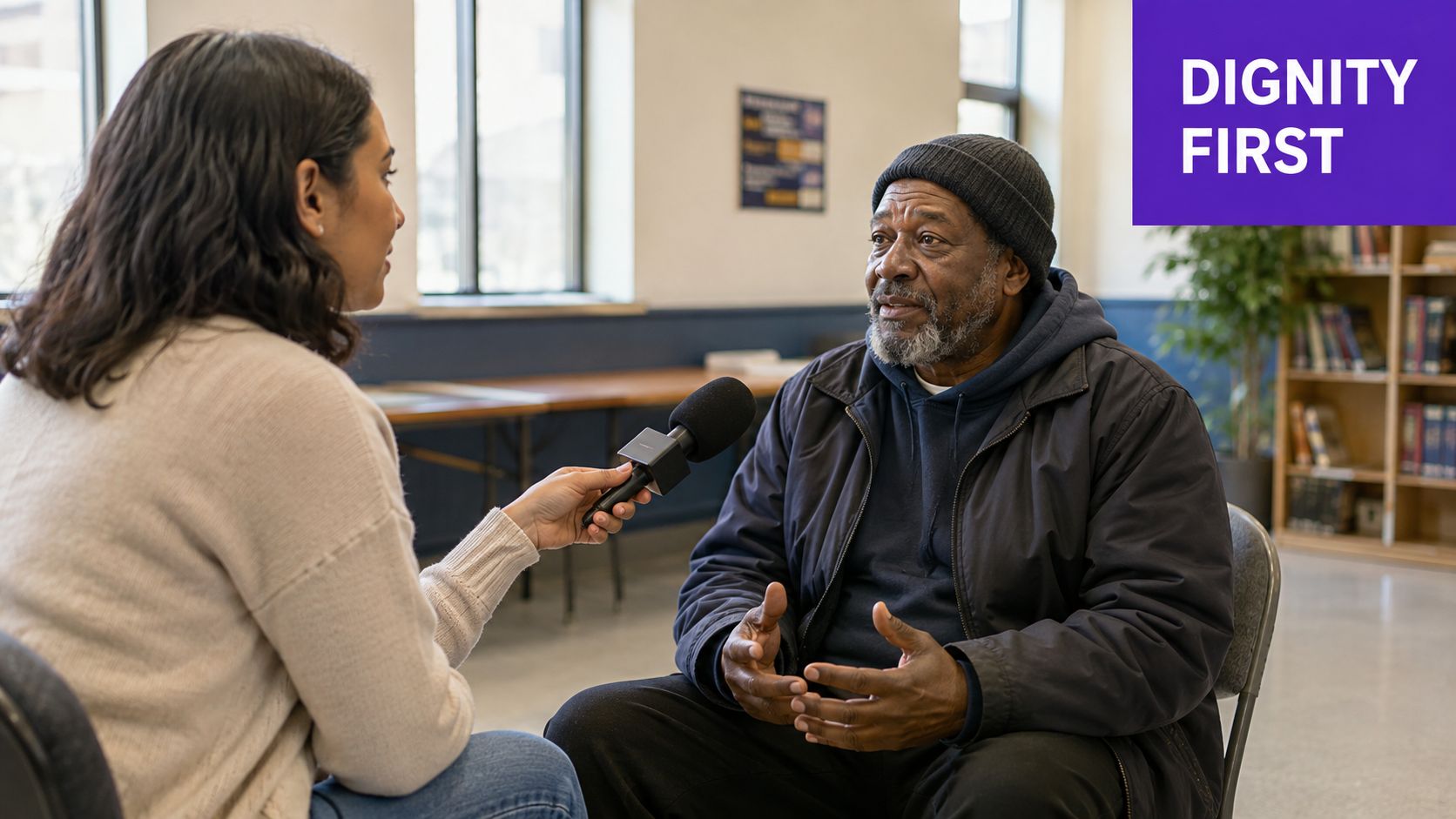
“Tell us how our program changed your life” contains the answer the organization wants. Try questions that leave room for the participant's own meaning:
Don't pressure someone to disclose trauma for emotional effect. If a participant begins sharing more than they intended, pause and remind them that they can stop, revise, or remove that material. A compelling edit is never more important than informed consent.
Give participants a transcript, rough cut, or caption draft in a format they can understand. Ask them to check names, dates, translations, context, and any implication that the organization has made a promise it can't keep. Where possible, let them identify the preferred image, title, and call to action.
This process may take longer than a conventional interview, but it improves accuracy and reduces the risk of turning a person into a symbol. It also surfaces details that scripted interviews miss, such as the practical barrier that prevented action or the community relationship that made progress possible.
Ethical storytelling isn't only a safeguard. It produces more specific stories because people speak with greater clarity when they aren't trying to guess the answer the interviewer wants.
Repurposing begins before recording. A long interview becomes useful across formats when the production team captures clean audio, visible expressions, complete answers, and enough visual variation to support different crops.
Start with the master version. Record the conversation in a stable horizontal composition, then keep the subject's face and important gestures within a central area that can survive vertical cropping. If a second camera is available, use it for a complementary angle rather than an elaborate cinematic setup. The priority is continuity, clean sound, and visual flexibility.
Ask each important question in a way that encourages a complete response. If the final clip will be watched without the interviewer's voice, the participant needs to restate enough context in the answer.
Instead of asking, “How did that help?” ask, “How did the community garden help you access food during that period?” The second prompt gives the editor a usable sentence and makes captions clearer.
Use a recording checklist:
Edit the same narrative at several levels:
Don't force every interview into a flagship film. A story with strong emotional detail but limited context may work as a short clip. A story with complex policy implications may deserve a longer edit and supporting article. Resource allocation should follow narrative value, consent conditions, audience relevance, and the action available after viewing.
The video production workflow guide is useful when teams need to document these decisions, assign review stages, and prevent each project from becoming a custom process. A repeatable workflow protects quality because editors spend less time searching for assets and more time preserving meaning.
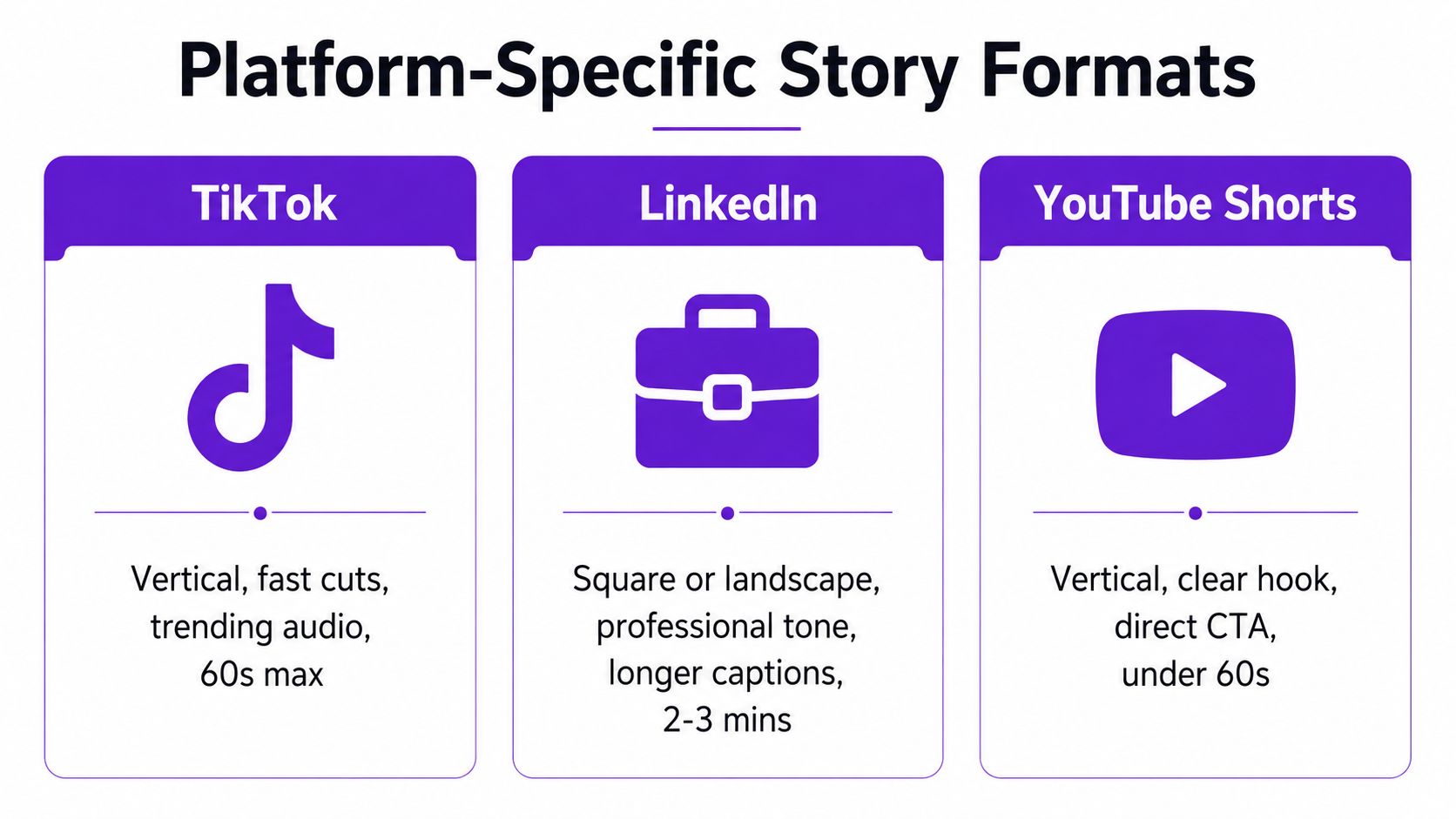
A social impact story should not be copied unchanged across platforms. Keep the core message stable, then adapt the opening, pacing, visual treatment, caption depth, and call to action to each channel's viewing habits.
TikTok needs immediate clarity and conversational delivery. Open with the human tension, not organizational history. Use on-screen text for context and make visual changes serve the story. A prompt such as “Share this with someone working on food access” may suit an awareness goal better than a broad request to “support our mission.”
LinkedIn can carry more context when lived experience connects to organizational practice, workplace responsibility, funding, or policy. Professional audiences still respond to human language. Give them a clear reason the story matters to their decisions, then explain the system or intervention and end with one specific invitation.
YouTube Shorts needs a strong opening frame, readable captions, and a clear payoff. The video should make sense without prior knowledge of the channel. Identify the organization's role early enough to establish accountability, but avoid a logo animation that delays the story.
Use captions to answer three practical questions in sequence: why should someone care, what supports the claim, and what can they do now? This structure differs from a spoken story arc because it gives evidence a defined job instead of treating it as a closing detail.
A reusable caption can follow this format:
Situation: “After losing reliable transport, Maya stopped attending appointments.”
Verified detail: “The community ride program recorded completed rides and participant feedback during the pilot.”
Meaning: “Reliable transport helped participants reconnect with care.”
Next step: “Donate or volunteer through the profile link to support the next round of rides.”
Keep the evidence specific and privacy-safe. If the source data is still being reviewed, say so. Do not turn an internal target into an outcome, or imply that one participant's experience represents every person served.
Teams creating content for congregations, schools, or community groups can use guidance on social media for church engagement, particularly the practice of matching posts to participation rather than treating every update as an announcement.
Build one approved caption brief before adapting it. Record the central claim, permitted evidence, audience action, consent limits, and platform version. A tool such as the Taja AI caption generator for videos can help draft variations, but an editor must verify each claim, protect consent, and preserve the participant's language. This workflow keeps repurposing efficient without letting platform conventions change the story's meaning.
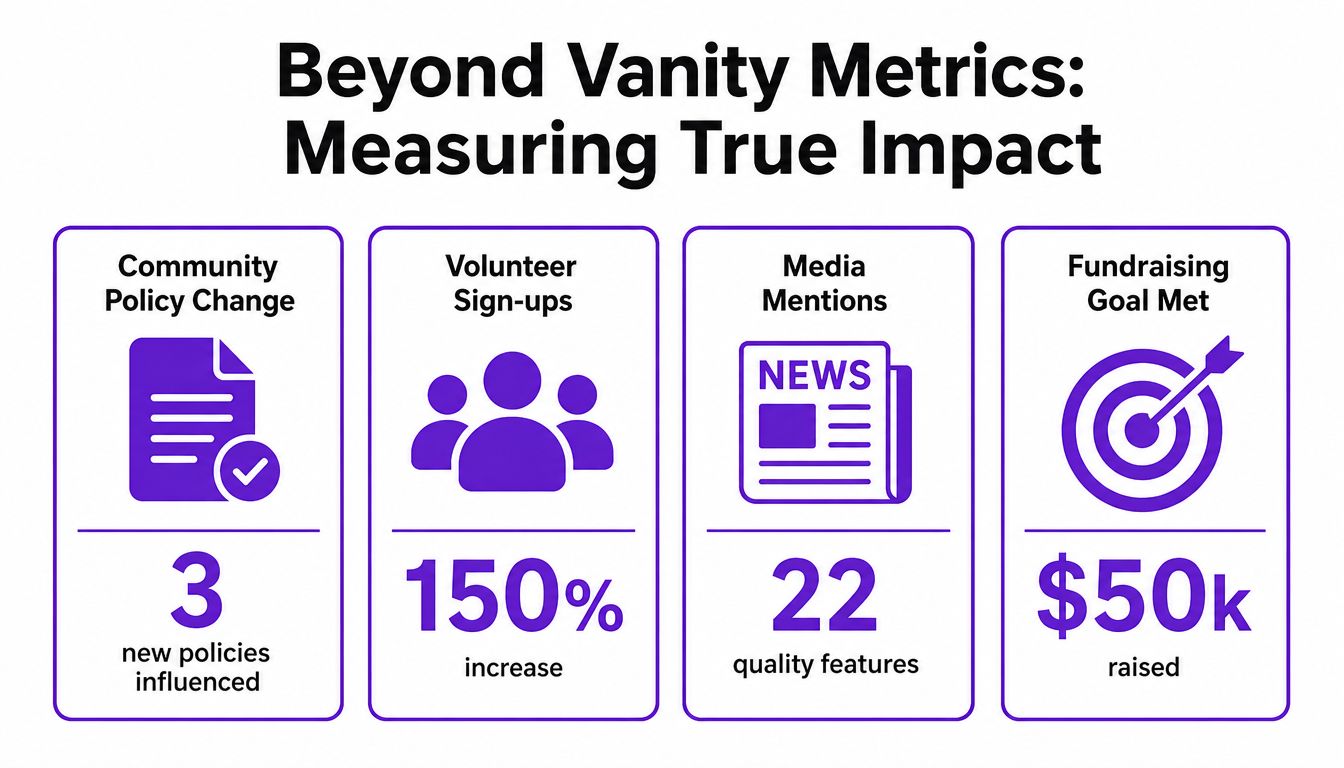
Views and shares show distribution, not change. A stronger measurement system starts with the behavior or norm a story should influence, then connects exposure to evidence of progress. That evidence might include a completed donation, a volunteer inquiry, a policy response, or a documented shift in community discussion.
A useful model is participatory mass storytelling with SenseMaker. In a UN Women Asia-Pacific baseline study, mainly women and girls shared stories about changes in traditional practices, beliefs, and social norms over five years. Participants recorded emotions, behaviors, and changes in power relationships for each story, allowing researchers to combine qualitative detail with aggregated analysis. The UN Women baseline report presents this method as a way to examine impact-level change rather than merely collect testimonials.
Integrate measurement into production by recording the intended outcome and its possible evidence before any asset goes live:
A methodology review reported that 52.2% of approaches were used to create impact, 39.1% to create and measure impact, and 8.7% solely to measure impact, according to the review of digital storytelling methodologies. The distribution highlights an operational gap. Teams often build persuasive content without a measurement layer that can test whether persuasion became action or longer-term change.
A 2024 UCL/UAL report also identifies limited investment in impact storytelling and insufficient evaluation of collective, large-scale arts, media, and narrative-change work. Your reporting system should separate output, response, and outcome. A video can attract attention, prompt an action, and contribute to a longer change process. Those are separate claims, so label them separately.
Keep the measurement layer attached during repurposing. Store the core claim, evidence source, consent limits, platform version, and intended action with each asset. Teams connecting video to inquiry or supporter journeys can also use this guide to lead generation with video to connect each version to a measurable next step rather than ending at publication.
A small team needs defaults, not a new creative debate for every post. Build a shared template library with three components.
Thumbnail formula: use a close, consent-approved portrait or action frame, one short phrase naming the tension, and a consistent brand mark. Keep the text specific. “Finding care after displacement” is stronger than “Real impact.”
Caption formula: lead with a human detail, explain the organization's role, add one verified outcome or measurement method, and end with one action. Never place several unrelated requests in the same caption.
Clip scorecard: rate each clip for clarity, emotional specificity, participant agency, evidence available, audience relevance, consent status, and action fit. Prioritize clips that communicate without missing context, avoid sensational framing, and can be adapted without changing the speaker's meaning.
Store transcripts, approved quotes, b-roll, consent records, impact evidence, platform versions, and publication dates together. That library turns one interview into a durable source rather than a forgotten upload. Review the templates regularly with participants and staff so efficiency doesn't flatten the story into a formula.
Taja AI helps teams turn long-form interviews into ready-to-publish clips, captions, thumbnails, blog content, and platform-specific posts from one upload, with editing, brand templates, and scheduling tools in the same workflow. If your organization needs to repurpose ethical, evidence-backed stories without asking a small team to become full-time editors, visit Taja AI and test the workflow with your next interview.


We are blessed to work with leading brands & Companies


We try to make easy and simple for every professionals. Get 30 days free trial - No credit card required.


© 2025 Taja AI. All rights reserved.