Blog Post Headline Generator: 10 Tools Compared for 2026
Compare 10 blog post headline generator tools by features, pricing, and best use cases, plus examples and tips to lift clicks and SEO in 2026.
5 min read
November 11, 2026

Turn any podcast episode into a publishable podcast to blog post: clean the transcript, verify facts, structure for search and publish with confidence.
Written by:


You've uploaded an interview, generated a transcript, and opened the first draft. It reads like a chat log: introductions, unfinished thoughts, and a useful answer buried beneath a long tangent. Turning a podcast to blog post takes more than cleaning up sentences. You need to rebuild the conversation around what a reader wants to know, without changing what the speakers meant.
Say you're adapting a 45-minute interview. The transcript captures the conversation, but the article needs a different structure: a clear answer, supporting evidence, practical examples, and a reason to keep reading. Treat that runtime as a planning example, not a promise that every episode needs the same amount of editing.
The audience spans different age groups: Edison Research's 2024 U.S. findings put monthly podcast listening at 59% among people aged 12–34 and 55% among those aged 35–54. The same findings reported monthly listening among 48% of Black Americans and 43% of Latino Americans.
Those figures establish the breadth of podcast listening, not how many people will read your adaptation. The editorial opportunity is to make the discussion useful to someone who prefers text, needs an accessible alternative, or wants an answer without playing the whole recording.
Use the following as working time budgets for the hypothetical interview, not measured industry averages. The draft budget assumes a focused article rather than a full rewrite of every topic.
Six-stage podcast to blog post workflow
| Stage | Output | Typical time | Done when |
|---|---|---|---|
| 1. Transcribe | Timestamped transcript | Budget 10–20 min automated | Every speaker and timestamp is present |
| 2. Clean | Readable transcript with speaker turns | Budget 45–60 min | Filler is removed without changing meaning |
| 3. Map topics | Topic map and reader questions | Budget 30–40 min | Each question has a source timestamp |
| 4. Draft | Article ordered by reader question | Budget 80–120 min | Each section answers one question |
| 5. Verify | Checked names, figures and quotes | Budget 45–60 min | No open flags in high-risk items |
| 6. Format and optimise | Title, meta, headings and links | Budget 30–45 min | SEO fields and internal links are set |
That example totals four to almost six hours. Difficult audio, unsupported claims, or specialist terminology can push the work beyond that budget.
Planning rule: Protect cleanup and verification time before spending extra time polishing the introduction.
It's tempting to jump from transcription straight to drafting. That shortcut leaves the writer building fluent paragraphs on uncertain speaker labels and misheard terms. Mark your current draft's actual stage before continuing: generated text isn't necessarily cleaned text, and readable text isn't necessarily verified text.
A reader arriving from search doesn't need the episode's running order. They need a relevant answer, enough context to trust it, and a clear next step. Keep the recording as your evidence while changing the order of presentation.
Use this process diagram to distinguish transcription from editorial drafting.
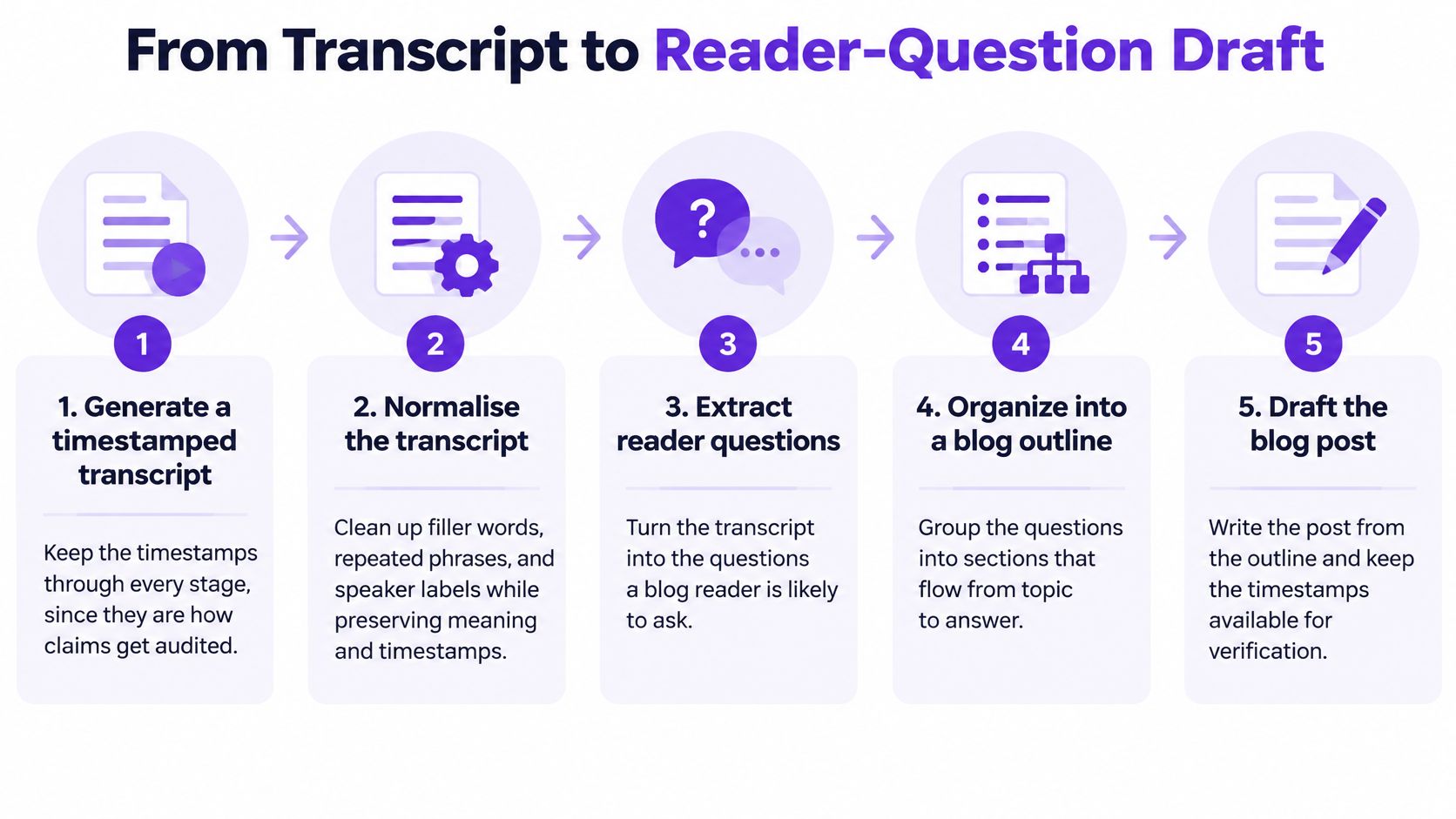
Generate a timestamped transcript. Export speaker labels and timestamps alongside the text, and retain an untouched copy before editing; the MP3-to-text guide covers the transcription starting point. Automated transcription takes minutes rather than hours, so spend the saved time on one check: pick three random timestamps and confirm each lands on the matching moment in the audio. You're done when an editor could audit any claim against the recording.
Normalise speaker turns and verbal clutter. Give each turn a named speaker, then remove filler, repeated phrases, and abandoned sentence openings without strengthening the claim. Merged speakers are the dangerous slip: a guest's tentative suggestion can become an apparently authoritative statement from the host. You're done when every paragraph of the cleaned text belongs to exactly one named person.
Create a topic map before writing prose. Use columns for central thesis, supporting evidence, examples, disagreements, and quotable passages, with timestamps attached to each entry. Leave a cell empty when the episode provides no evidence rather than asking a drafting tool to fill the gap. You're done when every row on the map traces back to a timestamp.
Turn topics into reader questions. Separate branded searches about the show or host from nonbranded searches about a problem. Those are two different readers: one already trusts the guest and wants more, the other has never heard of the show and only wants their question answered. Write headings for the second reader first, since the first will find the episode either way.
Write the short answer before the explanation. Start each section with a direct answer, then add the relevant example, qualification, and supporting passage from the episode. Use H3s for genuine subquestions and reserve a blockquote for an exact, audio-checked quotation, never a polished paraphrase. You're done when each section answers one question a searcher would actually type.
For example, replace the chronological heading Episode Part Two About Editing Costs with How Much Does a Podcast Edit Cost? The latter names a reader's question, but it only works if the conversation contains enough information to answer it. If the guest merely says editing can be expensive, choose a narrower heading about what affects the quote.
For an episode about hiring an editor, your topic map might reveal useful material about scope, revision requests, and handover files. That supports an article about preparing an editing brief, even if the original episode title focuses on the guest's career.
Don't force unrelated passages into the outline just because they contain a desirable keyword. If a section needs outside reporting to become useful, mark that requirement explicitly and distinguish the added material from the guest's contribution. A paragraph that promises what the episode never delivered will lose the reader the moment the answer fails to appear.
This video offers a companion walkthrough for the drafting process.
Use AI for grouping passages and proposing questions, but require it to retain the supporting timestamps and flag missing evidence. A useful drafting instruction is to preserve uncertainty, keep speakers separate, and identify any answer the recording doesn't support.
Finish with the stand-alone answer test. Read each section without the introduction or surrounding headings. If a searcher couldn't understand the answer, its conditions, and what to do next, rewrite it before adding more prose.
Clean sentences can conceal unresolved audio problems. Keep an uncertainty log beside the transcript, recording the timestamp, disputed wording, likely speaker, and action needed. That prevents an unresolved guess from becoming accepted text during successive edits.
Treat hard-audio work as part of the cleanup budget. When a passage requires a bilingual reviewer or subject specialist, schedule that review separately rather than squeezing it into final formatting.
If you still can't resolve a passage, omit the uncertain detail or explain the limitation. Don't invent the missing word because it would make the paragraph flow.
Keep the accessible transcript and edited article as distinct assets. The transcript records the exchange; the article reorganises its useful material. Zencastr's podcast transcript guide discusses accurate, readable transcripts and connecting them with episode metadata and structured data.
Publish the transcript as readable page text rather than only as an image or download. Use clear speaker labels, descriptive headings, and a player that readers can identify without relying on visual placement.
Add PodcastEpisode structured data to the episode page using supported properties for the episode title, associated people, and audio resource. Represent the host and guest through appropriate person and role relationships rather than inventing schema fields named host and guest.
Compare the markup with the live page: the title should match, people should be correctly identified, and the audio URL should resolve to the intended recording. The work is done when the published transcript, visible episode details, and structured data describe the same episode, not merely when a validator reports syntactically valid markup.
A readable transcript isn't necessarily a correct one. In Apple research using 800 segments from 61 American-English podcast episodes, the average conventional word error rate was 9.2%, while a readability-oriented error measure focused on consequential mistakes was 1.4%.
Those measures aren't interchangeable, and neither guarantees accuracy for your recording. The useful editorial distinction is between an awkward comma and a wrong name, number, or attribution. Spend review time on mistakes that change meaning before polishing harmless differences in spoken phrasing.
Keep a claim ledger with the draft passage, timestamp, external reference where needed, status, and reviewer. Use explicit statuses such as open, confirmed, revised, or removed so an editor doesn't mistake a comment for a completed check.
What to check before publishing and how
| Element | Check against | Pass condition |
|---|---|---|
| Proper nouns and titles | Show notes, guest bio, official site | Spelling matches the authoritative source exactly |
| Figures and statistics | Original report or primary source | Number, year, population and measure match |
| URLs and product names | Live page or company page | Link resolves and the name is current |
| Direct quotations | Audio at the cited timestamp | Words match and context is kept |
| Guest opinions | Audio, host note and attribution | Labelled as opinion, not as established fact |
| Technical terms | Glossary or expert reviewer | Meaning and spelling remain consistent across headings and body |
Checking a statistic means more than finding the same number somewhere online. Confirm what was measured, who was included, and when the measurement occurred. A figure about survey respondents shouldn't become a claim about all customers.
For quotations, listen before and after the selected passage. A clipped sentence can reverse the speaker's meaning when it removes a condition, a joke, or a subsequent correction. If you need substantial rewriting for clarity, use attributed paraphrase instead of quotation marks.
Say a guest recommends a particular editing method. You can accurately report that recommendation without presenting it as the best method for everyone. If the guest also makes a factual claim about what a product supports, check the current product documentation independently.
Acceptance gate: No unresolved flags in names, figures, URLs, technical terms, or attributed statements.
Assign a person to close each flag. A repeatable quality assurance process should identify who checks the draft and what prevents publication, rather than ending with a vague request to proofread it.
The verification stage is complete only when attribution is clear and the supporting timestamps remain in the editorial record. If a check fails, return to the audio for what was said and the primary source for whether the factual claim holds. The transcript can help you locate the passage; it can't verify itself.
SEO for a podcast-derived article starts with placement and honesty. Put the subject where readers look first, and make every title, heading, and description match the answer you can deliver. Adding a keyword doesn't repair a page that leaves the reader's question unanswered.
Scannability matters too. Nielsen Norman Group's web-reading study found that 79% of test users scanned new pages, while 16% read word by word. Give those scanners descriptive headings and useful opening sentences, not a transcript broken into decorative subheadings.
Treat title and description length as editorial constraints, not guarantees about how a search engine will display them. Use your CMS preview to spot awkward truncation, and prioritise a complete, accurate promise over filling every available character.
SEO elements for a podcast-derived post
| Element | Rule | Example pattern |
|---|---|---|
| Title | Put the keyword near the front; keep it concise enough to preview clearly | Podcast to Blog Post: Step-by-Step SEO Workflow |
| Meta description | Include the topic and a concrete outcome; remove filler | Turn a podcast to blog post with a reader-led outline, checked facts and practical SEO steps |
| H2 headings | Use a plain phrase naming what the reader gets | Verify Names, Figures and Claims Before Publishing |
| Introduction | Give a direct answer immediately, then establish scope | Explain the transformation and what the reader will produce |
| Episode link | Link the episode title and identify the host beside the player | Descriptive episode title with the host's name |
| Timestamps | Keep audit references and link key quotations when the player supports it | A checked quotation linked to its recording position |
For title decisions, use these SEO title best practices alongside a simple editorial test: would someone unfamiliar with the show understand why this page is relevant?
Suppose an interview explains how to hire a freelance podcast editor. A suitable title is How to Hire a Freelance Podcast Editor, provided the episode explains selection and hiring rather than only describing the guest's work.
Build headings around the supported decisions:
A generic episode recap title gives an existing listener a label but gives an unfamiliar searcher little reason to click. Equally, a detailed hiring title overpromises if the article never explains how to evaluate an editor.
Link to relevant service, glossary, or related-article pages where they help the reader act. Add author credentials and episode details where they clarify responsibility and expertise.
Complete the formatting stage with a promise check: compare every SEO field against the finished article. Remove repeated keywords, unsupported benefits, and headings about subjects the episode never addresses before saving.
Choose a recent episode with a clear central question and a recording you can access easily. Avoid starting with your most complicated panel discussion or an episode full of disputed claims. You're testing an editorial workflow, not proving that every recording deserves a blog post.
Write a short assignment before generating anything: the intended reader, their question, the useful outcome, and the material the episode provides. If you can't state those plainly, select a different episode or narrow the article's scope.
For your first attempt, reserve a focused drafting session and a separate review session. Use the opening workflow's budgets as a starting hypothesis, then log actual time by stage. Include time spent finding references and resolving unclear audio rather than recording only time inside the editor.
Keep a small production record:
A second episode may be easier because you already have templates, but don't assume it will be faster. Compare the work: a clean solo lesson and a technical interview create different review demands.
At Taja AI, we generate one blog post per video, editable with paragraphs, headings, blocks, tables, and uploaded images, video, or audio. Our SEO Optimization feature transcribes the video, captures brand voice, and suggests titles paired with SEO scores; we also create shorts, captioned clips, thumbnails, and platform-ready posts from the recording, then auto-schedule them across your platforms. Those outputs give you a starting point, while you retain responsibility for editorial checks.
Preview the article on a phone and desktop. Test the player, inspect tables, check heading order, and confirm that the transcript remains accessible. Remove production comments and private audit notes from the public page without deleting them from the editorial record.
Publish when the article helps the reader and the evidence is ready, not simply when the draft looks finished.
If an essential claim remains unresolved, delay publication or remove the claim and adjust the article's promise. Don't hide uncertainty behind smoother wording.
Pick the episode, assign its reader question, and set a publish date this week. Run the workflow once, record where the work went, and use that evidence to decide whether to repeat, narrow, or delegate the process.
Taja AI turns a long-form video into an editable blog draft and supporting content, giving you a practical starting point for podcast repurposing. Visit Taja AI to prepare your next episode's draft, then apply the reader-question outline and verification checks before publishing.


We are blessed to work with leading brands & Companies


We try to make easy and simple for every professionals. Get 30 days free trial - No credit card required.


© 2025 Taja AI. All rights reserved.