YouTube Shorts vs TikTok: Which Wins for Creators in 2026
YouTube Shorts vs TikTok compared on specs, reach, algorithms and monetization, with a clear platform pick for creators and brands in 2026.
5 min read
October 27, 2026

Learn resource allocation optimization to stop wasting time and money. This guide covers key methods, a 6-step framework, and common pitfalls to avoid for SMBs.
Written by:


Your week already has a familiar shape. A client wants faster turnaround. Your content calendar is half full. One team member is overloaded, another has gaps in their schedule, and your budget looks fine until you add the hidden cost of context switching, rework, and rushed decisions.
That isn't just a planning problem. It's a resource allocation problem.
For small businesses and creators, resources rarely mean forklifts and factory lines. They mean team bandwidth, cash, time, attention, software, and calendar space. Resource allocation optimization is the discipline of assigning those limited resources where they produce the best outcome under real constraints. Less waste. Better throughput. Fewer fire drills.
Most owners don't struggle because they lack ideas. They struggle because everything important seems urgent at the same time.
A launch needs copy. Existing clients need delivery. Marketing needs consistency. Admin keeps creeping into prime work hours. You hire carefully, but payroll still feels heavy because the issue isn't only headcount. It's how work gets distributed once those people are on the team. If you want a clearer view of what labor costs beyond salary, this guide for founders on employee costs is a useful grounding point.
Poor allocation creates a quiet tax on growth. One manager-focused source says organizations waste approximately 12% of resources because of inefficient allocation practices, which turns what feels like everyday chaos into a measurable operating cost (Rypple's front-line manager guide).
That waste usually doesn't look dramatic. It shows up in smaller ways:
Practical rule: If your team feels busy all week but your highest-priority work keeps slipping, the problem usually isn't effort. It's allocation.
This is why capacity planning matters. A simple planning rhythm often fixes issues that owners mistake for hiring problems. If you need a practical starting point, this piece on team capacity planning is worth bookmarking.
Resource allocation optimization starts when you stop asking, “How do we get everything done?” and start asking, “What should this person, this dollar, and this hour do next?”
Resource allocation optimization means making the best possible trade-offs with what you already have.
Imagine planning a road trip with limited fuel, limited time, and several possible stops. You can't do everything. So you choose a route that fits the constraints and gets you closest to your goal. Business works the same way. You have a fixed team, a finite budget, and a list of projects competing for attention. Optimization helps you choose the mix that creates the strongest result.
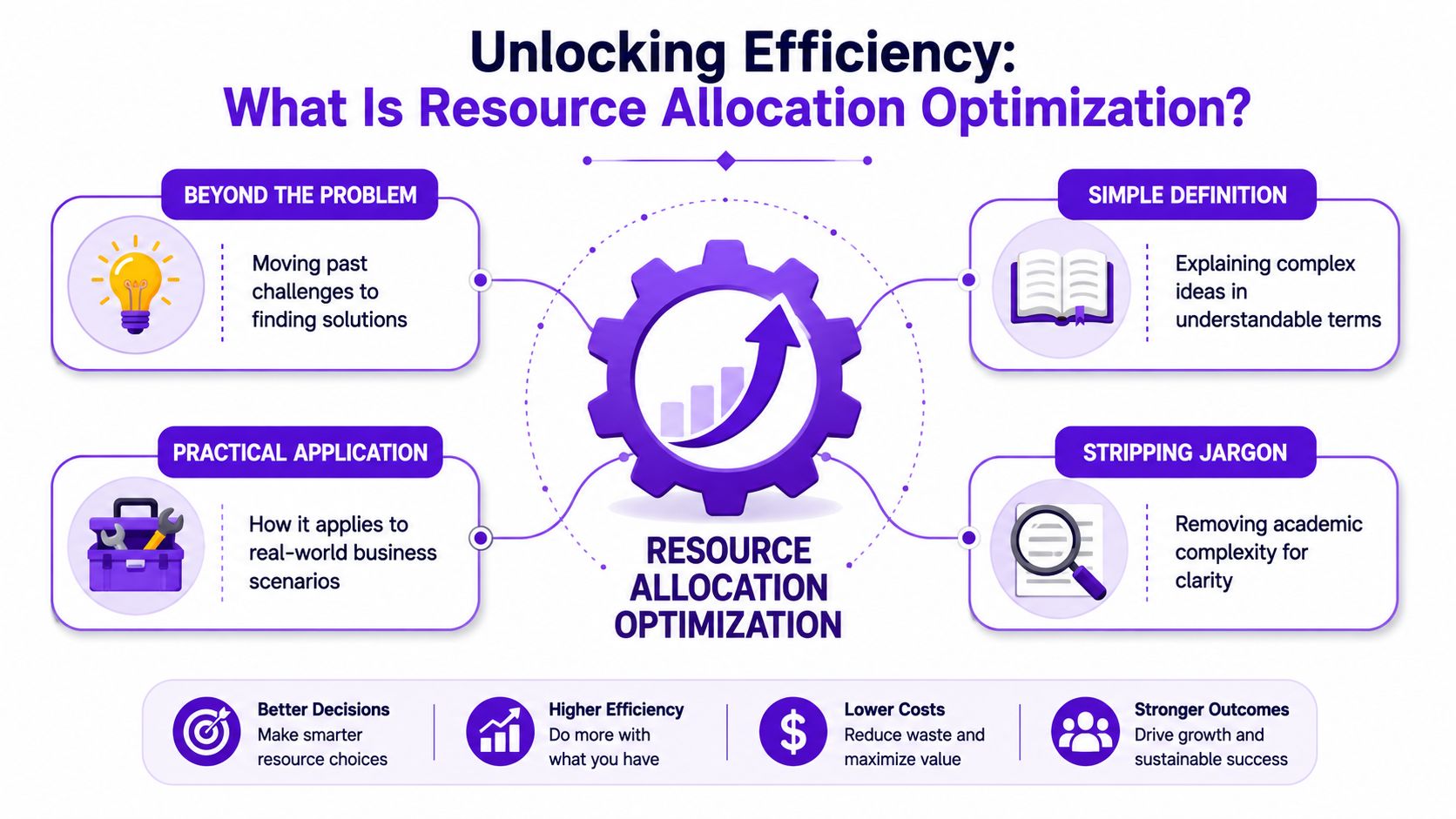
Small business owners often hear “optimization” and assume it belongs in enterprise software demos or academic journals. In practice, it can be as simple as deciding whether your next available ten hours should go to outbound sales, client fulfillment, or repurposing content that already performs.
The point isn't complexity. The point is better decisions under constraints.
A good optimization mindset asks questions like:
This isn't a trendy management phrase. The field gained a rigorous foundation in 1947 with George Dantzig's simplex algorithm, a method for solving linear programming problems that helped managers move from intuition-based allocation to constraint-based optimization (IBM on resource allocation).
You don't need to learn simplex to benefit from the principle behind it. The practical lesson is that allocation decisions improve when you define the goal and constraints clearly instead of relying on instinct alone.
The best allocation decision is rarely “pick the best option.” It's usually “pick the best option given what your business can actually support this week.”
Here's the non-jargon version:
| Business situation | Optimization question |
|---|---|
| Marketing budget | Which channel deserves the next dollar right now |
| Content calendar | Which formats can your team publish consistently without quality slipping |
| Client delivery | Who should handle what work based on skill and available bandwidth |
| Hiring | Is this really a hiring gap, or a scheduling and prioritization gap |
| Operations | Where is work piling up, and what should move to unblock flow |
A creator business might optimize around consistency and distribution. An agency might optimize around on-time delivery and margin protection. A service business might optimize around technician schedules and response times.
Different goal. Same discipline.
You don't need to become technical. But you do need enough vocabulary to recognize what kind of method fits your problem.
Some methods work best when your rules are clear and stable. Others help when things change quickly, data is messy, or the “best” answer depends on human judgment.
Linear programming is the classic model. It works when you want to maximize or minimize something under clear constraints. Consider planning meals with a fixed pantry and budget. If you know the ingredients, the limits, and the goal, this method is powerful.
Heuristics are practical shortcuts. They don't promise the mathematically best answer. They aim for a good answer quickly. This is like packing a suitcase by experience instead of measuring every angle. Owners use heuristics all the time, such as “protect client delivery first” or “never let one editor carry all rush work.”
Rule-based allocation follows preset logic. If task type A appears, assign it to person B unless capacity is full. This works well for recurring operational workflows and simple scheduling.
Simulation lets you test scenarios before committing. What happens if one client expands scope? What if ad spend shifts from one channel to another? This method is useful when the future is uncertain and you want to see how a system behaves.
Predictive allocation uses historical patterns to forecast likely outcomes from different choices. In business terms, it helps answer, “If we assign more of this resource here, what probably happens next?”
Effective models matter when the bottleneck is uneven demand or imbalance. A useful technical lesson from cloud systems is that you often get better results by reallocating resources to the constrained stage instead of scaling everything equally (ScienceDirect on robust resource allocation for skew and consumption issues).
That lesson applies outside tech too. If your content workflow stalls in editing, hiring more writers won't fix the actual bottleneck.
| Method | Best For | Analogy | Complexity |
|---|---|---|---|
| Linear programming | Clear goals and fixed constraints | Meal planning with a strict pantry | Medium |
| Heuristics | Fast decisions in messy environments | Packing a suitcase with rules of thumb | Low |
| Rule-based allocation | Repetitive operational work | If-this-then-that scheduling | Low |
| Simulation | Testing uncertain scenarios | Running practice drills before game day | Medium |
| Predictive allocation | Forecasting likely effects of choices | Estimating traffic before choosing a route | Medium to high |
| Robust models | Bottlenecks and uneven workloads | Adding cashiers to the longest line, not every line | Medium to high |
Most small teams don't need the most advanced model. They need a method they will use.
Start here:
For owners who want a sharper financial lens on operating trade-offs, these CFO insights for Australian SMEs are helpful because allocation decisions are often cash decisions in disguise.
And if your current operation is bogged down by repetitive handoffs, the biggest gain may come from redesigning the process before optimizing the staffing. This overview of workflow automation benefits can help you spot those opportunities.
Theory matters. A working process matters more.
The simplest version of resource allocation optimization for a small business is a repeatable six-step loop. You can run it in a spreadsheet, a project management tool like Asana or ClickUp, or even a shared planning document if your team is small.
Pick one goal. Not five.
If you say you want faster delivery, lower costs, better quality, more leads, less overtime, and more content output, you haven't defined an objective. You've listed hopes. Optimization works only when the target is specific.
For example:
Write the goal in one sentence. Then write what counts as success in plain language.
Decision filter: If two choices compete, the one that serves the stated objective wins.
You don't need perfect data. You need usable data.
For most small businesses, that means collecting the basics in one place:
Bad inputs create bad plans. If your team says a task takes two hours but history shows it takes half a day, your model is already off. The fastest fix is to review the last few weeks of actual work and adjust estimates to match reality.
This sounds more technical than it is.
A model can be a spreadsheet with four columns:
| Work item | Priority | Required resource | Constraint |
|---|---|---|---|
| Client onboarding | High | Ops manager and designer | Must start this week |
| Weekly email | Medium | Copywriter | Needs approval before send |
| Short-form video edits | High | Editor | Limited editing hours |
| Blog refreshes | Low | Content lead | Can move if client work spikes |
The model's job is to make trade-offs visible. It should show what resources exist, what work demands them, and where the constraints sit.
At this stage, many owners jump straight into rearranging tasks. Pause first.
Ask which response fits the problem:
Here's a practical way to think about it. If your content pipeline has plenty of ideas and drafts but very few published assets, don't spend the next week brainstorming. Put your next available time into editing, approvals, scheduling, or repurposing. Optimize the stuck stage.
A quick visual can help you map the process before you change it.
A plan that looks clean on paper can still fail in real operations.
Before locking it in, test the allocation with a few practical questions:
Owner judgment matters. A mathematically neat plan that ignores morale, client expectations, or approval delays usually breaks fast.
Allocation is not a one-time setup. It's an operating rhythm.
The most effective teams review resource use continuously, with monitoring, feedback loops, and visibility into capacity, utilization, and bottlenecks rather than relying on static annual planning, as highlighted in the manager guidance cited earlier in this article. In practical terms, that means a recurring review cadence.
Use a short weekly review:
A small business doesn't need a massive operations department to do this well. It needs a habit. Fifteen focused minutes with the right view of workload can outperform a quarterly planning session built on stale assumptions.
The easiest way to understand resource allocation optimization is to watch it show up in ordinary business decisions.
A small agency manages blogs, short-form video, and newsletters for several clients. Work keeps moving until the review stage. Drafts pile up. Editors become the choke point. Writers keep producing, but nothing ships on time.
The fix isn't to push every department harder. It's to reallocate toward the constrained stage. That might mean fewer new drafts for a week, tighter client approval windows, or moving a senior strategist into final review temporarily. The business improves output by unblocking flow, not by increasing activity everywhere.
A creator with limited ad spend, content production time, and community management hours can't treat every platform equally. Resource optimization means deciding which channel gets attention now, which one gets maintained lightly, and which one gets paused.
That's the same logic a business uses when trimming a content calendar. Not every format deserves the same effort every week. The question is which use of time and budget best supports the current goal.
A full calendar can still be a badly allocated calendar if it's packed with work that doesn't support the priority.
In cloud and analytics workloads, resource allocation is about maximizing performance or minimizing cost under constraints. Modern systems increasingly use predictive models to forecast the impact of different allocations, turning allocation from trial and error into a more model-driven search problem that helps reduce overprovisioning and lower costs (EDBT paper on predictive allocation in analytics workloads).
That sounds technical, but the business lesson is straightforward. If cost rises with usage, guessing gets expensive. Better forecasting helps teams assign the right amount of capacity instead of paying for idle headroom or suffering from underpowered systems.
The same principle applies to paid media, freelance support, and software seats. Predict before you commit whenever usage-based cost is involved.
Most failed optimization efforts don't fail because the owner lacked ambition. They fail because the team optimized the wrong thing, used weak inputs, or ignored how work gets done in real life.
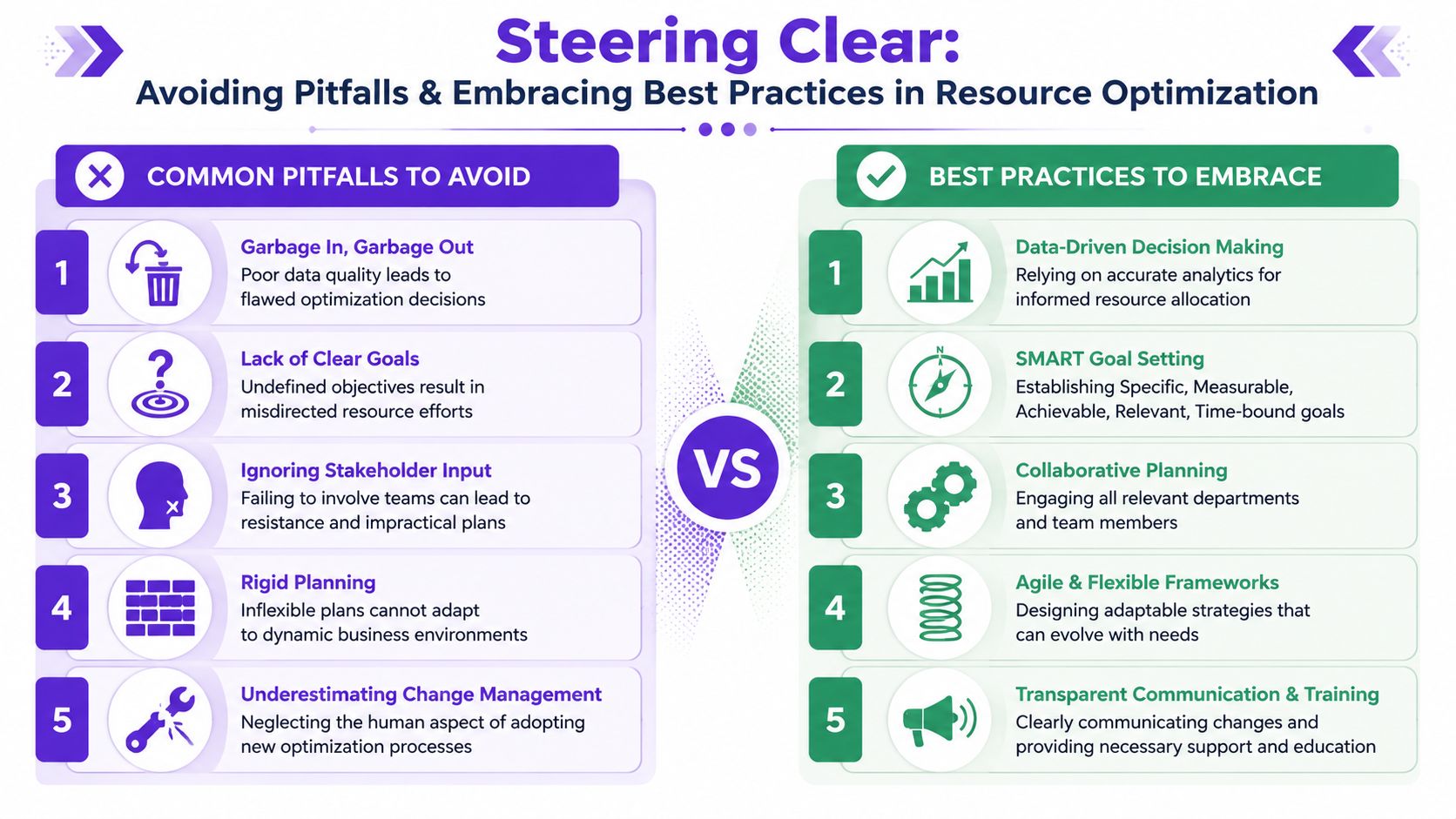
A common failure is focusing on the algorithm before clearly defining the objective, variables, and constraints. The more practical question is not “Which algorithm is best?” but “How do we encode priorities and real-world constraints so the recommendations can be trusted?” (PMC resource allocation review).
That shows up in small businesses all the time. Owners buy advanced tools before agreeing on basics like:
If you don't define those first, software only helps you produce a cleaner version of confusion.
Hours are not equal. Two available hours from a senior closer are not the same as two available hours from a junior coordinator. One design hour in the middle of a launch week may be worth far more than one design hour next month.
A plan breaks when it assumes every open slot can absorb any task.
Use these checks:
Some teams overcomplicate optimization until it becomes unusable. They create elaborate systems with too many variables, too many categories, and too much maintenance.
Keep the model simple enough that someone can update it under pressure. If the system only works when you have a quiet afternoon, it won't survive a busy quarter.
Keep your model as simple as possible, but detailed enough to expose the real constraint.
Allocation decisions affect morale, trust, and adoption. If you move work around without context, people feel whipsawed. If you optimize solely for efficiency, you may burn out the same reliable people who already carry the business.
Good optimization includes communication:
Static plans age fast. Demand changes. Team energy changes. Clients change their minds. Your allocation system has to flex.
The best safeguard is a lightweight review cadence. Short, frequent adjustments beat heroic replanning after things have already slipped.
You do not need a consulting engagement, custom software, or a data science team to start optimizing resources.
You need one problem worth fixing.
Start with the area where waste is easiest to see. Maybe it's your content pipeline, where drafts stack up but publishing lags. Maybe it's your service calendar, where one person gets slammed while others have room. Maybe it's your marketing budget, where you're spreading spend too thin across too many channels.
Pick that one area. Define the objective. List the constraints. Build a basic model in a spreadsheet. Make one allocation change. Review it next week. That's resource allocation optimization in practice.
The businesses that get this right don't always have more people or more budget. They usually have better clarity about what matters most right now, where the bottleneck sits, and what should move next.
If your business feels stretched, optimization is not a corporate buzzword. It's a way to lower stress, reduce waste, and create more output from the resources you already pay for. If content production is one of the areas where time keeps disappearing, this guide to content automation software can help you think through where automation fits into the mix.
If long-form video is sitting in your backlog while your team struggles to turn it into shorts, blogs, captions, and platform-ready posts, Taja AI can help you reallocate that effort intelligently. Upload one video, generate a large batch of publish-ready assets, and reduce the manual work that often clogs content operations for small teams.


We are blessed to work with leading brands & Companies


We try to make easy and simple for every professionals. Get 30 days free trial - No credit card required.


© 2025 Taja AI. All rights reserved.