.jpeg)
8 Reels Best Practices That Drive Views in 2026
Master reels best practices with 8 actionable tactics for hooks, pacing, captions, CTAs, and posting cadence that help short videos grow reach.
5 min read
October 12, 2026

Learn how to improve SEO rankings in 2026 with a practical roadmap covering audits, technical fixes, content, links, and AI search visibility.
Written by:


Organic rankings rose 26% while organic traffic fell 19% between January 2023 and December 2025, and pages showing AI Overviews saw the position-one click-through rate fall from 1.41% to 0.64%, according to recent ranking and traffic analysis. That should change how you approach SEO. A higher position is useful only when it earns visibility, captures a click, generates a lead, or contributes to revenue.
The practical answer to how to improve SEO rankings in 2026 is therefore broader than publishing more articles or adjusting title tags. You need a system that improves technical access, satisfies search intent, earns authority, creates content AI systems can interpret, and measures business outcomes instead of vanity positions.
AI-generated answers now compete with traditional organic listings for attention. Some SaaS sites have already seen more than 1% of traffic initiated by AI results, while AI-referral traffic grew 527% year over year, according to Search Engine Land's analysis of AI-driven search traffic. The discovery problem has changed. Your page may rank well and still lose the click if an AI Overview, featured snippet, or zero-click result resolves the user's question first.

A position-three page can underperform a position-seven page if the latter earns an AI citation, answers a commercial question clearly, or presents a stronger reason to click. That's why every recommendation in this roadmap serves one of three outcomes:
The sequence matters. Begin with a diagnostic, then remove technical barriers, improve content depth and intent alignment, turn video into discoverable assets, earn relevant links, strengthen local signals, and track outcomes. Technical SEO without useful content wastes engineering time. Content without authority struggles to compete. Rankings without conversion tracking leave you guessing.
For a broader set of practical tactics, review these actionable SEO strategies for growth, then apply them selectively to your market, audience, and commercial goals. The winning approach in 2026 isn't to chase every ranking signal. It's to identify the constraint preventing discovery or action and fix that constraint first.
Start with evidence, not a content calendar. A short audit can reveal whether your main problem is indexation, intent, performance, or authority.
Search Google for site:yourdomain.com and compare the apparent indexed footprint with the pages you want found. Look for parameter URLs, faceted navigation, duplicate category pages, old campaign URLs, thin tag archives, and orphaned pages. Then check Google Search Console's indexing report for excluded URLs, crawled-but-not-indexed pages, and recurring technical patterns.
Your objective isn't to force every URL into the index. It's to make sure Google can discover and prioritize the pages that support your business.
Run important templates through PageSpeed Insights and compare the results with Chrome User Experience Report data where available. Check Largest Contentful Paint, Interaction to Next Paint, and Cumulative Layout Shift, the three Core Web Vitals used in the practical workflow described by Search Engine Watch's Core Web Vitals reporting.
Audit templates, not isolated pages. A slow product template, blog template, or location template can affect every URL built from it.
Export your top landing pages and queries from Search Console. For each important query, label the intent as informational, commercial, transactional, or navigational. Then compare that label with the page users reach.
A comparison query shouldn't land on a generic homepage. A local service query shouldn't land on a broad educational article. Intent mismatch often explains weak performance better than missing keywords.
Use Ahrefs or Semrush to inspect referring domains, anchor text, lost links, and links pointing to your strongest competitors. Focus on unique, relevant domains, not the raw backlink total. Large-scale ranking analysis has repeatedly found a strong relationship between referring domains and rankings, including one analysis of 11.8 million Google results that found the first result had 3.8 times more backlinks than results in positions two through ten, as summarized by Surfer's ranking-factor overview.
Put every finding into one sheet with four columns:
This sheet determines what happens next. Index bloat belongs in the technical queue. Intent mismatch belongs in content. Weak referring domains belong in link earning. Poor local profile coverage belongs in the local workstream.
Technical SEO should remove friction, not become an endless checklist. Fix the problems that prevent important pages from being crawled, understood, indexed, or used.
Review faceted navigation, internal search results, URL parameters, duplicate archives, redirect chains, and orphan pages. Don't spend the next month publishing new articles while Google repeatedly crawls low-value URL variations. Consolidate overlapping pages, improve canonical signals, repair broken internal links, and make XML sitemaps reflect the URLs you want indexed.
Treat Core Web Vitals as a tiebreaker after relevance and authority, not as a substitute for either. Independent reporting indicates that 56% of desktop pages and 48% of mobile pages still fail the CWV threshold, so moving important templates from failing to passing can create a useful competitive advantage, even though the effect is more modest than content depth and backlinks.
Audit each template for render-blocking assets, oversized images, excessive JavaScript execution, and unstable layout elements. Compress and serve images in modern formats, defer nonessential scripts, reserve space for media, and retest the same templates after deployment.
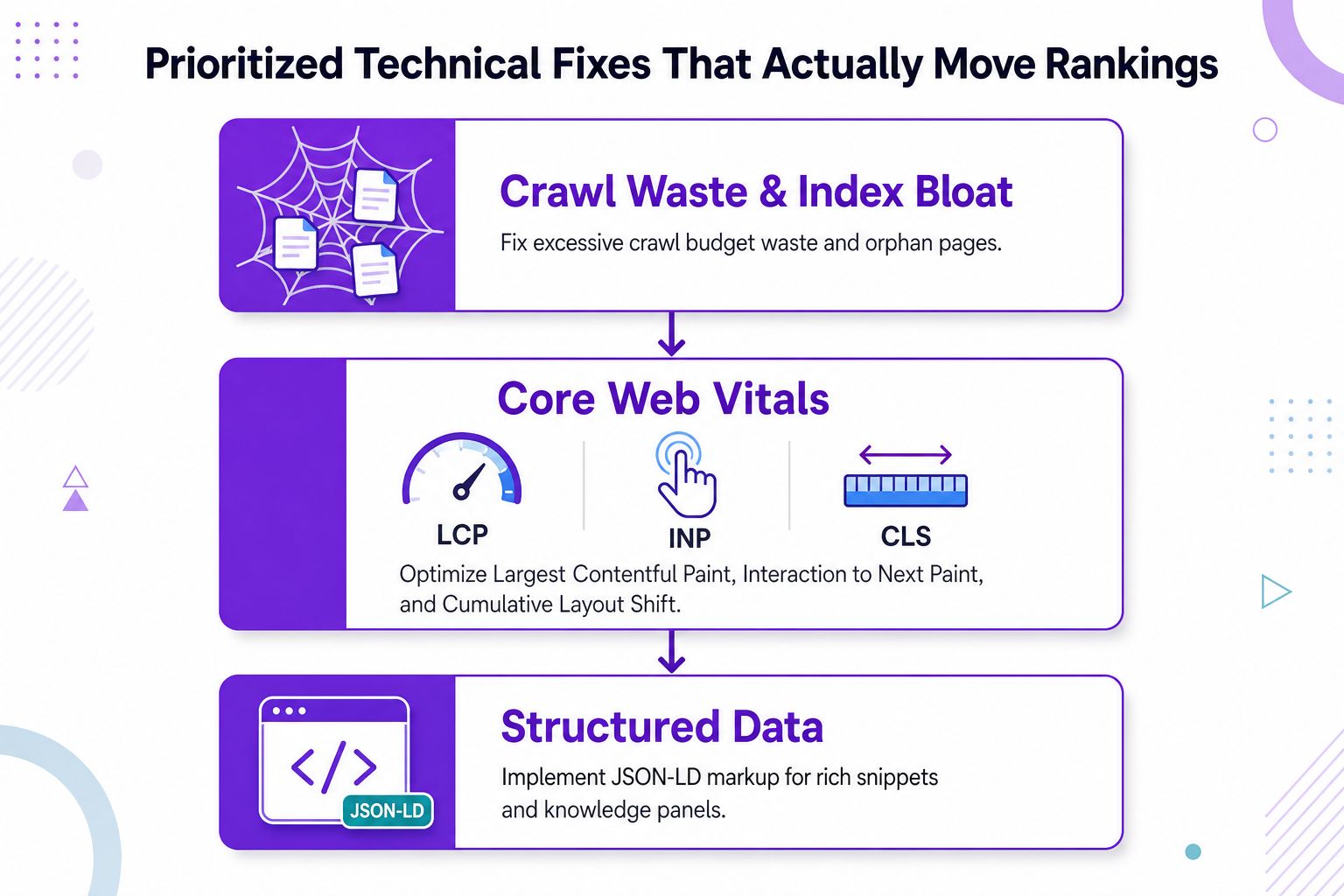
Use the Rich Results Test to validate structured data, then check whether the markup describes what users see. A product page needs product information. An article needs article information. A local business page needs accurate business details. Schema won't rescue thin content or create eligibility where the page doesn't qualify.
Internal links are the next practical layer. Every new post should link down to two relevant existing pages and up to one parent pillar page. Use descriptive anchors, place links where they help readers, and revisit older pages that receive few internal links.
For a deeper technical review, use this site speed and security audit as a reference point when checking performance and technical risk.
Don't waste engineering hours on meta keywords, repeated H1 rewrites, or cosmetic URL changes that don't solve a documented problem. Technical work earns priority when it improves crawl efficiency, indexing, rendering, interpretation, or conversion.
Keyword density is an outdated target. A page can mention a phrase repeatedly and still fail because it doesn't answer the question, cover necessary entities, or provide enough evidence for a confident decision.
One recent ranking-factor summary lists content depth at a correlation of 0.62, behind backlinks but ahead of many technical and schema-related factors, as reported in the content-quality research summary. Correlation isn't causation, but the direction is strategically useful. Pages that resolve the query in full give both users and AI systems more material to evaluate and cite.
Map each target query to one primary intent. Then inspect the current results and match the expected format. A guide should not imitate a product page. A service page should not bury its offer beneath an encyclopedia-style introduction.
Rate each area as weak, adequate, or strong:
Suppose a thin article says that local SEO matters but gives no process. A stronger rewrite defines Google Business Profile optimization, review recency, categories, local landing pages, NAP consistency, response practices, and conversion tracking. It adds firsthand examples, a clear checklist, and an FAQ that answers the questions buyers ask before contacting the business. That rewrite improves usefulness and creates concise passages an AI system can interpret.
Use AI tools for keyword research to expand question and entity discovery, but keep editorial judgment in control. Tools can surface patterns. They can't verify expertise or decide what a buyer needs.
| Signal | Correlation | Trend vs 2024 |
|---|---|---|
| Content depth | 0.62 | Listed as a top signal in the 2026 summary |
| Backlinks | Higher than content depth | Remains a leading authority signal |
| Schema-related factors | Below content depth | More supportive than foundational |
Before publishing, check the title, H1 parity, schema, internal anchors, author and business proof, source quality, and answer-first structure. A page should make its subject obvious to both a hurried reader and a retrieval system.
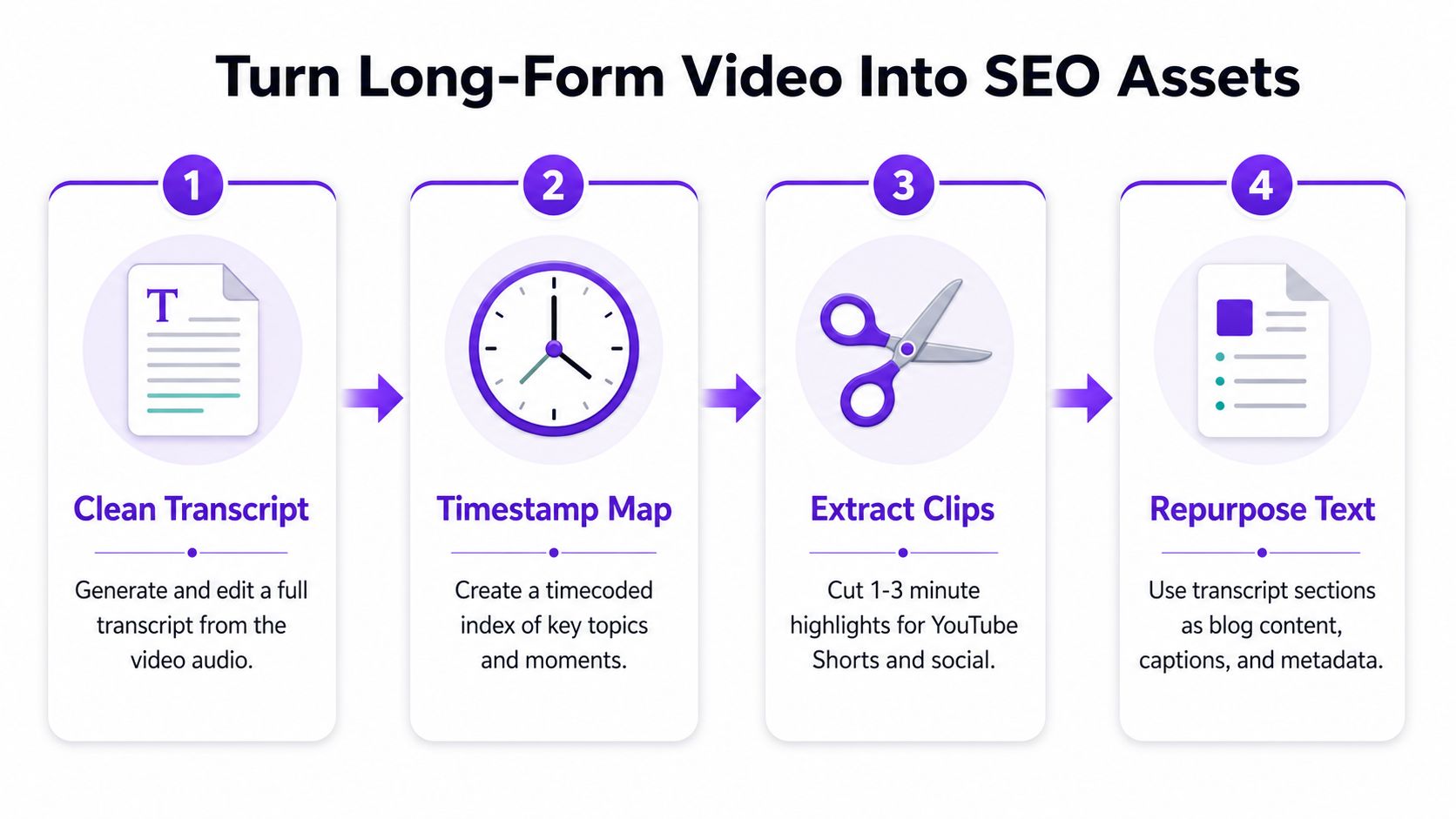
Long-form video contains questions, explanations, examples, and language your audience already uses. Treating it as one upload wastes the research and production behind it. The goal is to create a connected asset set that supports YouTube discovery, web search, AI citations, and conversion.
Start with a clean transcript. Remove false starts, correct names and technical terms, and separate the speaker's claims from off-topic discussion. Next, create a timestamp map that groups the recording into meaningful sections. Don't use generic labels such as “Part one.” Name the actual topic, problem, or question covered.
Extract long-tail keyword clusters from real viewer questions, comments, sales calls, and the transcript itself. A question like “how do I improve local rankings outside the city center?” can become a video chapter, a blog heading, a short clip, and an FAQ answer.
Put a concise summary above the fold so visitors understand the value immediately. Embed the video at the point where visual explanation adds the most value, rather than placing it automatically after the introduction. Follow the embed with a deeper written section that covers details the video couldn't address, such as implementation notes, templates, sources, or decision criteria.
A useful production sequence looks like this:
For transcript-led production, a tool such as Taja AI's video transcript generator can fit into the initial extraction stage. The editorial team still needs to review the output before publication.
Add captions, VideoObject schema where appropriate, descriptive titles, chapters, internal links, and a clear next action. A six-asset workflow can include the original video, a transcript-informed article, short clips, a carousel, quote graphics, and an email or social post. Ship the first versions quickly, then improve them based on actual impressions, clicks, and audience response.
Link building should mean link earning from relevant publishers, not buying directory volume. A relevant referring domain with a real audience can contribute more strategically than a collection of unrelated submissions because it can reinforce topical authority and introduce qualified visitors.
Build a prospect list of publishers that already rank for your topic. Qualify each site by relevance, audience quality, existing linking behavior, and whether it publishes the format you can provide. Then match the outreach angle to the publication instead of sending the same pitch everywhere.
Five realistic assets can attract attention without a large PR department:
The pitch should be short. Use a subject line that names the topic and asset, give a one-line value statement, provide proof in the next line, and make a low-friction request. Ask whether the editor would consider reviewing the resource, not whether they can “please add a link.”
Outreach rule: Make the publisher's next action obvious, useful, and easy to decline.
Run the channel monthly:
This cadence turns video, editorial work, and outreach into a compounding system. It also keeps link acquisition connected to click capture and revenue instead of treating links as an isolated score.
Local SEO rewards operational consistency. A complete Google Business Profile, steady review activity, and consistent business information give Google clearer evidence about who you serve and where you operate.
A 2026 local ranking analysis found Google Business Profile completeness correlated at 0.71 with top local-pack rankings. Review velocity over the previous 90 days correlated at 0.64, while total review count correlated at 0.41, as reported by Visionary Marketing's local SEO ranking analysis. The practical lesson is simple. Keep the profile complete and earn fresh reviews consistently instead of running occasional volume campaigns.
Fill every relevant category, service, attribute, description, photo, hours, and service-area field. Keep the business name, address, phone number, and landing-page details aligned. Add accurate photos that show the team, location, work, or finished result.
Google's proximity priorities also matter. A business outside the map centroid may need stronger relevance and prominence signals, but it shouldn't create fake locations or misleading addresses. Build useful service-area pages, explain coverage, and make the local value proposition clear.
Ask for a review shortly after the customer receives the service, while the experience is still recent. SMS often creates a more direct path than email, provided the customer has consented to receive messages. Keep the wording neutral and ask for an honest account rather than demanding positive language.
Reply as the owner or business representative. Thank the customer, mention the service naturally, and address the specific experience they described. Avoid robotic keyword insertion. A useful response sounds like a person who remembers the job.
Claim and audit the local sources your customers and partners use, including chambers of commerce, industry associations, trusted directories, and relevant local organizations. Check NAP data quarterly because old phone numbers, former addresses, and inconsistent business names can persist for years.
Video can support local trust when it shows real work and answers buyer questions. A practical example of this format is local business video marketing, especially when videos link to the matching service or location page.
Your dashboard should answer one question: did the work create more qualified business opportunities? Rank position is useful diagnostic information, but it isn't the final KPI.
Track branded and non-branded organic sessions separately. Branded growth can indicate demand or successful distribution, while non-branded performance shows whether your SEO work is reaching new prospects. Monitor impressions where the average position is strong but clicks remain weak. That pattern can indicate AI Overviews, featured snippets, or other search features are absorbing attention.
Measure conversion rate by landing-page template, not only by channel. A blog visitor, local service visitor, product visitor, and returning branded visitor behave differently. Track form submissions, calls, bookings, purchases, and qualified lead events. Keep local-pack conversions separate from blue-link clicks because users may call or request directions without visiting the website.
Connect GA4 to Looker Studio for sessions, engagement, conversions, landing pages, and revenue. Pair it with a rank tracker that exports keyword, URL, feature, and competitor data. Create a segment for pages targeting queries that regularly show AI Overviews, then compare impressions, clicks, click-through rate, assisted conversions, and direct conversions.
| KPI | Source | Review Cadence |
|---|---|---|
| Branded and non-branded sessions | GA4 and Search Console | Weekly |
| Impressions with weak click capture | Search Console and rank tracker | Weekly |
| Conversion rate by landing-page template | GA4 | Weekly |
| Local-pack actions | Google Business Profile and CRM | Weekly |
| Assisted organic revenue | GA4 and CRM | Monthly |
| AI Overview citation competitors | Rank tracker and manual SERP checks | Monthly |
| Priority audit issues | Audit sheet and project tracker | Quarterly |
Keep the review cadence disciplined:
Use a simple experimentation loop. Define a hypothesis, choose a measurable outcome, ship one meaningful change, hold it through two index cycles, then keep, kill, or expand the change. If you rewrite the page, change the internal links, alter the template, and launch new promotion at the same time, you won't know what caused the result.
The traffic disconnect matters here. Rankings can rise while visits fall, especially when AI summaries satisfy the query before a user reaches your page. Report both visibility and value, then improve the page's reason to be clicked. Add original evidence, useful tools, clearer comparisons, stronger calls to action, or a more direct path to the next commercial step.
SEO in 2026 is a discovery and demand-capture discipline. Improve rankings where they help AI systems find you, earn clicks where users still need depth, and build conversion paths that turn visibility into revenue.
Taja AI helps turn long-form video into search-ready transcripts, clips, captions, blog assets, thumbnails, and platform-specific posts, which can support the content and distribution workflow described above. Visit Taja AI to explore a practical way to produce and optimize more discoverable content from each recording.


We are blessed to work with leading brands & Companies


We try to make easy and simple for every professionals. Get 30 days free trial - No credit card required.


© 2025 Taja AI. All rights reserved.