.jpeg)
Repurposing Content on LinkedIn: A Practical 2026 Guide
Learn repurposing content on LinkedIn with a 2026 playbook that turns long-form videos and posts into carousels, captions, and scheduled assets that convert.
5 min read
September 16, 2026

Learn how to grow podcast audience with a proven system covering SEO, repurposing, and retention tactics for solo creators.
Written by:


You hit publish, share the episode once, and then the silence starts. The audio is solid, the conversation is sharp, maybe the guest even promoted it once, but the listener graph barely moves. That's the point where most creators blame the show itself, when the primary issue is usually discovery, distribution, and a missing entry path for first-time listeners.
A podcast doesn't grow because it exists. It grows because people can find it, start it, and keep listening. That's why the old “just make good content” advice falls apart. Growth comes from a system built around niche clarity, SEO-shaped episodes, multi-platform distribution, and retention.
The good news is that podcast growth is no longer locked inside one platform. When Apple Podcasts opened its directory to third-party podcasts in June 2005, podcasting moved from a manually downloaded niche into a searchable distribution channel. That history still matters, because today's audience growth depends on indexability, clear titles, good descriptions, and being present wherever listeners already search.
A lot of podcasters know this scene too well. The episode is edited, the cover art looks clean, the social post goes out, and then the next morning brings a few polite likes and almost no meaningful lift. The show feels alive to the creator and invisible to everyone else.
That gap usually gets misread as a content problem. In practice, it's often a findability problem. The episode may be good, but if the title doesn't match what people search for, if the description doesn't say who it's for, and if the show only lives in one or two places, the right listener never gets a clean path in.
Audio quality matters, but it isn't the bottleneck once a show is technically listenable. The bottleneck is whether a stranger can identify the value in a glance and know where to start. That's why growth strategy has to treat the episode like a discovery asset, not just a creative artifact.
Practical rule: if a new listener can't tell who the episode is for, what problem it solves, and where they should begin, the episode isn't positioned for growth yet.
The earliest mistake is overestimating what a single publish action can do. A show usually needs a repeatable path from search, to click, to start point, to follow. That path doesn't happen by accident, it comes from design.
The most useful lens is simple. Every episode should do four jobs at once, it should make the niche obvious, it should be searchable, it should travel across multiple channels, and it should help first-time listeners stay long enough to come back.
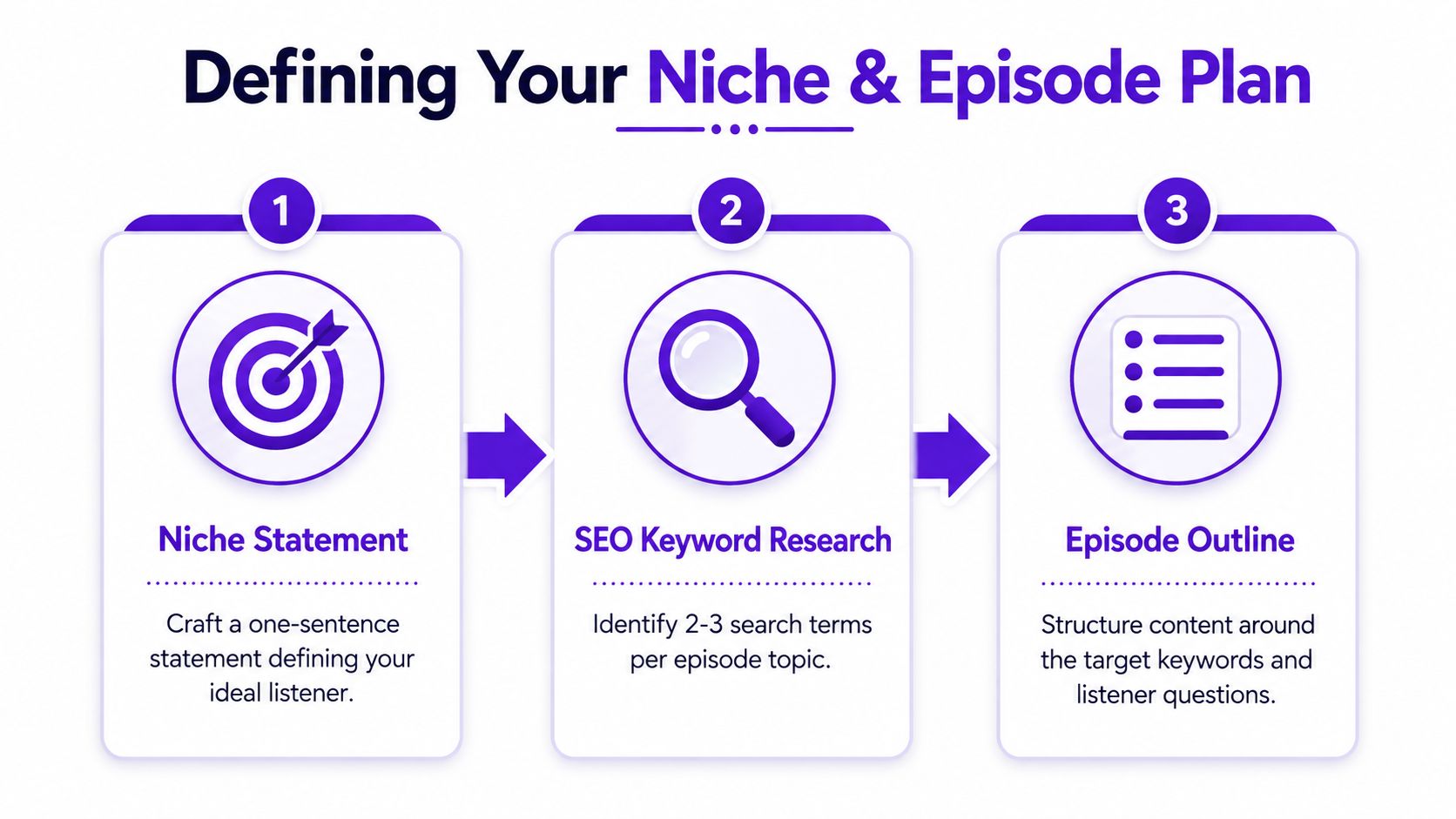
The cleanest way to start is with one sentence. Write down exactly who the show is for, what change they want, and why they should trust your angle. If that sentence takes three lines, the niche is too broad.
A useful niche statement sounds like a filter, not a slogan. For example, “I make practical marketing advice for solo service businesses that want leads from recorded content” is clearer than “I talk about marketing and business.” The first tells you what to make, what to leave out, and what search intent to target.
Once the niche is sharp, build 2 to 3 episode clusters around 10 to 20 long-tail keyword phrases that real people would type into Spotify, YouTube, or Google. Then draft 10 SEO-shaped titles for each cluster so you're not trapped by the first clever headline that comes to mind. The point is to give each episode a discoverable angle before you ever record.
That workflow pairs well with show notes, timestamps, and a landing page that captures email signups and episode-page views. The producer's job is to reduce friction for both humans and crawlers. If the episode page says exactly what the listener gets, and the timestamps make the structure obvious, search engines and people both have less work to do.
Use a transcript-first workflow for episode pages if your production process already starts with spoken content. It helps keep the text layer aligned with the episode itself, which makes the whole package easier to index and easier to skim.
A simple pre-recording checklist keeps this repeatable:
The value here is timing. Discoverability gets front-loaded before release, so the episode is findable the moment it goes live instead of weeks later after you've already moved on to the next one.
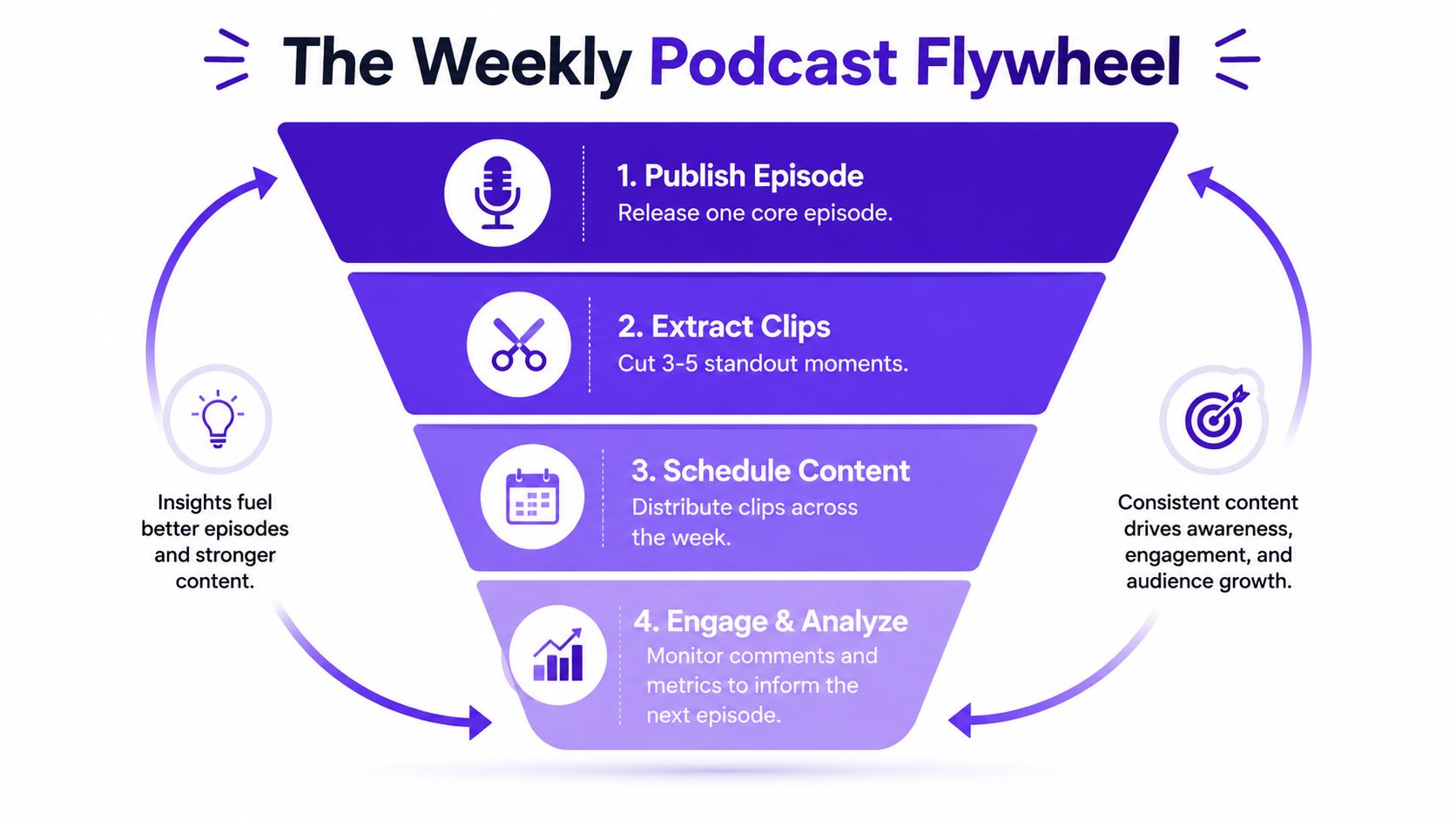
The most efficient growth loop is not a content calendar, it's a flywheel. One episode becomes several assets, those assets bring people back to the episode or a curated start point, and the response tells you what to repeat next week.
The first move is publishing a useful episode with a clear purpose. The second is extracting standout moments, because strong clips aren't random highlights, they're the lines that carry one idea cleanly on their own. The third is distributing 3 to 5 micro-clips, then sending traffic to a “Best Place to Start” episode or playlist instead of dumping new listeners into a random recent upload.
Spotify's guidance around a Best Place to Start is practical because first-time listeners need orientation. A starter episode reduces the confusion that happens when someone lands in the middle of a show's inside jokes, repeated segments, or advanced topics. Custom episode thumbnails or cover art can also support click-through on mobile, desktop, and TV because the visual package helps the episode stand out in a crowded feed.
A lot of creators invest in gear before they fix the pipeline. If you're still dialing in the recording setup, these podcast gear tips from Freeform House are useful because they focus on the equipment choices that support a smoother production process without turning setup into a hobby of its own.
The tracking layer is where the flywheel starts to earn its keep. Watch which clips generate follows and which start points keep people engaged long enough to move to another episode. The exact patterns will vary by show, but the decision rule stays the same, repeat what converts, retire what doesn't.
The next episode should be informed by the last episode's best-performing cut, not by a blank calendar slot.
That feedback loop is what makes the system compound. Without it, the show keeps producing content. With it, the show starts producing evidence about what people respond to.
Most creators are told to post everywhere. That advice feels ambitious, but it usually spreads effort too thin. The better question is simpler, where does your audience already search, browse, and subscribe, and which channel moves them from curiosity to a follow?
Search-led channels, social-led channels, and community-led channels each behave differently. YouTube and podcast SEO work well when your niche has explicit questions and problem-solving intent. TikTok and Reels help when your audience responds to quick hooks and personality. Newsletters and Discord work better when the relationship itself is the product.
Start by asking one question for your niche, what kind of action does a listener take when they're interested? If they search first, lead with discoverability. If they watch first, lead with short video. If they need trust before commitment, lead with owned community.
The trap is trying to run all three at once before one of them earns its place. A two-episode test is usually enough to see whether a channel deserves a larger share of time. If it doesn't produce follows, replies, clicks, or email opt-ins, it's probably a secondary channel, not the primary one.
| Audience Behavior | Lead Channel | Secondary Channel | Why It Converts |
|---|---|---|---|
| People search for answers before they choose | YouTube or podcast SEO | Newsletter | Search intent brings in listeners who already want the topic |
| People react to fast, visual hooks | TikTok or Reels | Podcast page | Short-form clips can create the first click |
| People want ongoing access and trust | Newsletter or Discord | Social clips | Owned communication supports repeat engagement |
| People follow experts in a topic cluster | Search plus episode pages | Cross-promotion | Clear topical depth makes the show easier to follow |
If you want a distribution lens that matches this decision process, the distribution guidance from Taja AI is a useful internal reference point because it aligns channel choice with where a show converts instead of where it gets views.
The goal is to stop treating every platform as equally important. One channel should carry most of the pressure. The others should support it.
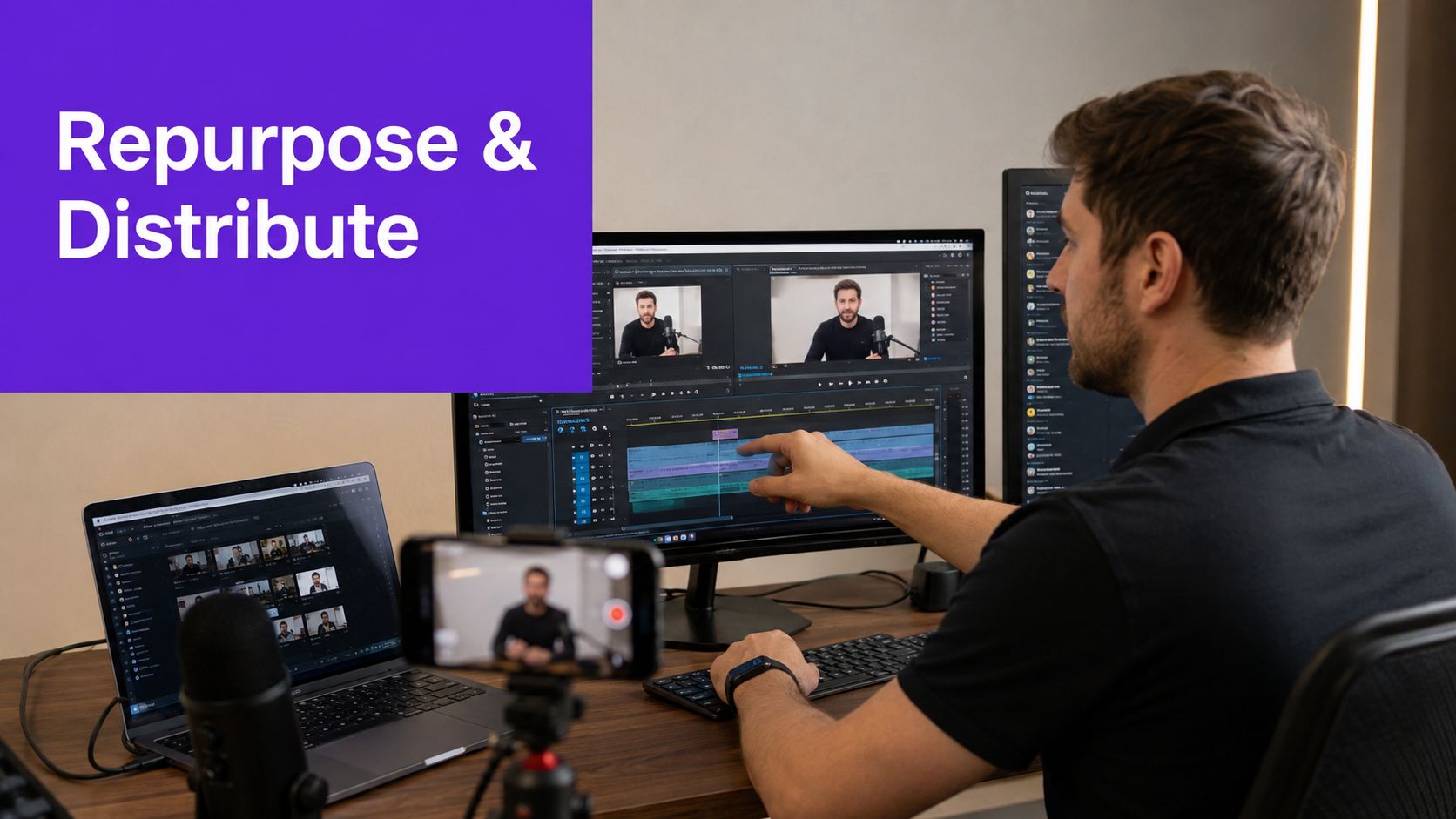
A single episode can carry a full week of distribution if repurposing is treated as production, not cleanup. The episode is the source asset, and every clip, post, and recap is an extraction from it. That shift matters because it keeps you from inventing fresh ideas for each platform and turns one recording into a repeatable system.
A practical repurposing map usually includes 3 to 5 short vertical clips, 2 to 3 quote graphics, a blog or newsletter recap, and platform-native posts for LinkedIn, X, or Facebook. If the show also lives on YouTube, a cut designed for that platform can extend the same core message without forcing a separate script. The goal is to build one episode into several entry points, then let each format do a different job.
Good clips have a hook in the first few seconds, one idea per cut, and captions baked in. If the clip takes too long to explain, it is not a clip. If it depends on the listener already knowing the episode, it is probably the wrong excerpt.
Vertical formatting by default saves time because it avoids resizing later. It also keeps the edit focused on the moment that matters, the point when a stranger decides whether to keep watching. That decision happens fast, so the edit should respect that.
Learn more about how to automate content creation to streamline this workflow.
A tool can help here if the workflow is already overloaded. Taja AI turns long-form video into shorts, clips, captions, thumbnails, blogs, and platform-specific posts from one upload, which fits the repurposing model described here. It gives creators one place to handle asset generation and scheduling instead of stitching together separate tools for every output.
The most useful version of this workflow is review-based, not creation-based. Check whether the clip has a clean opening, whether the caption supports the message, and whether the thumbnail fits the platform. That means less time making every asset from scratch and more time choosing which ones deserve attention. It also makes the weekly distribution pass easier to repeat, because the same standards can be applied to every episode.
The reason this matters is simple. One episode cannot do everything by itself, but a well-structured asset stack can make that episode visible in several places without turning the week into a production marathon.
The first thirty days decide a lot. A listener sees a clip, clicks through, lands on a page, and either finds a clear place to start or drifts away. That's why growth without retention is a leak, not a funnel.
A Best Place to Start episode should be pinned wherever first-time listeners are likely to enter. Pair that with playlists grouped by theme, and the show suddenly feels navigable instead of sprawling. When a new listener can follow a topic path, they're more likely to keep moving through the catalog.
A welcome email on subscribe helps because it creates an immediate next step. A predictable release cadence helps because people start to expect the next drop instead of stumbling onto it. Clean chapter markers, a consistent intro length, and transcripts for accessibility all signal that the show is organized for real use, not just publication.
The relationship deepens when the show makes room for listener feedback and Q&A without adding a full extra production layer. A few carefully chosen questions can turn casual attention into participation. Participation is what gives a show a memory.
Retention is not about forcing more content into people's feeds. It's about making the experience easy to continue. Once that happens, the first episode becomes the start of a habit instead of a one-time visit.
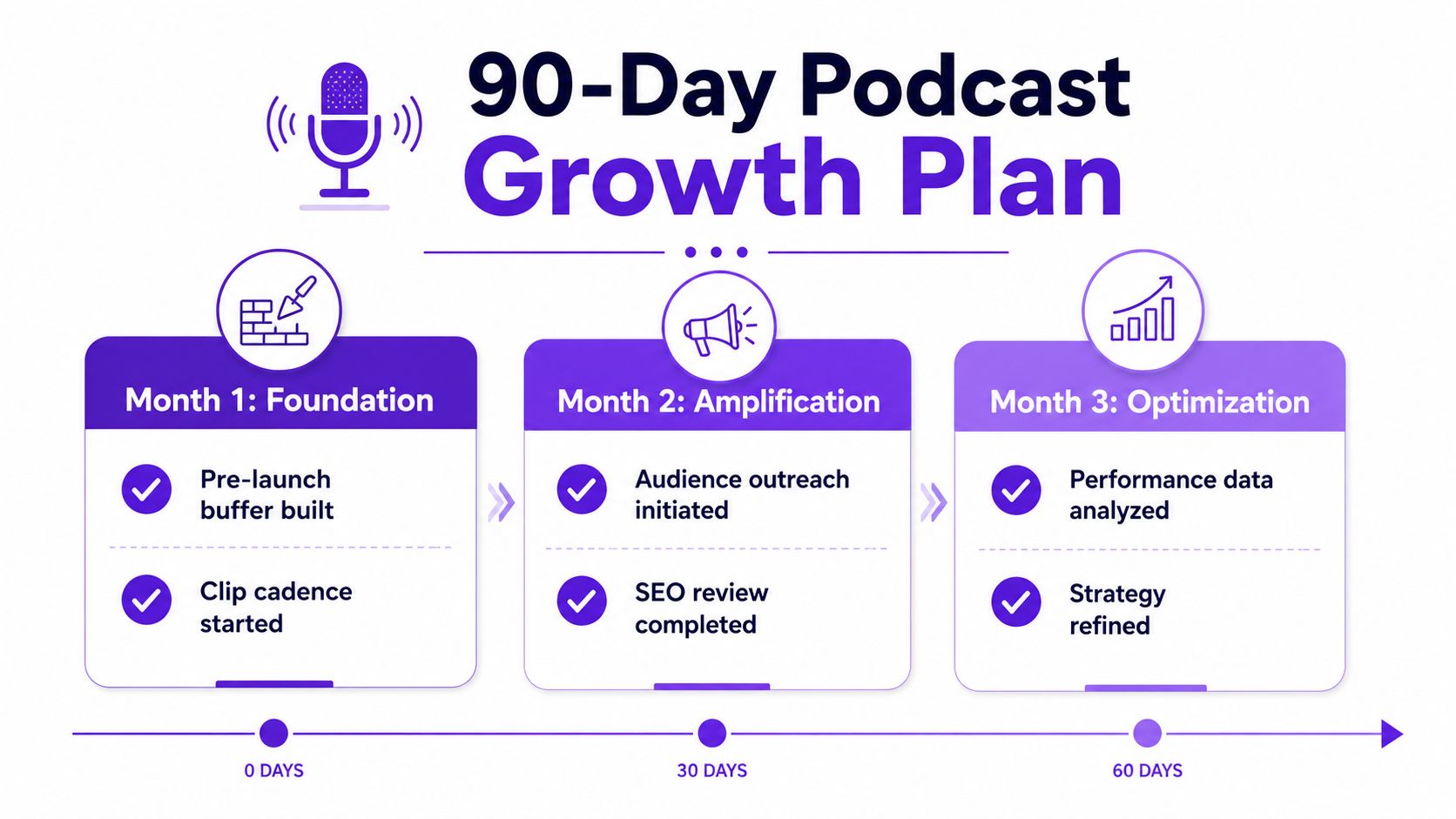
A usable 90-day plan does not try to repair everything at once. It starts with the foundation, widens distribution next, then tightens the parts that turn interest into listeners. That keeps the workload realistic for solo creators and prevents the process from turning into a constant guessing game.
Month one should protect the pre-launch buffer and establish the clip cadence. Month two should add audience outreach and review the SEO layer on episode pages. Month three should focus on performance data and strategy refinement so the next cycle starts from evidence instead of hope.
The rhythm matters because growth usually stalls in one of three places. A show can be easy to find but hard to understand, easy to sample but hard to keep, or easy to enjoy but hard to share. A 90-day plan gives each phase a separate job.
Keep the dashboard short. Track unique listeners, follows per episode, average consumption percentage, click-through from clips to the show, and email opt-ins from the episode page. Those numbers matter because they show whether people are discovering the show, sticking with it, and taking a next step.
If a metric does not change a production decision, it does not need a weekly meeting.
That rule keeps the system from getting buried in vanity reporting. The point of measurement is to decide what gets repeated next week, what gets rewritten, and what gets dropped.
A strong growth plan ties research, flywheel, channel choice, repurposing, and retention into one loop. That is what makes the show sustainable. It gives each episode a job before recording starts and a purpose after it goes live. If you want a faster way to turn long episodes into clips, captions, thumbnails, blogs, and platform-ready posts, Taja AI is built for that workflow. It helps creators package one recording into a multi-channel system, which is exactly what this growth model depends on. Visit Taja AI if you want to see how that kind of repurposing fits into your podcast process.


We are blessed to work with leading brands & Companies


We try to make easy and simple for every professionals. Get 30 days free trial - No credit card required.


© 2025 Taja AI. All rights reserved.