How to Promote Your YouTube Video Free: 7 Steps That Work
Learn how to promote your YouTube video free with packaging, playlists, Shorts clips, community sharing and analytics checks that show what works.
5 min read
November 15, 2026

Wondering how long should tik tok videos be? Match length to your goal using 2026 platform limits, engagement data and a simple test.
Written by:


TikTok videos longer than three minutes received more than twice as many views, on average, as videos lasting 6–10 seconds, according to Buffer's 2024 analysis. That's a useful challenge to the advice to keep everything short. It's not a reason to stretch every clip.
So, how long should TikTok videos be? Choose the length that matches the viewer's next decision: stop scrolling, understand a tip, trust an explanation, or act on an offer. For a business repurposing a long recording, the useful unit isn't one perfect-length video. It's a set of cuts, each with a distinct job and a relevant measure of success.
A quote can work without background. A tutorial often can't. Forcing the same runtime on both means either padding the quote or stripping out the explanation that makes the tutorial credible, so the length question starts with the job each cut has to do.
That is why one recording rarely produces one video. A single long-form clip can yield a hook that earns the stop, a tip that earns the reply, and a tutorial that earns the minutes. Each cut answers to a different measure, and each deserves its own length decision.
Use the table as an editing plan to test against your own retention data. One row carries a platform specification: TikTok's reservation in-feed advertising specifications recommend 9–15 seconds within an allowed 5–60-second range for that placement.
| Goal | Typical length | Best use |
|---|---|---|
| Hook, quote or awareness test | A few seconds | One punchy idea with a visual payoff |
| Retargeting pattern interrupt | A few seconds, cut tighter than the first exposure | Short re-engagement hook for people who saw earlier content |
| Focused tip or lead message | Up to about a minute | One problem and one solution |
| Paid in-feed ad | 9–15 seconds | Offer, proof and call to action inside the placement's 5–60-second range |
| Tutorial, interview or explainer | A minute or more, when the explanation needs it | Full sequence with enough context to follow the explanation |
The shortest cuts should stand on their own, even when they introduce a larger subject. A hook that requires viewers to find another video before it makes sense is an incomplete sentence, and it fails the job it was cut for.
Length earns its place through substance. For a focused tip, include the problem, the useful answer, and any qualification needed to avoid misleading the viewer. For a tutorial or interview, keep the sequence that makes the explanation credible. A longer runtime padded with a slower introduction gives retention data nothing to reward.
An analysis of 1.1 million TikTok videos, described by eMarketer, found that only about 12% exceeded one minute, yet those videos achieved 43.2% more reach and 63.8% more watch time than videos lasting 30–60 seconds. Median watch time in the same analysis was 11.3 seconds for videos over a minute, against 6.9 seconds for the shorter comparison group.
Read the two figures together. Longer videos accumulated far more viewing while a typical viewer watched a small fraction of the runtime. Reach can grow without sustained attention, so the advantage belongs in the reach column of a funnel plan; it does not prove audiences sat through the full explanation.
The comparison also leaves causation open. Topic selection, audience fit, presentation and distribution may all contribute to the difference, so treat the gap as a reason to test longer cuts and then confirm the effect against your own numbers.
Practical rule: Pick the goal before the runtime. Then ask whether viewers stayed long enough to receive the value that goal requires.
If your immediate objective is interaction, the engagement comparison gives you a sensible starting point. It doesn't give you a universal editing rule.
The Socialinsider duration analysis reported the following engagement rates, with the 15–30-second category ranking highest.
| Video length | Engagement rate |
|---|---|
| Up to 15 seconds | 5.90% |
| 15–30 seconds | 6.00% |
| 30–60 seconds | 4.20% |
| 60–90 seconds | 4.80% |
| 90–120 seconds | 5.15% |
| 120–180 seconds | 5.50% |
| Over 180 seconds | 5.90% |
The pattern isn't a steady decline as videos get longer. Engagement drops in the middle, then rises across the longer categories. That's a stronger argument against a simple short-versus-long rule than it is an argument for any precise runtime.
For a straightforward tip, start near the strongest short-form band. Put the useful answer early, remove repeated context, and make the payoff clear enough that someone can respond without watching again to understand it.
The lowest-performing band deserves attention, but it doesn't establish why those videos underperformed. You can't conclude from the table alone that their middles were slow, their hooks were weak, or their topics were less appealing.
Those are editing hypotheses to test, not findings from the comparison.
If your own clips in that band disappoint, inspect the transition from setup to explanation. A video can be too long for a simple observation yet too compressed for a convincing demonstration. The remedy might be a tighter edit, or it might be more useful proof.
Engagement rate isn't total reach, and neither is total watch time. A video can generate a smaller proportion of interactions while reaching more people overall.
For a local service business, that distinction changes the decision. An entertaining clip might attract conversation without explaining who the service is for. A detailed explanation might attract fewer casual reactions but prompt a relevant inquiry.
Use the table to choose a test range, not to declare a winner before publishing. The useful comparison is between videos serving the same purpose, with attention to both viewer behavior and the action your business needs.
TikTok's duration history explains why older editing advice can feel inconsistent. The platform expanded its publishing options, but permission to upload a longer video isn't a recommendation to make one.
PostNext's account of TikTok's length milestones traces the progression from 15-second videos to 60 seconds, then to three-minute videos in July 2021 and support for longer videos in 2022. It also records TikTok's May 2024 confirmation of a limited 60-minute upload test in selected markets, with broad availability not immediately planned.
That last distinction matters when planning content today. A historical test announcement doesn't establish what every account can upload now. Check the available options in your own app before committing to a long-format production.
Say a real-estate professional records a conversation about preparing a home for sale. The recording includes a useful warning about repairs, an explanation of pricing decisions, and a detailed walkthrough of staging choices.
The source recording should preserve the full conversation. The TikTok edit should preserve only what its particular promise requires.
This approach separates capture length from publishing length. You don't have to rush the original conversation just because some outputs will be short. Equally, you don't need to publish the full conversation because it was recorded well.
Treat the upload limit as a ceiling, not a target.
Before planning long episodes, confirm the upload options available to the account that will publish them. Also review whether the material works vertically and whether important visual details remain readable.
If the explanation needs a diagram, demonstration, or comparison, account for that in the recording. A longer upload allowance won't fix a shot that hides the essential evidence.
The planning question is therefore less about how much footage TikTok accepts and more about what the viewer needs to understand. Build the edit around that requirement, then check that the account supports the format.
In an analysis of short-video advertising published through ACM, 85.2% of users exited during the first quarter of the ad, while mean video duration was 56.7 seconds. That's a warning about early attention in the advertising context studied, not a universal organic TikTok benchmark.
Keep the viewer's decision to continue in mind when reviewing an opening.

A polished explanation can still begin in the wrong place. Introductions, scene-setting, and credentials may be useful eventually, but they shouldn't delay the reason someone would care about the topic.
Use a direct sequence: state the result or problem, show evidence, then give the next step. This makes the opening a promise the rest of the clip can fulfill.
Consider these hypothetical edits:
Choosing a strong excerpt isn't permission to distort it. A provocative sentence that loses its qualification may attract attention while weakening trust. Use the same context-preserving approach when making a highlight reel.
Use this video as a prompt to review where your own clips begin.
Inspect retention around the first quarter, midpoint, and ending. A sharp early decline suggests reviewing the hook, the relevance of the opening visual, and whether the promised answer is clear.
If viewers stay through the explanation but leave during the closing remarks, test moving the next step earlier or cutting the repeated summary. Don't shorten the useful demonstration merely to preserve a long sign-off.
Before publishing, check relevance, clarity, and delivery. Can viewers recognize their problem? Can they tell what they'll learn? Does the clip begin providing that value rather than merely announcing it?
A large observational study of 347 TikTok users covering 9.2 million recommended-video views found that 24% of views ended before viewers watched 20% of the video, according to the ACM paper on TikTok viewing behavior. That gives early abandonment a concrete place in your testing plan.
A longer cut shouldn't win just because it contains more footage. It should retain enough attention to justify the additional explanation.
Use the following workflow as a practical comparison, not a laboratory experiment. Organic distribution won't give you perfectly matched audiences.
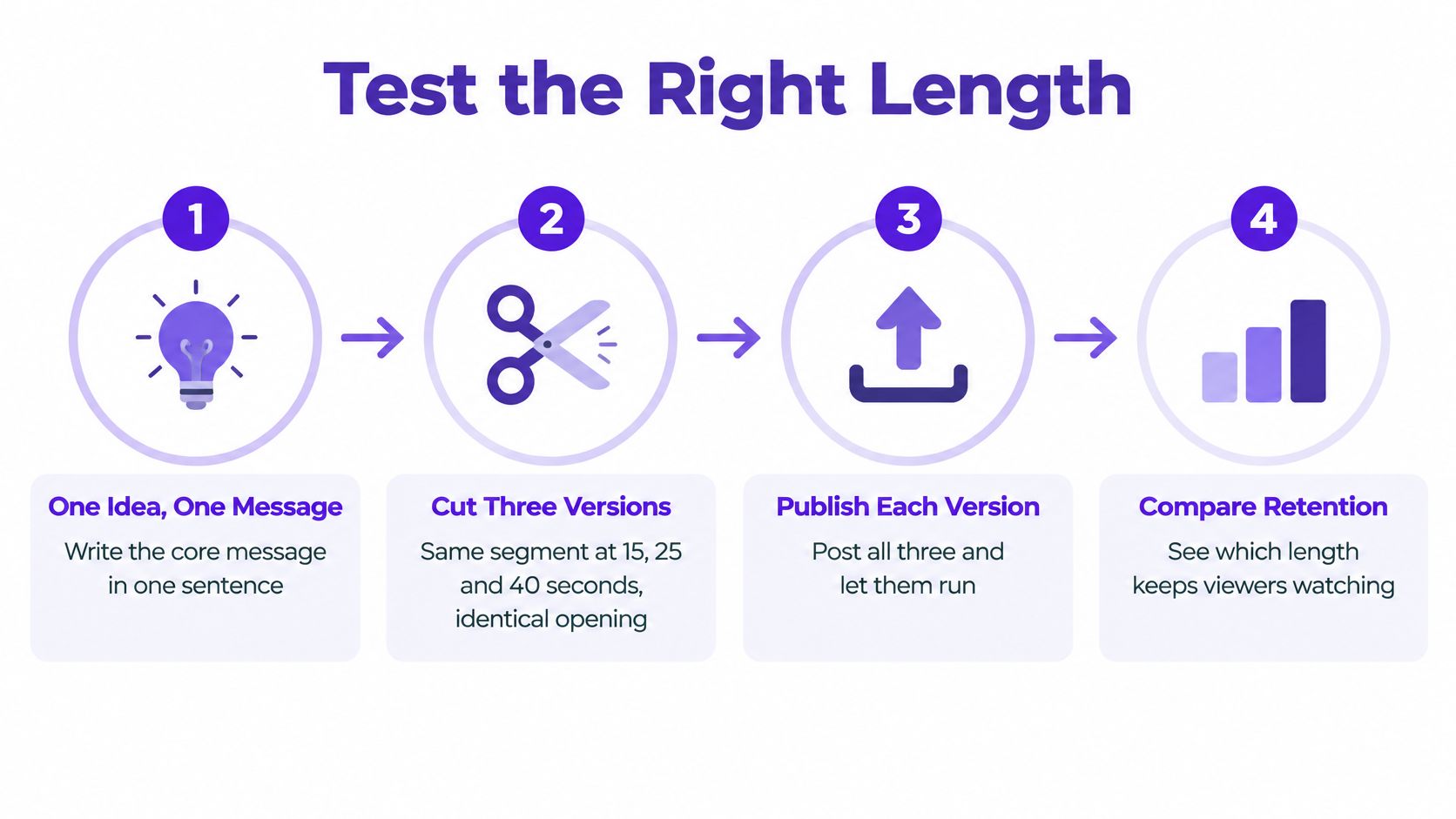
Choose one source idea. Write its core message in a sentence, such as explaining how a homeowner can recognize a leaking toilet seal. Keep unrelated maintenance advice out of every version.
Cut a brief, intermediate, and expanded version of the same segment, keeping the opening identical. For example, an editing test could use approximately 15, 25, and 40 seconds, with each cut still delivering a complete answer.
Publish under comparable conditions. Use a similar posting window, audience focus, caption approach, and presentation so you're not intentionally changing several variables at once.
Record average watch time, average watch percentage, completion, shares, saves, and comments. Also mark retention at the first quarter, midpoint, and ending, using whatever detail the account's analytics provides.
Compare the intermediate cut with the brief version. If viewers stay through the added explanation and average watch time improves meaningfully, the extra context has a defensible purpose.
Revise the weak segment rather than trimming blindly. Remove pauses, repeated setup, or a detour; split the topic only when each resulting post can still answer a useful question.
Keep the strongest length as a working default for that goal. Revisit it across subsequent uploads rather than treating one successful post as a permanent rule.
Average watch percentage helps you judge how much of the available runtime viewers consumed. Average watch time shows the attention received in time, while total watch time also reflects how many views the post received.
That distinction prevents a common mistake: crediting the edit for a total that mainly increased because distribution increased. Track both per-view attention and overall exposure.
A spreadsheet is sufficient to begin. If you're comparing a larger library, use video analytics tools to organize posts by goal, topic, format, and length rather than ranking everything in one list.
A longer cut earns its place when the added explanation produces more useful attention without worsening early abandonment.
If retention improves but relevant inquiries fall, inspect the offer and next step too. Duration testing should support the business objective, not become a separate contest to maximize viewing.
An organic explanation and a paid invitation don't need identical edits. The organic post may need to establish understanding; the ad may need to help a suitable viewer recognize an offer and take the next step.
The reservation in-feed recommendation is also placement-specific. Don't turn it into a rule for every TikTok advertising product, and don't treat an organic reach comparison as a paid-media forecast.
The comparison below is a starting distinction, not a requirement that every organic post be long.

Consider a hypothetical plumber's campaign. The paid version shows the service area, the repair offer, credible supporting evidence, and a clear contact action. The organic version follows the diagnosis of a real type of fault, showing why the repair is necessary.
For a real-estate agent, an organic neighborhood tour can explain the trade-offs between nearby amenities, street layout, and property types. A paid teaser can focus on the specific buyer the listing suits and invite that buyer to request details.
A faith community might publish an organic testimony with enough context to preserve the speaker's meaning. Its paid invitation can instead make the gathering's purpose, location, and registration step easy to understand.
These aren't shorter and longer copies. They answer different questions.
| Editing decision | Organic explanation | Paid invitation |
|---|---|---|
| Main viewer question | Is this useful or credible? | Is this relevant to me? |
| Evidence to retain | Reasoning, demonstration, or narrative context | Proof that supports the offer |
| Ending | A relevant continuation or next step | A clear action tied to the campaign |
| Primary evaluation | Attention and relevant audience actions | Cost per intended result |
For organic posts, review watch time alongside profile visits and relevant responses. For paid placements, connect spend to the intended result, such as inquiries, bookings, or registrations.
Don't assume every second is billed separately. The economic issue is that you're paying for distribution, so creative that delays the offer can consume budget without producing the intended action.
Likewise, a low-cost click isn't automatically a useful result. Check whether the landing page, inquiry, or booking matches the audience the creative promised to reach.
Before choosing the edit, ask: How much explanation does this claim need before the viewer can reasonably trust it? Then include that evidence without making the viewer sit through unrelated context.
Start with a recording that contains several useful moments, not with a target runtime. A customer interview, educational session, property walkthrough, or podcast conversation can support different posts because each excerpt answers a different question.
The important planning step is to label the role of each cut before editing. That keeps a discovery clip from carrying an entire sales explanation and stops a detailed demonstration from being judged only on casual views.
Build a simple editing sheet with the source timestamp, core promise, funnel role, next action, and measurement. Use these roles deliberately:
Say an educator records a lesson about preparing for an interview. The discovery cut could challenge a common preparation mistake. The consideration cut could demonstrate how to improve an answer, while the conversion cut could explain who a coaching session is designed to help.
These cuts may share source footage, but they shouldn't repeat the same message with different endings. Each needs a reason to exist.
At Taja AI, we turn a long-form video into shorts, captioned clips, thumbnails, and platform-ready posts, with clips vertical and under 60 seconds by default. Optimized and repurposed content is ready on our dashboard about 30 minutes after the video is added to the playlist; the free trial supports up to 4 long-form videos, and auto-scheduling supports YouTube, Instagram, TikTok, Facebook, X, and LinkedIn.
Review generated cuts against their intended roles before scheduling. Check that captions preserve the speaker's meaning, the opening matches the payoff, and the excerpt includes any qualification needed to make the claim accurate.
A default output length is a production setting, not proof that the length is right for every topic. Keep an expanded edit when the demonstration requires it, and remove footage when it contributes nothing to the viewer's decision.
A useful TikTok content strategy should make room for explanation as well as discovery. Publishing only hooks leaves interested viewers without depth; publishing only detailed explanations gives you fewer concise entry points.
Choose one recording for your next production session. Create a brief cut, a focused explanation, and an expanded version, assign each a goal, and use comparable publishing conditions to learn which edit best serves that goal.
Taja AI helps turn a long recording into captioned clips and platform-ready content, so you can spend more time reviewing the message and less time preparing every asset manually. Visit Taja AI to repurpose your next recording, build a set of goal-specific cuts, and let viewer retention guide your editing decisions.


We are blessed to work with leading brands & Companies


We try to make easy and simple for every professionals. Get 30 days free trial - No credit card required.


© 2025 Taja AI. All rights reserved.