How to Auto Generate Captions on TikTok: A Complete Guide
Learn how to auto generate captions on TikTok with this step-by-step guide. Master native tools, fix errors, and optimize for accessibility and SEO.
5 min read
October 20, 2026

Master content gap analysis with our guide. Identify missing topics, analyze competitors, and create content for real growth in 2026.
Written by:


You're probably in one of two situations.
You've been publishing steadily, but traffic and leads aren't moving the way they should. Or you have a backlog of posts, videos, guides, and landing pages, yet every planning session still feels like starting from zero.
That usually isn't a production problem. It's a coverage problem. Your content exists, but it doesn't fully match what buyers need, what competitors already answer well, and what your own library could do better. That's where content gap analysis stops being an SEO exercise and becomes a practical growth system.
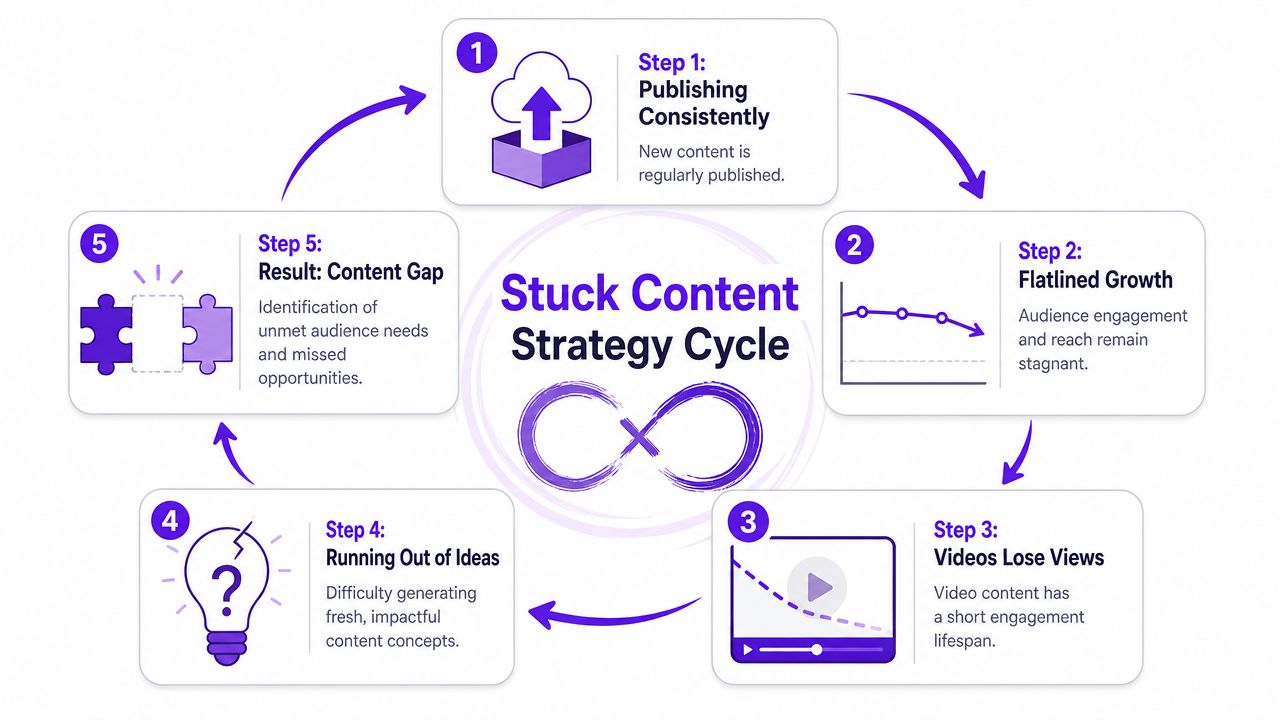
Most stalled content programs look active from the outside. The team publishes. Social posts go out. Videos get initial attention. A few blog posts rank. Then momentum fades.
The pattern is familiar. You keep creating, but the output doesn't compound because the underlying strategy is thin. You're reacting to ideas instead of building coverage around buyer questions, decision points, and competitive weak spots.
Founders often assume they need better brainstorming. Usually they need better diagnosis.
A proper content gap analysis compares what you already publish against a target state. That target state includes audience intent, competitor coverage, and the outcomes you want from content. Heretto describes the process as a six-step workflow: define goals and objectives, understand users, audit existing content, identify gaps, create new content, and measure results in order to close the difference between current performance and the desired state with new or revised assets (Heretto's content gap analysis guide).
That matters because content teams don't get stuck from lack of effort. They get stuck when all content problems are treated like one generic issue. In practice, different gaps require different fixes. Sometimes you need a new page. Sometimes you need a refresh. Sometimes you need to expand an existing topic so it covers a missing question or secondary angle.
A working content engine does a few things consistently:
Practical rule: If your editorial calendar is full but your pipeline is thin, stop asking what to post next and start asking what your buyers still can't find.
This is why experienced teams run gap analysis as an operating discipline, not a one-time audit. At scale, the work is data heavy. Brafton notes that keyword exports for a single domain often fall in the 10,000 to 20,000 keyword range, which shows how far this process has moved beyond casual editorial review into structured research across large opportunity sets (Brafton on content gap analysis).
If you work in a niche market, that same logic still applies. The dataset may be smaller, but the problem is identical. You need a clear view of what exists, what's missing, and what deserves another pass. That's also why vertical examples help. If you want to see how this plays out in a local, trust-driven category, this breakdown of mastering real estate content marketing is useful because it shows how content has to support both visibility and lead quality.
The fastest way to waste a month is to open Semrush or Ahrefs before you've decided what the content needs to do.
A lot of founders chase topic opportunities that look promising in a spreadsheet but have no clear link to revenue, pipeline, or qualified inquiries. Traffic without a business purpose feels good for a while. Then it becomes expensive noise.
Backlinko frames content gap analysis around the buyer's journey and competitive visibility, which is exactly where most small teams need discipline. It's not just about finding terms you don't rank for. It's about identifying the missing content that should support the different stages of how your audience discovers, evaluates, and chooses a solution (Backlinko's content gap overview).
That changes how you evaluate opportunities.
A top-of-funnel topic can be valuable if you need awareness. A mid-funnel comparison piece can matter more if prospects already know the problem and are choosing vendors. A bottom-of-funnel page may have less broad appeal but far more direct commercial value.
Use a simple map before you touch keyword data:
One practical detail many teams miss is timing. Backlinko points to reviewing top-performing blogs across a 12-month period to account for seasonality. That's a strong planning habit because it keeps you from overreacting to a short spike or slump and pushes content planning toward annual market coverage instead of short-term page tinkering.
If your audience behaves differently by season, event cycle, or budget cycle, a short lookback can mislead you. A founder who only studies the last month may wrongly conclude a topic has no value when it peaks at another time of year.
Before running any gap report, write down the outcomes the content must support.
Some useful examples:
If your content also feeds short-form channels, your goals should reflect that ecosystem. A blog post can support search, email, clips, carousels, and follow-up video content when the original topic is chosen well. That's one reason teams exploring AI-assisted workflows often rethink planning itself before production. This guide to AI for social media marketing is a useful reference point because it shows how distribution strategy breaks down when the source material isn't aligned with audience intent in the first place.
Don't ask, “What keyword should we go after?” first. Ask, “What buyer decision are we trying to influence?”
That one shift filters out a surprising amount of junk. It also keeps your content gap analysis tied to outcomes you can defend.
Before you look at competitors, look inward.
Most businesses already have enough raw material to uncover obvious wins. They just haven't organized it well enough to see patterns. A content audit doesn't need to be complicated, but it does need to be complete.

Use a spreadsheet or Airtable base. Put every meaningful asset in one place. That includes blog posts, service pages, landing pages, videos, webinars, guides, and pillar pages.
Track fields that help you make decisions, not fields that just make the sheet look thorough:
If you have analytics access, add organic traffic trends, impressions, clicks, average engagement, and assisted conversions. If you don't have clean conversion data, use directional notes rather than pretending the attribution is precise.
Here, audits start producing value. Every asset should land in a practical bucket.
These are pages or videos that already pull consistent visibility, branded search support, or qualified action. Don't “refresh” them casually. Protect internal links, update examples carefully, and preserve the structural elements that are already working.
This bucket often creates the best return. These assets have topic relevance and some traction, but the page is incomplete, outdated, poorly structured, or missing important subtopics. Often the gap isn't that the content exists. It's that it doesn't fully answer the intent.
Some content isn't helping. It may target irrelevant topics, thin variants, or outdated offers. If a piece adds confusion, competes with better pages, or weakens your topical map, archive it, merge it, or redirect it.
Founders with a video backlog usually find a lot here. A webinar can become a guide. A strong Q&A clip can become a FAQ section. A long podcast answer can become a comparison article or a short educational sequence.
Audit insight: Don't treat every old asset as a ranking candidate. Some pieces are better used as source material for stronger formats.
Once the inventory is visible, patterns jump out. You may notice that you publish lots of awareness content but almost nothing for buyers comparing options. Or you may have several videos on a topic with no supporting article, no recap post, and no decision-stage page to capture intent.
That's what makes content gap analysis broader than SEO. You're not only asking, “What keyword are we missing?” You're asking, “Where is the ecosystem thin?”
A healthy audit usually reveals three things quickly:
That's a better starting point than jumping straight into competitor reports.
This is the part commonly associated with content gap analysis. It matters, but it only works when you've already clarified goals and audited your own library.
If you skip those steps, a competitor report becomes a giant list of other people's ideas. That's not strategy. That's imitation with extra tabs open.
Use a keyword gap tool in Ahrefs or Semrush, but be selective about who goes into the comparison. You don't need every large publisher in your industry. You need businesses competing for the same attention and the same buyer intent.
A practical mix usually includes:
Semrush notes that advanced workflows commonly compare a domain against 1 to 3 competitors, and that large gap reports can exceed 100,000 keywords, which is exactly why unfocused teams drown in data instead of finding useful opportunities (Semrush on content gap analysis).
Raw exports are noisy. A good report starts broad and gets narrow fast.
Here's the filtering sequence that works well in practice:
Start with missing and untapped terms
Focus on topics you don't rank for at all, or where at least one competitor has coverage and you don't.
Remove branded and low-value noise
Strip out competitor brand terms, irrelevant product names, and topics outside your commercial lane.
Keep commercially relevant intent
Prioritize terms tied to services, problems, comparisons, workflows, implementation, or decision support.
Use a floor for meaningful demand
Semrush's guidance highlights prioritizing terms with at least 20 monthly searches when narrowing reports. That threshold won't fit every niche perfectly, but it's a useful guardrail against spending energy on ideas with little proven demand.
Group by topic cluster, not isolated keyword
A single topic often contains several related terms. Plan coverage at the cluster level so you don't create thin pages for every variation.
The biggest competitor-gap mistake isn't missing opportunities. It's treating a massive export like a to-do list.
Even after filtering, don't publish directly from the spreadsheet. Search the term. Study what ranks. Look at the format, angle, and intent.
Ask practical questions:
This matters a lot in local and vertical markets. For example, someone working on optimizing real estate visibility needs a very different content plan from a SaaS founder, even if both use SEO tools to find gaps. The mechanics are similar. The buyer intent is not.
Competitor gap reports often push people toward blog posts by default. That's too narrow.
A gap might be better filled with:
Later in the workflow, that format decision matters as much as the topic itself.
A quick visual example of how teams think about scheduled, multi-format output can help before you turn gaps into production:
The right lesson here isn't “publish everywhere.” It's “choose gaps that can support multiple useful assets once the core topic is validated.”
Once you've finished the audit and competitor review, you'll probably have more ideas than your team can execute well.
A common breakdown in content strategy occurs when teams confuse having a backlog with having a roadmap. They aren't the same thing.
A simple scoring model is enough for most founders. Rate each topic against three criteria:
Then total the score and sort.
| Content Gap Prioritization Framework | ||||
|---|---|---|---|---|
| Topic Idea | Business Value (1-5) | Audience Potential (1-5) | Effort (1=High, 5=Low) | Total Score |
| Service comparison page | 5 | 4 | 3 | 12 |
| Beginner educational guide | 3 | 5 | 4 | 12 |
| FAQ expansion for existing service page | 4 | 3 | 5 | 12 |
| Deep industry explainer | 3 | 4 | 2 | 9 |
| Webinar recap article | 2 | 3 | 4 | 9 |
This kind of table does two useful things. It slows down impulsive publishing, and it makes trade-offs visible.
A topic can have decent search potential and still rank low if it won't help the business. Another topic can have modest audience reach but win because it directly supports decision-stage buyers.
Not every gap deserves a long-form blog post. That's one of the most common planning errors I see.
Use the intent to decide the format:
Choose articles, guides, or landing pages when the topic requires explanation, comparisons, examples, or strong internal linking. This is usually the right move for complex buyer questions and search-first discovery.
If buyers need to see a workflow, watch a walkthrough, or build trust with the person behind the offer, video often carries more weight than text alone.
Short clips, carousels, and brief platform-native posts work best when they pull attention toward a stronger core asset. On their own, they rarely solve a major content gap. Paired with a substantial primary piece, they extend its lifespan.
Decision test: If a topic is important enough to rank for, it's usually important enough to support more than one format.
The most efficient content teams don't create isolated pieces. They create a central asset, then expand around it.
A useful workflow looks like this:
If you're trying to reduce production drag while keeping quality high, systems matter as much as ideas. That's why automation is most useful after prioritization, not before it. A workflow resource like automate content creation is valuable here because it supports scaling the output around a chosen topic instead of producing disconnected assets.
A strong prioritization process doesn't just tell you what to make first. It tells you what not to make at all.
A content gap analysis only matters if it changes performance.
Once new pages are live and older assets are refreshed, go back to the business goals you set at the start. Track whether the work improved visibility, engagement, and commercially relevant actions. If the content earned attention but didn't move the right audience closer to action, the gap may be only partially solved.
Use Google Search Console to monitor query coverage, impressions, clicks, and ranking movement for the target topics. Use Google Analytics to review landing page behavior, assisted conversions, and whether the new content supports lead flow or downstream action.
Keep the review grounded in the role each piece was meant to play:
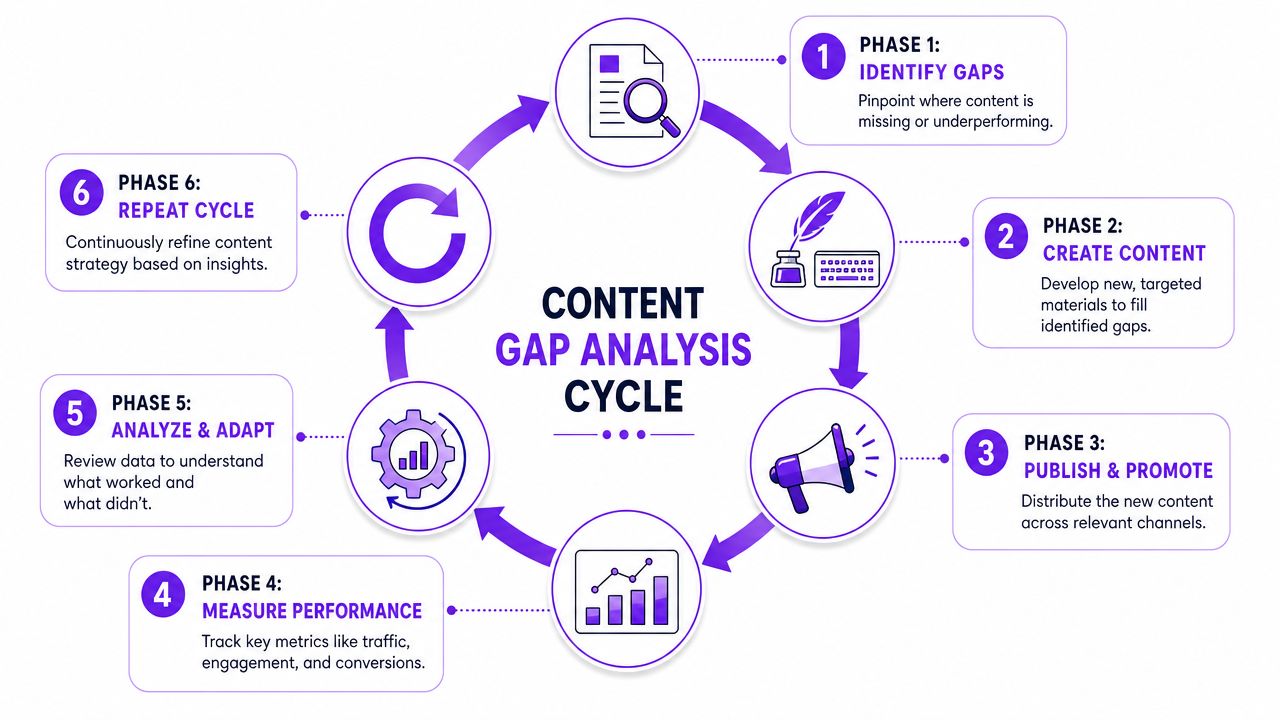
A good content strategy isn't static. Competitors publish. Search behavior shifts. Your own offers evolve. That means the gap analysis process needs a rhythm.
For most small businesses, a quarterly review is practical. It's frequent enough to catch drift and new opportunities, but not so constant that the team stays stuck in analysis mode. During each cycle, review what changed, what improved, what stalled, and which gaps are still open.
A strong optimization habit also includes better tooling over time. If you want a practical view of how teams tighten topic targeting and page refinement, this guide to an SEO content optimization tool is worth reading because it reflects the operational side of keeping content aligned after publication.
Content gap analysis works best when you stop treating it like a campaign and start treating it like maintenance for your growth engine.
The businesses that get the most from content aren't always the ones publishing the most. They're the ones that know what's missing, fix it deliberately, and keep repeating the cycle.
If you want to turn one strong video or long-form piece into a fuller content system without adding hours of manual work, Taja AI is built for that job. It helps creators and small teams repurpose long-form content into platform-ready assets, organize distribution, and keep publishing momentum without losing strategic focus.


We are blessed to work with leading brands & Companies


We try to make easy and simple for every professionals. Get 30 days free trial - No credit card required.


© 2025 Taja AI. All rights reserved.