.jpeg)

TikTok to Text: A Practical Guide for Creators
Learn how to convert TikTok to text the right way. Step-by-step workflow for transcripts, captions, and repurposing with accessibility and accuracy in mind.
5 min read
October 8, 2026

Learn what is content repurposing, how it boosts ROI, and practical workflows for creators, SMBs, and podcasters to scale reach without burning out.
Written by:


A creator spends 14 hours scripting, recording, editing, and uploading a YouTube tutorial. Subscribers watch it when it goes live. A few comments arrive, the initial traffic fades, and the video becomes difficult to find. The creator still has a useful lesson, a strong explanation, and dozens of ideas inside the recording, but the work has been treated as a single publication instead of a reusable asset.
That's the practical answer to what is content repurposing. It's the process of taking validated source material and adapting it into useful, platform-specific formats, while preserving the original idea and controlling its accuracy. The creative output matters, but the operational system behind it determines whether repurposing keeps working after the first burst of enthusiasm.
The tutorial was never necessarily bad. It had one opportunity to reach people, on one platform, in one format. YouTube recommendations, search behavior, subscriber habits, and audience timing all influence whether a video continues circulating. Meanwhile, potential viewers may spend their attention on Instagram, TikTok, LinkedIn, email, podcasts, or blogs instead.
A single upload leaves those audiences outside the distribution path. The creator may have explained a complex idea clearly, but someone who prefers a short vertical clip won't encounter it, and someone searching for a written answer may never open the video. The content's usefulness survives, but its access points disappear.
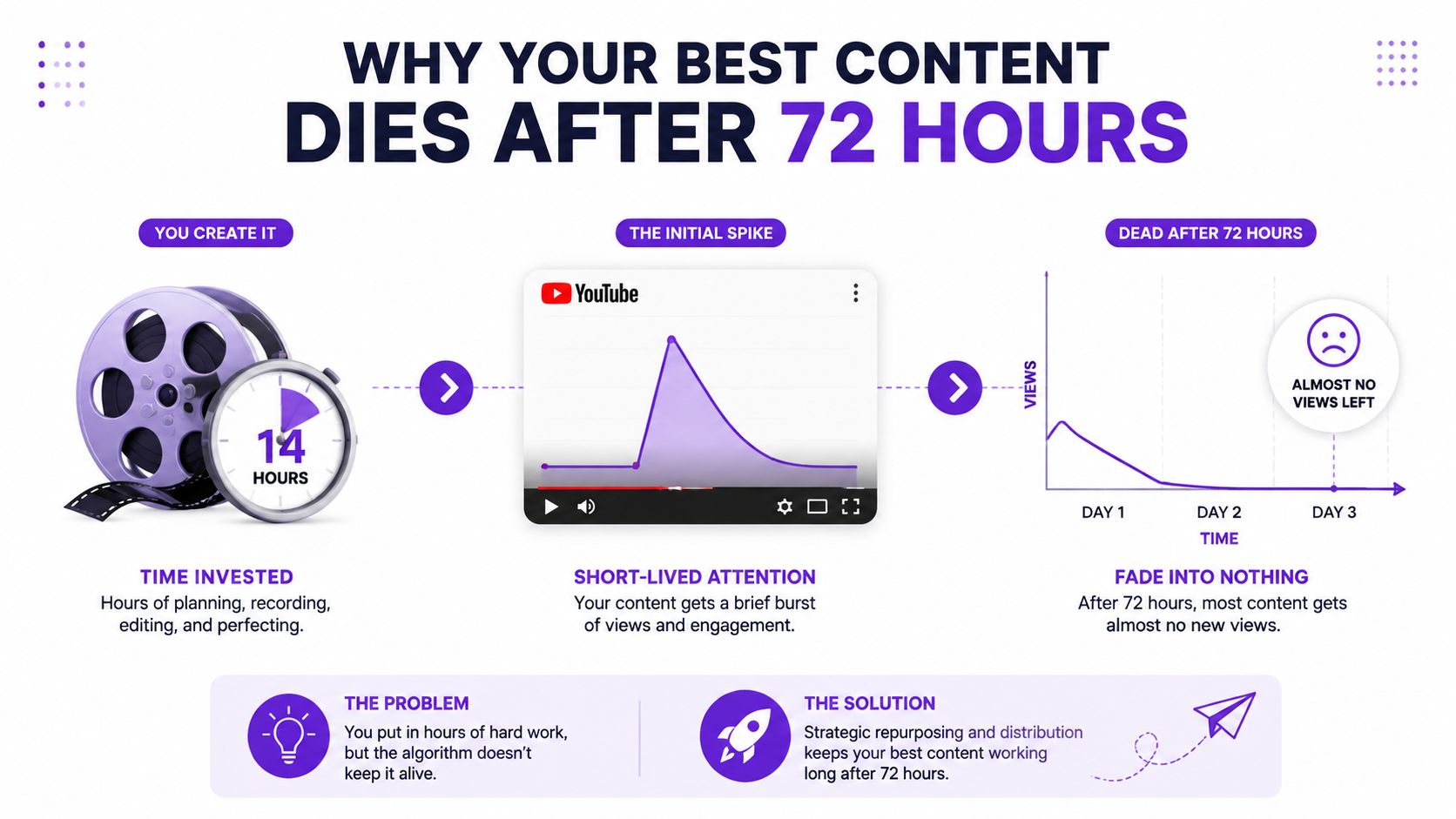
Freshness matters on recommendation-driven platforms, but freshness doesn't mean you need a completely new idea every time. It means you need new, relevant entry points. A tutorial can become a short answer to one question, a visual explanation of a process, a written checklist, an email lesson, or a discussion prompt.
The shift is from one-to-one publishing to multiplicative distribution. The content repurposing glossary from Kompozy describes how a podcast, video, or blog can be converted into platform-specific pieces, with one long-form asset potentially producing 20–30 downstream pieces. That range isn't a requirement for every team, but it illustrates the change in mindset. Your flagship recording can become part of a media library rather than a one-day event.
Practical rule: If a valuable idea exists in only one format, you've created a distribution bottleneck.
Repurposing also exposes a less glamorous truth. The hard part often isn't generating another caption or trimming another clip. It's finding the right moment, confirming its context, locating the latest brand language, and adapting the result so it feels native. A useful content distribution platform guide can help clarify where each derivative belongs, but the workflow still needs ownership, naming, review, and scheduling.
In 2026, multi-channel publishing is an operating requirement for many creators, consultants, educators, and small businesses. The original video may remain the authority, but derivatives give the idea more chances to reach the right person.
Content repurposing means adapting one source asset into multiple derivative formats for different platforms, audiences, and consumption contexts. The source might be a long-form video, podcast episode, webinar, blog post, newsletter, interview, presentation, or sermon. Each derivative keeps the central insight but changes its structure, length, framing, and presentation.
A useful analogy is a whole chicken. A cook might serve the roast as dinner, use the meat in sandwiches, and turn the bones into stock. Those meals come from the same source, but they aren't identical servings pushed onto different plates. Each one has a distinct purpose.
Content works the same way:
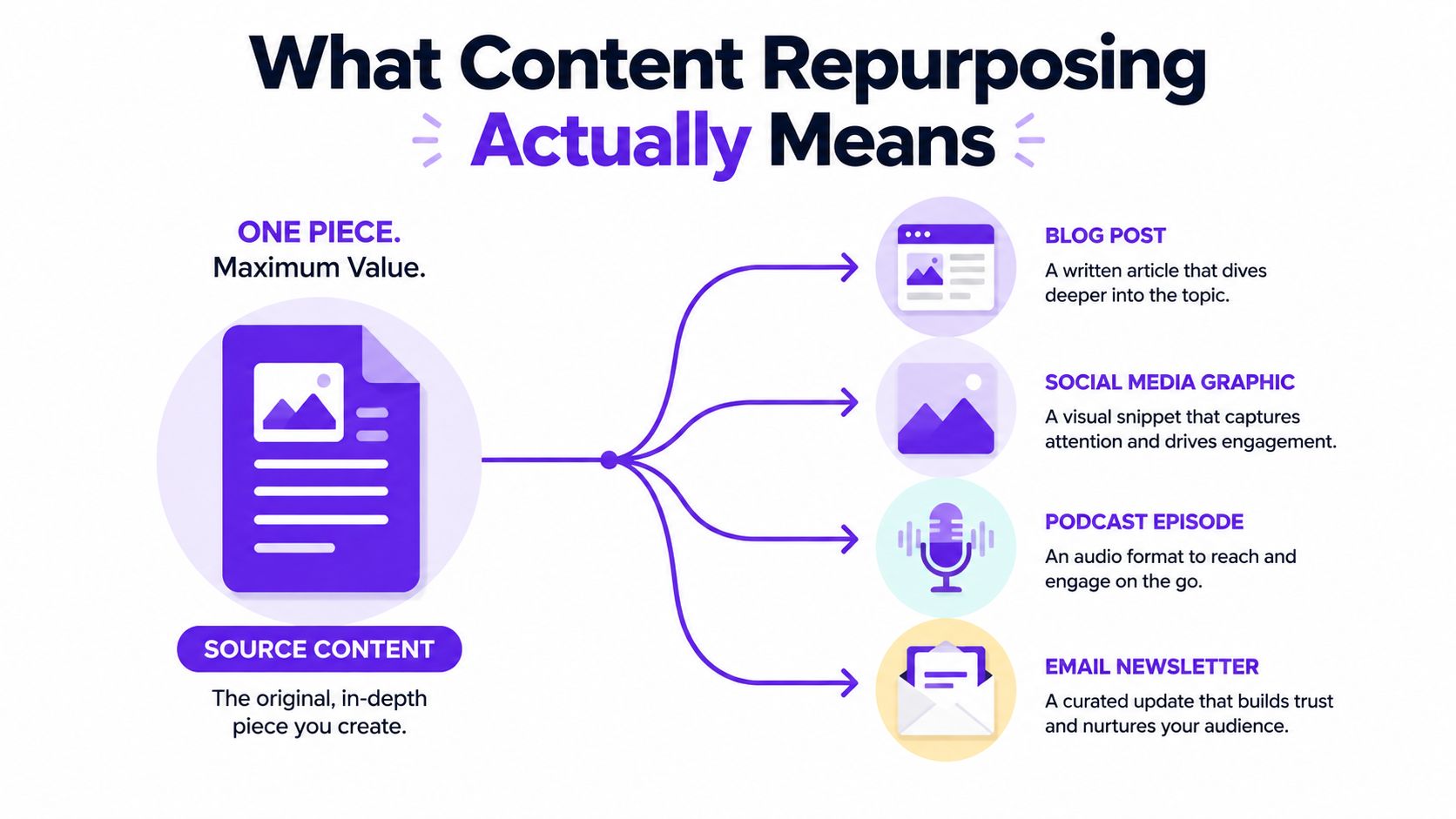
Recycling usually means publishing an existing asset again with minimal change. Reposting does the same thing on the original platform. Cross-posting publishes an identical or nearly identical asset on another platform.
Repurposing goes further. You extract the core message, then rebuild it for the destination. A YouTube explanation may need a faster hook for TikTok, a different opening for LinkedIn, a stronger search structure for a blog, and a direct call to action in an email.
The simplest test is this:
If the derivative wouldn't feel native on its target platform, it's probably cross-posting, not repurposing.
That test prevents a common failure mode. A vertical clip with a long introduction may work inside a full episode but lose viewers on short-form video. A punchy social hook may attract attention but make a weak blog opening. Adaptation isn't cosmetic. It changes how the audience understands and uses the idea.
A strong system begins with a validated source brief. Record the central claim, supporting points, publication date, intended audience, limitations, and source location before creating derivatives. Research on generative AI and reuse highlights the risks of provenance problems, duplication, and context drift when source material spreads across artifacts without tracking (Microsoft Research on GenAI and reuse).
The source remains authoritative, but every output should be reviewed as its own publication. That distinction lets a team preserve consistency without pretending that one approved video automatically makes every caption, clip, and article accurate.
Repurposing creates efficiency by separating idea development from format production. The research, expertise, interview, or demonstration already exists. A team then extracts useful components and adapts them instead of starting from a blank page for every channel.
The available benchmarks point in the same direction, although they come from independent marketing roundups and should be treated as directional rather than universal guarantees. One content repurposing ROI roundup cites research associating repurposed content with 60% more engagement than single-format original content. The same source discusses a benchmark of 75% higher results without a proportional investment increase, alongside workflows that produce 47% more content at 35% lower cost per piece.
Those figures don't remove the need for editing or strategy. They show why teams increasingly view repurposing as an efficiency system. The return comes from multiplying distribution opportunities while reusing the expensive parts of production, such as research, recording, subject-matter expertise, and creative direction.
A podcaster might record one substantial interview and identify several independent ideas inside it. One derivative can answer a narrow question, another can illustrate a disagreement, and another can explain a practical tactic. The work scales when each output has a clear job, rather than when the team cuts random moments to fill a calendar.
| Metric | Original Only | With Repurposing |
|---|---|---|
| Source investment | One flagship asset | One flagship asset plus planned derivatives |
| Creative starting point | New idea for each publication | Reuse of validated source material |
| Platform reach | Concentrated on the original channel | Distributed through adapted formats |
| Operational risk | Fewer versions to track | More versions requiring metadata and review |
| Main advantage | Simpler management | Greater leverage from existing work |
The trade-off is important. More outputs create more review, naming, storage, and approval work. Without those controls, a team may publish an outdated claim faster and in more places. A rigorous repurposing pipeline framework recommends metadata such as claim, date, population, limitation, destination, and source ID, so teams can audit performance and accuracy by output type.
The operational bottleneck also appears in audience research. A Canto and Ascend2 study summarized by MarketingProfs' content repurposing statistics overview lists adapting content for different platforms at 38%, maintaining brand consistency at 36%, lacking time or resources at 36%, and finding the right assets quickly at 35% among reported pain points. File structure, storage across locations, and version control also create friction.
The lesson is straightforward: repurposing can lower the cost of distribution, but only if the organization can locate, adapt, and govern its assets.
The same source-to-derivative principle looks different depending on the operator, audience, and constraint. A creator may need volume without hiring an editor. A realtor needs local relevance and lead follow-up. A marketing team needs sales materials that stay aligned with the campaign.
Consider five practical patterns:
A creator records a YouTube tutorial and marks the moments that answer distinct audience questions. Those moments become short-form videos, while the central framework becomes a carousel and a newsletter thread. The constraint is attention and editing capacity, so the creator should prioritize a small set of strong derivatives rather than publish every possible fragment.
A neighborhood walkthrough can support several buyer journeys. Short vertical clips highlight individual features, a blog post adds written context and embedded maps, and an email sequence answers follow-up questions for leads who aren't ready to schedule a showing. The realtor must update location details and avoid letting a general walkthrough sound like a current property listing.
A long interview contains stories, opinions, and useful explanations, but a clipped sentence can become misleading when separated from the exchange around it. Audiograms, quote graphics, and LinkedIn articles should preserve the guest's meaning while giving each format enough context to stand alone.
A quarterly webinar can supply a gated guide, ad variations, customer emails, and sales enablement one-pagers. The bottleneck is governance. Marketing, sales, and compliance teams need a shared source brief, approved claims, and clear version labels before derivatives move into paid or customer-facing channels. Teams extending proven creative can also study methods for reusing winning ad campaigns without copying a campaign blindly into a new context.
A Sunday sermon can become daily devotional clips, a midweek reflection, and social cards for community engagement. The editor should preserve the sermon's theological and pastoral context, especially when a short excerpt could sound different outside the full message. Guidance on sermon video clips is useful when the source is a service recording rather than a conventional studio production.
| Audience | Source Asset | Derivative Outputs | Primary Platforms |
|---|---|---|---|
| Solo creator | YouTube tutorial | Short clips, carousel, newsletter thread | YouTube, Instagram, TikTok, email |
| Realtor | Neighborhood walkthrough | Reels, local blog, lead emails | Instagram, website, email |
| Podcaster | Interview episode | Audiograms, quote graphics, article | Podcast platforms, LinkedIn, social |
| SMB team | Quarterly webinar | Guide, ads, sales one-pagers | Website, email, paid social, sales channels |
| Faith group | Sunday sermon | Devotional clips, reflection, social cards | YouTube, social, church website |
The common thread isn't the number of outputs. It's the deliberate match between source, derivative, audience, and platform.
A scalable workflow needs more than a list of content ideas. It needs handoffs that another person, contractor, or future version of you can understand. The following five stages keep creative extraction connected to publishing control.
Choose anchor content using evidence rather than instinct. Look for strong audience response, continuing relevance, recurring questions, or a topic your audience actively needs. A source doesn't have to be new. An evergreen video or durable webinar may offer better derivative opportunities than a timely announcement.
Write a short source brief before extraction. Include the main claim, audience, publication context, sensitive details, and limitations. This becomes the reference point for every later version.
Pull transcripts, timestamps, clips, quotes, visuals, examples, and supporting links into one repository. Use naming conventions that identify the source and output type, such as webinar-topic-clip-question-v1, rather than filenames like final-final-2.
Metadata is more valuable than a crowded folder. Record the source ID, date, topic, status, destination, owner, and approval state. This addresses the asset-discovery problem reported in the content repurposing statistics research, which describes reuse as mainstream while platform-specific tailoring remains less common.
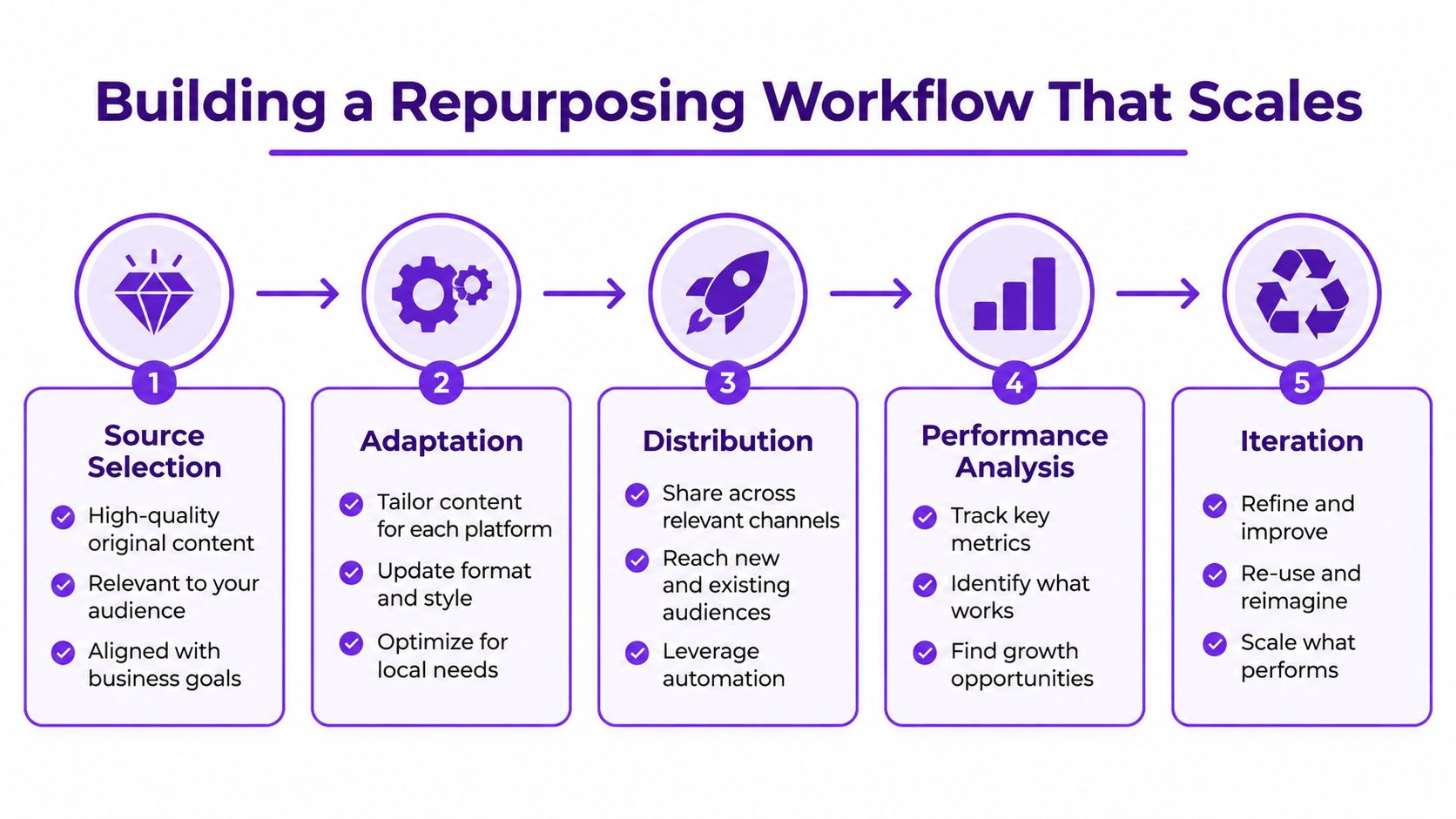
Decide the destination before editing. A short video needs a clear opening, readable captions, and a frame that works vertically. A LinkedIn post may need more context and a professional point of view. An email needs a subject line, a reason to click, and a direct next action.
This is where many teams lose time. Extraction creates raw ingredients, but adaptation creates publishable assets. A tool such as Taja AI can turn long-form video into clips, captions, thumbnails, blog content, and platform-specific posts, while a spreadsheet, Notion board, or native editor may be enough for a smaller workflow.
Track every derivative as a separate object. Store the source ID, version, reviewer, approval date, destination, and final link. If the original claim changes, you should be able to identify which captions, clips, graphics, and articles need review.
Versioning rule: Never label an asset “final” without recording what it is final for.
Stagger releases so audiences don't receive the same idea repeatedly in a short window. Assign each derivative a different angle or call to action, then review performance by format. The automated content creation workflow can reduce repetitive production work, but automation doesn't replace editorial judgment at the approval and distribution stages.
Repurposing fails when teams treat it as copy-paste distribution. The first derivative may look acceptable, but weak context, poor organization, and platform mismatch gradually reduce trust.
A clip opens halfway through an argument and makes the speaker appear to support a position they were challenging. The early signal is confusion in comments, questions that the original answered, or unusually high drop-off at the opening. Add a short setup sentence, include the missing qualifier, or choose a complete segment that works without the original.
A polished video becomes a rushed text post with vague wording and inconsistent terminology. The audience sees different standards across channels. Create a lightweight brand sheet with approved terms, tone examples, visual rules, and calls to action, then apply it during review instead of trying to repair every asset after publication.
Editors save clips in personal folders, marketers download copies, and nobody knows which version shipped. Duplicate posts and orphaned drafts follow. A shared repository with source IDs, status labels, owners, and destination fields fixes more than another creative meeting will.
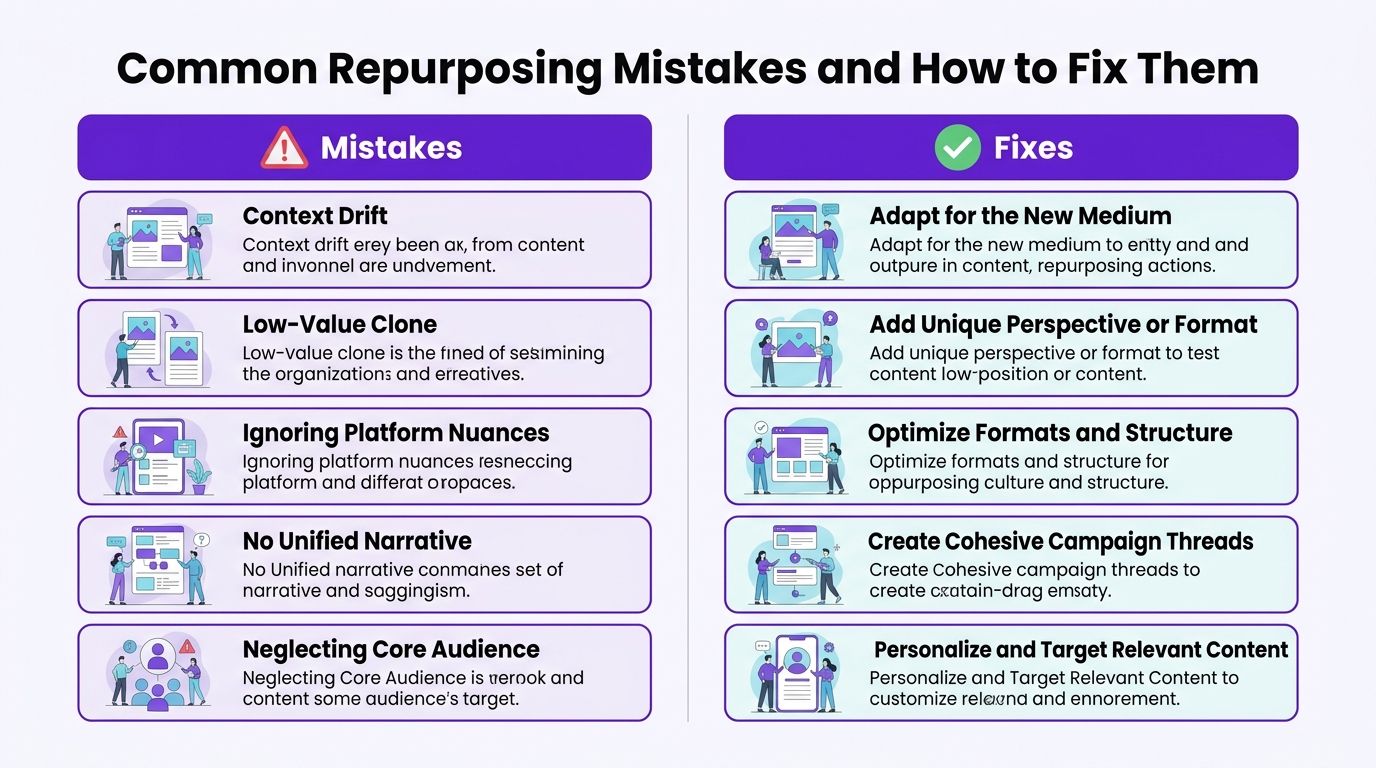
A long explanation forced into a short clip loses the nuance that made it valuable. A short-form hook pasted into a blog creates an empty article. Define the job of each format before production. If a point needs more space, split it into a sequence or link to the full source instead of compressing it until the meaning disappears.
Teams often keep producing the same derivative because it's easy to make, not because it works. Track reach, engagement, clicks, saves, shares, completion, or replies according to the platform and goal. Then keep the formats that earn useful audience action and stop treating every derivative as equally successful.
A derivative is a hypothesis, not a guaranteed winner. Publish it, inspect the response, and let the next version reflect what the audience actually understood.
You don't need a large production team to begin. Use one source asset, choose a few destinations you already understand, and create a tracking system before you create the derivatives.
Review the results after 14 days, then double down on formats that outperform the source asset and retire derivatives that consistently underperform. The objective isn't to manufacture endless content. It's to build a repeatable path from one strong idea to several accurate, useful ways for people to find it.
Taja AI helps turn long-form video into ready-to-publish shorts, clips, captions, thumbnails, blogs, and platform-specific posts from one upload. If asset extraction and formatting are slowing your workflow, visit Taja AI to explore a practical way to organize and distribute more of the content you've already created.


We are blessed to work with leading brands & Companies


We try to make easy and simple for every professionals. Get 30 days free trial - No credit card required.


© 2025 Taja AI. All rights reserved.