.jpeg)

Content Marketing ROI: A Practical Guide for 2026
Learn how to measure and grow content marketing ROI with practical steps and real examples. Improve your strategy and track results in 2026.
5 min read
September 27, 2026

A complete guide to video marketing for real estate agents. Learn strategy, production, and a repurposing system to generate leads without burning out.
Written by:


Most agents still treat video like a listing add-on. That's backwards. In practice, video is one of the clearest lead generation levers in the business.
The numbers are hard to ignore. Listings with video generate 403% more inquiries than listings without video, and 73% of homeowners say they're more likely to list with an agent who uses video, according to Keeping Current Matters' roundup of real estate video marketing stats. That changes the conversation immediately. Video isn't just something you do after the photos come back. It's part of how you win the listing, attract better-fit buyers, and stay visible in your market.
The bigger shift is operational. Most agents don't need one polished hero video. They need a repeatable system that turns one recording into a week or month of useful content across the channels where buyers and sellers already spend time. That's where video marketing for real estate agents starts to compound.
If you're still debating whether video is worth the effort, you're asking the wrong question. The useful question is how quickly you can make it part of your weekly workflow.
The simplest reason is buyer response. Listings with video can pull in dramatically more hand-raisers than listings without it. The seller-side reason is just as important. Homeowners aren't only hiring for pricing strategy and negotiation anymore. They want proof that you can market the property in a way that feels current, visible, and credible.
A lot of agents think about video only as a listing asset. That's too narrow. Video sits in two different parts of the business at once:
That mix matters because most lead generation problems aren't really top-of-funnel problems. They're trust problems. Static posts don't solve trust very well. Short, clear, useful video does.
Practical rule: If a homeowner can compare your marketing with another agent's in under five minutes, your video presence becomes part of the listing presentation whether you mention it or not.
There's also a visibility gap that many agents miss. Plenty of competitors still post sporadically or rely on a photographer to send over one finished listing reel. That isn't a system. That's outsourcing a moment. The agents who pull ahead are the ones who publish around the property, the neighborhood, the process, and the local questions people already have.
Some agents get stuck at this point. They assume "doing video" means acting like a creator full time. It doesn't. It means building a consistent communication habit with a camera.
For higher-end campaigns, local branding pushes, or broader awareness plays, it can help to study what polished broadcast-ready real estate commercials look like. Not because every agent needs television-level production, but because those spots show how pacing, scripting, and message clarity drive response.
For day-to-day lead generation, consistency wins. A practical way to see how this applies specifically to agents is through video workflows for realtors. The point isn't to create more random content. The point is to make video a business process.
Most agents point the camera at the house and stop there. That's useful, but it's incomplete. Buyers and sellers usually start with questions, not properties.
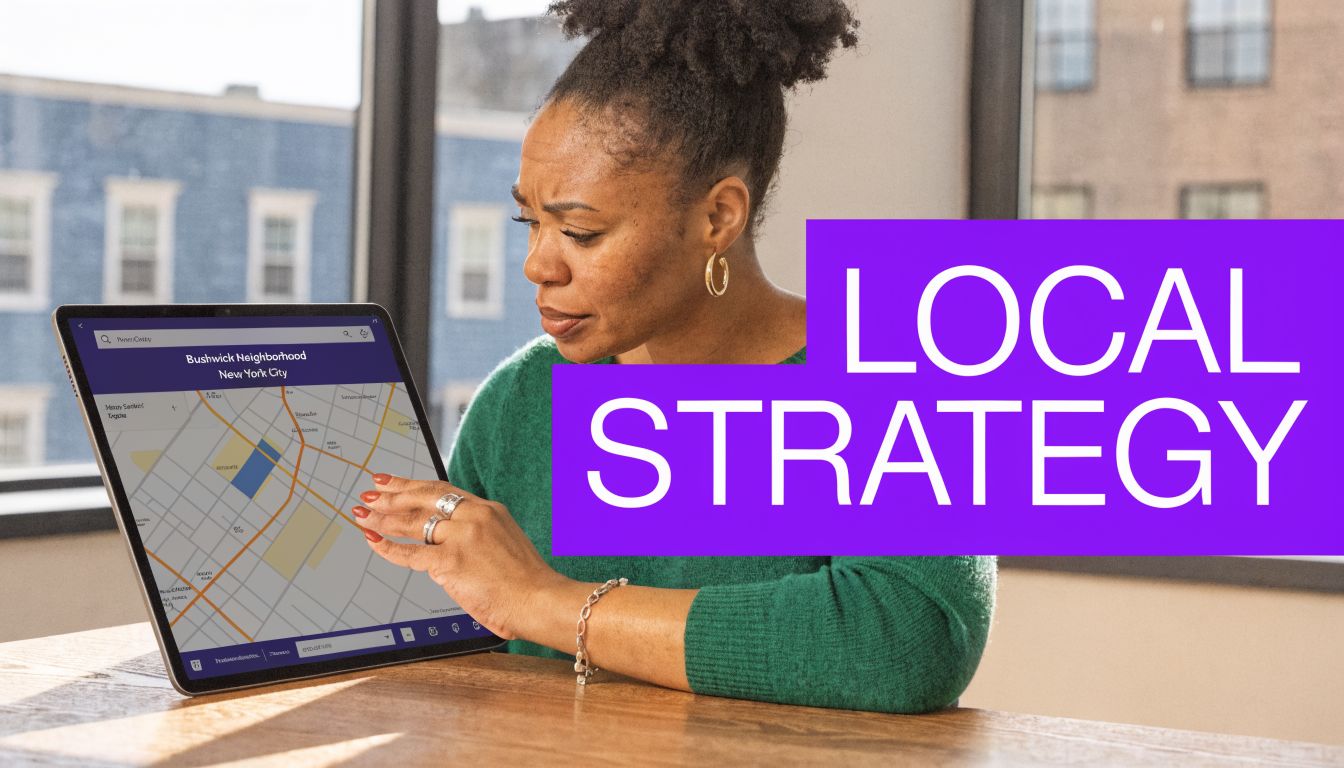
The strongest video marketing for real estate agents often looks more like a local answer library than a stream of listing tours. That's the missed opportunity highlighted in FocalAgent's guidance on real estate video marketing. Buyers and sellers start online, and the highest-value topics are usually specific local questions about schools, commute patterns, neighborhood feel, or what happens during the closing process.
Agents often ask, "Should I make Reels, Shorts, or YouTube videos?" That's not the first decision. The first decision is what question you're answering.
A useful planning filter is this:
| Search intent | What the prospect wants | Video angle that works |
|---|---|---|
| Early research | General local understanding | Neighborhood overview, area comparison, market basics |
| Active shopping | Help narrowing choices | School district breakdown, commute walkthrough, price-range tour |
| Decision stage | Confidence and clarity | Offer process, inspection expectations, closing timeline |
| Seller evaluation | Proof you know the market | Pricing explanation, prep-to-list checklist, local demand update |
This shift fixes a common mistake. Too many agents create content around what they want to promote rather than what clients want to understand.
If you want local dominance, keep your planning simple. Most agents can build an effective system around three recurring lanes.
Neighborhood videos
Cover what it's like to live there. Don't just say the area is "walkable" or "up and coming." Show the streets, explain the housing stock, name the type of buyer who tends to fit the area, and mention the trade-offs.
Process videos
Explain the steps that confuse people. Good examples include what happens after an offer is accepted, what buyers should know before touring homes, or how a local closing typically feels from contract to keys.
Market interpretation videos
Don't read numbers off a chart. Translate what current conditions mean for actual decisions. Sellers want to know how to price. Buyers want to know how to compete without making emotional mistakes.
The best local videos don't try to impress. They reduce uncertainty.
That gives you a body of work that keeps attracting prospects even when you don't have a new listing to promote.
A strong strategy includes both broad and narrow topics. Broad topics help strangers discover you. Narrow topics help serious prospects decide whether to contact you.
Use broad videos for discovery:
Use narrow videos for conversion:
Later in the process, this kind of visual teaching becomes even more powerful:
Before filming any video, run it through four quick questions:
Agents who dominate locally don't publish more content because they love content. They publish better-targeted answers than the competition.
Once the strategy is clear, the next question is what to record this week. Most agents need fewer formats than they think. They just need the right ones, used consistently.
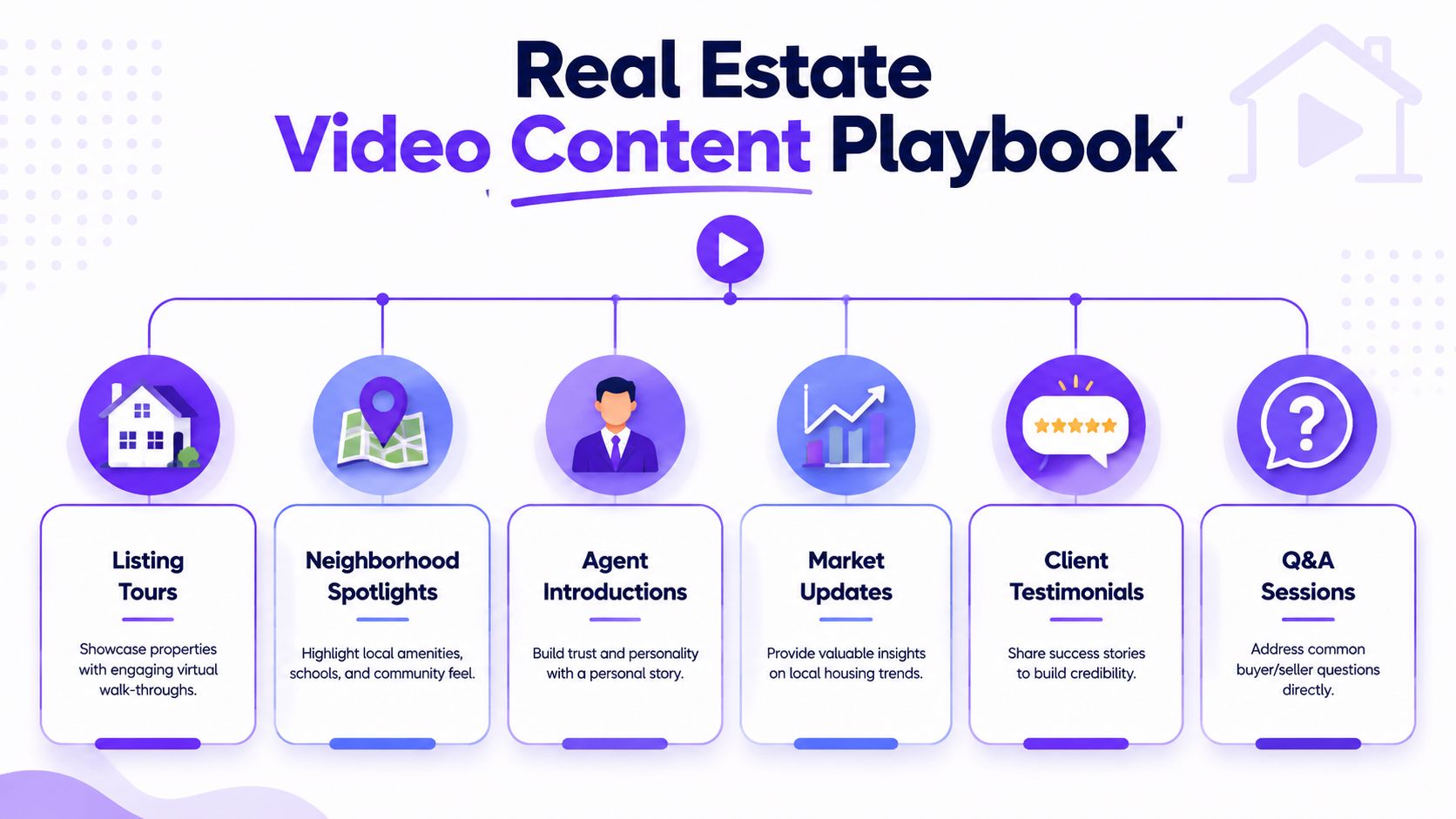
Here's the playbook I keep coming back to. These aren't vanity formats. Each one has a job.
This one is for attention and inquiry. Not for showing every room.
A good teaser creates enough curiosity to earn the next action. It gives the highlights, a feel for the property, and one or two reasons this listing stands apart. It doesn't turn into a slow walkthrough with generic music and no point.
A practical script starter:
Example opening: "If someone wants a move-in-ready home near the downtown core without giving up outdoor space, this is the one I'd put at the top of the list."
This format builds trust long before someone is ready to transact. It's also one of the best evergreen assets an agent can make.
Walk the area if possible. Talk about who tends to love it, what the housing mix feels like, what daily life looks like, and where buyers get surprised. Mention positives, but also mention honest trade-offs. That's what gives the video authority.
Field note: Neighborhood videos work best when you stop sounding like a tourism board and start sounding like an advisor.
A simple structure:
Many agents lose their audience at this point by turning into broadcasters. The fix is simple. Interpret instead of reciting.
Don't just say inventory changed or prices moved. Explain what that means for someone deciding whether to buy, list, wait, or price aggressively. Market updates earn attention when they reduce confusion.
Try opening like this: "If you're deciding whether to list in the next few months, this is the information local sellers need to understand right now."
This format also becomes easier to sustain when you build a real publishing rhythm. If you need help organizing recurring topics and dates, this guide on how to build an effective content calendar is a useful planning reference.
Most testimonial videos are too vague. They sound nice, but they don't help a future client picture working with you.
A stronger client story focuses on the situation, the obstacle, the decision, and the outcome. Keep it grounded in the actual process. What was stressful? What did you solve? What did the client need to understand to move forward?
If the client is on camera, ask better prompts:
This format is ideal for social and email because it answers real objections in plain language.
Pull questions from showings, listing appointments, DMs, and inspection conversations. Record short direct answers. One question per clip. No long intro. No branding speech.
Good prompts include:
A lot of agents either skip this or make it all about awards. Neither works especially well.
Your introduction video should answer three practical questions:
Keep it specific. "I help move-up buyers who need to sell and buy on a tight timeline" is better than "I serve all your real estate needs."
Most agents don't have a video problem. They have a friction problem. They think production has to be complicated, so they delay, overplan, and post nothing.
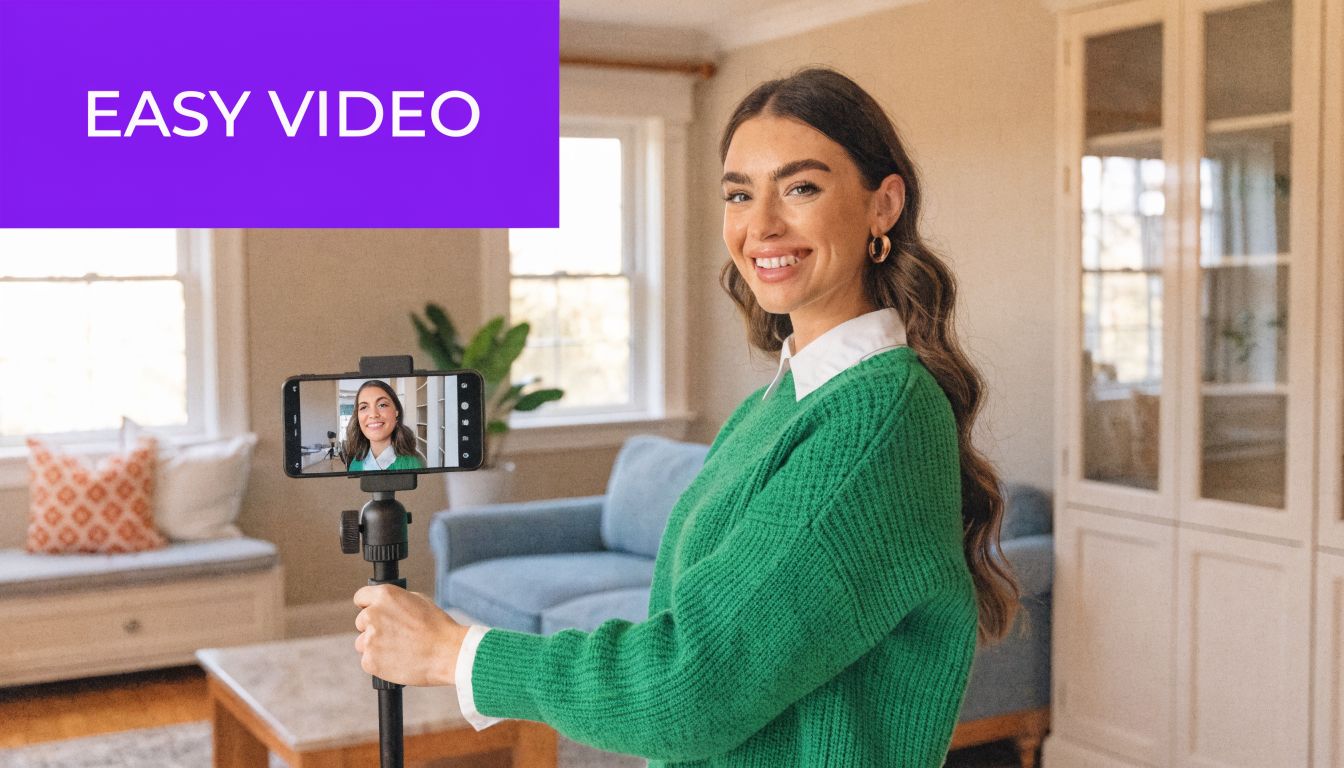
The good news is that useful real estate video doesn't require a studio. A recent smartphone, decent sound, stable framing, and clean light will carry most of the workload.
Viewers will forgive a slightly imperfect image. They won't stick around for muddy sound.
If you're filming on a phone, start with a simple lav mic or a compact wireless mic setup. If that's not available, get closer to the phone and reduce echo. Empty kitchens, tile-heavy bathrooms, and large unfurnished rooms often sound harsh, so record in softer spaces when you're doing talking-head segments.
Use this quick checklist before every take:
Most beginner videos look amateur because the subject is underlit or backlit. Window light solves a lot of that.
Face the window. Don't stand with the window behind you unless you know how to compensate. If natural light isn't good enough, use a ring light or place two lamps in front of you at slight angles. The goal isn't drama. It's clear, flattering visibility.
A workable setup for home-office recording:
You don't need cinematic movement in every video. In fact, too much motion makes many real estate videos feel less trustworthy.
For talking-head clips, use a tripod and keep the shot still. For property footage, move slowly, keep pans short, and don't try to show everything in one take. A few clean clips edit better than one long wandering walkthrough.
A calm camera makes you look more confident on screen.
Editing should stay light. CapCut, InShot, and Canva are enough for many agents when the source footage is clean. Trim dead space. Add simple captions. Put your contact details on screen. Then publish.
If you want a feel for how short-form edits are structured for attention, this breakdown of how to create YouTube Shorts is useful even if you also post to Instagram Reels and TikTok. The pacing principles carry over.
A lot of agents waste energy chasing polish that their audience never asked for. Buyers and sellers usually care more about clarity than cinematic style.
Use this production standard instead:
| If this is true | Your video is ready |
|---|---|
| People can hear you clearly | Publish it |
| The lighting is clean enough to see your face | Publish it |
| The message answers a real question | Publish it |
| The call to action is obvious | Publish it |
The market doesn't reward the most overproduced agent. It rewards the agent clients keep seeing, hearing, and remembering.
Most agents either build momentum or burn out at this stage.
They record one decent video, post it once, then disappear for two weeks because editing, resizing, captioning, and writing platform copy becomes a second job. That's why the operational side matters more than another lecture about "just be authentic."
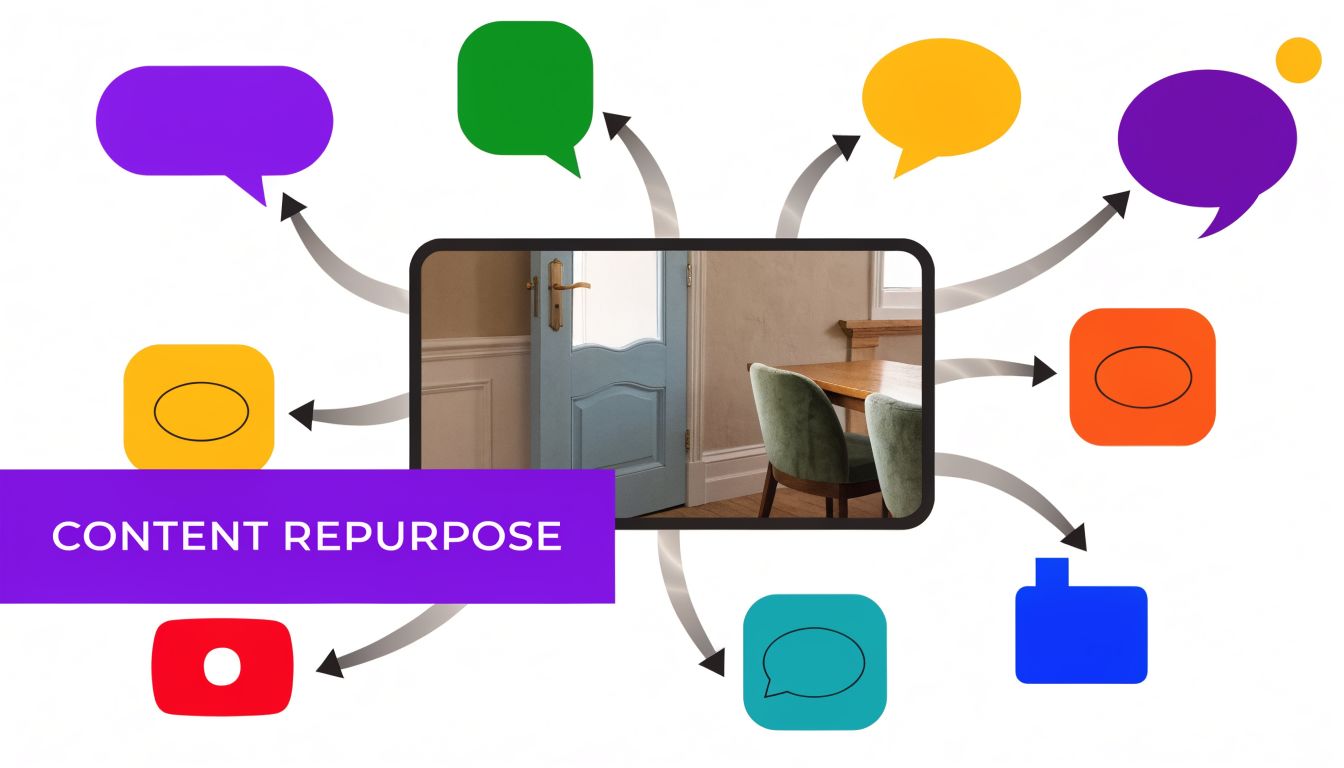
SproutVideo's real estate video marketing guidance gets at the core issue clearly. Consistency beats production value, but agents burn out when every video is treated like a separate project. The practical fix is a system: one recording becomes multiple platform-native assets such as clips, shorts, and captions.
The mindset shift is simple. Stop asking, "What should I post today?" Start asking, "What can I extract from this recording?"
A single market update, neighborhood walkthrough, buyer FAQ session, or listing explanation can generate:
That's the difference between creating content and building a distribution engine.
Here's a version that works for solo agents and lean teams.
Record one useful anchor video each week. It could be a neighborhood breakdown, a listing commentary, or a process explainer. Keep it focused and organized, but don't obsess over perfection.
Then break it down in layers:
| Asset type | Purpose | Best use |
|---|---|---|
| Full-length video | Search visibility and trust | YouTube, website, email landing page |
| Short clip with one takeaway | Fast attention | Reels, Shorts, TikTok |
| Direct-answer clip | Objection handling | Stories, DMs, follow-up posts |
| Text summary | Reach people who won't watch immediately | LinkedIn, Facebook, blog |
| Thumbnail and title variations | Improve clicks | YouTube and social reposts |
This is also where tooling starts to matter. Some agents use CapCut for clipping, Canva for graphics, Google Drive for organization, and native schedulers for posting. That's workable. It's just labor-heavy.
A more centralized option is automated content creation workflows. Taja AI, for example, is built to take one long-form video and generate shorts, clips, captions, thumbnails, blog content, and platform-specific posts from that source asset. For agents trying to stay visible without editing every night, that's a functional workflow choice rather than a branding exercise.
Operating principle: Your recording session should create inventory, not just one post.
A common mistake is posting the same exact asset everywhere. Repurposing doesn't mean duplicating without context.
Each platform rewards a slightly different behavior:
The source idea can stay the same. The packaging should change.
A boring system saves real time. Keep a simple structure:
That last folder matters. Some of your best future content will come from re-cutting or re-framing topics you've already recorded well.
Agents who stay consistent with video usually aren't more inspired than everyone else. They're better organized.
A video isn't finished when you export it. It's finished when it gets in front of the right people and creates the next action.
That's where many real estate video efforts stall. Agents spend time filming, then rush the title, write a vague caption, skip email, and judge success by likes. Leads don't come from that. They come from packaging, distribution, and follow-through.
Every platform gives you a chance to frame the video properly. Use it.
For YouTube, the title should sound like something a local buyer or seller would search for. Put the place, problem, or audience early. For example, "Living in [Neighborhood Name]" is stronger than "My latest area tour." The description should explain what the viewer will learn and where to go next.
For Instagram and TikTok, the hook matters more than the headline. Lead with the actual question or trade-off:
For Facebook, write captions that sound conversational and local. Mention the area. Mention the issue. Make it easy for someone to tag a friend or send it to a spouse.
You don't need to post everywhere every day. You do need a repeatable cadence.
A simple pattern works well:
Video content shouldn't live only on social media. According to Wyzowl's real estate video marketing data, email campaigns that include video can see a 65% boost in click-through rates. For agents, that's practical. Use video in newsletters, market updates, post-open-house follow-up, and nurture sequences so the content keeps working after the social post fades.
Views can be encouraging. They can also be misleading.
A useful weekly dashboard tracks the things that connect to conversations and appointments. For most agents, that includes:
| Metric | Why it matters |
|---|---|
| Link clicks | Shows whether the video moved people to a listing, landing page, or contact page |
| DM inquiries | Captures intent from short-form platforms |
| Email replies | Often the clearest buying or selling signal from nurtured leads |
| Form submissions | Ties video to actual lead capture |
| Calls or consultations booked | Measures movement toward business, not just attention |
| Topics that triggered inquiries | Helps you decide what to record next |
If a video gets modest views but leads to three serious conversations, that's a strong asset. If another gets broad reach and no inquiries, it may still help awareness, but it shouldn't dominate your strategy.
Some videos are closers. Some are trust builders. Some are magnets. Judge each one by its job.
The best optimization doesn't happen in the edit. It happens in the next recording.
Look back and ask:
Then adjust. Shorten the intro. Make the CTA clearer. Change the thumbnail. Re-record the same topic with a stronger opening. Good video marketing for real estate agents improves through repetition, not through waiting for a perfect formula.
If you want the easiest version of this workflow, Taja AI fits the operational side well. Upload one long-form real estate video, then turn it into shorts, clips, captions, thumbnails, blog content, and platform-specific posts from a single source asset. For agents and small teams, that makes consistency far more realistic than managing every edit and distribution step by hand.


We are blessed to work with leading brands & Companies


We try to make easy and simple for every professionals. Get 30 days free trial - No credit card required.


© 2025 Taja AI. All rights reserved.