.jpeg)
YouTube to Text: How to Convert Videos in 2026
Master YouTube to text conversion. Learn to extract auto-captions, download SRT files, use AI tools, and repurpose video content for SEO and growth.
5 min read
October 10, 2026

Master video metadata optimization to rank higher on YouTube, TikTok, & AI search. Get a step-by-step checklist & platform-specific tips.
Written by:


Most creators still treat metadata like packaging. It's closer to distribution. A strong video with weak metadata doesn't just underperform. It often never gets a fair shot at discovery in the first place.
That problem gets worse when you publish across YouTube, TikTok, Instagram, and a blog, then expect one generic title and one recycled description to work everywhere. They won't. Metadata optimization now has two jobs: help people decide to click, and help platforms understand what your content is about fast enough to route it to the right audience.
A lot of smart creators still believe quality wins eventually. It doesn't, at least not on its own. Platforms can't recommend, rank, clip, preview, or contextualize a video they don't understand.
Metadata optimization is the layer that gives platforms that understanding. Your title signals the topic. Your description clarifies the promise. Your tags, captions, categories, and supporting text reduce ambiguity. On short-form platforms, even on-screen text and sound selection play that role.
The video, for example, is the store. Metadata is the street signage, shelf labels, and directions in the map app. If those are vague, misleading, or missing, people don't wander in and discover your brilliance by accident.
What trips people up is that metadata feels small. It looks like admin work. So creators spend hours trimming edits, tweaking transitions, and color grading a clip, then write the title in thirty seconds and paste a generic description. That's upside down.
For teams handling multiple content formats, the same principle shows up outside video. Book marketers have dealt with this for years, which is why guides on optimizing books for search engines are useful context even if your main channel is video. The medium changes. The discoverability problem doesn't.
Your content isn't competing only on quality. It's competing on clarity.
The old advice was simple: add keywords and keep moving. That's not enough now. Platforms weigh context differently, and AI-driven search tools increasingly look for metadata that acts like a clean summary instead of a vague teaser. If your metadata doesn't explain the content clearly, your best work stays buried.
Metadata exerts influence because it affects three moments that decide whether content grows or stalls: being found, being clicked, and being correctly categorized.
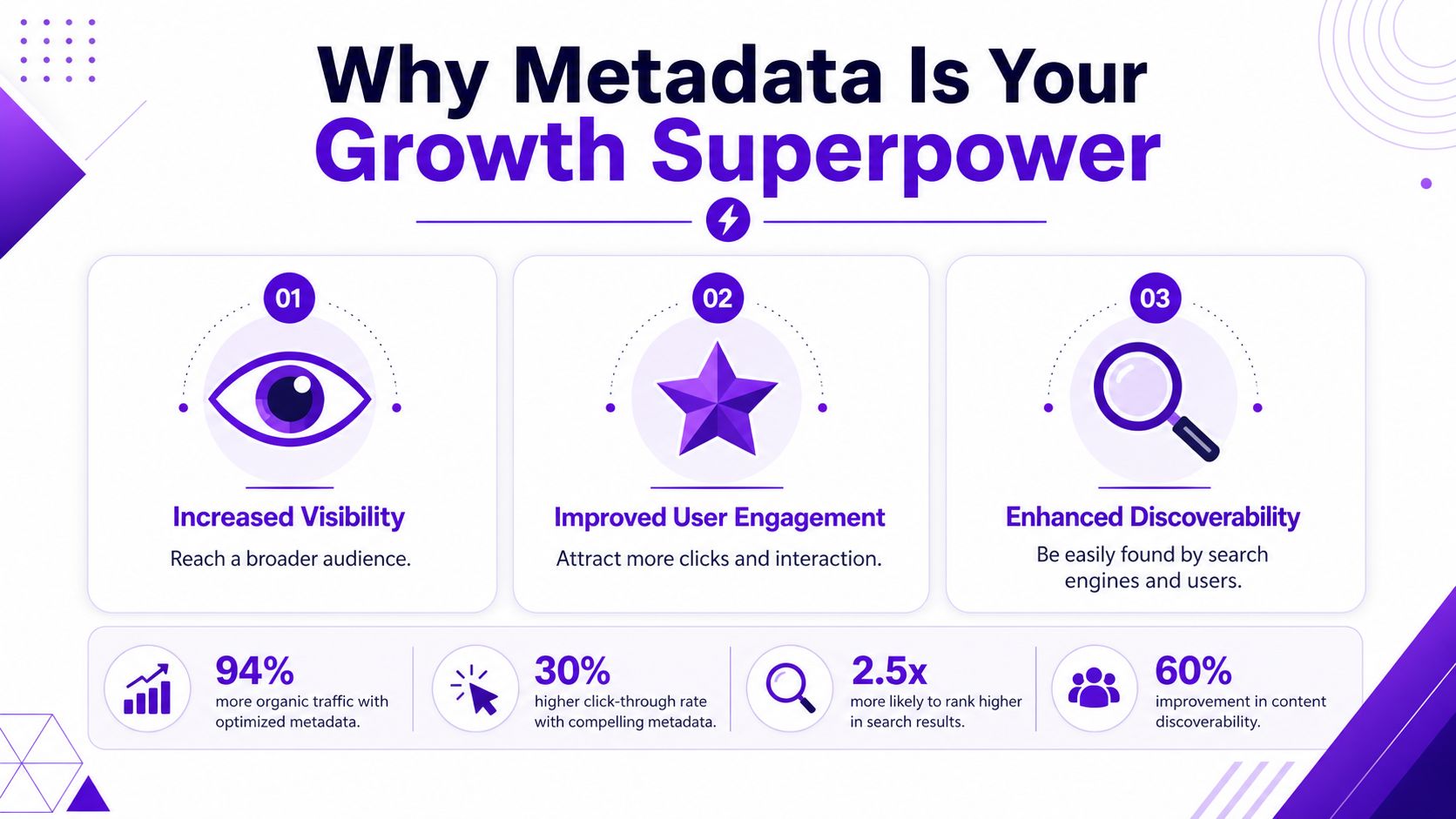
Small wording decisions can create a huge gap in discoverability. In publishing, the keyword “career change” gets 165,000 global monthly searches, while “changing careers” gets 27,100, according to metadata best practices for academic publishers. Same topic. Different phrasing. Very different demand.
That lesson applies directly to video. Creators often write titles based on how they talk, not how people search. Those aren't always the same. A strong working title in your content calendar can be a weak title on YouTube if it hides the core topic behind a clever hook.
A lot of metadata advice encourages exaggerated curiosity. That works less often than people think, especially outside entertainment. In educational, service-based, and B2B content, vague intrigue usually underperforms clear outcomes.
What works better is a title and description that quickly answer three questions:
When creators plateau, this is usually where I look first. Not because metadata is magic, but because it's often the clearest mismatch between the content they made and the audience they want.
Metadata isn't a bag of isolated fields. It works when the parts support the same story.
A title about YouTube lead generation, a description about “growing online,” tags about social media tips, and a thumbnail about passive income send mixed signals. The algorithm has to guess. Viewers have to guess too.
Practical rule: Every metadata element should reinforce the same promise from a slightly different angle.
That applies beyond search. Recommendation systems, social previews, related content modules, and internal search all benefit when your metadata is aligned. If your channel has inconsistent naming, sloppy tags, and recycled descriptions, you're making every platform work harder to place your content correctly.
You don't need a viral breakthrough for metadata optimization to matter. It improves the efficiency of your whole catalog. Better titles make old videos more legible. Better descriptions give repurposed clips cleaner context. Better keyword discipline keeps your topics from drifting.
That's why I call it a growth superpower. Not because it's glamorous. Because it improves the performance of work you've already done and makes future publishing less random.
If you strip away the platform differences, most discoverability work comes back to four pieces: titles, descriptions, tags, and thumbnails. Miss one, and the rest have to work harder.
Titles do two jobs at once. They tell the platform what the content covers, and they tell the viewer whether it's worth attention.
For search-driven content, the simplest rule still holds: put the main topic early. For web SEO, title tags should stay within 50 to 60 characters and meta descriptions within 140 to 155 characters to avoid truncation in Google search results, with truncation based on pixel width rather than a rigid character count, as explained in this guide to metadata strategies for SEO.
For video, I use the same mindset even when the exact interface differs. Front-load the subject. Don't bury the key phrase after a long setup.
A weak title:
A stronger title:
Descriptions are where creators either clarify the video or waste the opportunity with generic fluff.
A good description should expand the promise of the title, add context for search and recommendation systems, and help the right viewer self-select. On YouTube and blogs, this also means using the opening lines well, because many users see only the beginning before deciding whether to expand.
If the first sentence of your description could fit any video on your channel, it's too generic.
Descriptions also help when your title has to stay compact. You can include supporting entities, use cases, and related phrasing there without stuffing the title.
Tags aren't the starring role, but they still help disambiguate topics, variants, and adjacent search intent. The mistake is treating them like a dumping ground for every broad keyword in your niche.
Use tags to support the topic cluster around the video. Include close variants, adjacent terms, and category cues that match the content. If you want a practical breakdown of how to tighten this process, this guide on mastering YouTube tags with AI is a useful reference.
People separate thumbnails from metadata because they're visual. That's a mistake. A thumbnail is often the first interpretive layer a viewer sees.
Here's the job of the thumbnail in plain terms:
| Element | What it should do | Common mistake |
|---|---|---|
| Image | Show the subject, tension, or result | Busy composition |
| Text | Reinforce the idea in a few words | Repeating the full title |
| Design | Create a consistent cue for your brand | Using a different style every time |
Captions and on-screen text matter too. On short-form platforms especially, they function as contextual metadata because they help both users and systems understand the clip before audio is even on.
The primary time drain for creators is the assumption “optimized” means one polished set of metadata copied everywhere. Each platform reads context differently, surfaces content differently, and rewards different signals.
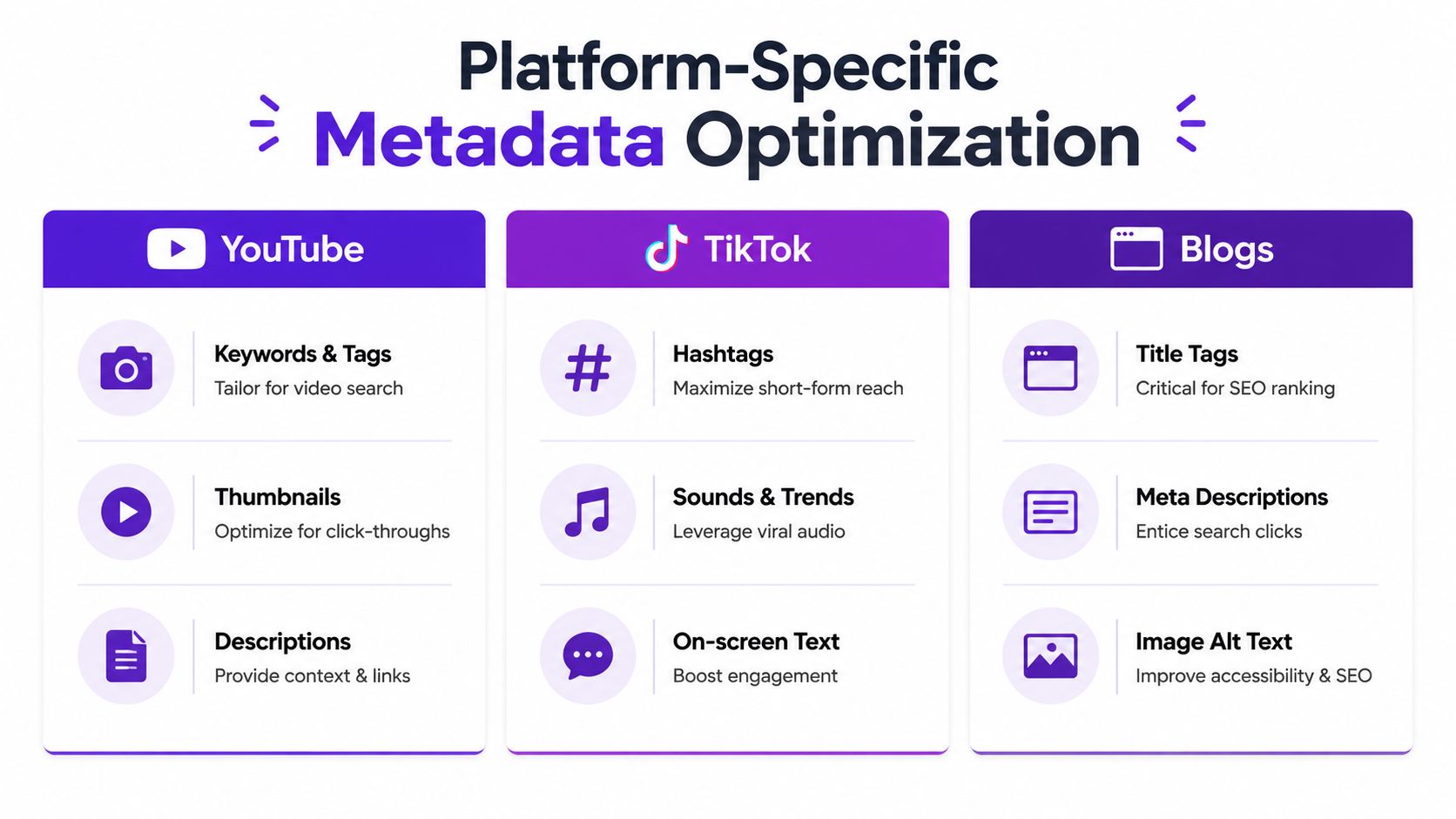
On YouTube, metadata has to support search, suggested videos, browse behavior, and channel context. That means your title and description need to do more than sound catchy.
The practical priorities are:
For creators publishing on a schedule, operational consistency matters almost as much as the writing itself. If you're managing uploads, descriptions, and publishing cadence manually, a platform workflow guide like how to post on YouTube helps tighten the handoff from finished asset to discoverable upload.
If you want a broader channel strategy lens, teams looking for expert digital marketing for YouTube often benefit from outside review because metadata problems are usually tied to positioning problems.
Short-form platforms interpret metadata more loosely, but that doesn't make it less important. It just moves the work into different fields.
On TikTok and Reels, I pay attention to:
What fails here is over-porting YouTube behavior. Long descriptions, formal SEO phrasing, and clunky keyword repetition can make short-form metadata feel unnatural. The platform wants fast comprehension, not a mini blog post.
The first second of a short-form clip and the first line of its on-screen text often do more work than the caption beneath it.
When you turn a video into a blog post, metadata optimization becomes more traditional again. Search engines need a clean title tag, a useful meta description, strong internal linking, and structured content that mirrors search intent.
This is also where schema and governance matter more. In marketing data integration, organizations using automated validation checks and centralized metadata definitions report a 30 to 45 percent reduction in data errors and mismatches across platforms, and teams using cloud-native metadata management platforms experience up to 50 percent faster data discovery as catalogs scale, according to this analysis of how metadata improves marketing data integration.
That sounds enterprise-heavy, but the lesson applies to small teams too. Naming conventions, reusable templates, and standardized fields prevent the little inconsistencies that break search performance across a growing content library.
Here's the practical comparison creators need:
| Platform | Metadata priority | What usually works | What usually fails |
|---|---|---|---|
| YouTube | Search plus recommendation context | Topic-first titles, clear descriptions, aligned thumbnails | Clever titles that hide the subject |
| TikTok | Instant comprehension | On-screen text, concise captions, relevant trend context | Copying long YouTube descriptions |
| Blogs | Crawlable search structure | Title tags, meta descriptions, internal links, schema-aware formatting | Treating the post like a transcript dump |
You don't need a separate strategy for every asset from scratch. You need a separate metadata expression of the same core idea. That's the difference.
Good metadata optimization isn't a last-minute writing task. It's a repeatable production process. When creators skip that process, they end up publishing inconsistent titles, vague descriptions, and mismatched platform packaging.
A simple workflow keeps the quality stable.
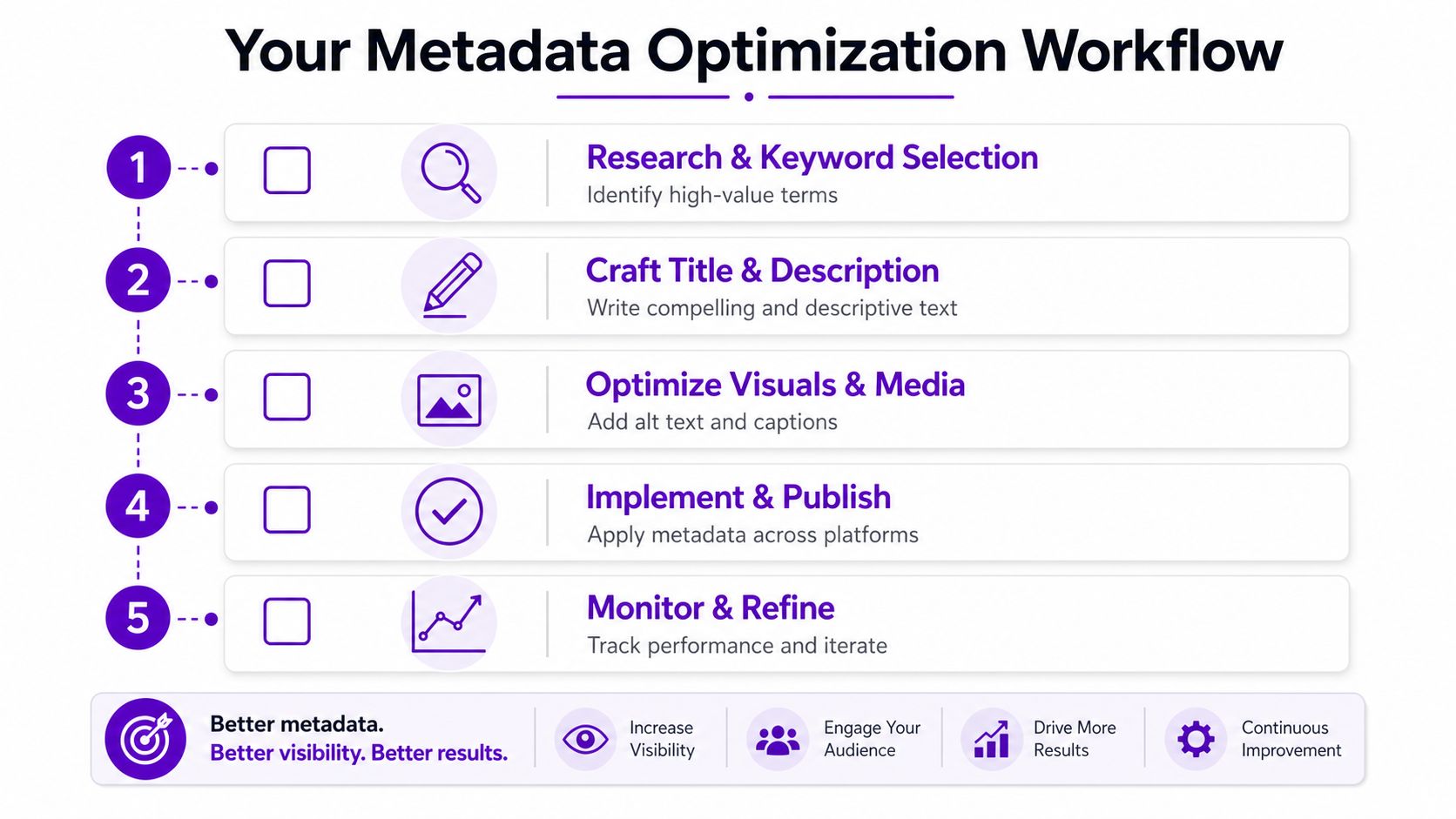
Metadata is frequently overlooked until export day. That's too late. You want the topic, search phrasing, and packaging angle decided while the content is still being shaped.
Use a working checklist:
Define the core query
What exact problem, topic, or outcome does this piece address?
List phrase variants
Note how your audience might word the topic differently.
Choose the platform angle
A YouTube search title, a TikTok hook, and a blog headline may all stem from the same source, but they shouldn't be identical.
Note supporting entities
Include tools, platform names, use cases, and adjacent terms that help clarify relevance.
Once the content angle is clear, write metadata in layers. I recommend drafting several title options, a first-line description summary, and a short bank of tags or label phrases before final publishing.
This is also where consistency pays off. In enterprise metadata management, teams improve quality by enforcing controlled vocabularies, standardized naming conventions, additive schema changes, and limited access to production metadata stores, as outlined in Adobe's guide to metadata best practices. You may not be running an enterprise repository, but the same discipline prevents chaos in a content operation.
Workflow check: If two team members would name the same topic in two different ways, you need a metadata standard.
A short internal template helps:
Here's a useful walkthrough on implementation details before publishing the next batch of content:
Set-and-forget metadata is outdated, especially for dynamic video content. Emerging industry data shows a bi-annual metadata review is insufficient for dynamic content. Successful publishers run 90-day experiment cycles and A/B test descriptions every 14 to 30 days to track CTR and organic rank movement, based on this discussion of metadata testing cadence.
That doesn't mean rewriting everything every week. It means reviewing the assets that matter most and testing the fields most likely to change performance.
Focus your review on:
The teams that get better at this don't obsess over perfection at publish time. They build a review loop and keep improving clarity.
Search behavior is changing faster than most metadata advice. A title that works for a human skimming results pages still matters, but now your metadata also needs to make sense to AI systems that summarize, extract, and cite content.
To be cited by AI search engines like Google SGE, content needs metadata that works as an “extractable summary,” with direct definitions and primary entities front-loaded in descriptions, according to this piece on metadata optimization for AI search. That's a very different standard from old-school teaser copy.
This shift changes how I approach descriptions. Instead of opening with promotional language, I'd rather open with a direct statement of what the content covers and who it helps. If an AI system scans the first lines, it should be able to identify the topic without guessing.
That means:
Metadata that sounds clever but says nothing is easy for humans to ignore and easy for AI to skip.
This is also where manual workflows break. If you're repurposing one podcast episode into multiple shorts, a blog post, social captions, and several platform uploads, metadata becomes production infrastructure.
Tools can help with drafting, standardization, and adaptation across channels, but they're only useful when they preserve strategy instead of generating generic filler. If you're evaluating automation stacks more broadly, lists like Iwo Szapar's AI tool recommendations are useful because they frame tools in the context of operator workflow rather than novelty.
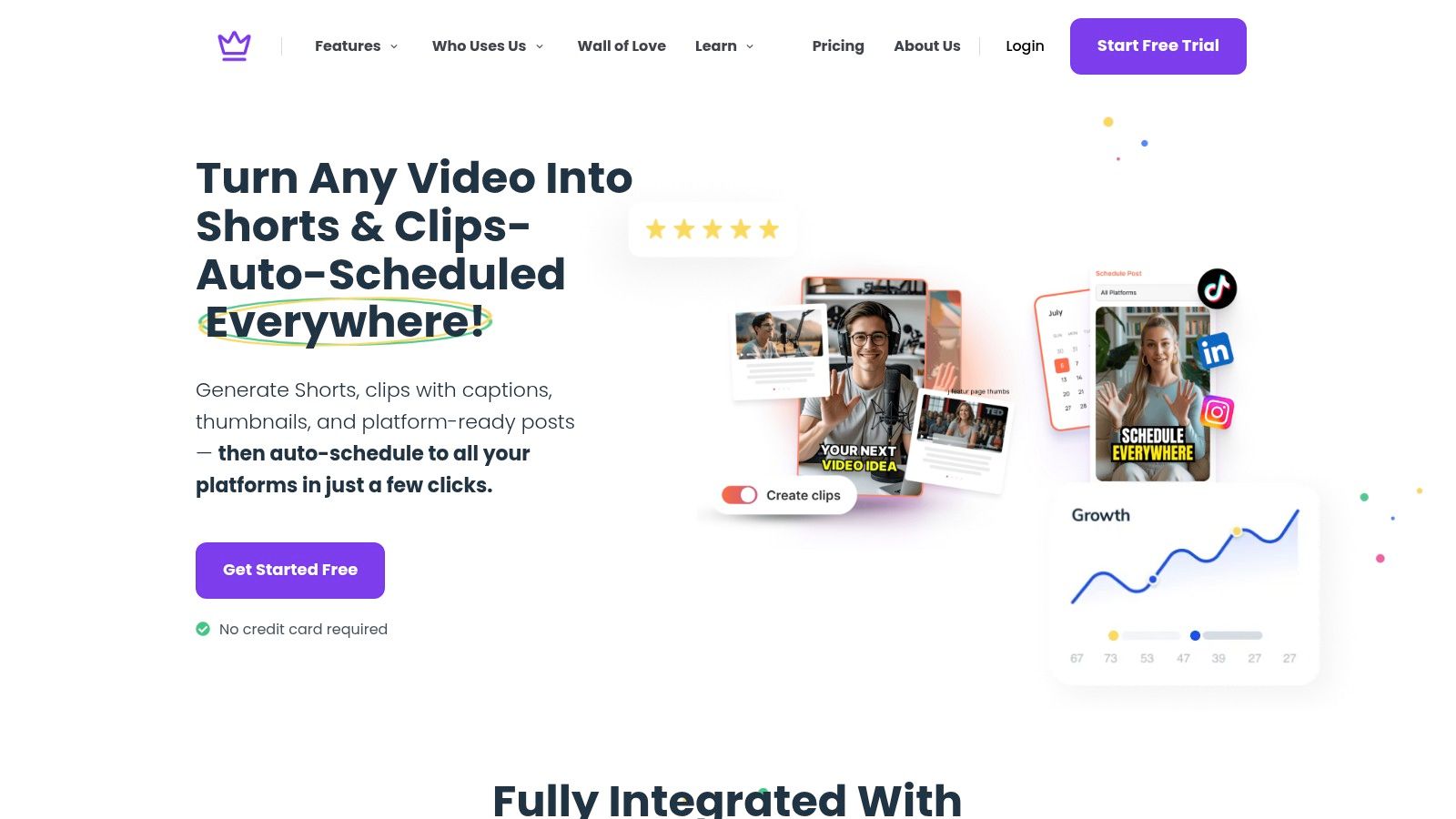
For video-heavy teams, automate content creation is the broader operational goal. Taja AI is one example of a system built around that workflow. It analyzes long-form video and generates platform-specific metadata, clips, and related assets so creators don't have to rebuild packaging manually for every channel.
The win isn't just speed. It's consistency. As AI search expands and content libraries get larger, metadata optimization will belong to the teams that can keep context clear at scale.
If you're publishing video regularly, Taja AI can help turn one long-form recording into platform-specific assets with metadata optimized for YouTube, short-form social, and blog workflows. It's a practical way to reduce manual repackaging while keeping your content discoverable across channels.


We are blessed to work with leading brands & Companies


We try to make easy and simple for every professionals. Get 30 days free trial - No credit card required.


© 2025 Taja AI. All rights reserved.