.jpeg)
Video from YouTube to Facebook: The Complete 2026 Guide
Move any video from YouTube to Facebook the right way in 2026. Learn native uploads, sharing, repurposing, specs, and tips that actually boost reach.
5 min read
September 23, 2026

Explore 10 Instagram Reel captions with hooks, CTAs, niche formulas, hashtag examples, and Taja AI ideas for faster content creation.
Written by:


A Reel caption can determine whether the video gets a fair chance. It doesn't just describe what viewers see. It frames the promise, gives people a reason to keep watching, and directs the next action. That matters on a format operating at enormous scale. Industry reporting says Reels account for 46% of all time spent on Instagram in the U.S., while another 2026 summary reports that more than 2 billion people engage with Reels monthly worldwide and that Reels are reshared more than 4.5 billion times per day (Hootsuite's Instagram statistics).
The right approach depends on the response you want. Some Instagram Reel captions should stop the scroll. Others should increase watch-through, invite comments, earn saves, build trust, or move a qualified viewer toward a booking or sale. Choose with six filters: hook strength, clarity, tone, length, CTA fit, and hashtag relevance.
Your caption should complete the video's promise, not compete with it.
Below are ten practical approaches, organized by viewer response. Use them as working templates, then adjust the language to your niche, offer, and audience.
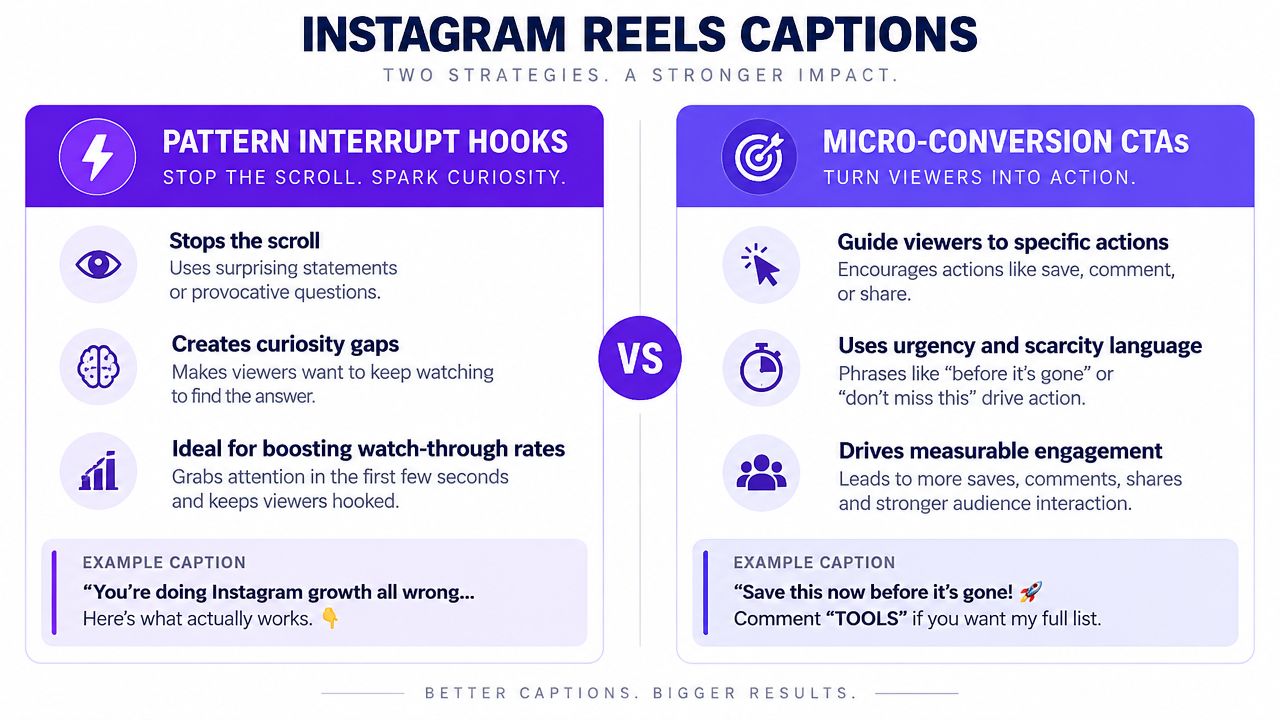
A pattern interrupt breaks the viewer's automatic scroll with a surprising statement, sharp question, or unexpected contrast. The caption doesn't need to explain everything. It needs to create enough tension for the viewer to pause and give the video a chance.
Try a short first line such as:
The strongest hooks feel specific without making a promise the Reel can't deliver. A real estate agent showing a hidden storage feature can use “The room buyers overlook,” but “This secret changes everything” is too vague. A contractor demonstrating a maintenance mistake can lead with the consequence, then let the video explain the fix.
Keep the opening highly scannable. The first line matters because viewers may not tap “more,” and recent guidance on writing Instagram captions reinforces that Reel copy should be easy to skim. Test several variations instead of trying to perfect one sentence in isolation. Taja's auto-caption workflow can generate hook variations from the video, giving you options to compare in your native analytics.
Match intensity to audience expectations. A dramatic hook may work for commentary or entertainment, but a local professional account usually earns more trust with a direct, credible promise.

A CTA works best when it asks for one clear behavior that fits the value of the Reel. “Follow for more” is easy to ignore because it could appear under anything. “Save this before your next home walkthrough” gives the viewer a concrete reason to act.
Use the CTA to create a small next step:
A useful structure is benefit, proof or context, action. For example: “Three inspection questions that expose expensive surprises. Save this before your next viewing.” The content earns the save, and the CTA names the moment when the save becomes useful.
Place the CTA where it makes sense. If the Reel opens with a list and the caption supports it, lead with the save prompt. If the video builds toward a service offer, put the conversion request after the context. Test both placements, but don't stack competing commands.
For broader account growth, pair content-specific CTAs with a consistent publishing system. This guide to growing Instagram followers is useful when you want the caption to support a larger audience strategy rather than chase isolated interactions.
Practical rule: Ask for one primary action. A save, comment, share, and booking request in one caption usually weakens all four.
A short story gives the viewer a reason to care about the person, decision, or transformation inside the Reel. It adds context without turning the caption into a transcript. Two or three sentences are often enough to establish what changed and why the moment matters.
Use a simple sequence:
Examples:
Story captions work because they make the video feel like a moment rather than a promotion. A faith organization can frame a testimony around doubt, service, or a decision. A personal brand can show the point before and after a business or career change.
Pull language from the actual transcript. The most convincing line is usually a real turning point, not a polished slogan. Taja can help identify moments in long-form recordings, then you can edit the draft so the final caption sounds like the speaker.

A storytelling approach also fits storytelling as a marketing tool, especially when your audience needs trust before it needs a sales pitch. Avoid inventing a dramatic arc. If the video contains no genuine tension or change, use an educational or conversation caption instead.
Educational captions lead with the answer, skill, or decision the viewer will gain from watching. They work well for educators, real estate professionals, local businesses, consultants, and service providers because they make the Reel's usefulness obvious before the viewer presses play.
Try formulas such as:
The benefit must be specific. “Improve your home search” is broad. “Three questions to ask before you book a second viewing” tells the viewer what the Reel contains and who should watch it.
Numbers can make an educational promise easier to scan when they're supported by the video. Don't add figures just to make a caption look more authoritative. If you cite a benchmark or research point, link the source in the same sentence. For example, current benchmark reporting says Reels between 30 and 60 seconds generate the highest average reach rate, about 5.60%, while longer videos perform less strongly (Reel statistics and benchmarks). That supports a concise teaching format, but it doesn't mean every subject belongs in a short Reel.
Educational captions should also support silent understanding. About 80% of people watch Instagram Reels with sound on and 20% without sound, according to the same summary, so the caption and on-screen text should make the topic clear even when audio isn't available. Taja's Instagram auto-caption workflow can help generate and refine that supporting text.
Conversation captions make the viewer part of the subject. They use “you,” ask for an opinion or experience, and create a response that doesn't require specialist knowledge. The best prompt has no single correct answer.
Examples include:
Specific questions outperform empty engagement bait because they give people something to say. “Thoughts?” asks the viewer to invent the discussion. “Would you keep the original cabinets or replace them?” provides a clear choice and invites explanation.
Use casual language and contractions. A caption that sounds like a real person asking a real question will usually feel less forced than “Engage below with your perspective.” You can also use a two-part prompt: “Would you take this deal? Tell me what you'd negotiate first.”
Respond to early comments with substance. A creator who answers “Why did you choose that material?” with a useful explanation gives later viewers a reason to join the thread. Pin a comment when it adds context, raises a worthwhile objection, or models the kind of response you want.
Vary the question type across your content:
Don't ask for comments on every Reel. If the content is better suited to a save or direct conversion, use that action instead.
Trend-led captions borrow a recognizable format, meme, audio reference, or point of view, then translate it into your niche. The trend earns the initial familiarity. Your niche-specific twist gives people a reason to watch.
Examples:
Trend captions weaken when they copy the original joke. Adapt the format to a real customer question, recurring misconception, or visual moment from your work. A plumber can use a popular reaction format to show a failed repair. A local café can use a familiar audio structure to contrast a quiet morning with the weekend rush.
Don't treat every platform as interchangeable. Instagram Reel captions should usually stay skimmable and relevant to the video. A caption written for a longer YouTube description may be too heavy for the Instagram feed, while a minimalist TikTok-style line may omit useful context for an Instagram searcher.
Use Taja's trending audio workflow to identify opportunities, then check whether the trend fits your audience and brand. Backlog Boost can also help revive an older video with a new angle, but a new caption won't rescue footage that has no clear relevance.
Keep trend posts balanced with evergreen content. Trends can create fast relevance, but educational, narrative, and authority captions give your profile durable value.
An open loop tells viewers that the Reel contains a resolution, then withholds that resolution from the caption. It works when the unanswered question is real and the video pays it off clearly.
Use a premise plus an unresolved outcome:
The caption creates a viewing obligation, but it must remain honest. If the video reveals a minor detail, don't frame it as a life-changing secret. Clickbait may win a pause, but the mismatch damages trust and can encourage viewers to leave once they realize the promise was inflated.
A strong open loop depends on the footage. Watch the Reel and identify the moment where the viewer naturally asks, “Why?” or “What happened next?” Build the caption around that question instead of forcing mystery onto an ordinary clip.

Use an ellipsis sparingly. “Here's what happened next…” can work when the video immediately delivers the answer. It becomes stale when every post ends the same way. Pair an open loop with a clear keyword or niche cue so discovery doesn't disappear behind the mystery.
Trust-oriented captions reduce uncertainty. They can point to a verified customer experience, relevant credential, transparent process, or documented result. The key is evidence you can stand behind, not impressive-sounding language.
A local service provider might write, “A homeowner called us after two temporary fixes failed. This Reel shows how we diagnosed the underlying issue.” A real estate professional could write, “I'm walking through the inspection questions I use with buyers before they make an offer.” A podcaster can name a guest's relevant experience when that context helps the audience assess the conversation.
Specific evidence is useful only when it's accurate. Don't publish made-up testimonials, unsupported percentages, ratings, client counts, or media placements. Social proof carries a high credibility cost when viewers discover that the wording exaggerates what happened.
Use authority as context, not as a substitute for substance:
This approach may sound less aggressive than “Thousands of customers agree,” but it gives the Reel a stronger trust foundation. A caption should help viewers understand why your perspective is worth their attention, then let the video demonstrate the expertise.
Specialized language helps the right audience recognize relevance quickly. A real estate professional might refer to days on market, comparable sales, contingencies, or inspection periods. A podcaster speaking to founders could discuss dilution, runway, or pre-seed fundraising. A service provider might use terms such as abatement, load calculation, or preventive maintenance.
The trade-off is clarity. Insider language can signal expertise, but too much jargon makes new viewers feel excluded and can attract the wrong interpretation. Define a term when beginners may need help, then use it naturally.
Try two versions of the same idea:
Use the version that matches the Reel's audience. If you're speaking to industry peers, precision may matter more than simplification. If you're trying to generate local leads, plain language usually keeps the audience wider while still allowing relevant keywords.
Taja's keyword research can help surface niche terms for caption drafts, but automation doesn't verify meaning. Review every technical phrase, acronym, and product name before publishing. A caption that misuses industry language signals carelessness to the exact people you want to impress.
Hashtags should support the topic rather than replace it. Include relevant niche terms in the prose first, then add a focused hashtag set that reflects the subject, location, or audience. Don't fill the caption with unrelated popular tags.
Pain-point captions name a frustration the viewer already recognizes. They work when the language feels observant rather than manipulative. Start by acknowledging the problem, then point toward the relief or perspective inside the Reel.
Examples:
Use the audience's words. Customer emails, comments, sales calls, and support questions often reveal better phrasing than a brainstorming session. “I'm tired of paying for repairs that don't last” is more concrete than “Are you experiencing home maintenance challenges?”
Empathy should lead somewhere. After validating the frustration, promise a useful explanation, practical next step, or hopeful perspective. Don't exploit fear without giving the viewer something they can do.
Name the problem accurately, then make the next sentence useful.
Tone matters more here than cleverness. A serious subject needs restraint. A playful frustration can support a lighter hook. If the Reel is a testimonial or personal story, let the caption create emotional context without claiming an outcome the video doesn't show.
| Approach | 🔄 Implementation Complexity | ⚡ Resources & Speed | 📊 Expected Outcomes | 💡 Ideal Use Cases | ⭐ Key Advantages |
|---|---|---|---|---|---|
| Hook-First Captions with Pattern Interrupts | Low–Medium: quick to craft; requires A/B testing | Low: AI-ready; very fast iteration | Higher CTR & early watch-through; more saves/shares | Short-form attention-first content (TikTok, Reels, Shorts) | Immediate scroll-stopping impact; scalable templates |
| Call-to-Action (CTA) Captions with Micro-Conversions | Medium: needs strategy and timing tests | Moderate: tracking, link setup; templatable | Direct measurable conversions (clicks, leads, saves) | Promotions, lead gen, sales funnels, appointment bookings | Drives measurable business outcomes; repeatable funnels |
| Narrative Storytelling Captions | High: demands authentic craft and coherent arc | Higher: transcript mining, editing; slower production | Increased retention, emotional connection, loyalty | Personal brands, faith orgs, long-form repurposing | Deep engagement and memorable brand differentiation |
| Value-Forward Educational Captions | Medium–High: requires expertise and accuracy | Moderate: research and SEO work; can be templated | Attracts high-intent viewers; authority and quality engagement | Educators, thought leaders, service providers | Positions creator as expert; supports discoverability (SEO) |
| Audience-Direct Conversation Captions | Low–Medium: simple to write; needs moderation plan | Low: fast to deploy; requires comment management | Higher comment rates; stronger community signals | Community-building, podcasts, interactive posts | Boosts comments, fosters belonging and audience data |
| Trend & Platform-Optimized Captions | Medium–High: needs trend monitoring and tailoring | High: rapid turnaround, platform-specific edits | Short-term reach spikes; platform-specific visibility | Trend-driven content, repurposing backlog for momentum | Maximizes trend-fueled reach; multi-platform optimization |
| Curiosity Gap and Open-Loop Captions | Medium: craft incomplete premise that aligns to video | Low–Medium: quick to write but must match content | Higher watch completion and retention; better retention signals | Attention hooks, short-form storytelling, listicles | Proven to increase watch-through; pairs well with hooks |
| Social Proof and Authority Captions | Medium: requires verifiable data/testimonials | Moderate: gather evidence, legal/claim checks | Increased trust, higher conversion rates for sales content | Service providers, high-consideration offers, local biz | Dramatically boosts credibility and reduces hesitation |
| Niche-Specific Terminology and Insider Language Captions | Medium: needs accurate jargon and keyword research | Moderate: research time; may require dual versions | Better niche discoverability; higher-quality audience | Professional/technical niches, B2B, specialist communities | Signals expertise, improves niche SEO, filters audience |
| Emotional Resonance and Pain-Point Captions | Medium–High: requires authentic empathy and nuance | Moderate: audience research and careful phrasing | Strong engagement from motivated viewers; loyalty growth | Coaches, therapists, support communities, service providers | Builds trust through validation; drives shares and retention |
You don't need to use all ten approaches at once. Choose the caption style according to the response the Reel needs. Pattern interrupts and open loops suit attention and watch-through. Educational captions and niche terminology support discovery when the audience is searching for a solution. Conversation prompts are built for comments. Storytelling and emotional resonance create connection. CTAs and social proof help qualified viewers take action.
Start with the video's actual job. A quick property reveal may need a hook that creates immediate interest. A repair tutorial should state the problem and benefit clearly. A founder interview may need a story frame that gives the clip emotional context. A service offer should remove uncertainty and present one next step.
Caption length should follow intent, not habit. A 2026 study found that Reel engagement stayed broadly flat across caption lengths at roughly 3.3% to 3.6%, while median reach fell from about 380 to 141 once captions exceeded 500 characters (Instagram caption length analysis). The practical takeaway is simple. Keep the hook near the front, cut context that doesn't help the viewer, and use longer copy only when the additional explanation earns its space.
Reels already carry strong interaction in many benchmark datasets. One Hootsuite summary reports an average Reel engagement rate of 2.7% across more than one million social posts, compared with 3% platform-wide Instagram engagement in that dataset (engagement rate calculation guide). That suggests the caption usually supports the video rather than replacing it. Your copy should clarify the promise, add useful context, and guide the next action.
Use this publishing check before you post:
Taja AI can support this workflow by analyzing long-form video, generating caption variations, creating short clips with timed captions, and scheduling platform-specific outputs from one workflow. Its tools are especially relevant for podcasters, educators, real estate professionals, local service providers, and small marketing teams that need to turn one recording into multiple publishable assets. Use the generated draft as a starting point, then make the final promise, tone, and CTA your own.
The best Instagram Reel captions aren't the longest or most keyword-heavy. They're the ones that make the video easier to understand, more relevant to the right viewer, and more useful at the moment a decision is made. Pick one viewer response, write toward it, and measure whether the next Reel deserves the same formula.
Taja AI can turn long-form recordings into captioned vertical clips, generate Instagram Reel caption variations, and help schedule platform-specific posts from one workflow. Visit Taja AI to create a practical caption and repurposing system for your next batch of Reels.


We are blessed to work with leading brands & Companies


We try to make easy and simple for every professionals. Get 30 days free trial - No credit card required.


© 2025 Taja AI. All rights reserved.