.jpeg)
Content Calendar Creation for Small Teams
Master content calendar creation without burnout. Learn to map platforms, set realistic cadences, and automate repurposing with AI tools like Taja AI.
5 min read
October 14, 2026

Learn how to find trending topics that match your audience, not just global hype. A practical guide with tools, metrics, and a repeatable workflow.
Written by:


You've found a topic that's everywhere. It's appearing in search suggestions, filling your social feeds, and showing up in conversations across your industry. You publish quickly, expecting the momentum to carry the piece, but the response is flat. The problem usually isn't speed. It's that the trend never belonged to your audience in the first place.
Finding trending topics is easy. Finding trends that fit your niche, audience, geography, authority, and publishing capacity is the skill. The strongest process combines search data, social signals, regional context, and editorial judgment. It treats a trend as a hypothesis to validate, not an automatic content brief.
A creator watches a celebrity moment explode across the internet and decides to move fast. They publish a post connecting the story to marketing, add a few familiar keywords, and share it everywhere. The result is disappointing because their audience came for B2B demand generation, not entertainment commentary. A large topic can attract attention without attracting the right people.

That mismatch creates three hidden costs. First, audience resonance suffers. People may notice the post, but they have little reason to read another article, subscribe, or trust the creator's recommendations. Second, the brand voice becomes diluted. A software company that repeatedly comments on unrelated viral moments starts to look opportunistic rather than knowledgeable.
The third cost is operational. Teams jump from one unrelated subject to another, changing tone, research habits, and production formats every time a platform produces a new spike. That creates algorithmic whiplash. Platforms may distribute individual posts, but an audience still learns what a publisher is for. Inconsistent subject matter makes that promise harder to understand.
A relevant trend has three kinds of overlap:
A trend that passes only one test is usually a distraction. A popular news story might have topical overlap but no audience overlap. A niche discussion might fit your readers perfectly but lack enough freshness to justify reactive coverage.
Google Trends has been available since May 11, 2006, giving marketers a long-running public baseline for comparing relative search interest across regions, time ranges, categories, and YouTube searches (Google Trends history and methodology). That history matters because trend research is a measurement problem. You're comparing movement, not reading a perfect count of every search.
Practical rule: A trend earns production time only when it gives your existing audience a timely reason to care and gives you a credible way to add value.
Search engines also reward useful, focused coverage more than superficial trend-jacking. A site that builds depth around a subject can strengthen its topical authority, while an unrelated viral post rarely compounds into a durable content asset. The rest of the process should therefore answer a harder question than “What's hot?” It should answer, “What's gaining attention that my audience can use?”
No single platform shows the full picture. Search reveals intent, social platforms expose conversation, video platforms show formats and questions, and forums preserve the language people use when they need help. Use each tool for the signal it handles well, then check whether that signal fits your niche, audience, and geography before turning it into a brief.
Google Trends is a strong first stop for comparing search interest, checking regional differences, and finding related queries. Enter a seed topic, set the geography and search property, then review Rising and Top queries. Google defines Rising as terms with the strongest growth for the selected period, and labels a term Breakout when growth exceeds 5000% (Google's explanation of Trends data).
The important caveat is interpretation. Trends uses normalized values from 1 to 100 and samples Google searches, so it shows direction rather than an absolute volume report. Compare related terms using the same geography, timeframe, and benchmark. A breakout query that remains visually tiny beside a known term may be a sharp, low-volume spike rather than a durable opportunity.
Run the comparison in your target market, not the default region. A topic rising in one country may have little relevance to readers elsewhere, and a broad term may hide the wording your niche audience uses.
YouTube Trending and Explore help video-first publishers identify subjects and formats gaining attention. Search suggestions reveal questions viewers type, while related videos indicate whether the opportunity suits a tutorial, explanation, interview, review, or reaction.
The trending tab can lag behind a live spike and reflects platform selection, so it is not a complete real-time feed. For a faster research pass, review recent uploads, search suggestions, and comments around the topic. If a promising video needs an initial review before you decide whether to respond, summarize YouTube with transcript.im to extract its main points, then verify the details yourself.
This step is useful because a trend is not yet a content idea. The same subject might become a short explainer for beginners, a comparison for buyers, or a technical breakdown for experienced readers. Let the questions and formats already appearing on the platform guide that choice.
TikTok Creative Center helps identify hashtags, songs, creators, and audience context. It is useful for seeing how a topic is packaged, but its signal can skew toward younger users and overrepresent United States activity. Adjust for your target market before treating a format as broadly relevant.
X Explore and Trending can surface raw signals quickly, especially around breaking news and public debate. The trade-off is noise. Trending labels may reflect intense but narrow conversations, coordinated activity, or low-quality engagement, so use X to generate hypotheses rather than approve briefs.
Reddit offers a different kind of evidence. Rising posts in focused subreddits often contain high-intent questions, objections, and practical vocabulary. A single popular thread does not establish a broad trend, but repeated questions across relevant communities can reveal a useful content angle. Manual scanning takes time, so save recurring searches or use RSS where appropriate.
| Tool | Best For | Signal Type | Watch Out For |
|---|---|---|---|
| Google Trends | Search growth and regional comparison | Relative search interest | Indexed data can mislead without a benchmark |
| YouTube Explore | Video topics and viewer questions | Search and viewing behavior | Platform discovery can lag live events |
| TikTok Creative Center | Hashtags, sounds, and formats | Short-form social activity | Audience and regional bias |
| X Explore | Fast breaking-topic detection | Real-time conversation | High noise and questionable signal quality |
| Niche pain points and language | Community discussion | One thread may not represent a wider topic |
Keyword research supports this process after a topic has passed the relevance check. A guide to AI tools for keyword research can help expand a validated idea into related queries and publishable angles. Paid platforms can speed up monitoring, clustering, and alerts, but they cannot decide whether a topic belongs in your channel. Software reduces research time. It does not make an irrelevant trend useful.
A small team can screen a candidate trend quickly if it uses the same questions every time. The purpose isn't to predict the future perfectly. It's to eliminate obvious mismatches before anyone spends hours outlining, recording, designing, or editing.
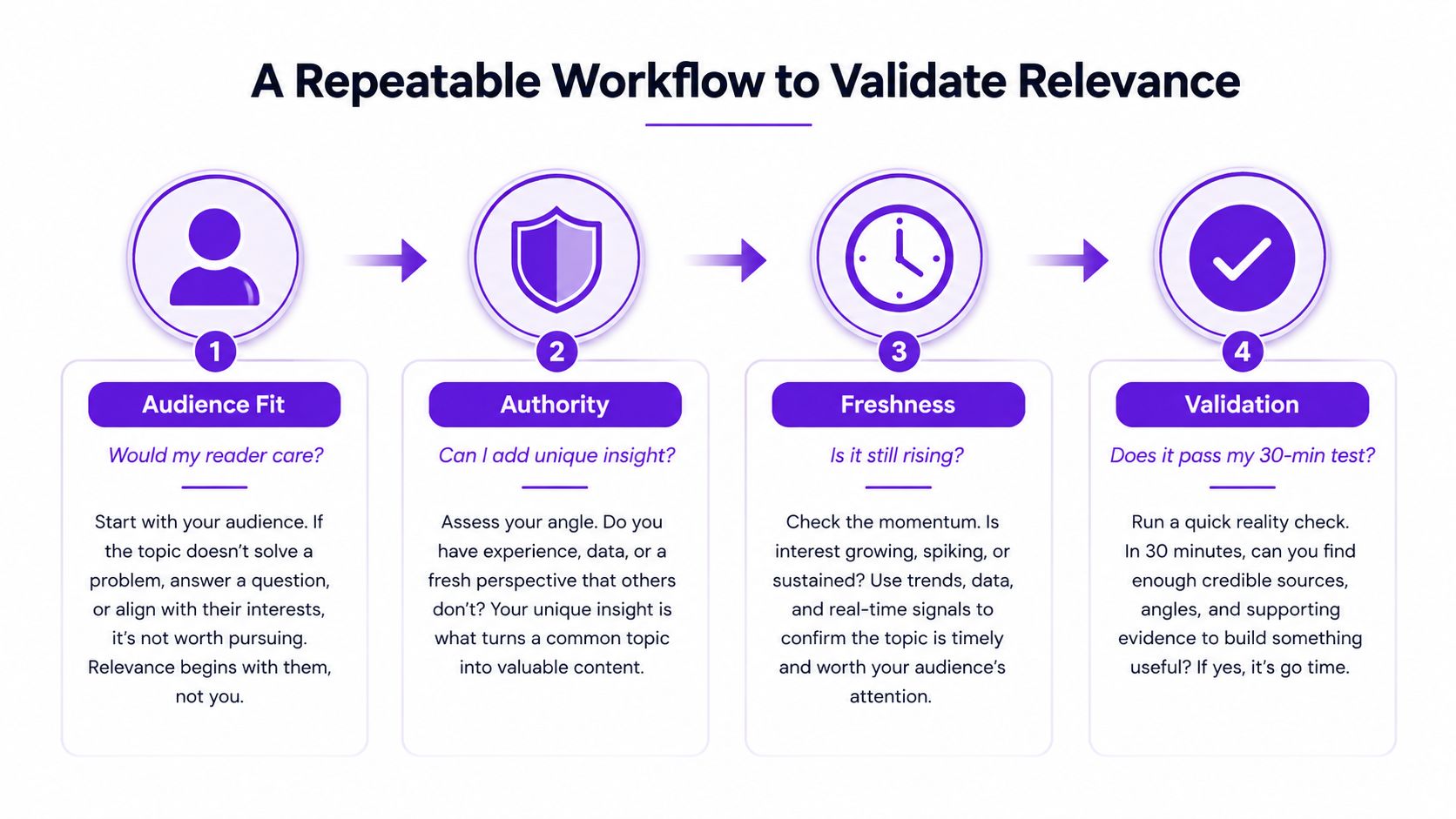
Ask three questions before opening another tool:
A finance creator might notice “buy now pay later regulation” rising in Google Trends. The topic passes the first filter because it affects household borrowing, consumer education, and financial decision-making. A celebrity story trending at the same time fails immediately. The creator may be able to comment on it, but the audience has no reason to expect that commentary from this channel.
Set geography, language, search property, and timeframe before interpreting the chart. A rise in one country can disappear when you view global data, while a phrase that looks weak internationally may be highly relevant to a local service provider. Google's Explore tool supports regional interest, related topics, and related queries, which makes localization part of validation rather than a final editing step.
Seasonality deserves its own check. Compare the current pattern with the same period in the previous year, when that view is available. A recurring holiday, tax deadline, conference cycle, or school calendar can create a predictable spike. That doesn't make the topic useless, but it changes the content strategy from urgent news coverage to planned seasonal publishing.
Use at least two platforms before approving the idea. For the finance example, Google Trends can show search acceleration, Reddit can reveal real questions and objections, and TikTok finance creators can show whether the subject has entered short-form conversation. The signals don't need to look identical. They need to support the same underlying audience need.
A useful trend has evidence of movement and evidence of meaning. Search movement tells you that attention is changing. Community discussion tells you why it matters.
Record the result as publish, monitor, or skip. A topic with strong relevance but limited confirmation belongs in monitor. A topic that passes audience fit, geographic fit, seasonal review, and cross-platform validation can move to production.
Use a publishing workflow such as the Donivo posting workflow guide once the idea is approved, particularly when several formats must be coordinated. For additional idea discovery, a content gap analysis can reveal where a validated trend intersects with questions your existing library hasn't answered.
The following video can help teams visualize the process before they turn it into an internal checklist.
A rising line doesn't automatically indicate a valuable topic. Strong validation looks for several signals that answer different questions: Is attention accelerating? Is the conversation meaningful? Does the subject have practical depth? Can the interest survive beyond a single burst?
The first signal is velocity. Compare a short window with a longer window, such as seven days against thirty days, while keeping the geography and benchmark consistent. A short-window rise suggests freshness. A longer-window rise suggests that the topic may have more staying power. Google's Breakout label is useful for identifying exceptional growth, but it doesn't prove that the query has enough volume or relevance for your niche.
Engagement needs interpretation too. Likes are easy to collect and weak as a standalone decision signal. Comments, shares, saves, click behavior, and thoughtful replies tell you more about whether people are processing the subject or merely passing it along.
Comment sentiment can expose the difference between curiosity and backlash. Read a sample of comments and classify them as questions, agreement, disagreement, requests for examples, jokes, or attacks. A discussion full of specific questions often gives you a useful content brief. A thread dominated by outrage may still deserve coverage, but it needs a different risk assessment.
On visual platforms, saves and shares usually indicate utility or identity value more clearly than likes. On YouTube, sustained viewing and thoughtful comments suggest depth, while a high click-through impression with immediate abandonment points to packaging rather than substance. These are directional judgments, not universal thresholds.
| Metric | What It Measures | Healthy Benchmark | Platform Context |
|---|---|---|---|
| Velocity | How quickly interest is changing | A rise that remains visible across more than one comparison window | Google Trends and search |
| Breakout status | Exceptional relative growth | Worth investigating, never sufficient on its own | Google Trends |
| Meaningful engagement | Questions, shares, saves, and useful replies | Interaction that advances the conversation | Social platforms |
| Comment sentiment | Curiosity, approval, confusion, or backlash | Specific questions and constructive disagreement | TikTok, YouTube, Reddit, X |
| Watch depth | Whether viewers stay for the substance | Continued viewing paired with relevant discussion | YouTube |
| Cross-platform presence | Whether the theme travels beyond one feed | Related evidence in at least two distinct environments | Search plus social or community |
Don't ask whether a trend is big enough in isolation. Ask whether its signal is strong enough for the decision you're making.
A topic can be publishable with modest search interest if it serves a valuable niche and you have unusual expertise. Conversely, a massive spike can be a poor investment if the audience overlap is weak or the subject will disappear before production finishes. Metrics narrow uncertainty. Editorial judgment makes the final call.
A validated trend should produce more than one rushed post. The efficient approach is to keep the core fact or question stable while changing the reader promise, format, depth, and point of view.
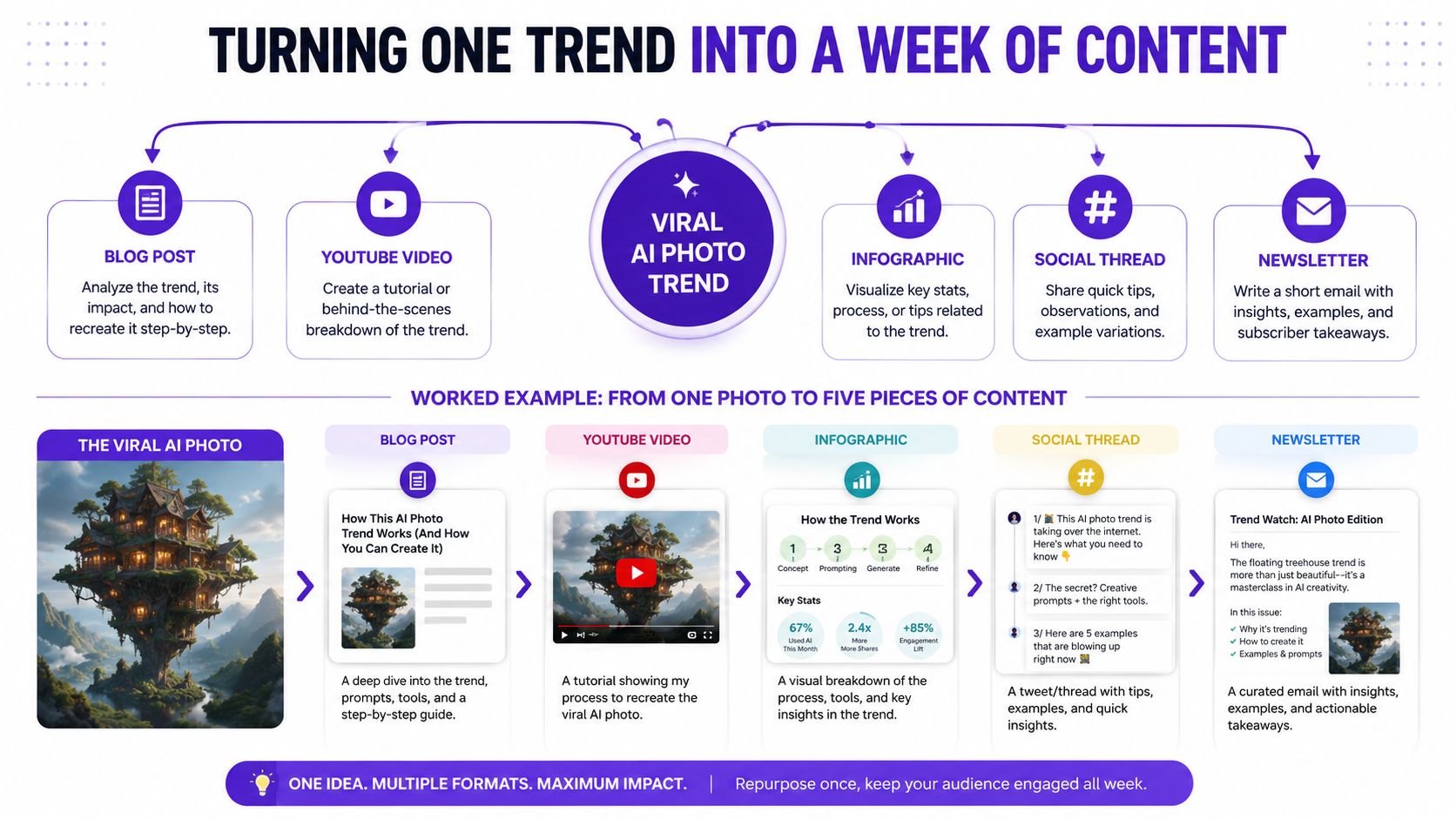
Take a validated viral AI photo trend for a creative software audience. The central idea might be the way people use an image-generation style, but each asset should answer a different question:
The formats shouldn't repeat the same script. Use five angle types to keep the series distinct: tutorial, opinion, list, story, and counterpoint. The tutorial shows the method. The opinion makes a defensible judgment. The list organizes applications. The story gives the audience a human context. The counterpoint challenges the obvious conclusion.
Publish the fastest format while the conversation is active, then use the longer formats to capture questions that emerge. A short video can expose confusion. The blog post can answer it in detail. The newsletter can explain what changed after the initial excitement. A later professional carousel can translate the topic for a narrower decision-making audience.
A practical repurposing checklist looks like this:
Teams working with AI should also document review standards for accuracy, rights, disclosure, and brand voice. A practical framework for AI content governance can help define those checks before production scales. For scheduling and ownership, a content calendar keeps the sequence visible instead of leaving each asset in a separate platform draft.
The goal isn't to publish everywhere automatically. It's to make one well-chosen trend earn its place by producing a connected set of useful responses.
Reactive content has an opportunity cost. Every hour spent chasing a weak trend is an hour unavailable for a pillar article, customer resource, product tutorial, or search page that can remain useful after the conversation moves on.
Skip the trend when the audience mismatch is obvious. Also step away when brand safety risks are difficult to control, when the topic requires more verification than your team can perform, or when the trend's lifespan is shorter than your production cycle. A late response can look careless rather than timely.
Use this filter:
If any answer is no, bank the idea as a note and protect the planned evergreen work. The trend may become useful later as an example, FAQ, comparison, or section inside a broader resource.
Speed is valuable only when it serves a clear editorial position.
Evergreen content often compounds because it answers a persistent need and can be improved over time. Trend content can create a timely entry point, but it shouldn't replace the subjects that establish your authority. A balanced editorial system uses trends to respond to movement and pillar content to build the foundation.
A workable routine doesn't require constant monitoring. A solo creator or small team can use a focused Monday session to produce a short list of qualified opportunities, then make a brief Friday check for late developments.
Spend twenty minutes scanning Google Trends, X Explore, Reddit, and YouTube Trending. Filter every platform to your niche, target geography, and relevant language where the platform allows it. Capture candidate topics in a simple sheet with the topic, source, audience, location, and first observed date.
The output should be a list of raw candidates, not finished ideas. Don't write headlines yet. Your first job is collection.
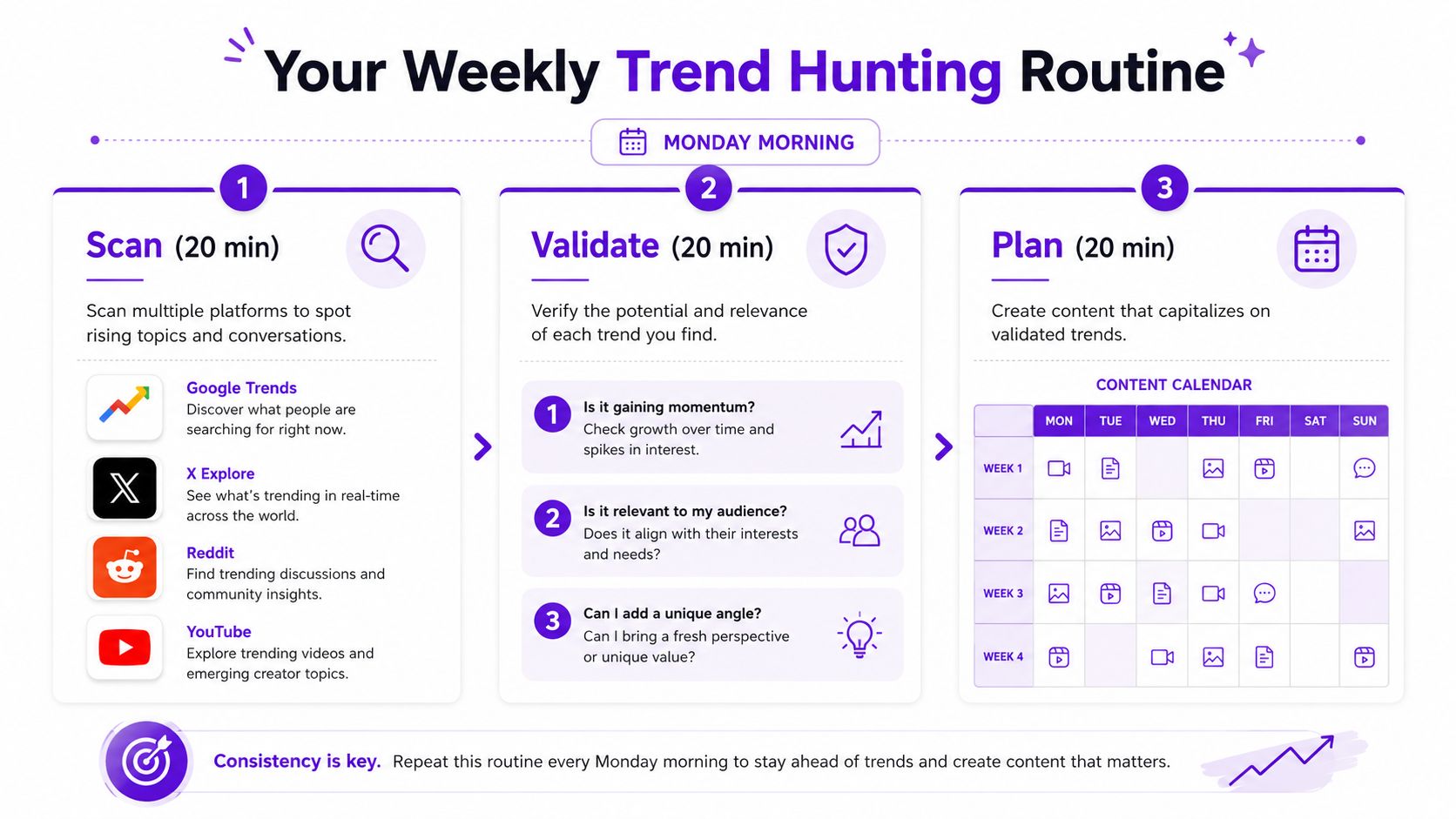
Use another twenty minutes to apply the relevance filter. Tag each candidate as publish, monitor, or skip. For publish candidates, record the audience problem, geographic context, unique angle, supporting platforms, and ideal format. For monitor candidates, write the missing evidence you need before approval.
This block prevents the common mistake of treating discovery as validation. A topic can appear in several feeds and still fail because your readers don't care or your brand can't contribute anything distinctive.
Use the final twenty minutes to map publish candidates to the content calendar. Assign an owner, format, working angle, and review point. If a trend needs a fast response, choose a lightweight format. If it has lasting relevance, assign a deeper asset and consider a supporting sequence.
On Friday, spend ten minutes checking the same sources for meaningful developments. Fold a late-breaking signal into scheduled work only when it strengthens the existing angle. Don't discard a strong planned piece because a new spike looks exciting.
Keep this checklist visible:
Common failures are predictable. Teams ignore geography, treat every spike as newsworthy, and skip the relevance filter when time is tight. Those shortcuts create more production work, not less, because weak ideas still consume research and editing time.
Taja AI can help turn a validated topic into publish-ready clips, captions, thumbnails, blogs, and platform-specific posts from one long-form video, while its idea tools connect niche signals with potential next topics. Visit Taja AI to see how you can move from trend validation to a consistent, multi-format publishing workflow.


We are blessed to work with leading brands & Companies


We try to make easy and simple for every professionals. Get 30 days free trial - No credit card required.


© 2025 Taja AI. All rights reserved.