.jpeg)

10 Hashtags for Music to Boost Discovery
Find the best hashtags for music by genre, platform, mood, and trend, plus practical ways to mix broad and niche tags for stronger discovery.
5 min read
October 5, 2026

Discover what a creator economy platform is, how it works, and how to choose the right one to scale content, monetize faster, and reduce burnout in 2026.
Written by:


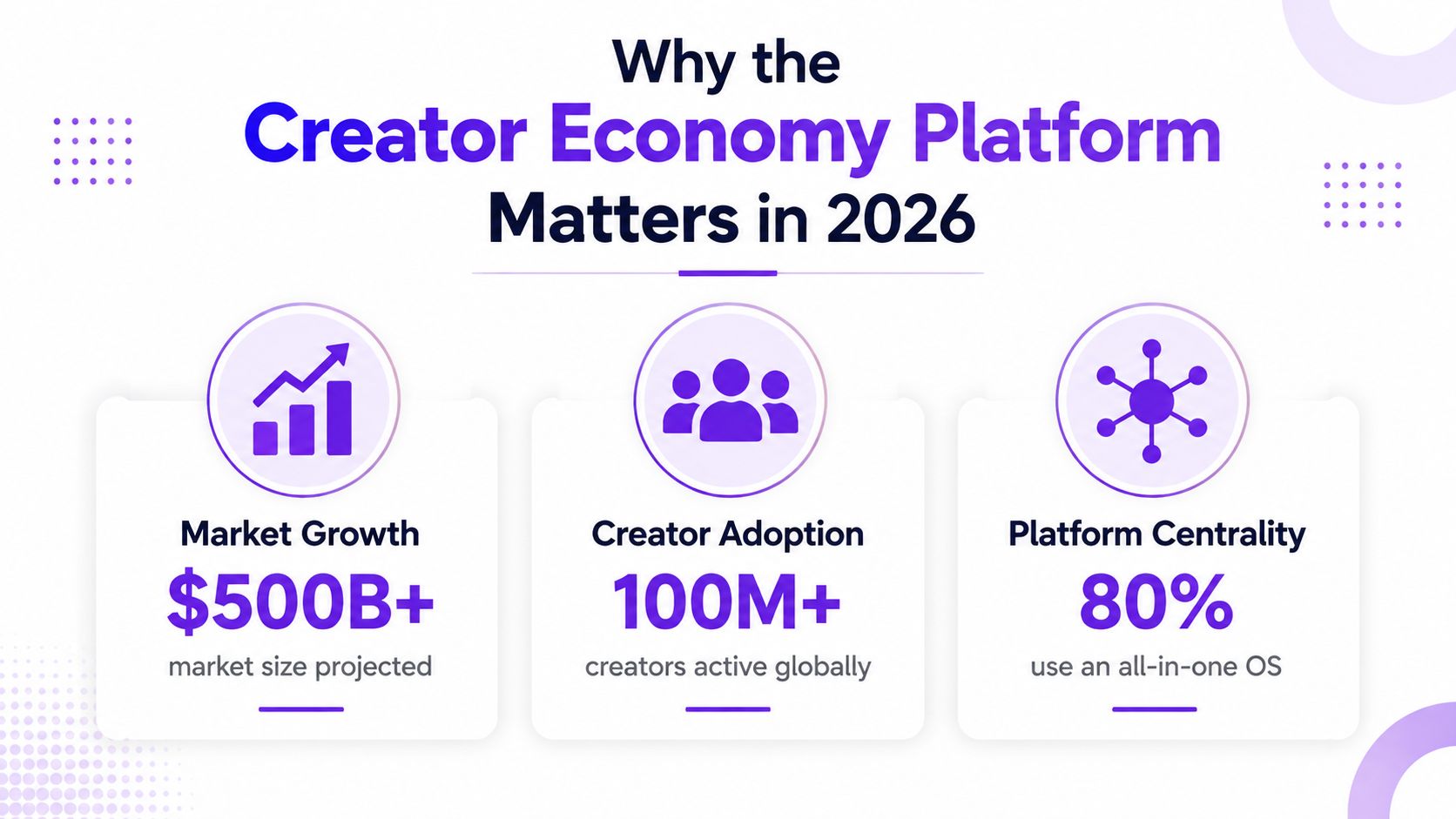
The creator economy is no longer a side market for influencers and hobbyists. One widely cited estimate values it at about USD 203.6 billion in 2024, with a projection of USD 1.1813 trillion by 2032, while another estimate places the market at USD 252.3 billion in 2025 and projects USD 1.3455 trillion by 2033. The difference between estimates reflects a broad, rapidly changing category, not a lack of momentum. (SNS Insider market estimate, Grand View Research market analysis)
That growth has changed the software problem. Creators no longer need only a place to publish. They need a system that turns one idea into useful assets across fragmented channels, protects them from algorithm volatility, and helps convert attention into an audience and revenue stream they can influence directly.
A creator economy platform should therefore be judged like business infrastructure. Publishing is only the visible layer. The value sits in the connections between production, distribution, audience ownership, analytics, and monetization.
The market's scale makes one point clear: creator work has become a serious commercial operating model. Independent market coverage estimates that roughly 50 million creators participate in monetization globally, while the United States represents about 35% of the global creator economy and approximately USD 50–56 billion in annual value in 2024. (Creator Economy Reports market coverage)
That concentration matters for small operators because the same infrastructure that supports large creator businesses is increasingly available to solopreneurs, educators, local service providers, and niche publishers. A creator economy platform can sit between the raw recording and the commercial outcome, coordinating the work that used to happen across a video editor, social scheduler, keyword tool, email platform, spreadsheet, and analytics dashboard.
Social and video distribution still dominate the platform layer. One forecast estimates that social media platforms will represent 46.2% of the creator economy market in 2026, while another tracks social platforms at 29.0% of platform value in 2024, down gradually from 31.7% in 2019. (Coherent Market Insights creator economy forecast)
Those figures describe a fragmented distribution environment. A podcast episode, webinar, property tour, or sermon may need a long-form version, vertical clips, captions, thumbnails, written posts, and search-optimized metadata. If a creator produces each version manually, distribution becomes a bottleneck. If the creator publishes only on one network, the business inherits that network's changing rules.
Algorithm volatility adds another layer of risk. Recent trend coverage identifies algorithm volatility as a concern for 32% of creators, while micro- and nano-influencers are projected to receive 45.5% of influencer marketing spend in 2026. (Venture Lab creator economy trends) Smaller creators need efficient distribution, but they also need a path beyond rented reach.
Practical rule: Treat social platforms as discovery channels, not as the entire customer relationship.
The right platform helps you publish consistently without confusing output with progress. It should make repurposing easier, preserve a recognizable brand voice, reveal which topics attract qualified attention, and connect discovery to email, community, products, services, or subscriptions. That makes platform selection a strategic decision, not a routine software purchase.
Think of a creator economy platform as the operating system between your content factory and your revenue engine. It doesn't replace judgment, expertise, or a distinct point of view. It coordinates the repetitive work required to turn those assets into a reliable publishing and business workflow.
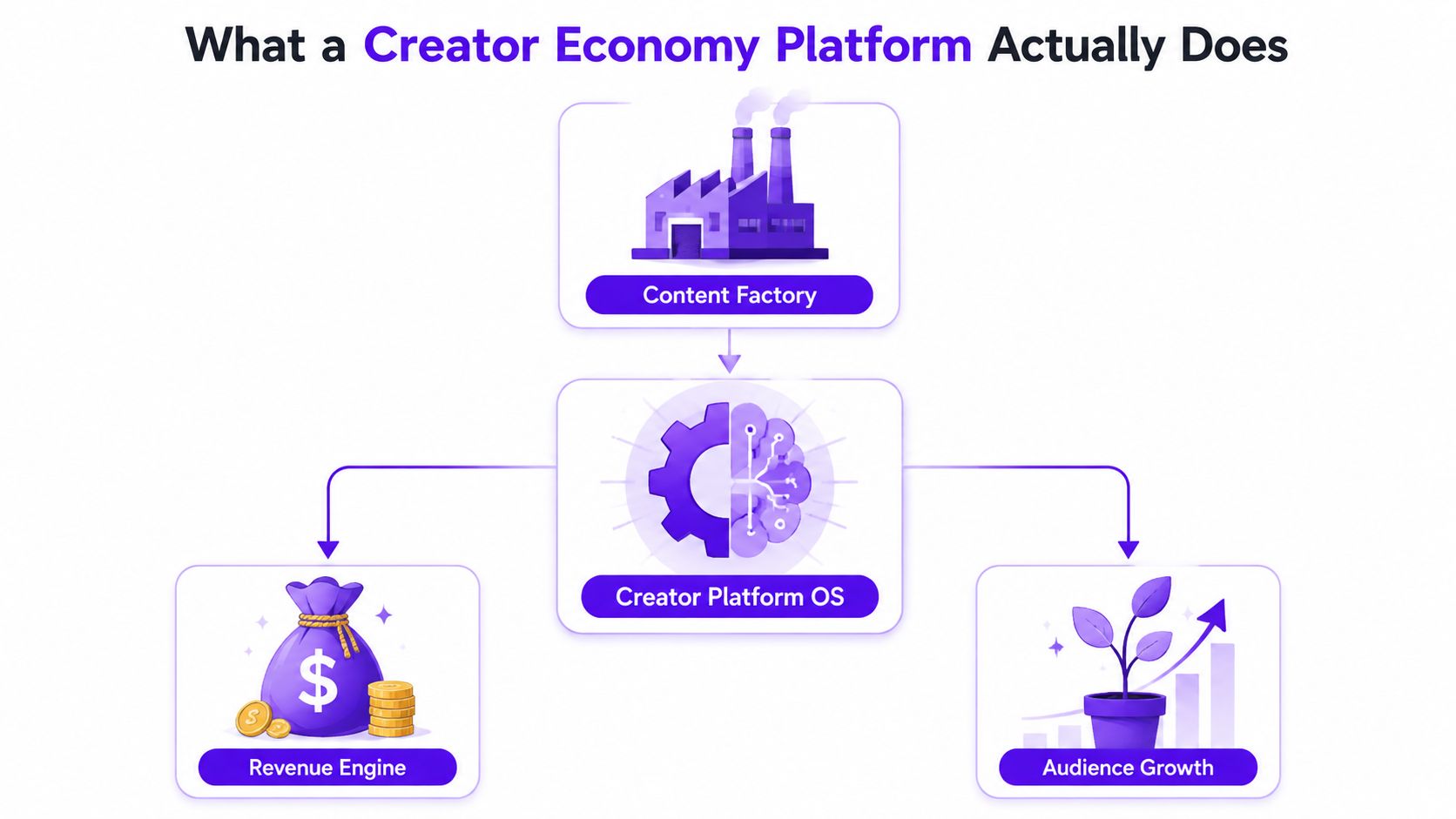
Creation and repurposing is the first layer. Strong systems can ingest long-form video or audio, identify useful moments, create shorter assets, generate captions, and adapt formats for different channels. The important test isn't whether a platform produces many outputs. It's whether those outputs preserve the original argument, context, and brand standards.
Distribution and scheduling handles the publishing burden. Look for channel-specific formatting, scheduling rules, approval workflows, and bulk publishing. A single caption copied everywhere rarely performs as well as a post adapted to the expectations of each network. Good automation reduces repetition without making every channel look identical.
Audience and community form the ownership layer. This may include email capture, newsletters, memberships, discussion spaces, customer records, or integrations with tools that provide those functions. A platform that generates reach but leaves you unable to communicate with interested people outside the social feed solves only the top of the funnel.
Monetization and analytics connect activity to the business. Depending on the product, this can include digital products, subscriptions, sponsorship workflows, tips, services, conversion tracking, content analytics, and revenue reporting. You need enough data to distinguish visibility from useful business action.
A practical way to understand the workflow is to follow one recording:
The content distribution platform guide offers useful context on why this middle layer matters. A creator economy platform earns its place when it closes gaps between these layers. If it covers only publishing, you'll still need separate tools for content production, audience ownership, and revenue operations.
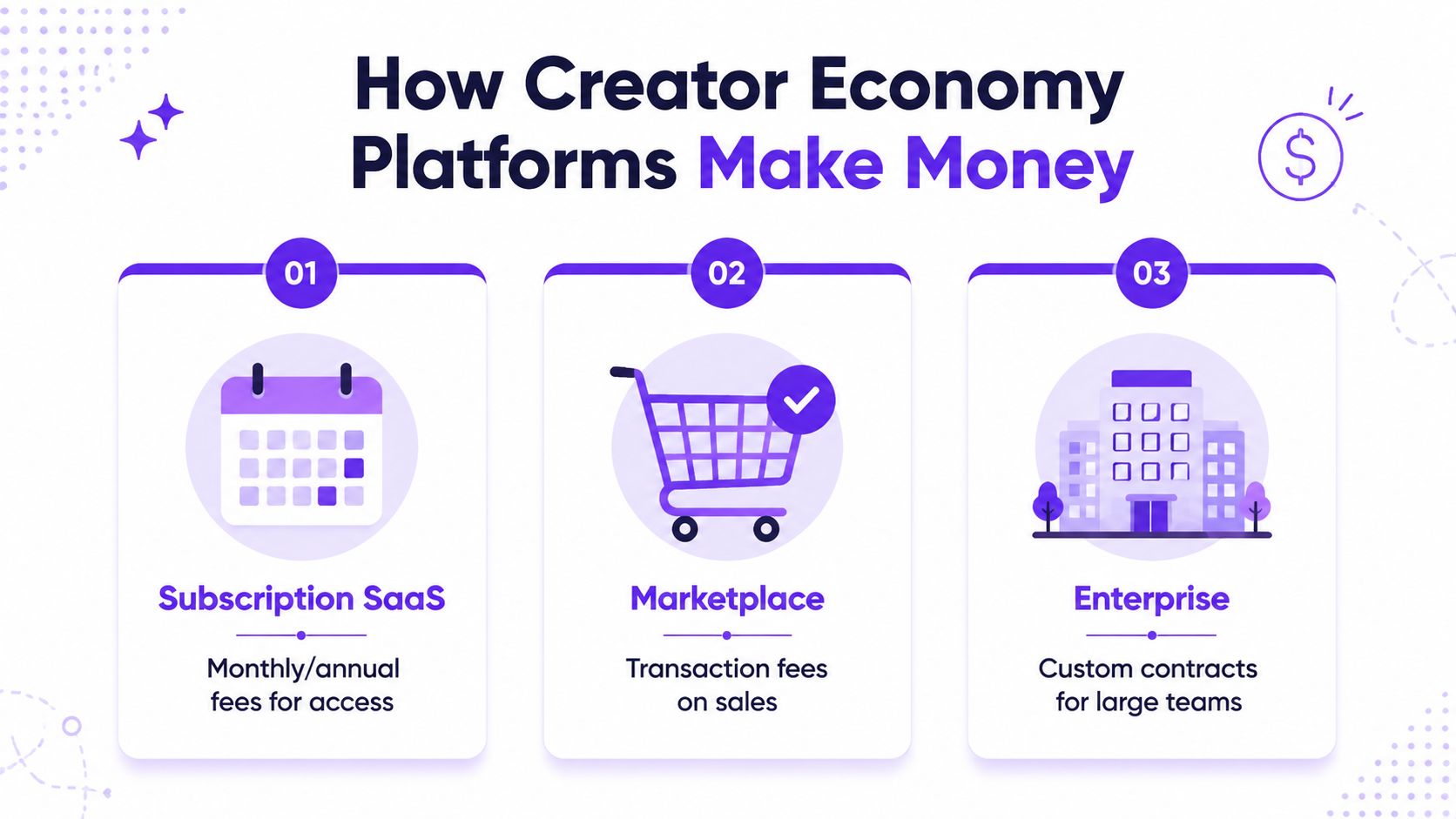
The platform's pricing model tells you what it wants to optimize. That doesn't automatically make one model good and another bad, but it does reveal where incentives may point when your business grows.
A subscription SaaS platform charges recurring fees for access to features, storage, automation, analytics, or team controls. This model can be predictable for the creator and the vendor, but feature tiers deserve close attention. A low entry price may exclude essential scheduling, export, collaboration, or audience tools, forcing an upgrade once the workflow becomes central to the business.
Subscription pricing tends to align with creators who want operational consistency. You pay for infrastructure rather than surrendering a portion of every sale, which can make the economics easier to understand as products or services mature.
Marketplace platforms commonly take a fee when creators sell courses, templates, memberships, tickets, coaching, or other digital products. The attraction is simplicity. Payments, checkout, discovery, and sometimes customer support may exist in the same environment.
The trade-off is that fees rise with revenue. A transaction model can be sensible when it replaces several operational tasks, but you should understand whether you can export customer data, control pricing, communicate with buyers, and move the offer elsewhere if the platform changes its terms.
Some platforms share advertising, tipping, or other audience-generated revenue. That can reduce upfront cost, but it usually ties creator income to platform traffic, eligibility rules, advertiser demand, or changing payout policies. For creators who already have strong reach, the model may be useful. For smaller businesses, ad-only income can leave the core business exposed to unpredictable distribution.
Freemium products use free access to attract creators, then charge for advanced limits or capabilities. They can be a practical way to test a workflow, but don't evaluate the free plan in isolation. Test the features required for your actual publishing cadence, brand controls, analytics, and owned-audience strategy.
The market is also becoming more unequal. Coverage of 2026 creator economy data reports that the top 1% captured 21% of creator ad-payment volume in 2025, up from 15% in 2023, while the top 10% captured 62%, up from 53%. The same coverage says only about 4% of global creators are professionals earning over USD 100,000 annually, compared with 10% in 2022. (Digital Applied creator economy data)
A platform that monetizes attention isn't automatically a platform that helps a small creator build a business.
For a clear explanation of advertising economics, review this practical guide to YouTube pay per view in 2026. Then ask whether your chosen platform helps you build subscriptions, services, products, or community revenue alongside advertising. Those alternatives matter because smaller and mid-tier creators often need conversion and retention systems more than another incentive to chase viral reach.
The right platform looks different depending on what you publish and how you sell. A real estate agent, podcaster, educator, and marketing manager may all need video repurposing, but their success criteria aren't the same.
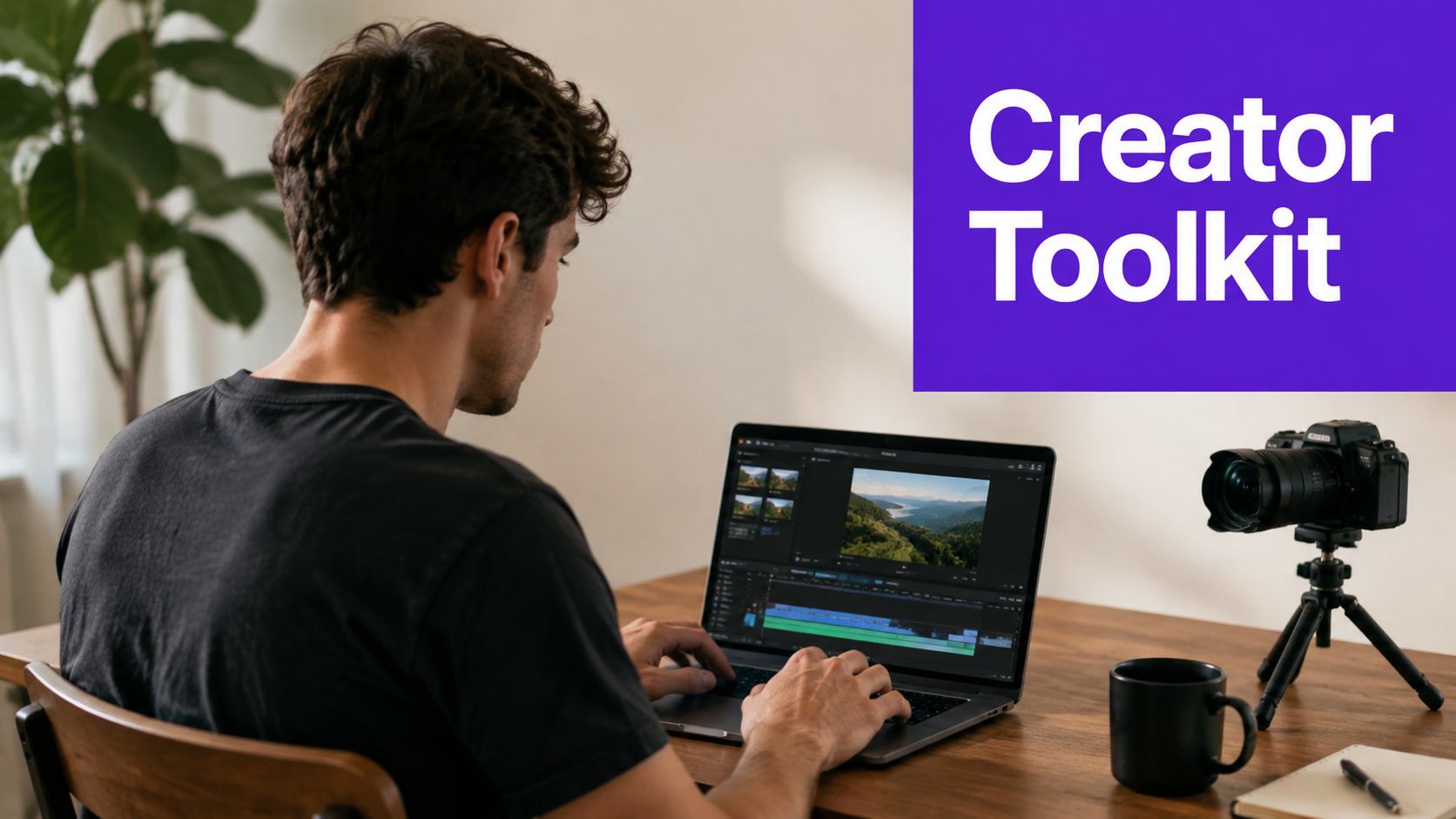
A real estate agent can record a property tour once, then create a set of vertical clips focused on layout, neighborhood context, renovation details, and buyer questions. The useful platform features are accurate transcription, vertical reframing, captions, branded templates, location-aware copy review, and scheduling across the channels where local prospects spend time.
The business outcome isn't more posts. It's a repeatable way to demonstrate expertise, create reasons for prospects to remember the agent, and direct qualified viewers toward an inquiry or consultation.
A podcaster or interviewer needs a different workflow. The platform should find coherent moments rather than isolated sentences, preserve speaker context, create clips with readable captions, and support written adaptations for show notes, newsletters, and search pages.
Automatic extraction is only the first pass. Editors still need to check names, claims, pacing, and whether a clip makes sense to someone who hasn't heard the full episode. The best system saves selection and formatting time while keeping editorial control with the publisher.
A faith-based organization can use one sermon or teaching session as the source for short reflections, quote cards, discussion prompts, an email summary, and channel-specific posts. Accessibility, respectful editing, approval permissions, and a consistent publishing calendar matter more here than aggressive trend chasing.
The platform should help the organization maintain continuity between public discovery and deeper community participation. It can support reach, but the organization still needs a clear destination for members, volunteers, donations, events, or pastoral connection.
A small agency or internal marketing team may manage several brands without a full-time editor. In that case, reusable templates, workspace separation, role permissions, approvals, asset libraries, bulk scheduling, and client-ready reporting become decisive.
A cheap tool that requires manual cleanup across every account can create more coordination work than it removes. A more capable platform may justify its cost if it makes handoffs clear and lets one producer support several recurring content programs without losing brand distinctions.
Solopreneurs should prioritize a short path from recording to published assets, while teams should prioritize governance and repeatability. The solopreneur use-case guide is a useful reference for matching a platform to a lean operating model.
Feature lists create false confidence. A platform can advertise clipping, analytics, AI writing, and scheduling yet still fail your business if the outputs need heavy correction or if your audience remains trapped inside rented channels.
Start with the business model. Decide whether your immediate priority is client leads, product sales, memberships, sponsorships, services, or a combination. Then evaluate each platform against the workflow that produces that outcome.
| Evaluation Criteria | What to Look For | Why It Matters |
|---|---|---|
| Cross-channel distribution | Channel-specific formats, scheduling, approvals, and bulk publishing | Reduces fragmented manual work without treating every channel the same |
| Repurposing quality | Accurate clips, captions, transcripts, titles, thumbnails, and written adaptations | Turns one source asset into useful distribution rather than duplicate filler |
| Discovery support | Keyword research, topic signals, metadata controls, and searchable content outputs | Helps people find content beyond the immediate social feed |
| Owned audience | Email capture, memberships, community options, customer data, or reliable integrations | Reduces dependence on algorithmic reach |
| Monetization | Products, subscriptions, services, tips, sponsorship support, or commerce integrations | Gives small and mid-tier creators more than ad-based income |
| Analytics | Content-level reporting, conversion paths, retention signals, and exportable data | Connects publishing activity to commercial decisions |
| Pricing transparency | Clear limits, fees, upgrade rules, and team pricing | Prevents an apparently affordable workflow from becoming expensive at scale |
| Portability | Exportable content, audience records, analytics, and integrations | Protects your business if the platform changes direction |
Use one representative recording during evaluation. Include the material you publish, with the speakers, pacing, terminology, and visual style your audience sees. Measure how much correction the system requires, how easily you can approve assets, and whether the final versions fit each channel.
Pay special attention to failure modes. Does it select an incomplete thought? Does it invent context in a caption? Does it crop a product demonstration badly? Does the scheduling process create duplicate posts or make revisions difficult? These problems often matter more than the headline feature list.
Owned-audience capability should carry more weight than vanity analytics. A large view count can be useful, but the durable question is whether interested people can enter a relationship you can continue, such as an email list, membership, community, consultation, or customer account.
For a broader way to compare tool stacks on taap.bio, use a category-by-category review rather than choosing the platform with the longest feature page. Also review how content automation software fits into your existing process. Automation should remove repetitive handling, not remove the human review that protects quality and trust.
Migration fails when a small team treats software setup as the project. The project is changing the operating rhythm without losing publishing consistency, search value, brand quality, or audience trust.
Begin with an audit. List your content sources, channels, offers, audience destinations, publishing responsibilities, templates, and recurring bottlenecks. Mark each task as automated, assisted, or manual. This reveals whether the new creator economy platform replaces a tool, connects several tools, or adds another dashboard.
Choose one content pillar for the pilot. A podcast series, weekly tutorial, property tour, or recurring interview works well because you can compare the same type of workflow repeatedly. Define qualitative and operational measures before you start, such as review time, assets approved, publishing consistency, correction volume, clicks to an owned destination, and inquiries or sales associated with the content.
Configure the system around your brand rather than accepting default outputs. Create templates for captions, thumbnails, descriptions, calls to action, naming conventions, and approval states. Establish a rule for factual review, rights review, accessibility checks, and final sign-off.
Keep the pilot deliberately narrow. Too many channels, formats, and automations at once make it difficult to identify what helped and what created noise. Your team should know who uploads, who edits, who approves, who publishes, and who reviews results.
Migration rule: Preserve the old workflow until the new one has completed a reliable publishing cycle.
Do not redirect every audience destination immediately. Protect existing search pages, email sequences, product links, and evergreen content while you test the new system. Export what you can, document dependencies, and keep original recordings and final assets in an independent archive.
Scale only the parts that passed the pilot. Add another content pillar, then another channel or team member. Review the workflow at the end of the period and decide which automations should remain, which need human approval, and which should be removed.
Your review should answer practical questions. Are editors spending less time on repetitive formatting? Are more planned assets reaching publication? Are the outputs accurate enough for your brand? Are viewers moving toward an owned destination? Is the revenue path clearer, even if the audience metrics remain uneven?
A migration succeeds when the team can repeat the process without relying on the person who configured it. Document the process, assign ownership, and schedule a regular review so the platform remains connected to business goals rather than becoming another neglected subscription.
A creator economy platform should make your business more resilient, not merely busier. Start by choosing the primary revenue path you want your content to support, then select one platform and run a focused pilot around a repeatable content pillar.
Track operational measures first. Record review time, approved assets, publishing consistency, traffic to owned destinations, inquiries, sales, or membership actions. Those signals tell you more than a dashboard full of reach metrics that never connect to a commercial outcome.
After the pilot, expand carefully across channels and formats. A well-run stack should give you a steady stream of channel-appropriate content, clearer discovery signals, less repetitive editing, and a growing relationship with people you can reach outside a social feed. Set a 90-day review and decide what to keep based on evidence from your own workflow.
Take one recording today, map every step from source file to revenue action, and identify the handoff that wastes the most time. That bottleneck is the best place to test a new platform.
Taja AI turns long-form video into ready-to-publish shorts, clips, captions, thumbnails, blogs, and platform-specific posts, with editing, brand templates, and multi-channel scheduling in one workflow. If distribution fragmentation is slowing your content business, visit Taja AI and test whether its repurposing and scheduling tools fit your next 90-day operating plan.


We are blessed to work with leading brands & Companies


We try to make easy and simple for every professionals. Get 30 days free trial - No credit card required.


© 2025 Taja AI. All rights reserved.