YouTube Shorts Caption Generator: A 2026 Workflow
Use a YouTube Shorts caption generator the right way: extract, condense, style, keyword-fit, then QA before publishing. A practical 2026 workflow for creators.
5 min read
November 28, 2026

Get a brand voice guidelines template you can copy, score and customize. Includes attributes, observable rules, channel examples and a publish-or-revise rubric.
Written by:


Most advice on building a brand voice starts in the wrong place. You're told to gather your team, pick three inspiring adjectives like bold, authentic, and clear, drop them into a slide deck, and expect every writer to sound the same. That mood-board approach fails almost immediately because two writers can read the same adjective and produce completely opposite drafts.
The execution gap shows up across organizations of every size. Most organizations report using brand templates, but only a small fraction deploy them across all teams. The cost of that gap is measurable: according to Shapo's branding statistics report, 33% of businesses in 2025 reported that consistent branding increased revenue by 20% or more.
A working brand voice guidelines template is an operational scoring and approval system with observable writing rules, clear publish thresholds, and a recurring audit loop. Adjectives alone don't survive contact with a deadline. Rules do. When a small team runs voice like a checklist instead of a taste test, drafts ship faster, reviewers stop arguing about feel, and the output stays recognizable across every channel.
Copy the seven-row structure below into an editable document like Google Docs or Notion before you write a single rule. Every row maps to a decision a writer or editor has to make before an asset goes live.
| Template component | What to define | Example entry |
|---|---|---|
| Voice attributes | Three to five traits, each with a one-line meaning | Direct: states the outcome in the first sentence |
| Observable behaviors | Sentence length, grammatical person, reading level, punctuation, emotional intensity | Sentences under 20 words, second person, about Grade 8 reading level |
| Sounds like / does not sound like | Two contrasting sample sentences per attribute | Sounds like: Your invoice is due Friday. Does not sound like: We kindly remind you that payment may be due |
| Banned phrases and approved alternatives | Words to avoid and the wording to use instead | Leverage becomes use; world-class becomes a specific result |
| Channel rules | How the voice shifts for each platform while the message stays the same | Short-form hook: energetic. LinkedIn post: same claims, analytical structure |
| Scoring rubric and approval threshold | Points per criterion and the minimum score to publish | 0 to 2 points across five criteria (10 total); 9 to 10 publishes, 7 to 8 revises, under 7 escalates |
| Owner and review date | Who approves changes and when the guide is reviewed | Content lead, reviewed quarterly against published samples |
Fill those seven rows in sequence from top to bottom. If you try to write channel rules or a scoring rubric before locking down your attributes and observable behaviors, you'll end up grading drafts on vague instincts. Each row feeds the next: attributes define what matters, behaviors turn traits into checkable habits, and the rubric verifies whether a draft followed them.
Many organizations already have a document somewhere in a shared drive, yet almost nobody opens it during production. According to Capital One Shopping Research, cited in Omnibound's brand consistency statistics, 95% of companies in 2024 reportedly had brand guidelines, but only 25% to 30% actively used them across their organizations. Unused documents are almost always bloated, unsearchable, or disconnected from daily editing.
Practical rule: Keep the entire template to two pages. Brevity isn't a compromise; it's the only way a busy writer will actually read the guide before drafting.
Pair your voice rows with practical mechanics if multiple people contribute to your blog, newsletters, or social accounts. Reviewing writing style rules for teams from RedactAI helps you standardize basics like capitalization, formatting, and plain-language phrasing alongside your voice decisions. Keep both in one living document so writers don't bounce between three folders to check a single sentence.
At the end of this setup step, you should have a blank copy of the seven-row table sitting in your team workspace with one named owner at the bottom. Don't worry about filling the rubric or channel rows yet. Start by turning abstract traits into concrete writing rules.
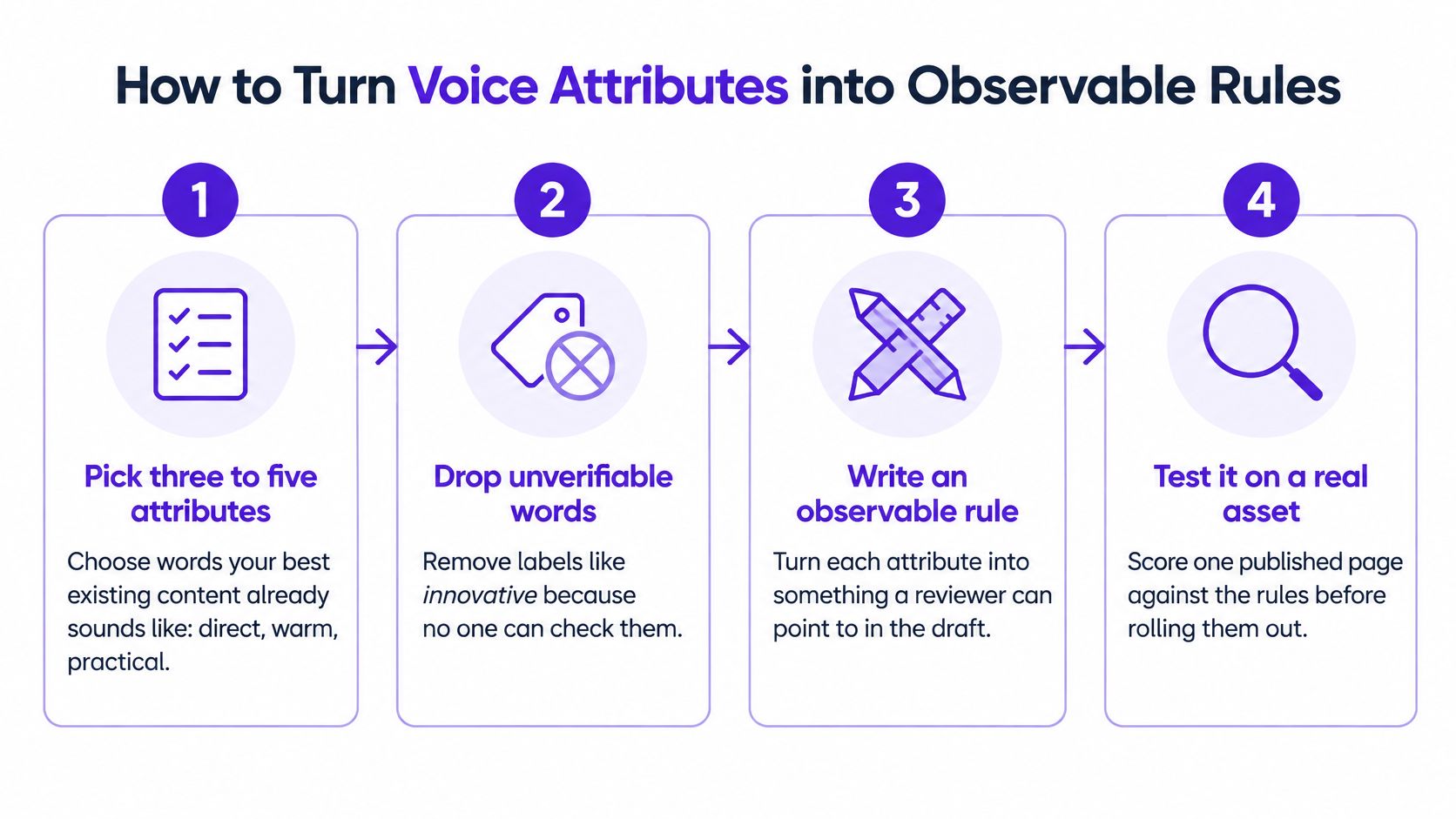
An adjective isn't an instruction. Telling a contractor to sound trustworthy or energetic leaves too much room for guesswork, which is why off-brand copy slips into production even when a guide exists. In The Impact of Brand Consistency report, more than 60% of organizations reported that materials were created that didn't conform to their guidelines, while organizations with formal, enforced guidelines were more than twice as likely to present their brand consistently.
Tone resists standardization far more than colors or fonts do. A hex code is either right or wrong; a sentence can be technically correct and still feel off. The fix is the same one you'd use for any quality problem: convert subjective judgement into pass/fail checks an editor can run in seconds.
Move from broad traits to observable mechanics using five concrete passes over your existing work:
Say a local bookkeeping firm selects direct as its core attribute. Its observable rules cap sentences at 18 words, require second-person address (you), and ban hedging verbs like might or kindly in billing notices.
Watch how fast an editor can verify that rule. There's no debate about whether the first line feels direct enough; it puts the deadline in the first sentence, removes soft filler, and gives one action. That check takes under ten seconds, and it produces the same verdict no matter who runs it. Consistency across reviewers is the entire point. If two editors looking at the same draft can reach opposite conclusions, the rule is still an adjective and needs a tighter threshold.
Once you finish all five steps for your chosen attributes, you'll have a single rules page that a brand-new writer can follow on day one without pinging anyone on Slack to ask what the brand sounds like.
Keeping a consistent voice doesn't mean pasting the exact same paragraph onto every platform. Look at how one idea moves from a short-form video hook to a LinkedIn post without losing its identity:
Notice what stayed fixed and what shifted. The point of view, plain vocabulary, and core claim remained identical across both lines, while the pacing, sentence rhythm, and analytical framing adjusted to match how people scroll on each platform. Your channel rules should always separate fixed elements (claims, vocabulary, ethical boundaries, point of view) from flexible elements (length, structure, hook energy, and formality).
Add concrete transformation examples for every format your team publishes regularly so writers don't default to robotic copy-and-paste habits:
When one long-form recording becomes localized clips, emails, and articles across regions, word-for-word translation breaks brand personality fast. As outlined in WaveGen's brand voice guidelines template guide, a globally workable guide separates core brand principles from language-dependent expression. Your brand can stay direct and reassuring everywhere while sentence length, humor, formality, gendered phrasing, and calls to action adapt to local expectations.
Build a dedicated do-not-translate list inside your template for idioms, sports metaphors, and regional jokes that fall flat or confuse readers abroad. Track separate document versions by language and region, and require a native or culturally competent editor to review each market's examples before launch.
Personality survives localization when editors translate intent and trust, not word-for-word idioms.
Finish this section of your template with accessibility rules for video and social formats. Require descriptive captions rather than raw auto-transcripts, specify readable contrast and line lengths for text overlays, include plain-language alternatives for technical terms, and add pronunciation notes for brand names or guest names so voiceovers and captions stay accurate everywhere.
Without a prepublication filter, even well-written rules turn into opinion battles during editing. Standardizing approval requires a lightweight scoring rubric that checks five specific criteria on a 0 to 2 scale for a maximum of 10 points.
| Criterion | 0 points | 1 point | 2 points |
|---|---|---|---|
| Audience fit | Written for a different reader | Right reader, but one generic line | Speaks directly to the reader's stated problem |
| Clarity | Main point unclear or buried | Point present, one tangled sentence | Point in the first two sentences, no unexplained jargon |
| Attribute alignment | Breaks a behavior rule | Follows the rules but reads flat | Each attribute visible in sentence length, person and punctuation |
| Evidence | Claim with no source | Claim with vague support | Claim sourced or checkable by the editor |
| Prohibited-language compliance | Banned phrase or unsupported claim present | One near-miss to rewrite | None found |
Use the visual checklist below as a quick desk reference while reviewing drafts so every editor scores against the exact same five checks.
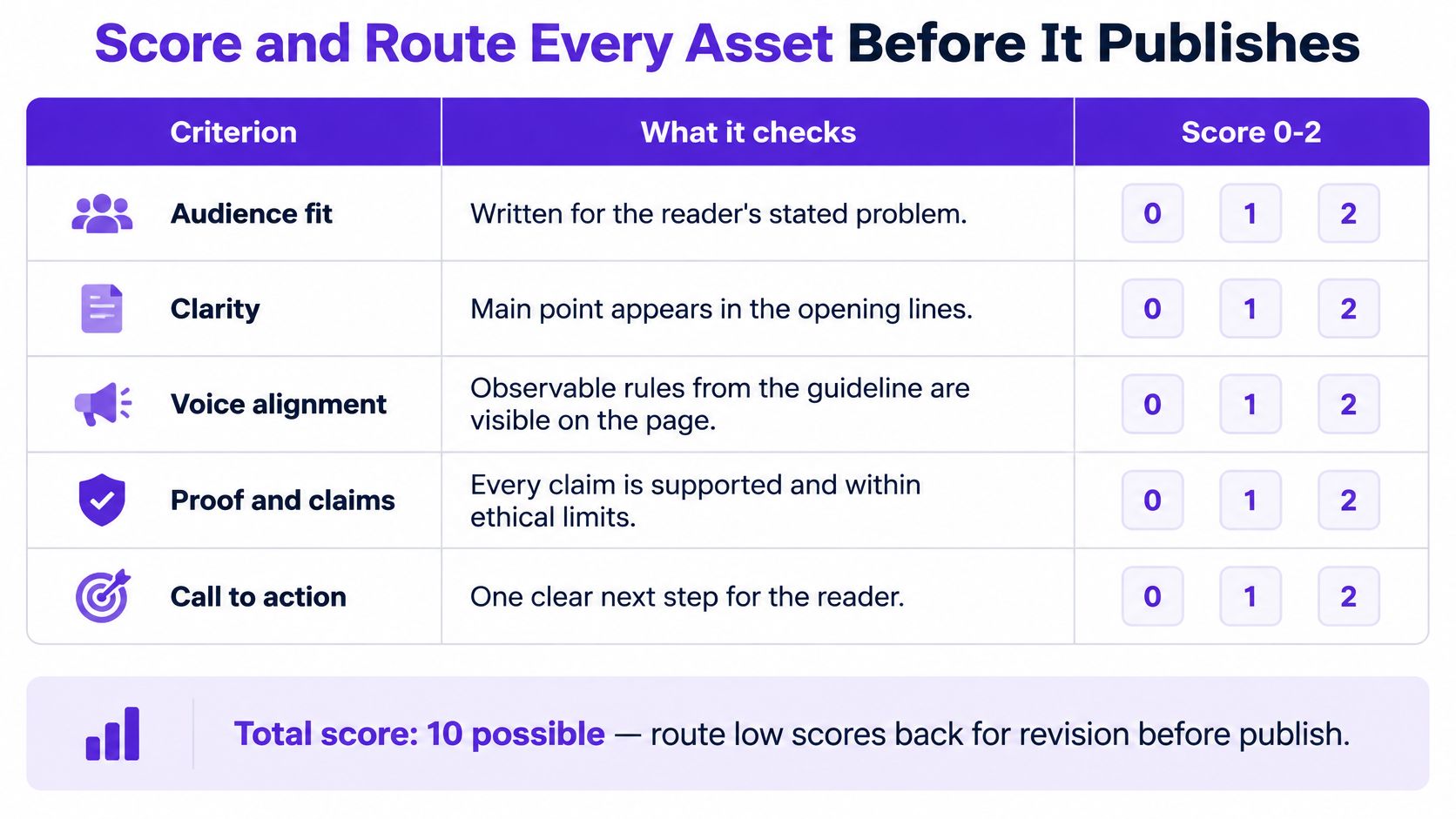
Attach an automatic routing action to each score band so a small team can clear dozens of repurposed assets without turning every post into a meeting. Guidance from OverAds on AI-oriented brand voice guidelines emphasizes replacing vague tone descriptors with concrete, checkable rules and a lightweight publish / revise / escalate decision matrix.
Remember to separate voice consistency from message repetition while scoring. A caption, a short-video hook, an email, and a LinkedIn post should use different structures while sharing one point of view and one set of ethical limits. Score whether the draft obeys your voice behaviors, not whether it recycles identical phrases.
A scoring rubric only works when writers and editors share one transparent handoff process. Building these thresholds into a documented content approval workflow stops bottlenecks before launch day, and reading ContentBuck on production and marketing alignment offers useful perspective on keeping creative output synchronized with team standards.
For a practical walkthrough of aligning review steps around voice standards, watch the short overview below before setting up your team's tracking sheet.
Track three operational numbers in a simple spreadsheet log every week to see whether your template is improving output:
When those numbers stall, you know immediately whether a specific writer needs coaching or a specific rule in your template is written poorly.
Stakeholder intuition is a terrible way to test a voice guide. Tone is far harder to standardize than visual identity, and Visme's compiled brand consistency statistics show why: only 50.8% of creators feel very confident selecting the correct tone of voice, compared with 68.6% for brand colors and 65.0% for fonts. Instead of asking your team if the template feels right, run a controlled content audit.
Follow a repeatable baseline process to spot weak rules before scaling your guide across channels:
Watch for four recurring pitfalls that almost always surface during that first reconciliation session: vague attributes like visionary, contradictory pairings like conversational but highly formal, examples drawn from only a single format, and banned phrases that lack approved swaps. Track inter-rater agreement alongside your first-pass approval rate, revision minutes, and banned-phrase share; as evidence accumulates, cut subjective explanations so your guide gets shorter and easier to execute.
Every time two editors disagree on a draft's score, the problem is rarely the draft. Nine times out of ten, the rule in your guide isn't specific enough.
Not every organization needs the same voice weight, evidence format, or call to action. Use the reference grid below to tune your template rows to your specific audience.
| Business type | Voice emphasis | Proof and call to action |
|---|---|---|
| Solo coach | Warm and direct, first-person stories | One client result per post, one invitation to reply |
| Real estate agent | Confident, local proof, short sentences | Neighborhood sales figures with a date, one clear next step |
| Faith-based group | Gentle pace, plain language, no jargon | Member stories and community dates, invitation to attend |
If your team turns long recordings into multi-platform content, you can check your written rules directly against your repurposing pipeline. When you add a video to Taja AI by uploading it or pasting a YouTube link, our system analyzes your channel information and brand voice; our SEO Optimization feature transcribes the video, captures that voice, and generates a list of titles paired with an SEO score. Even with automated voice capture handling the heavy lifting, a human editor should still score every generated asset against your rubric before it goes live.
Don't spend two months perfecting a voice manual in isolation. Roll out your template with a focused seven-day pilot that proves what works under real deadlines:
Turning a recorded podcast, sermon, or tutorial into a week of consistent clips, captions, titles, and blog posts takes far less editing when your workflow starts from your real channel voice. Taja AI helps creators and small teams repurpose long-form video into multi-channel assets while capturing your brand voice, and we offer a free 1:1 content consultation to map out a workflow that fits your publishing schedule. Visit Taja AI to see how your next recording can stay on-voice across every platform.


We are blessed to work with leading brands & Companies


We try to make easy and simple for every professionals. Get 30 days free trial - No credit card required.


© 2025 Taja AI. All rights reserved.