How to Resize Videos for Any Platform: Ratios and Sizes
Learn how to resize videos for YouTube, Reels, TikTok and feeds with the right aspect ratios, export settings and fixes for cropped subjects.
5 min read
November 24, 2026

Learn social media caption writing step by step, with length benchmarks for Instagram, TikTok, Facebook and LinkedIn, plus hooks, CTAs and brand voice.
Written by:


TikTok videos with captions shorter than 30 words averaged a 4.90% engagement rate. LinkedIn multi-image posts with captions over 90 words reached 6.30%. Both figures come from the same Socialinsider caption-length analysis of brand accounts with 1,000 to 1 million followers, and they pull in opposite directions.
That contradiction is the job. Social media caption writing isn't a hunt for one correct word count. It's a small piece of engineering where length, format, opening line, readability and accessibility each pull on the others, and where a chunk of your audience will never hear the audio at all.
The Socialinsider dataset covers 38,460,950 Facebook posts, 28,625,078 Instagram posts, 9,661,391 TikTok videos and 896,780 LinkedIn posts, with results split by platform and post format rather than blended into a single average. That split is the useful part, because the same dataset shows short captions winning on TikTok and long captions winning on LinkedIn.
Best caption length by platform and post format
| Platform | Post format | Best caption length | Reported engagement |
|---|---|---|---|
| TikTok | Short-form video | Under 30 words | 4.90% (3.90% above 90 words) |
| All posts | Under 60 words | Best overall (carousel peak 0.37%) | |
| Carousel | Under 60 words | 0.37% peak | |
| Reels and albums | 30 to 60 words | 0.28% | |
| Text-only status | Under 30 words | Rate not broken out, shortest of the Facebook formats | |
| Multi-image posts | Over 90 words | 6.30% |
TikTok is the cleanest example of a straight decline: 4.90% under 30 words, 4.50% at 30 to 60, 4.30% at 60 to 90, then 3.90% above 90. Instagram follows the same shape with a looser threshold, with captions under 60 words performing best overall and carousel posts peaking at 0.37%. Facebook splits by format instead of length alone, since Reels and albums did best at 30 to 60 words (0.28%) while text-only status posts did best below 30 words. LinkedIn flips it for multi-image posts, where captions over 90 words reached 6.30%.
Every row is an average across thousands of brand accounts, which means it describes what the middle of that field achieved, not a ceiling. Your audience, offer and hook can shift the peak a long way.
Working rule: write the benchmark length first, then test one deviation at a time. Copying one caption across four networks guarantees that three of them are the wrong length.
If Instagram carries most of your reach, the Instagram Reel captions guide digs into the opening line, which is where most of the drop-off happens.
Plenty of caption advice boils down to keep it short. The data says that advice is sometimes right and sometimes expensive.
A 2024 study of two datasets, one from a Facebook merchandise retailer and one from an Instagram travel influencer, found an inverted-U relationship between caption length and engagement: captions that were too short or too long both underperformed, and captions of around 600 characters were associated with roughly 20% higher engagement, according to the Brandenburg University of Technology repository record.
The shape isn't identical everywhere. A 2025 preregistered study of 75,000 posts from nearly 1,000 influencers found an S-shaped relationship, including a local minimum followed by a longer-caption peak that beat very short text, as reported in the EMAC conference proceedings. Colorado State University's review of its own 2024 Instagram and Facebook content lands somewhere else again: its most-shared posts averaged about 370 characters, or roughly 70 words, per the CSU social media team's end-of-year analysis.
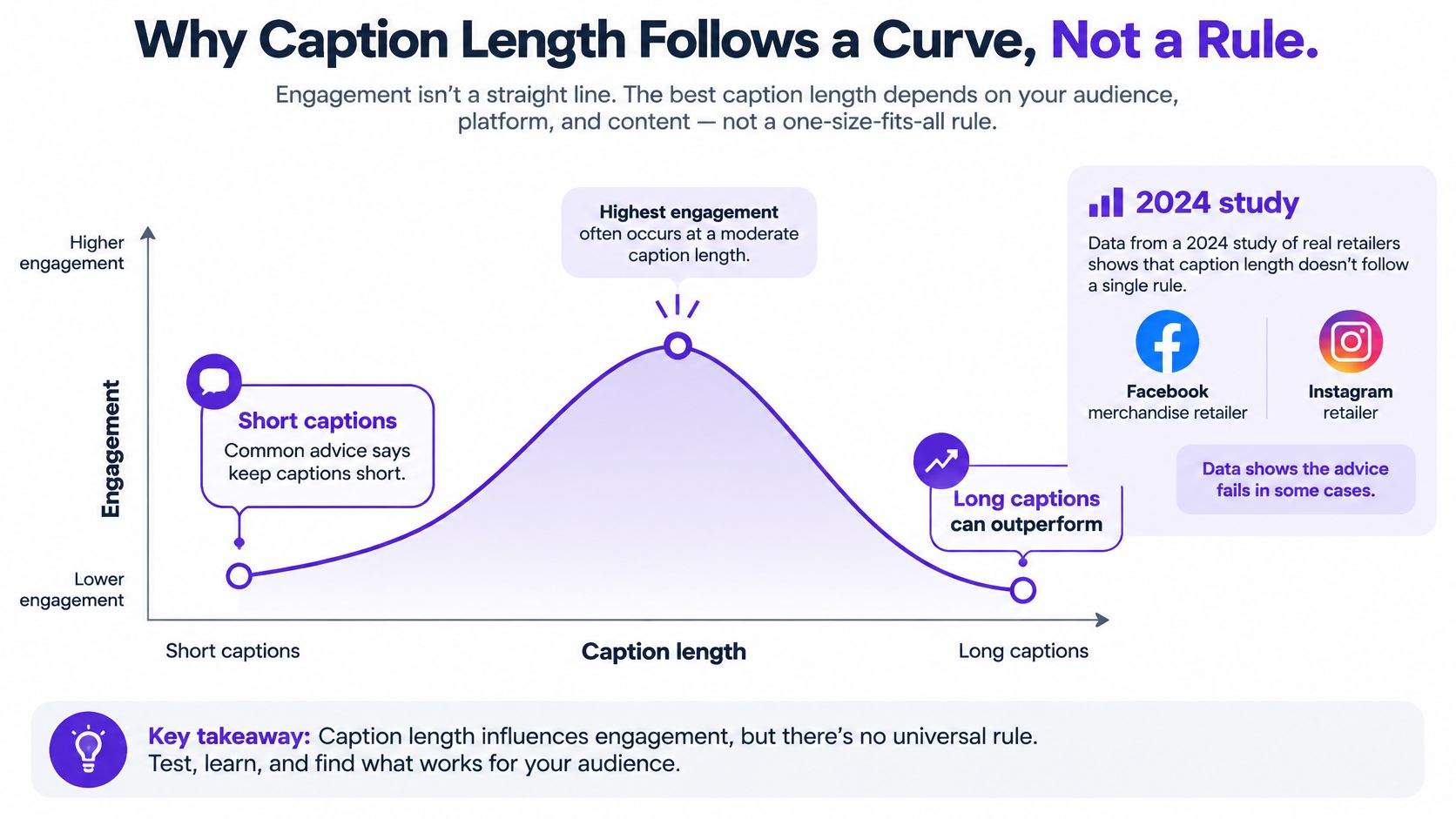
Write two versions of the same post, one at the short end and one near 600 characters, publish them on comparable days and compare likes, comments, saves and shares across at least four posts before you draw a conclusion. One post tells you about one post.
The edge case matters as much as the average. A product drop or a date announcement can stay at two lines. A tutorial, a customer story or anything that has to carry a reader from problem to fix needs room, and cutting it to 20 words strips out the reason to read. For a bank of compressed openers to react against, tweet inspiration from SuperX is a useful reminder of how much a single line can carry.
A caption template sounds like the enemy of voice. In practice it's what stops voice from collapsing at 11pm when you're scheduling next week's clips. The template carries the structure so your attention goes to the one sentence that decides whether anyone reads the rest.
The flow below holds whether the caption is a 20-word TikTok line or a 120-word LinkedIn post.
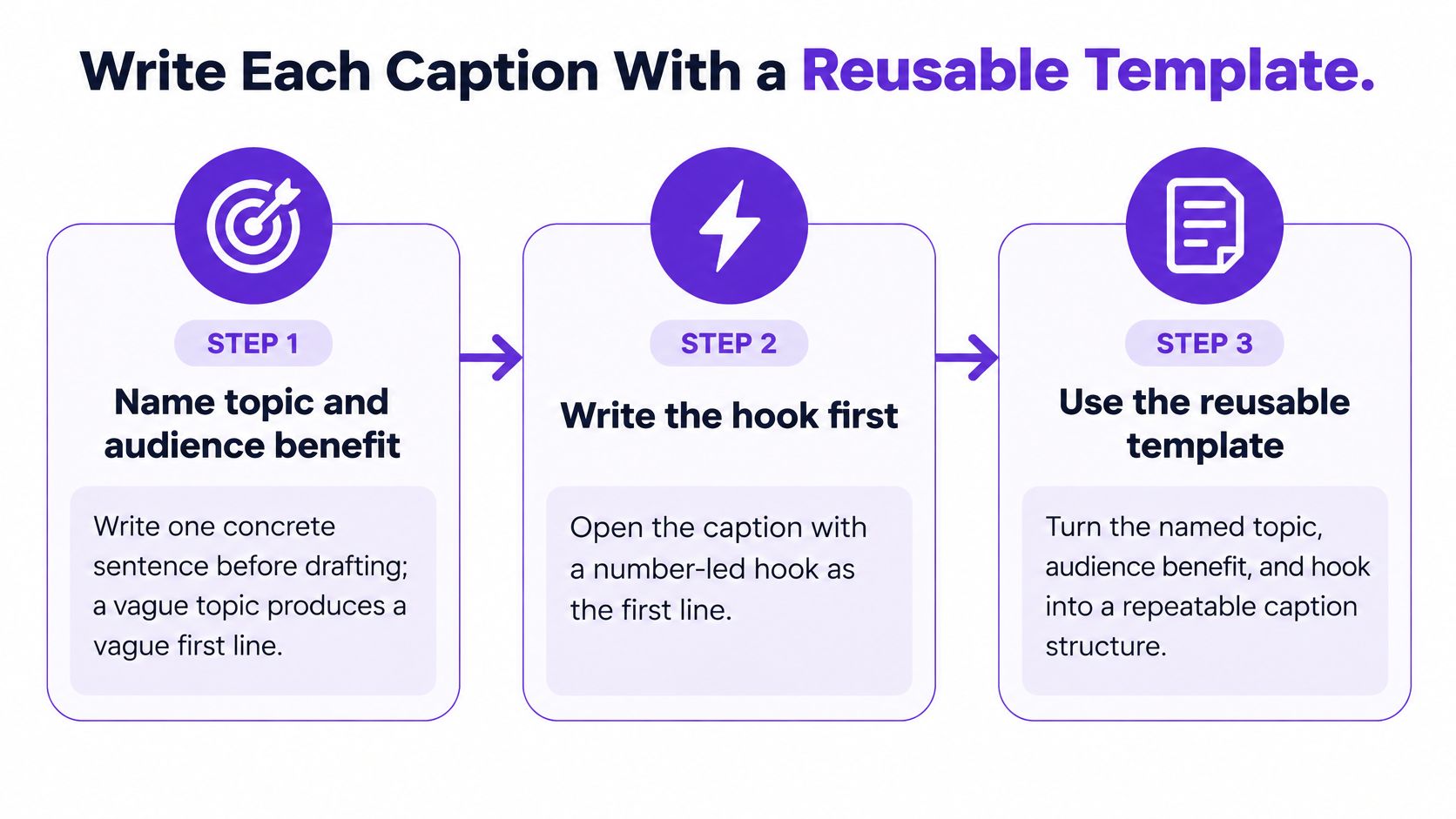
Hashtags come last. Writers who draft tags first end up building captions around keywords instead of around the reader.
Fill-in template: [Topic] plus [who it helps] in the first line. Two to four short paragraphs, one idea each. One call to action that matches the goal. Relevant hashtags at the end, nothing stacked.
Here's the template doing real work on a listing tour. The strongest transcript sentence is "we basically rebuilt the entire back wall so the kitchen could face the yard." That becomes the hook: "The kitchen faces the yard because we rebuilt the back wall." Two short paragraphs follow, one on the light the new wall brings in, one on what it cost. The TikTok version stops there with "Save this if you're touring 1970s subdivisions." The Instagram version keeps the same two paragraphs and adds the before photo. The LinkedIn version carries the extra context about resale value and permits, because that's the row where length earns its keep.
Taja AI generates captions for clips and keeps them editable before posting, thumbnails included, which shortens the drafting loop; the topic sentence and the call to action still need your judgment. When TikTok is the platform and the well is dry, TikTok caption ideas gives you openers to adapt rather than invent.
This week, pick one platform, write three captions from the template and score them against that platform's benchmark row.
Hooks and calls to action are where a decent video gets made or wasted. The lines below are the kind I'd hand a new social media manager on day one, written as finished sentences for real accounts rather than as advice about sentences.

Calls to action follow the same discipline. A save prompt belongs on a checklist or a template, where keeping the post has obvious value. A comment prompt works best when it offers a choice rather than asking for a thought. A link needs a stated reason to click, not just the link. A keyword sent by DM suits resources people will act on later. Three CTAs in one caption cancels all three out.
For voice, define three traits, name two words you'll use and two you'll never use, and repeat the same sign-off so followers recognize you before they read the name. That set is what lets one voice stretch from a casual TikTok clip to a formal LinkedIn summary without losing its values. The brand voice consistency guide shows how to document those rules so a second writer can hold them.
Voice test: hand a draft to someone who doesn't work on your account and ask what the brand cares about. If they can't answer, the traits aren't doing any work.
Readability and accessibility are a gate that runs after the draft exists, not a formatting pass you do while writing. In a study of 135 branded Facebook image posts, easier-to-read text, captions longer than 31 words or 321 characters, and a higher number of hashtags were positively associated with engagement and reach, per the published study in the DOAJ index. Treat that as directional. It came from one fashion-retail page, and observational data can't prove cause, so use readability as a quality bar rather than a reason to pad copy.
Accessibility is where most caption advice stops short. A 2025 systematic review of 36 peer-reviewed studies found that social media video captioning spans accessibility, engagement, education and language learning, while platform constraints and community-specific needs are often overlooked, according to the Monash University research record. Write for four groups at once: people watching with sound off, Deaf and hard-of-hearing viewers, neurodivergent readers, and language learners.
Confirm the main keyword sits in the opening sentence. Check that every hashtag describes the content. Name the speaker when several people talk, and keep meaningful sound cues such as [door chime] or [crowd cheering]. Avoid stacked punctuation and all-caps. Make sure any on-screen text matches the caption's promise, then read the whole thing aloud with the video paused.
Before: "yeah so basically the sensor just, like, died on us and we, uh, didn't notice for three days."
After: "[Host]: Why our kiln ran hot for three days. The temperature sensor failed silently, and here's how we now check it every morning."
Auto-transcribed captions mangle jokes and sarcasm, so proof them by hand. A caption tuned only for search can also reduce comprehension when it turns dense and repetitive.
The most common symptom I get asked about is flat comments on a post that pulled decent reach. Reach proves the hook landed; silence proves the caption never asked for anything.
| Symptom | Likely cause | Fix |
|---|---|---|
| Flat comments despite good reach | No prompt at the end | Add one specific question tied to the video's claim |
| Saves and shares stay flat | No reason to keep the post | Add a checklist, template or memorable number |
| TikTok viewers drop off | Caption over 60 words | Cut to under 30 words and let the video carry detail |
| LinkedIn multi-image posts underperform | Caption under 90 words | Expand to 90 or more words with context |
| Viewers scroll past the opening | Topic buried after the hook | Move topic and benefit into the first line |
| Hashtags add nothing | Unrelated or stacked tags | Keep only relevant tags and test the count |
Some fixes show up in a single post. A missing question at the end, a buried topic and an irrelevant tag block all change results immediately, because they're structural. Length changes and voice consistency take longer, often four to six posts, before the numbers mean anything, so don't judge a longer caption on one outing.
Voice complaints follow the same logic. When a manager says a caption "doesn't sound like us," the usual cause is that nobody wrote down what "us" sounds like. Three traits, two banned words and a fixed sign-off solve more of those arguments than any rewrite.
Taja AI turns one long recording into shorts, clips, thumbnails and platform-ready captions you can edit before anything publishes, then schedules those posts to YouTube, X, Instagram, Facebook, TikTok and LinkedIn from a single dashboard. That means a tight TikTok line and a longer LinkedIn version stop being two separate jobs. Start free at Taja AI and put this week's length test on the calendar.


We are blessed to work with leading brands & Companies


We try to make easy and simple for every professionals. Get 30 days free trial - No credit card required.


© 2025 Taja AI. All rights reserved.