.jpeg)
How to Make a Highlight Reel That Actually Performs
Learn how to make a highlight reel that hooks in the first three seconds, keeps viewers watching, and converts across YouTube, TikTok, and Instagram.
5 min read
October 3, 2026

Learn how to start a vlog in 2026, even with a 'boring' life. Our guide covers niche, gear, editing, and growth tactics for creators and small businesses.
Written by:


Most advice on how to start a vlog gets the first assumption wrong. You do not need a life full of travel, dramatic milestones, or cinematic moments. You need a point of view, a repeatable format, and a workflow you can sustain when work gets busy.
That matters because the audience for vlogs is already huge. Over 44% of global internet users watch vlogs every single month, and YouTube's core vlogging audience sits in the 25 to 34 bracket at 21.7%, while the 35 to 44 and 45 to 54 groups are growing fastest, according to VloggingPro's roundup of vlogging statistics. That's not a niche hobby. That's a mainstream viewing habit.
If you're a solopreneur, local service provider, educator, agent, coach, or small business owner, that changes the question. It's no longer “Is my life interesting enough?” It's “Can I package what I already do into content people want to follow?” In most cases, the answer is yes.
The “boring life” objection stops more channels than bad editing ever will. People assume viewers only care about exotic places, dramatic transformations, or polished creator lifestyles. In practice, audiences often care more about clarity, usefulness, and relatability.
A baker showing the actual process behind morning prep can build trust. A real estate agent walking through first-time buyer questions can build authority. A therapist, pastor, tutor, or contractor can document patterns from daily work and turn routine into substance.
The market for vlogs is broad enough that you don't need to entertain everyone. You need to matter to someone specific. That's why “ordinary” routines can work so well. They feel accessible. They lower the distance between creator and viewer.
Practical rule: Don't ask whether your life looks exciting on camera. Ask whether your perspective helps, teaches, reassures, or organizes someone else's day.
The growth in older viewer segments matters here too. A lot of aspiring vloggers still think vlogging is only for younger creators. It isn't. People across age groups are watching, and many of them want grounded content from people who know their field, not just people who know how to edit montage sequences.
The wrong starting point is “What can I film that looks impressive?” That usually leads to sporadic posting, expensive gear purchases, and ideas that collapse after two uploads.
A better starting point is simpler:
That's where sustainable vlogging starts.
If you need prompts that fit everyday business life, this list of social media video ideas for creators and brands is useful for turning ordinary work into repeatable content angles.
People rarely subscribe because your day looked glamorous. They subscribe because your content helped them make sense of their own.
A strong vlog doesn't require a cinematic life. It requires a clear lens on an ordinary one.
The fastest way to burn out is to start filming before you know what your vlog is about. “Lifestyle” is not a niche. “My business journey” is not a niche either, at least not yet. Those are umbrellas. You need a sharper promise.

Content performs better when it feels real, not overproduced. Instagram Reels with everyday themes now drive 30% higher retention than overly curated clips, and videos titled “How to Start Vlogging (Even If Your Life Is Boring)” reached 2.1M views in 12 months, according to Amberscript's guide on starting a YouTube vlog. That demand is a signal. Viewers are open to grounded content if the angle is specific.
Your channel needs a sentence that filters every idea before it reaches your camera roll.
Use this format:
I help [specific viewer] solve [specific problem] through [specific kind of vlog].
A few examples:
That's far stronger than “I vlog about my life as an entrepreneur.”
A lot of beginners pick a topic based only on personal interest. That creates broad, unfocused videos. Start with the viewer instead.
Ask these questions:
What are they trying to do right now
Not in theory. Right now. Buy a first home, stay consistent with fitness, grow a small business, manage a family budget, or learn a creative skill.
What keeps confusing or slowing them down
These friction points become episodes. If people repeatedly ask the same question in your business, that's content.
What tone will they trust
Some audiences want direct advice. Others want calm companionship. Others want a step-by-step breakdown.
A real estate agent shouldn't default to house tours if the stronger audience need is education. “First-time homebuyer mistakes” is a much sharper lane than “local property content.”
A niche should give you constraints without trapping you. The easiest test is this one:
If you're still refining that positioning, this guide on finding your niche for a successful YouTube channel can help you pressure-test the angle.
Reality check: Your first niche doesn't need to be perfect. It needs to be clear enough that a stranger can understand why they should come back.
Write your promise down. Keep it visible. If a video idea doesn't fit it, cut it. That discipline saves you more time than any editing shortcut.
Most vloggers don't fail because they run out of ambition. They fail because they run out of formats. Every upload becomes a brand new puzzle, and that's exhausting.
The fix is to stop thinking in isolated videos and start thinking in content pillars and repeatable formats. That's how you turn “I need to post something” into a working system.
Different vlog formats do different things. Treat them like tools, not creative labels.
Here's a practical breakdown:
| Format | Best use | Works well for |
|---|---|---|
| Day-in-the-life | Building familiarity and trust | Solopreneurs, service providers, creators with process-heavy work |
| Tutorial vlog | Teaching and search visibility | Educators, coaches, specialists, trades |
| Review or breakdown | Showing judgment and expertise | Tech creators, consultants, agents, product-led businesses |
| Talking-head analysis | Fast production and clear opinion | Commentators, strategists, educators |
| Behind-the-scenes | Humanizing the business | Local brands, teams, makers, agencies |
A “boring” routine usually becomes stronger when paired with a format. A day in the life of a tax preparer sounds flat. A day in the life during deadline week, with three client mistakes explained on camera, becomes useful.
Pillars keep your ideas organized without making your channel repetitive. Each pillar should support your main promise from the section above.
For example, a local fitness coach might use:
A real estate agent might choose neighborhood education, buyer mistakes, market explanation, listing prep, and local lifestyle.
If you map ideas this way, you can plan a month without guessing. Put one or two video concepts under each pillar, then rotate formats.
For planning that at a practical level, a content calendar template and workflow guide makes the process much easier.
A lot of creators argue about long-form versus short-form like one has replaced the other. That's the wrong lens. They serve different roles.
Videos under 5 minutes are best for general discoverability, while 30 to 60 minute videos drive the highest click-through rates for action-oriented goals, with 67 to 75% of viewers completing forms or clicking links during the middle half of those videos, according to Hootsuite's YouTube statistics roundup.
That gives you a practical split:
If your goal is reach, trim aggressively. If your goal is conversion, depth often wins.
For business-focused vlogging, the best system is usually mixed format. Publish one substantial video that carries your full idea. Then pull shorter clips from that same recording for discovery and distribution. That approach respects your time because one recording session does more than one job.
Beginners spend too much time shopping and not enough time publishing. Gear matters, but not in the way YouTube rabbit holes make it seem.
You do not need a creator setup that looks impressive on a desk. You need tools that solve obvious problems. Bad audio confuses people. Dim lighting makes you look less credible. A shaky camera distracts. Start there.
Use a simple rule. Every piece of equipment should have one clear job.
If your content includes desk-based updates, screen-led explainers, or livestreams, OctoStream's ultimate webcam guide is a solid reference for comparing practical webcam options without overbuying.
| Category | Essential (Start Here) | Optional (Upgrade Later) |
|---|---|---|
| Camera | Smartphone you already own | Mirrorless camera when you need lens flexibility |
| Audio | Wired lav mic or basic USB mic | Shotgun mic, wireless system, audio recorder |
| Lighting | Window light or simple LED light | Multi-light setup for more control |
| Stabilization | Small tripod or phone mount | Gimbal for moving shots |
| Editing | Built-in phone editor or simple desktop app | More advanced editor once speed or complexity demands it |
The smartphone setup is enough for most early-stage channels. It removes friction, shortens setup time, and helps you learn framing, pacing, and delivery before you start troubleshooting camera settings.
Buying rule: Upgrade only when your current setup blocks execution, not because another creator's kit looks better.
A mirrorless camera can be a smart move later, especially if you need shallow depth of field, stronger low-light performance, or interchangeable lenses. But if your first problem is inconsistency, better gear won't fix it. A published phone vlog beats an unshot cinema setup every time.
A sustainable vlog lives or dies on workflow. If recording feels chaotic and editing takes forever, you won't stay consistent. The goal isn't to become a filmmaker. It's to make production repeatable enough that you can keep going.
Start with structure. Your shoot should feel predictable before you hit record.
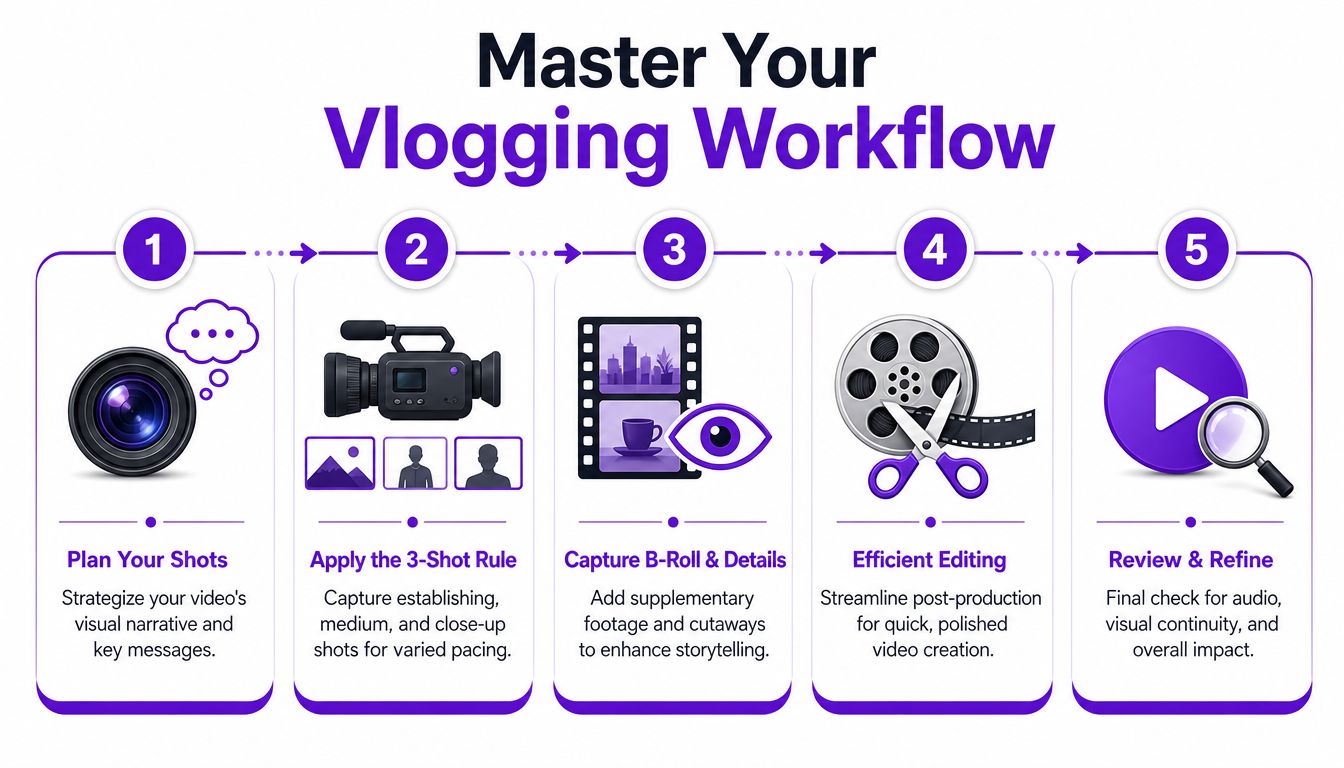
The opening matters more than most beginners think. Retention drops by 40% if the first 5 seconds fail to capture attention, according to AWeber's guide on how to start a vlog. Don't open with a long greeting, a logo animation, or thirty seconds of scene-setting.
Open with one of these instead:
Examples:
That's enough to create momentum.
A short tutorial can help if you want to see how other creators structure this visually:
One of the best low-effort upgrades for beginner footage is the 3-shot rule. Film each important moment three ways:
AWeber notes that filming wide, medium, and close-up shots increases average watch time by 25% when applied consistently in vlogging workflows. This works because even mundane actions feel more intentional when the visual pacing changes.
A normal scene becomes more watchable fast:
Instead of one long clip, capture the room, the action, and the detail. That's enough variety for editing without needing a “cinematic” life.
Most scenes don't need more excitement. They need better coverage.
A clean filming workflow usually looks like this:
If you create spoken content often, the production side overlaps with podcasting. This list of recommended tools for podcast professionals is useful for mics, recording, and creator workflow tools that also fit vlog production.
Most editing time gets wasted in two places. Over-sorting footage and over-finessing effects. You don't need either.
A practical editing flow is enough:
| Editing step | What to do |
|---|---|
| Rough cut | Remove mistakes, pauses, and dead starts |
| Structure pass | Make sure the story or teaching flow is clear |
| B-roll pass | Cover cuts, add detail, support key lines |
| Audio cleanup | Balance levels and reduce distractions |
| Final review | Check pacing, hook strength, and ending |
Create a reusable template inside your editor. Keep the same intro style, lower-third style, music choices, and export settings. Templates reduce friction because you're making fewer decisions every time.
The best editing system is boring in the best way. Predictable. Fast. Easy to repeat on a tired Tuesday.
Uploading the vlog is not the finish line. It's the start of distribution. A single video becomes valuable when it creates multiple chances to be discovered.
That's why creators who grow steadily usually think like publishers. They don't ask, “What did I post this week?” They ask, “How many useful assets did this recording produce?”
You do not need complicated SEO software to publish well. Start with basics that match search behavior and viewer intent.
Focus on three things:
If your vlog is built around a question your audience already asks, your title and packaging get easier. That's another reason niche clarity matters.
The most efficient creators don't treat repurposing as an afterthought. They build the original vlog with clipping in mind.
That means looking for:
A long-form vlog can become:
| Asset | Purpose |
|---|---|
| Short vertical clips | Reach new viewers on Shorts, Reels, and TikTok |
| Quote graphics or caption posts | Reinforce core ideas on LinkedIn, X, or Facebook |
| Email content | Bring subscribers back to the full video |
| Blog adaptation | Turn spoken insight into searchable written content |
| Follow-up Q&A video | Extend the topic without inventing a new theme |
Many small business creators save serious time. Instead of producing separate content for every platform, they extract different versions from one strong recording session.
Working principle: Don't ask every platform for a brand-new idea. Ask one good idea to do more work.
Early analytics can mess with your head if you read them emotionally. Use them diagnostically instead.
Pay attention to patterns like:
If viewers drop at the opening, the hook probably needs work. If a practical topic gets stronger retention than a personal update, your audience is telling you what they value. If clips around one recurring question outperform everything else, that question likely deserves a full-length vlog.
Growth usually comes from tightening the loop:
That's a system. And systems beat bursts of motivation.
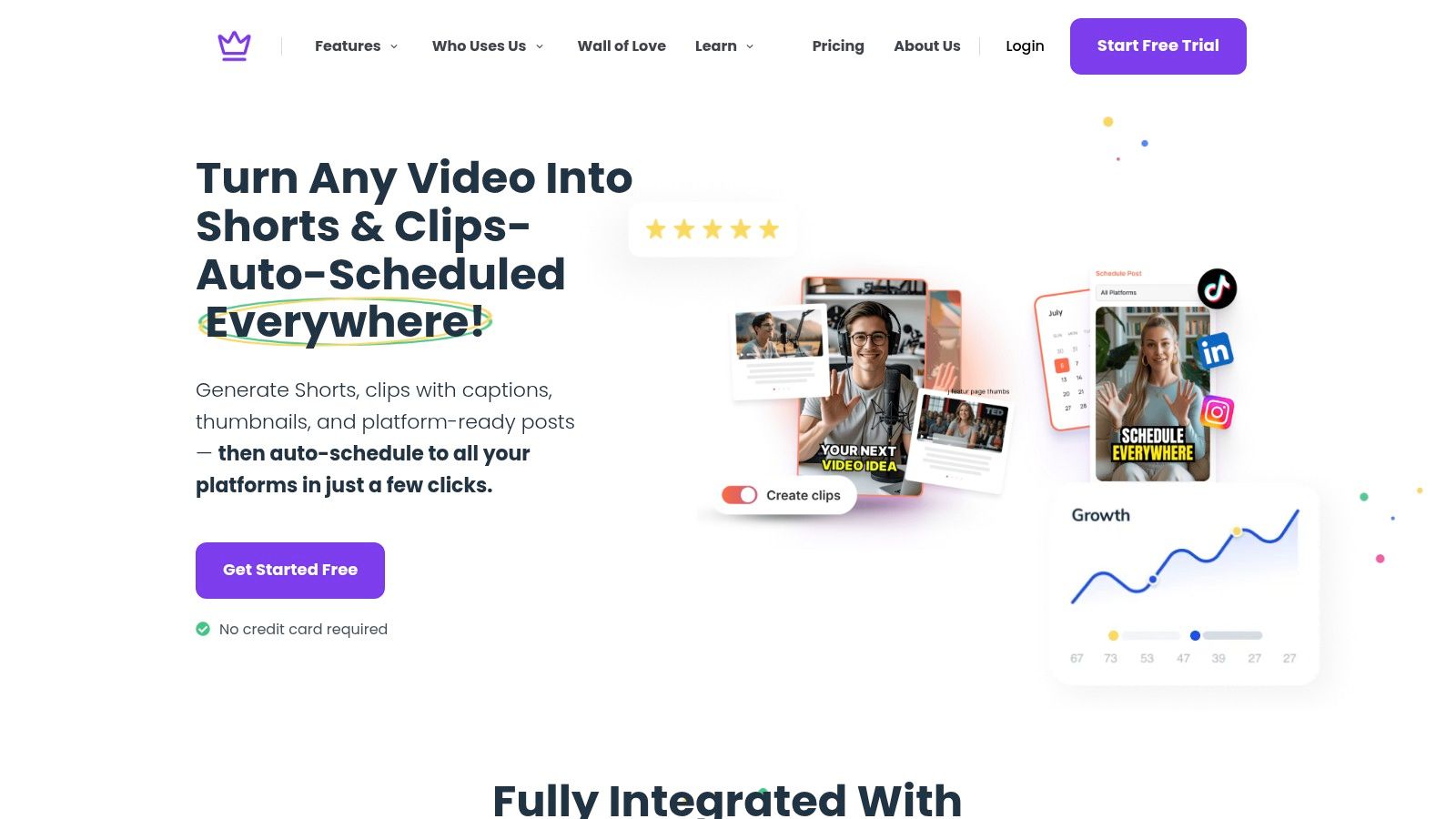
If you want to make that repurposing workflow much lighter, Taja AI helps turn one long-form video into ready-to-publish shorts, posts, captions, thumbnails, and more from a single upload. It's built for creators and businesses that want consistent output without spending their week buried in editing and formatting.


We are blessed to work with leading brands & Companies


We try to make easy and simple for every professionals. Get 30 days free trial - No credit card required.


© 2025 Taja AI. All rights reserved.