How to Auto Generate Captions on TikTok: A Complete Guide
Learn how to auto generate captions on TikTok with this step-by-step guide. Master native tools, fix errors, and optimize for accessibility and SEO.
5 min read
October 20, 2026

Discover how a social media content generator turns one video into 20+ posts. Learn the workflow, benefits, and how to choose the right AI tool to save hours.
Written by:


If your social strategy still depends on making every post by hand, you're running an outdated system. As of 2025, 71% of social media images are AI-generated (artsmart.ai). That number doesn't just say AI is popular. It says the workflow has already changed.
Most creators and small teams don't fail because they lack ideas. They fail because the publishing rhythm is brutal. One video becomes one post, maybe two if there's extra time. Then the process starts over. Record, edit, caption, resize, schedule, repeat.
That model burns people out fast. It also creates inconsistent output, which is poison for audience growth.
A good social media content generator changes the unit of work. Instead of asking, "What do we post today?" it starts asking, "How much can we extract from what we already made?" That's the shift that matters. You're not buying a shortcut. You're building a content engine.
One recorded asset can produce a full week of posts. Yet many founders, consultants, and lean marketing teams still treat every social update like a separate project. That mismatch is why content starts to feel endless.
The old workflow looks busy, but it wastes your best hours. You record a podcast, webinar, interview, or market update. Then the intensive effort begins: clipping, caption writing, hook testing, thumbnail decisions, resizing, platform rewrites, scheduling.
If you're doing that by hand every time, social media stops being a growth channel and becomes maintenance work.
The issue is not work ethic. The issue is operating model.
A one-post-at-a-time process creates the same problems over and over:
This is the primary cost. You are not just losing time. You are burning creative judgment on repetitive production tasks instead of using it on positioning, storytelling, and audience insight.
AI content generation matters because manual repurposing does not hold up once you publish at a serious pace. The teams growing without burning out usually stop asking, "What should we post today?" They build a system where one strong source asset feeds the calendar.
That is a different workflow. A podcast episode becomes clips, captions, quote cards, carousels, post variants, and scheduled drafts. A webinar becomes a content backlog. A customer interview becomes a week of social output. The point is not more content for its own sake. The point is getting more distribution from work you already did.
Much generated content feels flat, repetitive, or obviously synthetic. The fix is better systems and tighter human review. AI should handle the first pass, formatting, extraction, and variation. You should still decide what is sharp, credible, on-brand, and worth publishing.
This roundup of content marketing automation tools frames automation as an operating model, not just a writing feature.
The practical shift is simple. Stop treating every post as a fresh task. Start building a content engine that turns one good recording into sustained output.
A social media content generator is best understood as a content refinery. You feed it raw material, then it turns that material into multiple finished assets for different platforms.
Raw material can be a podcast episode, a YouTube video, a webinar, a product demo, a sales call recording, a sermon, or even a long article. The generator analyzes that source and breaks it into usable social outputs.
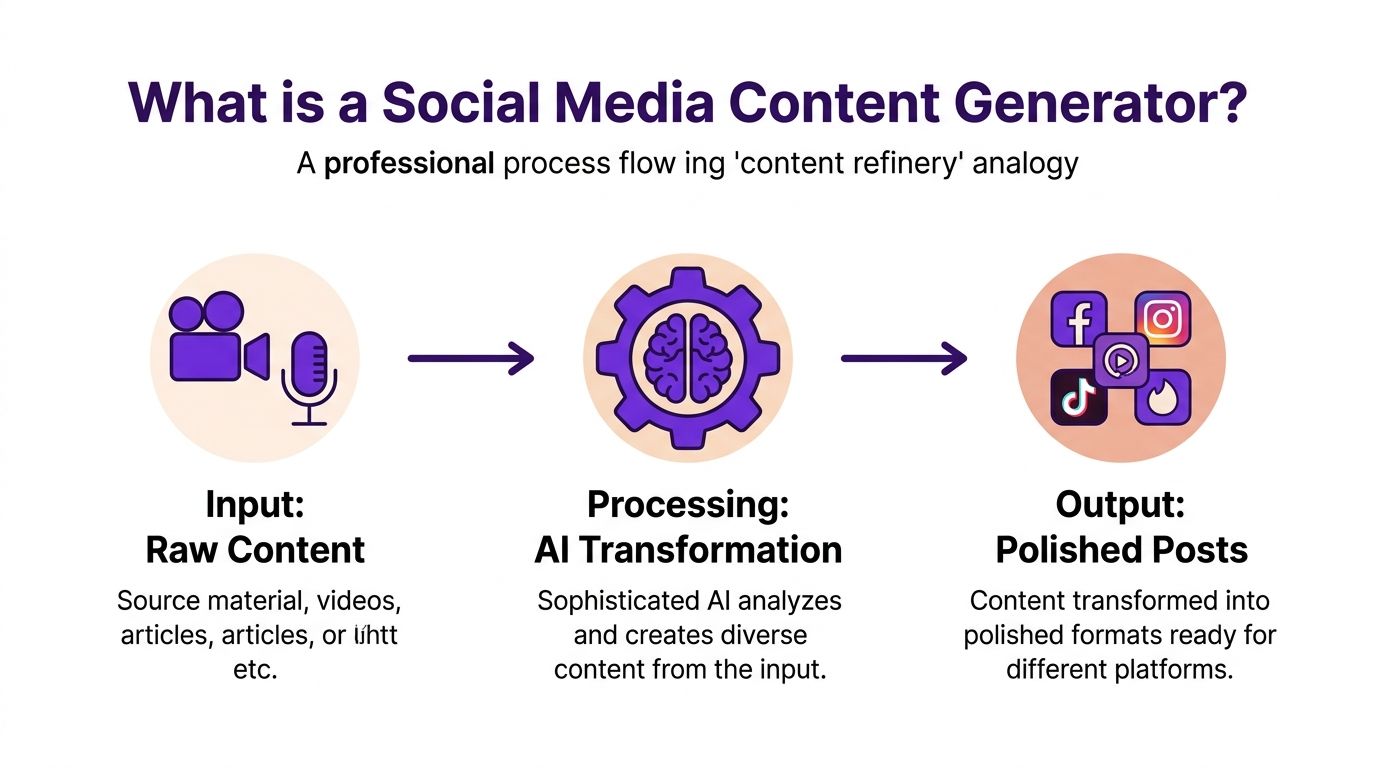
This is the core idea. One source asset turns into a week of content instead of a single post.
A strong generator typically produces things like:
The point isn't volume for its own sake. The point is that the message stays consistent while the format changes.
A common point of confusion arises here. A text tool can write a caption from a prompt. That's useful, but it's not the same thing.
A social media content generator works from existing content context. It understands what was said, what the emotional peaks were, what topics repeat, and what format fits the destination platform. The better tools do more than write. They repurpose.
That matters if your main bottleneck isn't "I need one caption." It's "I already recorded something valuable and need to turn it into everything else."
There's also a practical split between organic and paid workflows. If your focus is ad creative rather than repurposing long-form content, this guide to a social media ad generator helps clarify the difference.
A text prompt gives you an idea. A repurposing system gives you a calendar.
Teams often buy these tools for speed, then keep them because they create order. Instead of scrambling every day, you start batching around source content.
That changes how content gets planned:
| Workflow model | What happens |
|---|---|
| Manual one-off posting | Every post starts from zero or near zero |
| Generator-based workflow | One recording becomes multiple assets and scheduled posts |
Once you see it that way, a social media content generator stops looking like a novelty feature. It becomes a production system for staying visible without rebuilding the wheel every morning.
The reason these tools feel more useful now than they did a few years ago is simple. They don't just handle text. They interpret text, audio, images, and video together.
Advanced AI social media content generators utilize multi-modal generative AI models capable of processing and synthesizing text, images, and video inputs to produce coherent, platform-specific outputs from a single creative brief, reducing content production time by 70-80% while enhancing quality and consistency (jasper.ai).
Older tools treated content like plain text. Newer ones work more like production assistants.
They can inspect several layers at once:
This is why good repurposing tools often outperform generic prompt workflows. They don't guess what your content is about. They inspect the source.
A useful way to think about it is this: AI is good at scanning a lot of material quickly. Humans are still better at deciding what should represent the brand.
When a generator works well, the handoff looks like this:
That last part matters. The tools that disappoint people usually get used in fully automatic mode with no editorial pass. Then every caption sounds alike and every clip feels mechanically chosen.
Use automation for extraction and formatting. Keep human review for positioning, tone, and final selection.
The biggest win isn't that AI can write. It's that AI can reorganize production around a single source asset. That turns content ops from scattered tasks into a repeatable pipeline.
A dedicated repurposing workflow, such as one built around an AI content repurposing tool, makes that pipeline easier to run because the source video becomes the center of the system.
A good engine won't save weak ideas. It also won't fix poor positioning. But if you already have strong raw material, it can extract far more value from each recording than a manual workflow usually does.
The ROI case for a social media content generator isn't just about saving a few minutes on captions. The significant return shows up when your team stops rebuilding the same workflow every week.
There's a reason adoption has accelerated. 77% of marketers now use AI to produce social media text from scratch, with adoption surging 86% between 2023 and 2024. A majority of users, 73%, report higher engagement and impressions from AI-generated content (talkwalker.com).
That matters because social media has always had a compounding problem. Inconsistent output weakens reach. Weak reach makes posting feel pointless. Then teams publish less, not more.
This is the easiest gain to notice. A generator removes the repetitive tasks that drain energy but don't require strategic thinking.
For most operators, that means less time spent on:
The immediate result is lower friction. The more important result is that publishing becomes sustainable.
A lot of people look for ROI only in direct revenue. That's too narrow for content operations.
A healthier workflow tends to improve performance because it supports better habits:
| ROI area | What changes in practice |
|---|---|
| Output | More of your source material gets published |
| Consistency | Fewer gaps in your posting cadence |
| Message quality | Each platform gets a version shaped for its format |
| Team focus | Human time shifts toward strategy, offers, and audience insight |
That last line is often underrated. When your team spends less time clipping and formatting, they can spend more time improving the actual message.
For a realtor, that can mean turning one local market video into a week of neighborhood content, listing support, and follow-up authority posts. For a podcaster, it can mean getting multiple discoverable clips out of each episode instead of letting the archive collect dust. For a service business, it means showing up consistently enough that prospects remember the name when they need help.
Content ROI rarely breaks because the ideas are bad. It breaks because the workflow is too fragile to repeat.
The strongest argument for automation isn't that it replaces your team. It protects your team from wasting judgment on repetitive production tasks. When that happens, content starts acting less like a constant burden and more like a system that feeds visibility, trust, and pipeline over time.
A small business owner records a product demo on Tuesday morning. It's one solid long-form video. Useful, clear, and packed with answers customers ask every week.
In the old workflow, that video might become one YouTube upload and then sit there. Maybe someone remembers to cut a clip for Instagram later. Maybe not.
A generator-based workflow treats that same recording as the source for the whole week.
The upload goes in once. The system reads the transcript, identifies usable moments, and starts splitting the source into smaller assets. Instead of asking the owner to decide manually which thirty seconds matter, it drafts multiple candidates.
That changes the decision from "What do I make?" to "Which version do I publish first?"

In practice, that can include short vertical clips, post drafts, title ideas, thumbnail directions, and text assets built from the same source material. If you want to see the workflow in product form, this page on generating content from video shows the category clearly.
Many tools differentiate themselves at this stage. A basic generator gives you outputs. A useful one gives you a system.
A video-first repurposing setup commonly needs these pieces:
That last point is often underestimated. A lot of businesses aren't short on content. They're short on extraction.
One option in this category is Taja AI. It takes long-form video and turns it into shorts, captions, thumbnails, blogs, and platform-specific posts from a single upload. It also includes features tied directly to content operations, such as a thumbnail generator, content calendar, backlog revival, and scheduling across multiple channels.
The value isn't the feature list by itself. It's the sequence. Record once, process once, review once, then publish across the week.
The strongest social workflow doesn't ask your team to be endlessly creative every day. It asks them to make one good source asset and extract it properly.
What works is starting with content that already has substance. Tutorials, interviews, demos, lessons, local insights, FAQs, and opinion-based commentary usually repurpose well because they contain multiple standalone moments.
What doesn't work is expecting software to manufacture clarity out of weak source material. Rambling video creates rambling clips. Generic talking points create generic posts.
The better approach is simple. Make one strong long-form piece. Use the generator to break it into usable parts. Edit for taste. Schedule the batch. Repeat next week.
That isn't more content. It's a better production model.
A lot of teams buy an AI writer and still miss their posting schedule.
The problem usually is not caption quality. It is workflow fit. If your content starts as recordings, interviews, webinars, demos, or podcasts, a text box that spits out posts is only handling the last 10 percent of the job.
Evaluate the tool based on the raw material you already produce.
For a video-first team, that means asking whether the platform can ingest long-form video or audio, identify strong moments, and turn them into assets that fit each platform's format and tone. Plenty of products can summarize a transcript. Fewer can pull a clean short, write a usable caption, generate a thumbnail, and keep the context intact.
That difference matters because the goal is not one more draft. The goal is a repeatable weekly engine where one recording becomes a batch of publishable assets.
Ask:
Many evaluations go soft at this stage. Buyers test generation quality for five minutes and ignore the handoff between draft and publish. That handoff is where teams lose time, miss deadlines, and leave good content sitting in review folders.
Use a simple filter:
| Evaluation question | Why it matters |
|---|---|
| Can you batch and schedule content? | A content engine needs publishing capacity, not just draft volume. |
| Can you reuse older assets? | Strong systems help you get more value from your archive. |
| Can you control brand style? | Without guardrails, outputs flatten into generic creator-speak. |
| Does it help with planning? | Calendar support cuts the weekly scramble over what goes out next. |
If scheduling is part of the bottleneck, check whether the product includes direct publishing or a workflow like bulk scheduling for social content. Exporting every draft into another tool adds friction right where consistency usually breaks.
Trend detection can help. It can also create a feed full of forced posts that sound like your brand is chasing attention.
The better question is whether the tool helps you respond in a way that still sounds like you. For some brands, fast reaction content works. For others, the higher-return move is extracting stronger clips from evergreen material and publishing them consistently. I have seen more accounts grow from disciplined repurposing than from trend chasing with weak source content.
To see how these evaluation criteria apply in a real tool, watch how a video-first system handles clip extraction, brand style, and scheduling in this walkthrough:
Choose the product that fits your source material, your approval process, and your publishing cadence. That is what turns AI from a novelty into a working content system.
The big shift isn't from human content to AI content. It's from manual posting to system-based publishing.
That's why the phrase social media content generator can be misleading. You're not just buying a post maker. You're choosing a way to turn one useful recording, lesson, interview, or demo into a repeatable content supply.
For creators and small teams, that's the difference between always catching up and finally getting ahead. The manual model asks you to create from scratch too often. The better model asks you to create one strong source asset, repurpose it intelligently, and schedule distribution before the week runs away from you.
If you're burned out, the answer usually isn't "work harder on content." It's "stop treating every post like a separate project."
Start there. Audit your last few long-form pieces. Ask how many assets you published from each one. If the answer is one or two, the opportunity is obvious. Your content isn't too small. Your workflow is.
If you want to test a video-first workflow without rebuilding your whole process, try Taja AI. It turns long-form recordings into publishable shorts, captions, thumbnails, and platform-specific posts from a single upload, so you can see what a content engine looks like before committing to a heavier system.


We are blessed to work with leading brands & Companies


We try to make easy and simple for every professionals. Get 30 days free trial - No credit card required.


© 2025 Taja AI. All rights reserved.