Auto Generate Captions for Video in 2026
Learn how to auto generate captions for video with AI tools, accuracy tips, and platform publishing workflows that actually scale in 2026.
5 min read
October 18, 2026

Apply keyword research best practices with 10 actionable tactics for intent, competition, tools, content clusters, video, social repurposing, and planning.
Written by:


A big search number can be a terrible keyword choice. High volume doesn't guarantee attainable rankings, qualified visitors, or content that answers the searcher's actual need. Research on keyword selection shows that popularity, competition, specificity, and intent work together, and that a high-volume phrase isn't automatically the most efficient target. Research on keyword choice and ranking efficiency
That matters even more for creators and small businesses. A local service provider may need one highly relevant neighborhood query, while a podcaster may need a conversational question that works in Google, YouTube, and short-form video. The strongest workflow combines audience language, search intent, realistic competition, platform format, trend signals, and production capacity.
The data supports a sharper focus on specificity. One 2025 industry summary reported that 70–92% of search traffic comes from long-tail keywords, while 91.8% of all search queries are long-tail. It also reported that 92.42% of queries have 10 or fewer monthly searches, a useful reminder that low volume doesn't mean low value. Long-tail keyword research statistics
The ten practices below turn research into a working publishing system. You'll learn how to classify intent, discover attainable phrases, validate demand, map keyword clusters, study competitors, plan seasonal content, optimize for search features, and repurpose one researched idea across blogs, video, and social channels.
Search intent is the reason behind a query. A person searching “how to stage a home for sale” wants guidance, while someone searching “real estate agent near me” is looking for a local provider. Both phrases relate to real estate, but they require different pages, calls to action, and content formats.
Classify each keyword as informational, navigational, commercial, or transactional. Then inspect the search results before assigning the phrase to a content brief. If Google shows step-by-step articles and featured answers, an educational guide may fit. If the results show local listings, service pages, or product comparisons, a generic blog post probably won't satisfy the searcher.
A real estate professional could create a tutorial for “how to stage a home for sale,” but a service page for “real estate agent near me.” A faith-based organization might use an educational video for “sermon on faith” and a location page for “churches in [city].” A podcaster could use a long-form explainer for “how to start a podcast” and a comparison page or product video for “best podcast microphone.”
For video creators, intent also determines the repurposing plan:
Practical rule: If the content format on the first results page doesn't match what you can produce well, choose a different keyword or change the format before publishing.
Use the target phrase naturally near the beginning of the title and opening paragraph. A practical keyword research workflow recommends early placement while preserving readability, so readers understand the subject immediately. Keyword research workflow guidance

Broad head terms attract attention, yet they can give a new site, solo creator, or small local business a difficult starting point. Long-tail keywords describe a narrower need, so you can connect them to a defined audience, offer, and production format. “How to use TikTok for real estate leads” gives a real estate professional clearer direction than “real estate marketing.”
Specificity also improves distribution. “Podcast tips” is vague and crowded, while “How to repurpose podcast episodes into social media clips” identifies the task, audience, and likely deliverables. A local HVAC company might target “emergency HVAC repair in [neighborhood]” instead of “HVAC repair.” A small church could publish around “contemporary Christian worship songs for small church groups,” then adapt the answer into a search article, video explanation, and short social clips.
Keyword tools can surface lower-competition ideas, but a difficulty score should not decide the target by itself. Search Google's People Also Ask questions, review autocomplete suggestions, and read social discussions where customers describe their problems. Customer language often differs from the polished wording in a marketing brief, and that difference can reveal a useful title, video hook, or social caption.
Organize related phrases around one production plan. Start with a pillar such as “content repurposing,” then group variations covering podcast episodes, blog posts, social clips, and budget-friendly workflows. Assign each group to the format that answers it best: articles for detailed explanations, videos for demonstrations, and short clips for one practical answer. Prioritize constraints that affect a real buyer, such as “how to repurpose video without expensive software” for a solopreneur managing a limited budget.
Taja AI's keyword research workflow can support idea discovery and help connect keyword research with content planning. The final choice still depends on your audience, offer, and ability to produce useful material across search, video, and social channels. Long-tail research works when specificity improves the answer, not when you just make a phrase longer.

Search volume can confirm interest, but it cannot decide whether a topic deserves production time. A keyword may attract searches while matching neither your offer nor the content formats your team can create. Validate the opportunity against demand, audience fit, visible competition, and distribution potential.
Start with the search results, then build outward. Search the phrase manually, review ranking pages, compare related queries, and check whether interest appears stable or newly developing. For “podcast repurposing,” expand the seed into questions and use cases such as “how to repurpose podcast episodes,” “podcast repurposing tools,” “repurposing podcast content for social media,” and “repurposing podcasts into blog posts.” Each variation can guide an article, tutorial video, short clip, or social post rather than creating several pages that compete for the same intent.
A simple scorecard keeps prioritization practical:
Use volume and difficulty as inputs, not final decisions. A local HVAC company serving one city may gain more from a modest local phrase than from a national keyword with broader demand. The local topic can reach relevant buyers and support a focused production plan.
Google Search Console shows the queries people used before reaching your site, including impressions, clicks, and unexpected wording across up to 16 months of query data. Compare those patterns with Google Search Console and Google Trends guidance to identify topics worth testing, updating, or repurposing.
Taja AI's keyword research workflow can assist with idea discovery and content planning. Keep the final decision tied to your audience, offer, and production capacity.
Track the core phrase, variations, intent, location, format, priority, and status in one spreadsheet. It prevents duplicate targeting and turns validated research into a coordinated publishing queue.
A keyword score is a starting point, not a publishing decision. Each platform draws from different data sources, estimates, filters, and scoring methods. Use tools for separate jobs, then compare their signals before spending time on an article, video, or social campaign.
Begin with accessible sources. Google Keyword Planner can generate ideas, Google Search Console shows queries already connected to your site, Google Trends reveals relative movement and seasonality, and AnswerThePublic surfaces question patterns. Paid platforms such as Ahrefs, Semrush, and Moz add competitor analysis, difficulty estimates, and wider discovery when the workflow needs more scale.
The useful test is a live SERP check. Suppose Ahrefs labels “podcast promotion for small business” as difficult. Open the results before rejecting it. If the leading pages target large media brands, lack examples for small teams, or offer no video and social support, the score may overstate the competition for a focused guide. If several results have strong authority and closely match the intended format, keep the difficulty warning and choose a narrower variation. The tool creates a hypothesis. The results page decides whether the production angle is viable.
A social media manager might use Keyword Planner for initial demand signals, Ubersuggest for additional ideas, and Ahrefs for competitor review. A real estate professional can add location-specific SERP checks. A faith-based organization may compare audience questions with seasonal movement before producing a sermon series.
Validate each candidate against five questions:
Tool scores are estimates. Your Search Console queries, engagement patterns, leads, and sales provide stronger feedback for future decisions.
Taja AI's overview of AI keyword research tools can support discovery and video planning. Review every suggestion against audience language and analytics, then cluster the validated terms into a production queue. One core topic can become a search page, a video, and platform-specific social clips, but each format still needs its own intent and opening.
A competitor's ranking page is evidence, not a publishing brief. Inspect the pages, videos, and social posts appearing for your target queries, then record what they explain poorly, leave out, fail to localize, or have not updated. The strongest opportunity combines visible audience interest with a specific way to make the content more useful.
Start with one live results page and compare formats side by side. A real estate agent reviewing videos for a neighborhood or home-selling query might find outdated footage, vague titles, weak captions, or no practical next step. That gap supports a clearer walkthrough with current local context, short clips for social distribution, and a relevant service-page path. The same keyword can guide production across search, video, and social, provided each version fits its channel.
A podcaster could discover broad coverage of “podcast promotion” but little instruction on turning one interview into platform-specific clips. A church might find general sermon content while small-congregation questions remain unanswered. A marketing agency could see plenty of “social media tips for small business” and few practical methods for reducing production time through repurposing.
Use a gap sheet that connects research to execution:
Content gap analysis guidance from Taja AI can help organize the review. Apply judgment before committing: a competitor may rank for a phrase unrelated to your offer, or leave a gap open because production is difficult rather than because demand is absent.
Prioritize gaps where the audience already shows interest and your team can deliver a clearer answer. A distinct production angle, credible examples, and a planned distribution path matter more than a slightly different headline.
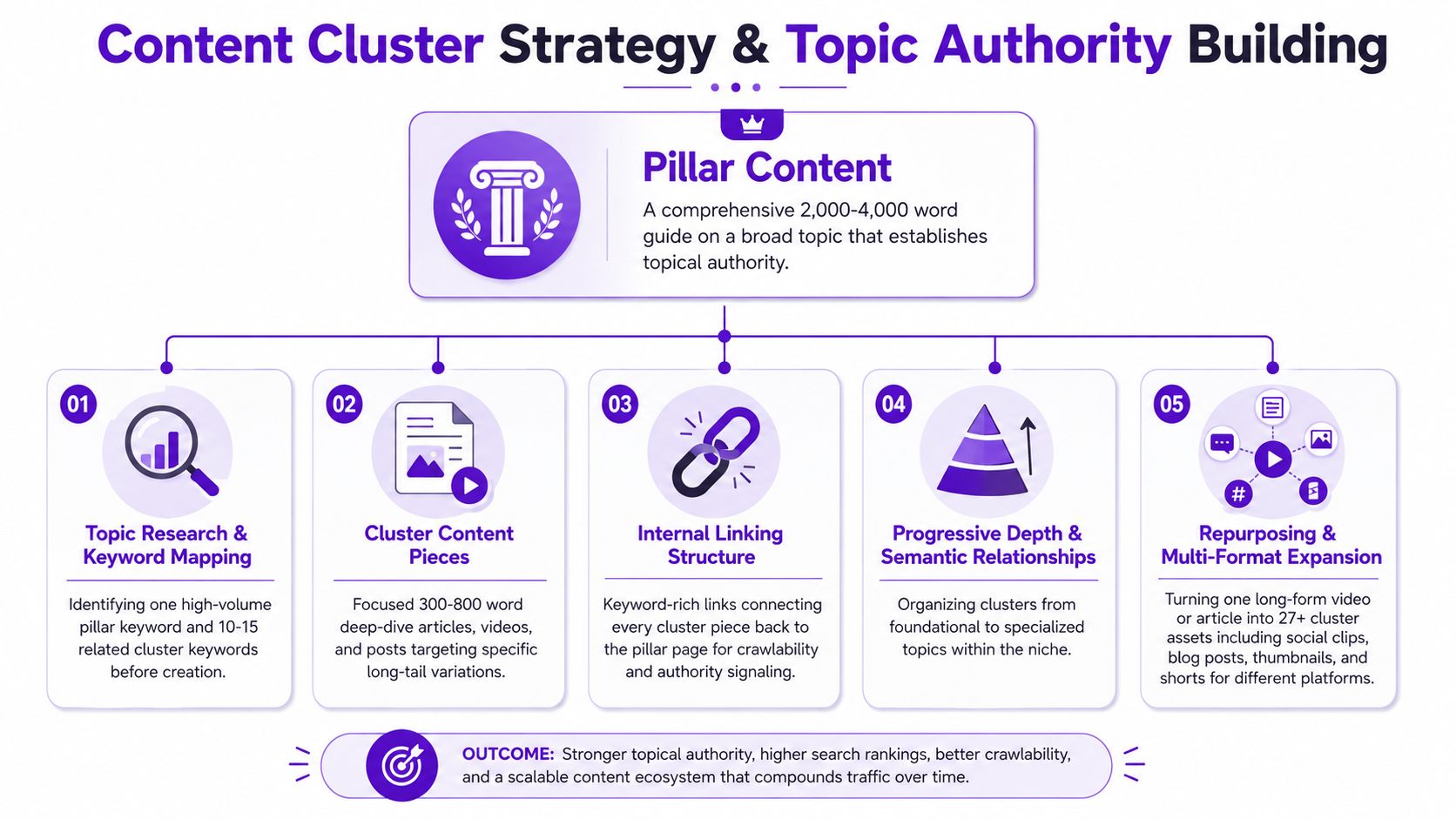
A keyword becomes more useful when it fits a production system. Build around a pillar topic, then connect narrower queries, formats, and distribution channels to that central resource. The cluster should show both search engines and audiences how each piece answers a different need.
Start with the audience and the available production capacity. A real estate professional might center a cluster on “complete guide to real estate video marketing,” then cover virtual home tours, YouTube optimization, editing tips, and before-and-after videos. A podcaster could organize a beginner's guide around recording audio, hosting, SEO, promotion, and monetization. The strongest plan matches the creator's experience and publishing schedule, rather than copying a competitor's topic map.
One recorded interview, tutorial, or presentation can supply the whole cluster. Turn its sections into a blog article, YouTube episode, short clips, captions, thumbnail concepts, email content, and platform-specific posts. Give each version a distinct job: answer a search query, demonstrate a process on video, or present one useful takeaway in a social feed.
Map the work in a planning sheet:
Group phrases that express the same intent instead of producing thin pages for every wording variation. Separate assets when the audience needs a different answer, format, level of detail, or commercial next step. A small business may combine several beginner questions in one guide, while creating a separate service page for buyers ready to act.
Review the cluster after publication. Queries that attract attention but remain unanswered can become the next video, clip, newsletter section, or social post. Keyword research then guides which moments to extract, which questions to answer on camera, and which audiences to address on each platform, not just the headline of a web page.
Seasonal keywords reward teams that publish before demand peaks. Holidays, community events, school cycles, tax periods, and industry seasons each create a planning window. Start production after searches surge, and the audience may already have chosen competing sources.
Use seasonal signals to set production dates, not to repeat a general trend report. For a spring home-selling campaign, a real estate agent might record the main guide in January, edit the video and prepare its landing page in February, then publish in March as sellers begin taking action. The same workflow applies to Easter or Christmas material, back-to-school lessons, and recurring annual planning questions from customers.
Build the calendar around the audience's decision process:
Give each keyword a distribution plan. A seasonal guide can answer the search query, a video can demonstrate the process, and short clips can address individual questions on social platforms. Record the core asset early enough to create the supporting pieces without rushing. A title, description, transcript, captions, and landing page should be ready for the same publishing window.
Pair seasonal campaigns with evergreen material. Evergreen pieces keep the channel useful throughout the year, while seasonal assets give the schedule timely relevance. Avoid treating low tool volume as proof that demand is absent. Customer conversations, Search Console queries, direct SERP review, community discussions, and emerging-topic research can reveal interest before keyword databases reflect it. Emerging-topic keyword research guidance
Review the calendar after publication. Record which queries led to engagement, which clips earned attention, and which questions remained unanswered. Those gaps can become the next article, video, newsletter section, or social post. Research is complete only when the keyword has a validated topic, a production deadline, and a distribution role.
Google results pages contain more than blue links. Depending on the query, searchers may see featured snippets, People Also Ask questions, local packs, image results, knowledge panels, and video carousels. The visible features tell you what Google believes will satisfy the query, so they should influence the format you produce.
Search “how to stage a home” and you may find that a concise list, a tutorial, and visual examples serve different parts of the result. A real estate agent can structure a page around clear staging steps, then publish a video that demonstrates those steps. A podcaster targeting “how to start a podcast” can answer common questions in a guide while using video clips to address equipment and recording problems.
Don't write for a snippet at the expense of the visitor. A short answer can earn visibility, but the surrounding content should provide examples, caveats, proof, or a logical next action. For a local service, the page must still make it easy to understand the service area and contact the business.
A long-form video transcript can supply the raw material for answer blocks, while short clips can target video discovery separately. The distribution workflow should preserve the original meaning instead of cutting sentences so aggressively that the clip becomes vague.

Review the actual result page before production. A tool may label a phrase as promising, but the SERP may show that searchers prefer video, local listings, images, or direct answers. Your content plan should reflect that reality.
People don't always phrase spoken searches the way they type them. A typed query such as “emergency plumber” may become “Is there an emergency plumber near me open now?” Spoken language adds context, urgency, location, and a complete question.
That difference changes the research process. Read customer emails, sales calls, community threads, and comments for the exact wording people use aloud. Search autocomplete and People Also Ask can help reveal question patterns, but direct audience language often provides the clearest prompts for scripts and FAQs.
A real estate professional might target “show me homes for sale in downtown [city].” A church may answer “What's the sermon topic at [church name] this Sunday?” An educator could address “How do I start a podcast with no equipment?” These queries suggest not only keywords, but also the opening line of a video.
Use conversational structures:
People often speak in questions, not keyword fragments. Your script should sound like a useful answer from a knowledgeable person.
Voice optimization isn't a reason to stuff pages with “near me.” Use a local modifier only when the business serves that place. A national educator shouldn't create artificial location pages, and a local service provider shouldn't hide its service area behind generic wording.
The content cluster helps here. One conversational question can become a long-form explanation, several short answers, a social Q&A post, and a local landing page. That gives the phrase a role across search and distribution instead of leaving it stranded in a spreadsheet.
A keyword describes a search, but it doesn't fully describe the person searching. Two people may use similar phrases while facing different problems, levels of urgency, or buying stages. Strong keyword research connects the query to the audience's pain point, desired outcome, objection, and next action.
A homeowner searching “home staging tips” may worry about selling quickly. Someone searching “luxury home features” may be exploring status and lifestyle. Those phrases sit in the same broad market but require different examples, visuals, and calls to action.
A solopreneur searching “how to repurpose content” may be overwhelmed by limited time and budget. Someone searching “content repurposing tools” is already evaluating solutions. A podcaster looking for editing software has a technical problem, while someone searching “how to grow a podcast audience” may be dealing with uncertainty about distribution and demand.
Build a simple audience map:
Community discussions can reveal the language behind those stages. Reddit threads, niche forums, customer interviews, comments, and support tickets often expose frustrations that keyword tools flatten into generic categories. Use that language in titles, scripts, examples, and calls to action, but keep the final content useful rather than manipulative.
Keyword research attracts attention. Audience value earns retention. If a creator targets “how to repurpose podcast episodes” but delivers a vague list, the keyword may bring the right viewer only to lose them. A practical video should show the workflow, explain the decisions, and direct viewers to the next relevant resource.
| Item | 🔄 Implementation Complexity | ⚡ Resource Requirements & Speed | ⭐ Expected Outcomes | 💡 Ideal Use Cases | 📊 Key Advantages |
|---|---|---|---|---|---|
| Search Intent Analysis and Keyword Alignment | 🔄 Medium, requires audience analysis and SERP review | ⚡ Moderate, tools + manual SERP checks; slower research cadence | ⭐⭐⭐ Better relevance, lower bounce, higher conversions | Content strategy planning; repurposing video vs. text | Identifies best content format per query; improves qualified traffic |
| Long-Tail Keyword Targeting and Low-Competition Discovery | 🔄 Low, straightforward keyword filtering | ⚡ Low, inexpensive tools, fast wins for small creators | ⭐⭐ Strong conversion from targeted traffic | Solopreneurs, niche creators, local businesses | Easier rankings; lower CAC; high intent traffic |
| Search Volume Validation and Topic Expansion Mapping | 🔄 High, data modeling and clustering required | ⚡ High, multiple tools, spreadsheets, ongoing validation | ⭐⭐⭐ More realistic ROI estimates and broader coverage | Resource allocation, ROI-driven content roadmaps | Prevents wasted effort on misleading volume; expands reach via variations |
| Keyword Research Tool Selection and Multi-Tool Validation | 🔄 Medium, setup and cross-tool workflows | ⚡ Medium–High, potential subscriptions; integration time | ⭐⭐⭐ More accurate metrics and confident decisions | Teams validating high-value content / enterprise planning | Triangulates data; reduces blind spots from single-source bias |
| Competitor Keyword Analysis and Content Gap Identification | 🔄 Medium, requires competitive exports and interpretation | ⚡ Medium, competitive tools often paid; fairly fast insights | ⭐⭐⭐ Quick wins by targeting proven demand | Market-entry planning; gap-based content ideation | Reveals proven topics, white-space opportunities, benchmarking |
| Content Cluster Strategy and Topic Authority Building | 🔄 High, requires upfront planning and editorial coordination | ⚡ Medium, initial heavy lift, then efficient content repurposing | ⭐⭐⭐ Long-term authority and multi-keyword ranking | Brands building topical authority; long-form + repurposing workflows | Scales content ROI; improves crawlability and topical signals |
| Seasonal Trends and Content Calendar Alignment | 🔄 Low–Medium, calendar planning and trend analysis | ⚡ Low, Google Trends + scheduling; requires lead time | ⭐⭐ Predictable traffic spikes and timely relevance | Holiday/event-driven campaigns; limited-budget creators | Maximizes impact at peak demand; enables pre-planned campaigns |
| SERP Feature Optimization and Featured Snippet Targeting | 🔄 Medium, requires format-specific content structure | ⚡ Medium, content edits and structured markup; iterative | ⭐⭐⭐ Can dramatically increase visibility (Position 0, carousels) | Video creators, FAQ pages, how-to content | Multi-entry visibility (snippets, PAA, video carousel); high CTR |
| Voice Search and Conversational Keyword Optimization | 🔄 Medium, adapts language to natural queries | ⚡ Low–Medium, content tweaks; tracking is harder | ⭐⭐ Growing reach in conversational queries; local advantages | Local services, FAQ-heavy sites, hands-free discovery | Captures spoken queries; benefits from PAA/snippet optimization |
| User Intent, Audience Psychology and Pain Point Mapping | 🔄 High, requires qualitative research and persona work | ⚡ Medium, forums/interviews + content testing; slower payoff | ⭐⭐⭐ Higher engagement and conversion through relevance | Conversion-focused campaigns and messaging-led content | Deep audience fit; emotionally resonant content that converts |
| Content Repurposing (implicit across strategies) | 🔄 Low–Medium, leverages existing long-form assets | ⚡ High efficiency, one asset → many outputs (fast scaling) | ⭐⭐⭐ Improved reach across platforms with less effort | Platforms like Taja AI; creators with long-form videos | Multiplies content ROI; fast distribution into clusters and snippets |
Keyword research becomes valuable when it controls what you produce and distribute, not when it fills a spreadsheet. Start every opportunity by classifying the intent. Ask whether the searcher wants an explanation, a destination, a comparison, or an action. Then inspect the live results to confirm the content format that currently satisfies that need.
Expand the topic before choosing a final phrase. Record questions, synonyms, local modifiers, audience constraints, seasonal variations, and platform-specific language. A single seed term may produce several distinct content opportunities, but similar phrases should stay together when they express the same intent.
Validate the opportunity from more than one angle. Compare tool estimates, inspect competition manually, review Google Trends, study Search Console data, and read audience conversations. Google Search Console is especially useful for discovering the actual queries that already lead people to your site, while Google Trends can reveal related and rising topics. Google's search trends guidance
Then score the phrase against your real resources. A small business with limited authority may choose a specific local or long-tail query over a broad head term. A creator with an existing video library may prioritize a topic that can be answered immediately through repurposing. A startup entering a niche may focus on emerging questions that established competitors haven't explained clearly.
Each selected keyword should have a clear destination:
The production workflow should start with a strong source asset when video is part of your strategy. A long-form recording can become a blog, clips, captions, thumbnails, and platform-specific posts. That doesn't mean every asset should repeat the same keyword. Each adaptation can answer a related question while preserving the core insight and pointing audiences toward the appropriate next step.
Creators and small businesses can also use this startup SEO strategy resource when organizing search visibility around a broader growth plan. The important principle is operational: research, produce, distribute, measure, and update.
Review performance after publishing and feed what you learn back into research. Queries that generate impressions may deserve stronger titles or answer sections. Queries that attract engagement but no business action may need a different offer or audience angle. Topics that perform well in video may deserve a written guide, while successful articles may provide the script for a series of clips.
Taja AI can fit into this workflow as an optional production layer. Its platform is designed to turn long-form video into shorts, clips, captions, thumbnails, blogs, and platform-specific posts, with tools for editing, brand templates, keyword-led ideas, content calendars, and scheduling. Used carefully, it can help a small team move from one researched topic to a coordinated publishing system without treating automation as a replacement for judgment.
The best keyword research practice is therefore not “find the biggest phrase.” It is find the clearest audience need, prove that the opportunity is worth serving, choose the right format, and publish enough useful variations to meet people wherever they search.
Taja AI turns a researched long-form video into ready-to-publish shorts, clips, captions, thumbnails, blogs, and platform-specific posts, helping you connect keyword planning with consistent distribution. Upload a video and explore the workflow at Taja AI to start repurposing your next search-informed topic.


We are blessed to work with leading brands & Companies


We try to make easy and simple for every professionals. Get 30 days free trial - No credit card required.


© 2025 Taja AI. All rights reserved.